news
Notes about Contributors
Jordan Karney Chaim is a doctoral student and Raymond and Margaret Horowitz Foundation Fellow in American Art at Boston University where her research focuses on intersections of contemporary American and Latin American art in California. Before attending Boston University, she was the Assistant Director at Mary Ryan Gallery in New York.
Notebooks


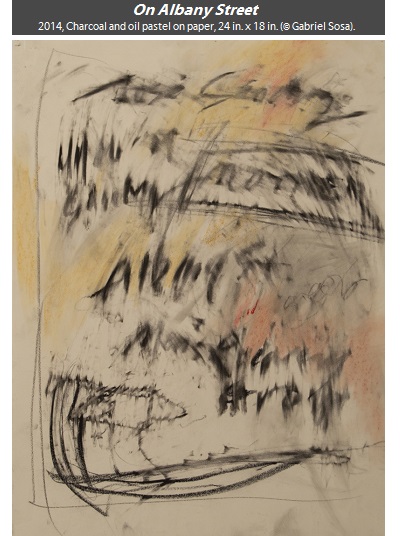
It is the job of a Court Interpreter to translate both the trial proceedings to a witness, and their testimony to the court. As the witness attempts to recall events from memory, sometimes long passed, the interpreter must render those memories as faithfully as possible while remaining grounded in the immediate present. The Court Interpreter functions as translator, surrogate and interface—between the witness and the court, memory and reality, the past and the present. -Jordan Karney Chaim
“Based on my work as a Court Interpreter, these images belong to a series of drawings that reference the notes taken during witness testimony in order to ensure the accuracy and precision of the oral translation. They evoke the parallel process between the witness recalling memories and the interpreter, who disposes of memories as soon as they are formed, creating space for the next words to be interpreted. The quick, palimpsestic mark-making implies the ephemerality of memory, hinting at the rapidness with which language and art are often experienced, leaving us with only a lingering impression of the content.”
Gabriel Sosa
Book Review: ‘ZERO: Countdown to Tomorrow, 1950s-60s’
VALERIE HILLINGS,
with contributions from Daniel Birnbaum, Edouard Derom, Johan Pas, Dirk Pörschmann, Margriet Schavemaker.
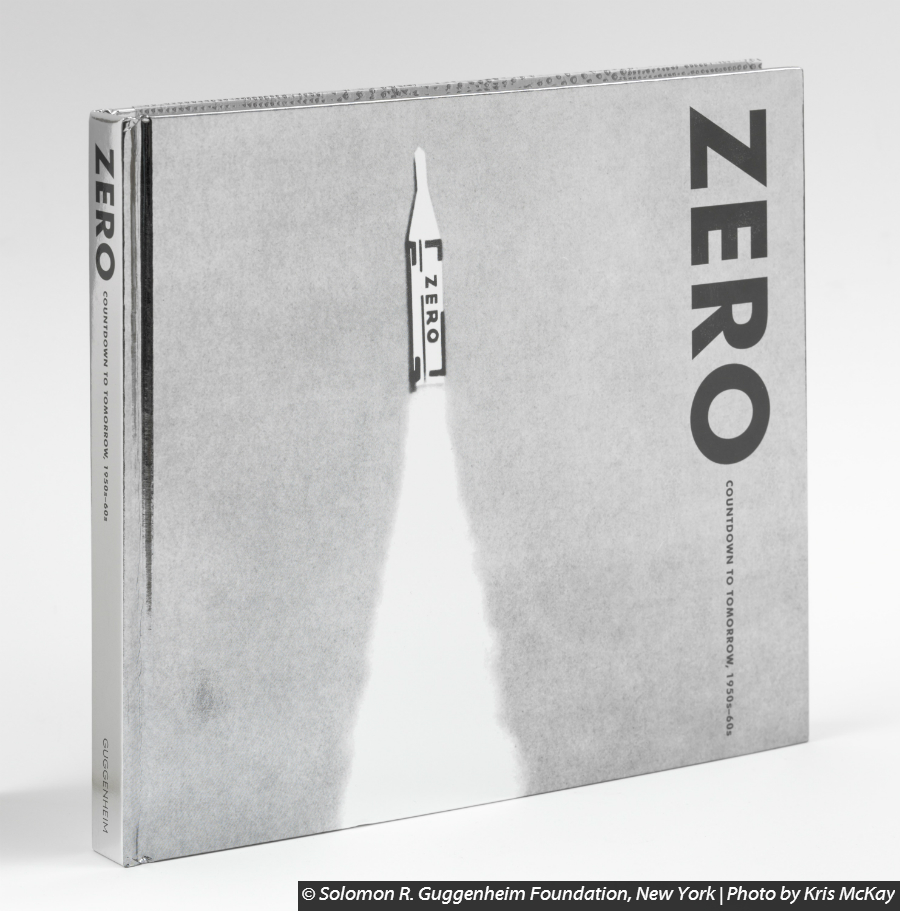
ZERO: Countdown to Tomorrow, 1950s-60s.
New York: Solomon R. Guggenheim Museum, 2014. 244 pp.; 170 color ills.
$65
9780892075140 0892075147
Catalogue of an exhibition held in Solomon R. Guggenheim Museum, New York, from October 10, 2014 to January 7, 2015.
In the fall of 2014, the Guggenheim Museum in New York presented the exhibition ZERO: Countdown to Tomorrow, 1950s - 60s, the German Group Zero’s first large scale historical survey in the United States. One of many artist groups to emerge during the immediate postwar period, Group Zero sought to break with past traditions and create a new beginning for art through an investigation of alternative methods and materials. Its core members included Otto Piene, Heinz Mack, and Günther Uecker, along with thirty-seven other artists that the exhibition curator, Valerie Hillings, calls the “ZERO network.” Differentiated from the German Group Zero through its capitalization, the ZERO grouping comprised artists scattered throughout the globe: in ten countries and over four continents. These artists not only shared similar tendencies in their artwork, but also made direct contact with the Group Zero in Germany. While in the past few years there have been a number of exhibitions aimed at historicizing Group Zero – at the Boston Cyberarts Gallery (2015), the Neuberger Museum of Art (2014), and Sperone Westwater in New York (2008), to name a few – this exhibition repositions the Group Zero artists. By highlighting key artworks and Group Zero’s exhibitions and publications, Hillings demonstrates how the Group Zero practitioners were involved in a global network, placing them among artists engaged in similar art-making practices that collectively expressed a forward-looking vision.
Editors’ Introduction
As the current issue of SEQUITUR goes to press, it is difficult to believe that it is only our second issue. Since launching last December, our readership has expanded well beyond the confines of our hometown in Boston. Visitors to www.bu.edu/sequitur hail from across the country, and from as far away as China and Australia. The geographic reach of our readers is reflected in the authors of this issue, who represent five schools from locales as distant as Alabama and Scotland. The growth of SEQUITUR in its first year is a testament to the vitality of art historical research and scholarship around the globe, especially among graduate students, who are already staking their claim on the field. The present issue of SEQUITUR introduces a group of young scholars who represent the promise and productivity of this new generation.
In the featured essay, “Outside the Gate: The Seduction of Belonging in the Charleston Works of Elizabeth O’Neill Verner,” Olivia J. Kiers considers the South Carolina artist’s drawings of Charleston’s urban center and rural outskirts, highlighting the complementary modes of curiosity and longing, observation and occlusion, they reveal. Kiers elucidates Verner’s own liminal identity in Charleston as a compositional feature, one that propelled her choice of subjects and views.
Amy Williamson’s interview, “The State of Museum Visitor Engagement,” with Kristi McMillan, Assistant Curator of Education for Visitor Engagement at the Birmingham (Alabama) Museum of Art, probes current strategies for engaging museum goers inside the gallery, and raises questions about the role of technology in the museum experience. With its focus on contemporary museological practices, Williamson’s interview stands as a coda to SEQUITUR’s first issue, which focused on art collecting and exhibition practices.
Three publication reviews present critical perspectives on recent scholarship. Sasha Goldman reviews the exhibition catalogue accompanying the landmark Guggenheim Museum exhibition on the post-war German Group Zero and its network (closed January 2015). Conveying the grand scale and ambitious scope of the exhibition and catalogue, Goldman suggests ways that scholarship on Group Zero, its artistic networks, and the German post-war decades will play a key role in future European post-war art research. In his review of a new book by Michael Wayne, Professor in Screen Media, Brunel University, London, Bakary Diaby assesses current trends in aesthetic theory. Against the backdrop of a larger critical interest in the “political potential” of philosophical aesthetics, Diaby asserts the value of Wayne’s interest in Kantian aesthetics as a way to critically approach present socio-economic and political inequities. Lastly, Valentina S. Grub introduces a highly anticipated new offering on English Gothic architecture and design by Paul Binski, Professor of the History of Medieval Art and Fellow of Gonville and Caius College, Cambridge University. Grub encapsulates Binski’s central claims of the widespread influence of the late medieval English Decorated Style and the doctrinal efficacy of its ornate design elements. She also calls attention to areas that would benefit from further research and discussion, a prescient reminder of the ever-evolving nature of art historical inquiry.
This issue also includes two Research Spotlights. First, Bradley J. Cavallo introduces the curious case of Italian funerary portraits painted on metal and stone. Cavallo’s account of his discovery of this distinct type of portrait, now a central part of his dissertation, is a heartening reminder of the often unpredictable and serendipitous nature of art historical research. Additionally, Lydia Harrington provides a first-hand account of the second annual Art+Feminism Wikipedia Edit-a-thon in Boston (one of 40+ simultaneously staged worldwide). Part reflection, part interview, Harrington discusses her experience as a participant in the event alongside excerpts from a discussion with Boston-area organizers Gabrielle Reed and Amanda Rust.
Finally, SEQUITUR Junior Editor Ewa Matyczyk reports on “Creative Conflict,” the 31st annual Boston University Graduate Student Symposium on the History of Art & Architecture, held February 27-28, 2015, at the Boston University Art Gallery and the Museum of Fine Arts, Boston. Engaging with the event’s theme, presentations, and discussions, Matyczyk foregrounds the destructive and generative potential of conflict, and draws attention to the fundamental role of artistic production in shaping, mirroring, and commemorating cultural identities.
This issue of SEQUITUR is notably varied in the range of topics explored. Moving from medieval design to contemporary critical theory, Italian tombs to American cityscapes, the essays, reviews, reflections, and conversations mirror the diversity and breadth of current research, methods, and discourses comprising art and architectural history today.
Beth Pugliano
Book Review: ‘Gothic Wonder: Art, Artifice, and the Decorated Style, 1290-1350’

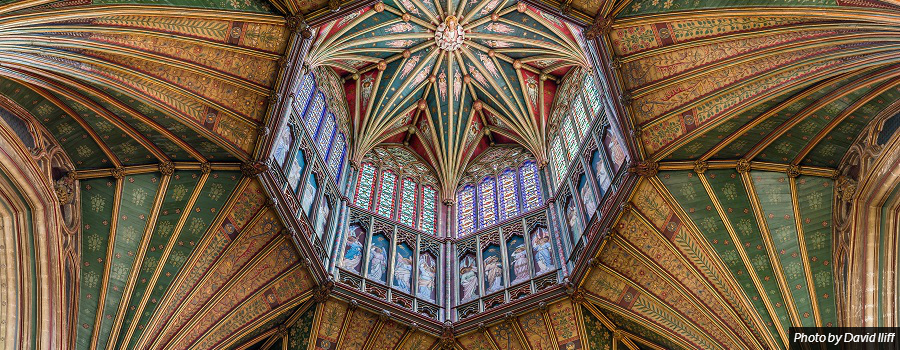
PAUL BINSKI.
Gothic Wonder: Art, Artifice, and the Decorated Style, 1290-1350.
New Haven: Yale University Press, 2014. 452pp.; 140 color ills., 175 b/w.
$75.00
9780300204001
Paul Binski is well known among medievalists as an accomplished academic and expert on Gothic art and architecture. In his latest book, Gothic Wonder, which focuses on the art and intentionality of the English Decorated Style, he re-establishes the Middle Ages as a time of sublime aesthetic creativity.
Notes about Contributors
Olivia J. Kiers is in the final semester of the M.A. program in History of Art & Architecture at Boston University. She is currently a graduate assistant at the Boston University Art Gallery at the Stone Gallery. Olivia's research interests focus on 19th- and early-20th-century works on paper, particularly European and American prints. Her M.A. scholarly paper is entitled “The Deadly Spectacle: Experiencing World War I through the Woodcuts of Félix Vallotton.”
Amy Williamson is an M.A. student at the University of Alabama at Birmingham. Her research interests in art history include Fin-de-Siècle Vienna, female art collectors, global textiles, and Mughal art and architecture. She received her B.A. in French and Art History from Oglethorpe University in Atlanta, Georgia.
Sasha Goldman is a Ph.D. student at Boston University where her research focuses on modern and contemporary art and exhibition histories in Italy. She received her M.A. in Art History from the Tyler School of Art at Temple University and her B.A. in Art History from Connecticut College.
Bakary Diaby is a Ph.D. candidate in the Literatures in English Department at Rutgers. He works in the fields of 18th- and 19th-century Literature and Romanticism. He specializes in Philosophy of Mind, Social Theory, and Aesthetics. His particular interest lies in the politics of poverty since the Enlightenment.
Valentina S. Grub completed her B.A. at Wellesley College in Medieval & Renaissance Literature and Classical Civilization with honors. Since then she has received an M.Litt. with distinction in Medieval Studies at the University of St. Andrews, where she is currently pursuing a Ph.D. in Art History with a focus on medieval English embroidery.
Bradley J. Cavallo studies with Dr. Tracy E. Cooper, Dr. Marcia Hall, and Dr. Ashley D. West as a Ph.D. candidate in art history at Temple University. He earned his M.A. in Syracuse University’s Florence Art History Program with Dr. Gary Radke and Dr. Rab Hatfield. His dissertation addresses 16th- and 17th-century oil paintings on metal and stone supports that served functions other than as altarpieces or Wunderkammer collectibles, thereby broadening the scope of appreciation for the creation and meaning of these artworks.
Lydia Harrington is a Ph.D. student in the Department of History of Art & Architecture at Boston University. She works on the representation of Islamic art and architecture in museums and the introduction of modern institutions to 19th-century Ottoman Baghdad.
2014-2015 SEQUITUR Editorial Team
Senior Editors: Beth Pugliano, Martina Tanga, Naomi Slipp
Junior Editors: Ewa Matyczyk, Steve Burges
Faculty Advisor: Professor Alice Tseng
Special Thanks to Susan Rice and Chris Spedaliere
Outside the Gate: The Seduction of Belonging in the Charleston works of Elizabeth O’Neill Verner
“To the artist the spirit rather than the letter is the important thing.” [1]
Thus wrote Elizabeth O’Neill Verner (1883-1979), a sketcher and printmaker focused on depicting the stark contrasts between light and dark in her hometown of Charleston, South Carolina. Light and dark is meant both literally and figuratively here, as Verner did much of her drawing out of doors on the streets under the brilliant South Carolina sunlight. She focused her gaze on the obscured edges of a shady garden or on a tree-shrouded aristocratic home peeking from behind a wrought iron fence. Her most enchanting images are ones in which she let the play of light and shadow dapple across surface creating a sense of calm and nostalgia, as seen in Gates of the Mikell Jenkins House. (Fig. 1) Of Verner's numerous sketches and etchings of Charleston, some were compiled into book format and published, accompanied by lyric essays by Verner herself on the history and culture of the city. The images in this article, which are representative of her graphic work from the 1920's and 30's, were taken from two of Verner's publications, Mellowed by Time (1941) and Prints and Impressions of Charleston (1945). While her depictions of Charleston are sentimental, Verner never pictures a Southern belle to complete the air of ante-bellum prosperity. She relied instead on a completely different cast of characters.
2015 Symposium Reflection
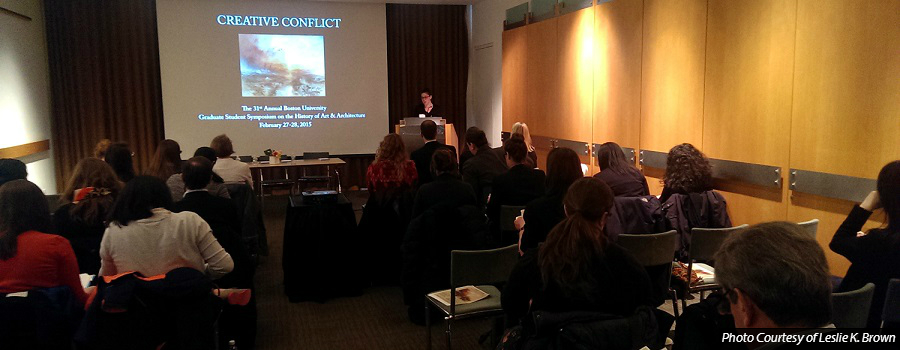
Creative Conflict - The 31st Annual Boston University Graduate Student Symposium on the History of Art & Architecture, February 27th & 28th, 2015
This two-day event was generously sponsored by The Boston University Center for the Humanities; the Boston University Department of History of Art & Architecture; the Museum of Fine Arts, Boston; the Boston University Graduate Student History of Art & Architecture Association; and the Boston University Art Gallery at the Stone Gallery.
On February 26, 2015, news outlets around the world showed video footage released by Islamic State militants depicting the violent destruction of antiquities and artifacts at the Mosul Museum in Iraq. The vicious spectacle served as a sober reminder that a commitment to the preservation of art and cultural heritage is far from a foregone conclusion in contemporary life. The following day, the Boston University History of Art & Architecture community gathered at the Boston University Art Gallery (BUAG) for the keynote talk of the 31st Annual Graduate Student Symposium, titled “Creative Conflict.” In his address, “Killing Identity: Heritage Destruction in the Syria and Iraq Conflicts,” Dr. Richard M. Leventhal, Executive Director of the Penn Cultural Heritage Center (PennCHC) at the Penn Museum and Professor in the Department of Anthropology at the University of Pennsylvania, foregrounded the Mosul footage, stressing that cultural heritage is regularly endangered by conflicts worldwide. He explained its inextricable links to both memory and national and cultural identity in places like Syria and Iraq. Leventhal developed his lecture by outlining some of the work undertaken by the PennCHC, which implements a bottom-up, community-driven approach to help curators, scholars, and activists in conflict-stricken areas protect and safeguard cultural heritage. Dr. Leventhal ended his talk with a “Post-conflict Postscript” that introduced aspects of his own research on historical conflicts in the Yucatán, Mexico. The keynote address sparked an engaging and thoughtful Q&A session, which highlighted the importance of identity and community-building for areas impacted by conflict. More
Creating Wonder: A Discussion with Kristi McMillan, Assistant Curator of Education for Visitor Engagement at the Birmingham Museum of Art
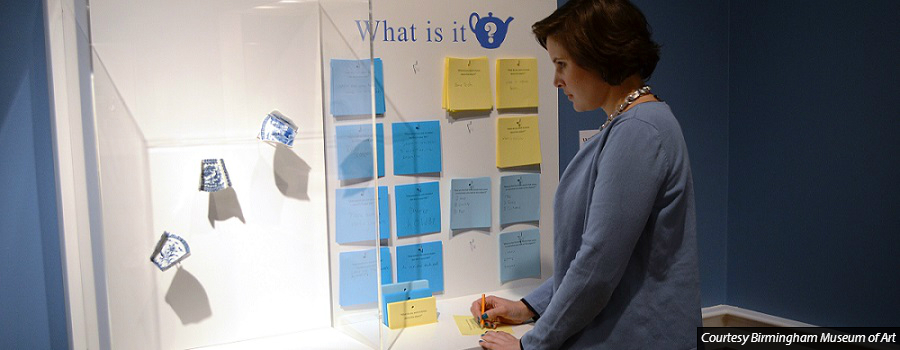
This interview focused on technology in educational programming at museums and was conducted via email between Amy Williamson and Kristi McMillan, Assistant Curator of Education for Visitor Engagement at the Birmingham Museum of Art (BMA) in Birmingham, Alabama. In summer and fall of 2014, Williamson served as an intern at the BMA.
Q: Talk about the BMA's avenues for visitor engagement.
We engage visitors with artworks through facilitated and self-guided interpretation. Facilitated interpretation can include tours, workshops, lectures, performances, and outreach; self-guided interpretation is defined more broadly, from exhibition design and signage to interactive spaces, technology, and printed material. Education, curatorial, communications, and new media staff work together on these efforts. We’re successful if we can build a bridge between a visitor and an object; provide understanding or create wonder about human creativity; or best of all, help a visitor associate an object – perhaps made in another part of the world at a different time by people living lives wholly unlike theirs – with their own experience. This definition of success may seem lofty and hard to measure, but we see sparks of connection happen every day.
Research and Scholarship for the 21st Century: The 2015 Art+Feminism Wikipedia Edit-a-thon

On March 7, 2015, I attended the Art+Feminism Wikipedia Edit-a-thon held at the Massachusetts College of Art and Design (MassArt) in Boston, Massachusetts. [1] Only a year earlier, in March 2014, the same week as International Women’s Day, Art+Feminism founders Siân Evans, Jacqueline Mabey and Michael Mandiberg organized the first Edit-a-thon in New York City. Their goal was to increase the small number of articles written about women in the arts and the number of women editors (who make up only about 10% of Wikipedia editors) by offering training and guidance to participants. [2] It spurred simultaneous events in twenty other U.S. cities and in Canada, Europe, and Australia. [3] In its second year the Art+Feminism Wikipedia Edit-a-thon has expanded to over 75 satellite events globally, “resulting in the creation of nearly 400 new pages and significant improvements to 500 articles on Wikipedia.” [4] This event was of particular interest to me since it intersects both the arts and technology, areas in which women’s participation is still met with obstacles, demonstrated by the work of groups such as the Guerilla Girls or individuals like Anna Sarkeesian, a feminist media critic who focuses on the harassment of women in online gaming culture and sexist representation of female characters in video games. [5] More