news
Early Modern Funerary Portraits Painted on Metal and Stone Supports: Results of Field Work in Rome
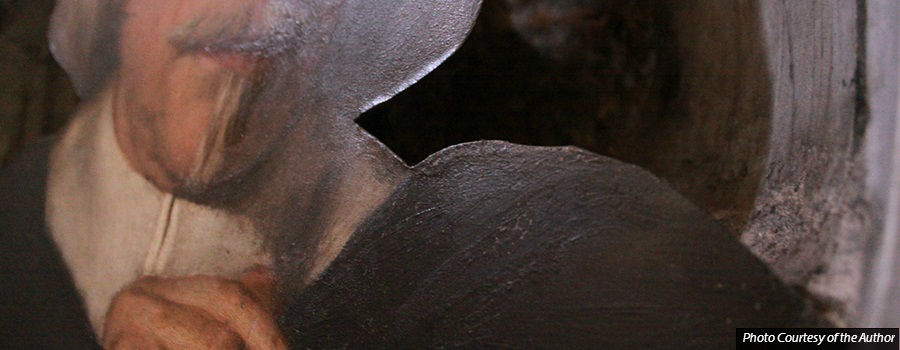
In the spring of 2013, while conducting dissertation research in Rome, I noticed the funerary portraits of Gaspare Rivaldi and Ortenzia Mazziotti in the church of Santa Maria della Pace. Intrigued by their appearance, I inquired of the sacristan as to their material. (Fig. 1) To my surprise, he promptly tapped upon Signore Rivaldi’s visage as on the hood of a car, pointed to the over-painted rivets affixing the artwork to its marble frame, and said “aluminum.” [1] Although chemists did not produce pure aluminum until the nineteenth century, the sacristan correctly noted the support’s metallic composition. [2] Surprisingly, subsequent research revealed no investigations of these portraits or any others in situ in Rome painted in oils on metal plates or stone panels. [3] In fact, the Rivaldi/Mazziotti portraits of ca. 1611-1614 contradict expectations to find such artworks nowhere other than in early modern Wunderkammer collections as records of a Mannerist “evolution of taste and interest.” [4] But did these funerary effigies represent isolated instances or exemplars of a larger phenomenon overlooked by art historians? More
Book Review: ‘Red Kant: Aesthetics, Marxism, and the Third Critique’
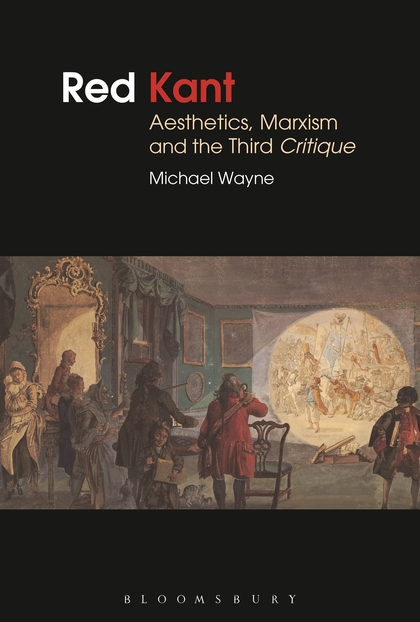
MICHAEL WAYNE.
Red Kant: Aesthetics, Marxism, and the Third Critique.
London: Bloomsbury Publishing, 2014. 240 pp.
$112
9781472511348.
Screen media scholar Michael Wayne’s new book, Red Kant: Aesthetics, Marxism, and the Third Critique, offers a cogent and valiant defense of the necessity for sophisticated thinking about aesthetics in our contemporary moment. As with Wayne’s previous work, particularly on cinema and media, Red Kant focuses on the relationship between Marxist social theory and contemporary aesthetics. But unlike his earlier books—Political Film: the Dialectics of Third Cinema (London; Sterling, VA: Pluto Press, 2001), Marxism and Media Studies: Key Concepts and Contemporary Trends (London; Sterling, VA: Pluto Press, 2003), and Marx’s Das Kapital for Beginners (Hanover, NH: For Beginners, 2012)—Red Kant extends Wayne’s range into eighteenth-century philosophy and its influence on subsequent Marxian thinkers.
Book Review: ‘Permission to be Global/Prácticas Globales’
JEN MERGEL and LIZ MUNSELL.
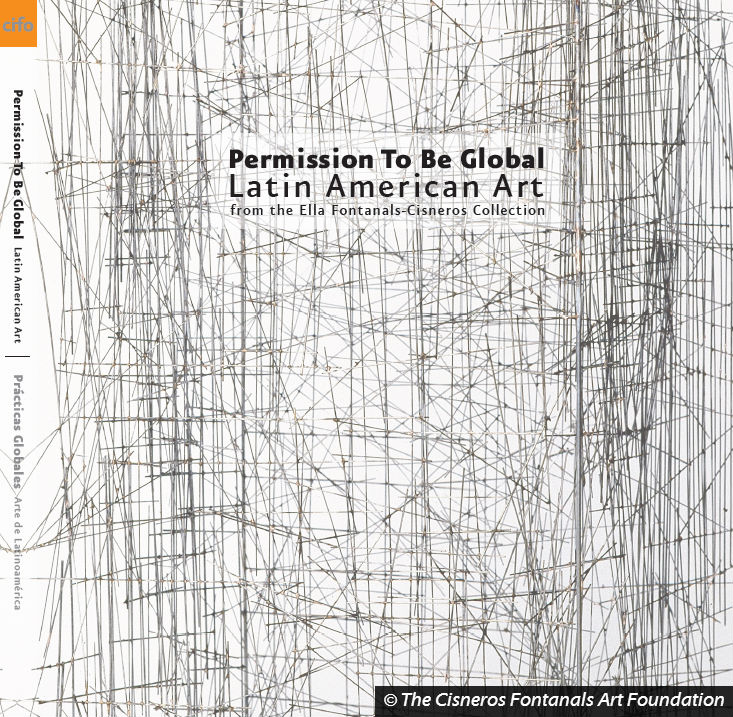
Permission to be Global/Prácticas Globales: Latin American Art from the Ella Fontanals-Cisneros Collection.
Miami: The Cisneros Fontanals Art Foundation, 2013. 135pp.
$40.00 paper
9780615911014
In the spring of 2014 the Museum of Fine Arts, Boston (MFA) mounted Permission to be Global/ Prácticas Globales: Art from the Ella Fontanals-Cisneros Collection, the first exhibition of Latin American art in its 138-year history. Permission to be Global debuted at the Fontanals-Cisneros Art Foundation (CIFO) during Art Basel Miami in December 2013 before travelling to Boston. Jointly organized by MFA and CIFO curators, the exhibition and accompanying catalogue present some 60 works from Fontanals-Cisneros’s private collection made by Latin American artists such as Lygia Clark, León Ferrari, Cildo Meireles, and Ana Mendieta, along with many emerging artists, including Eduardo Abaroa and Daniel Medina.
‘Pontormo and Rosso Fiorentino: Diverging Paths of Mannerism,’ Palazzo Strozzi, Florence, Italy
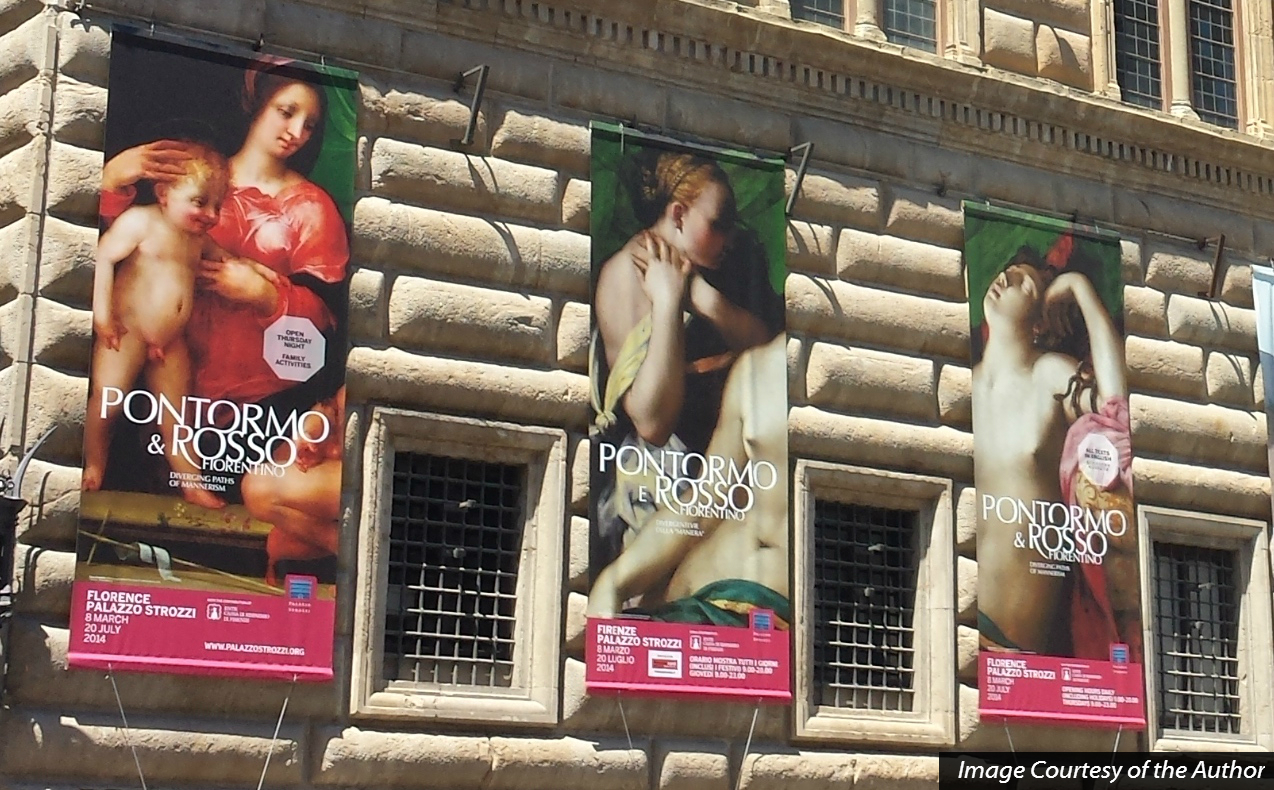
Presented at Florence's Palazzo Strozzi March 8 - July 20, 2014, the exhibition Pontormo and Rosso Fiorentino: Diverging Paths of Mannerism offered an illustration of the equally divergent approaches taken by European and American scholars to the often controversial study of Mannerist painting. While American scholars frequently characterize the artifices of Mannerism as a diversion from (or even perversion of) Renaissance ideals, exhibition curators Carlo Falciani and Antonio Natali instead sought to establish Jacopo da Pontormo and Rosso Fiorentino's individual and divergent approaches to the Mannerist aesthetic, exclusive of any reference to the normative ideals of Renaissance art. Viewing the exhibition freed from the traditional need to justify or rehabilitate Mannerist art was refreshing, and allowed this American viewer to concentrate completely on the works at hand.
‘Jim Hodges: Give More than You Take,’ Institute of Contemporary Art/Boston

What will you leave behind when you die? This appeared to be the question asked in the recent mid-career retrospective Jim Hodges: Give More than You Take at the Institute of Contemporary Art in Boston (ICA). In organizing this exhibition, the ICA's curators worked closely with Hodges to install artworks representative of nearly three decades of the artist’s work, made of a hodgepodge of materials ranging from delicately applied gold leaf to human spittle. Hodges’ voice was unmistakably present, and, considering the deeply personal nature of many of the pieces shown, it was a welcome addition. Yet, even in this celebratory exhibition of the artist's life’s work, the presence of his contemporaries and predecessors – his influences and inspiration – loomed large. The retrospective exhibition is, in effect, a homage, not just to its subject, but also to those he has followed and loved throughout his career. More
Editors’ Introduction
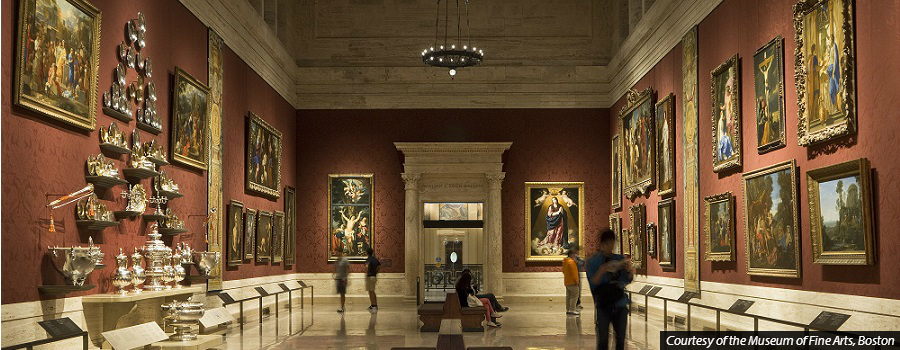
We are excited to launch the online art journal SEQUITUR. As we begin publication, we join a lengthy and inspiring tradition of scholarship on art and architectural history. It is with reverence for this legacy, but with an eye to the present and future that we initiate this endeavor, aimed at sparking germane conversations about current happenings in the field and bringing fresh, critical perspectives to the people, events, and scholarship that shape art and architectural history today. In this inaugural issue, we take a global perspective on art collecting and exhibition practices. Our lens encompasses the importance of classical antiquity in the display of art in nineteenth-century Boston, the development of Mannerism in Italy, and a traveling contemporary Latin American art exhibition. The range of essays, interviews, and reviews also covers a long history, from early modern displays of art in the seventeenth century to today. What transpires is the versatility of the exhibition medium: it can be a vehicle to highlight pedagogy, scholarship, and innovative experimentation. More
Notes about Contributors
Deborah Stein is a Ph.D. candidate in the Department of History of Art & Architecture at Boston University, focusing on nineteenth-century American art as well as the history of American art collecting and museum formation. Her dissertation project is entitled “Charles Callahan Perkins, Classical Sculpture, and the Rhetorical Tradition in Mid-Nineteenth Century Boston.” More
The Kunstkammer Gallery at the Museum of Fine Arts, Boston
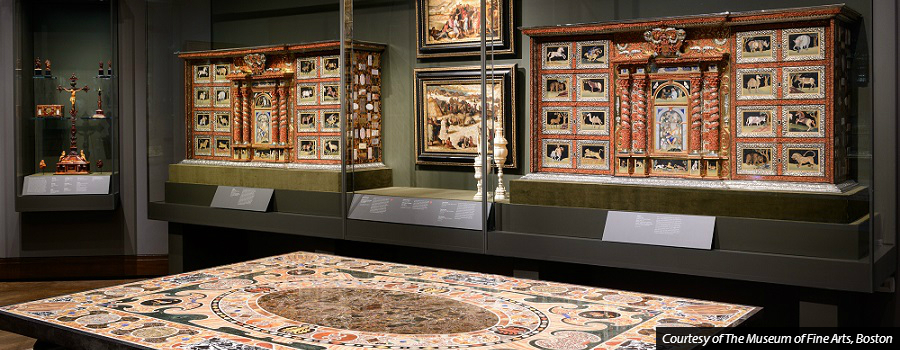
The newly installed Kunstkammer Gallery at the Museum of Fine Arts, Boston, which opened on June 4, 2014 as part of the museum’s larger project to renovate the display of European art in the Evans Wing, aims to replicate for the modern viewer the dazzling experience of entering just such a space in the Renaissance and Baroque era. The museum’s re-creation of a sixteenth- to seventeenth-century encyclopedic kunstkammer—literally, “art room” or cabinet of curiosities, conceived as the universe in microcosm—showcases a diverse array of naturalia, artificialia, and exotica. These objects splendidly attest to the period’s fascination with works wrought by nature or man (or, more often than not, an elision of the two) and exotic materials hailing from far-flung shores.
Classical Rhetoric and the Institutional Fine Arts in Nineteenth-Century Boston
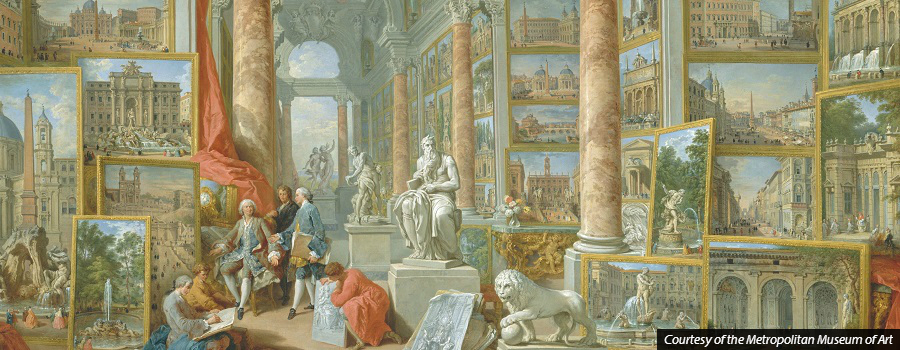
On July 4, 1876, the Museum of Fine Arts, Boston, located in a purpose-built Ruskinian Gothic building in Copley Square, opened its doors for the first time to an enthusiastic public. [1] The day was doubly celebratory as it was also the nation’s centennial. Visitors were greeted throughout the Museum by a display of diverse art objects largely borrowed from institutional lenders, most particularly the classically-oriented painting and sculpture collections of the Boston Athenaeum, which had been to that point the city’s leading arts organization. In addition to the Athenaeum’s collection, there were Renaissance and Baroque engravings as well as collections of Egyptian, Cypriot, and Italian antiquities. Also on view was a collection of eighty-six plaster casts, many of them sourced from European manufacturers, intended to visually represent the history of antique sculpture. [2]
The State of Museums in Boston: A Conversation with Professor Melanie Hall
This interview was conducted via email between graduate students Bridget Hanson and David Silvernail, and Professor Melanie Hall, Director of Museum Studies and Associate Professor, History of Art & Architecture
Q: The inaugural issue of Sequitur features reviews of recent contemporary exhibitions and catalogues in Boston museums. How would you characterize the growing prominence of contemporary projects, and the difference in contemporary curatorial strategies at the MFA, the Gardner Museum, and the ICA/Boston?
There has been a significant rise in interest in contemporary art internationally during the past 15-20 years, but such interest can also be subject to external forces. In the case of the MFA’s Permission to be Global, the works come from an individual collector: Ella Fontanals-Cisneros, founder and president of CIFO. More