news
Jean Tinguely’s Cyclograveur: The Ludic Anti-Machine of Bewogen Beweging
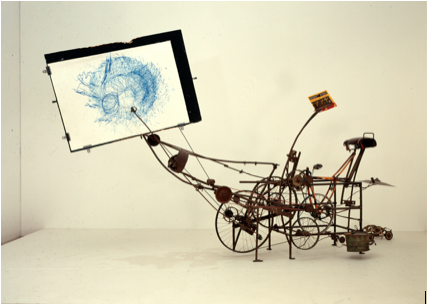
Bewogen Beweging (Moved Movement) was an exhibition held at the Stedelijk Museum, Amsterdam, from March 10 to April 17, 1961. Curated by two museum directors—the Stedelijk’s Willem Sandberg and Pontus Hultén, from the Moderna Museet, Stockholm—together with artists Daniel Spoerri and Jean Tinguely (1925–1991),[1] the show constituted a survey of Kinetic art as it presented nearly two hundred works by over seventy artists, all of whom contributed to the novel spectacle of rusty wheels, chains, broken typewriters, strollers, and alarm clocks that moved and made noises. Many of the works on display incorporated bicycles in various forms.[2] A Netherlandish metaphor for both play and utility, the bicycle is at once a child’s toy and the predominant mode of transportation for adults in Amsterdam. Examining in particular Tinguely’s Cyclograveur—a sculpture based primarily on the bicycle—this essay reveals that the exhibition deployed the illogical movements of mechanical components in a ludic critique of the rapid industrialization and modernization of the Netherlands after World War II.
2016 Symposium Reflection
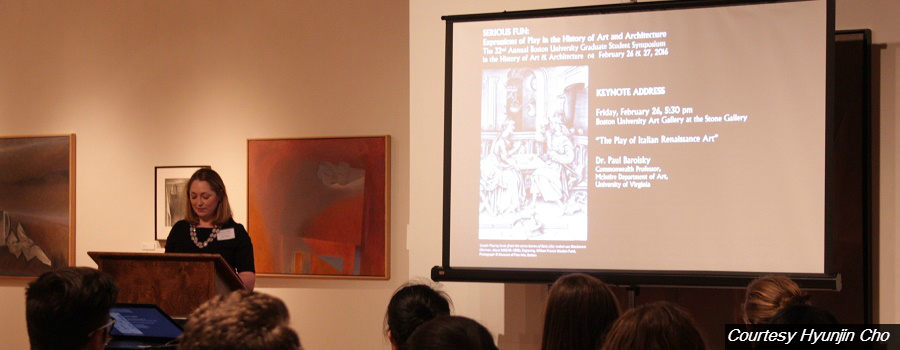
Serious Fun: Expressions of Play in the History of Art and Architecture – The 32nd Annual Boston University Graduate Student Symposium in the History of Art & Architecture, February 26th & 27th, 2016
This two-day event was generously sponsored by The Boston University Center for the Humanities; the Boston University Department of History of Art & Architecture; the Museum of Fine Arts, Boston; the Boston University Graduate Student History of Art & Architecture Association; and the Boston University Art Gallery at the Stone Gallery.
Grotesque Irreverence: The Transformation of ‘Ecce Homo’
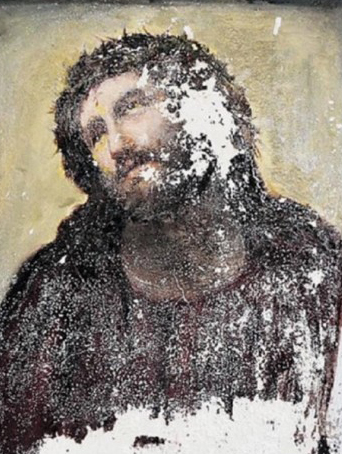
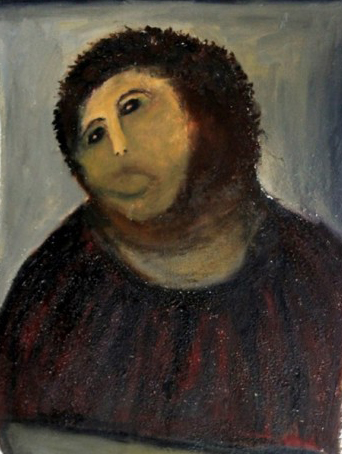
To expand the photos of before and after Cecilia Giménez's intervention, slide the toggle in the center.
The global online community erupted on August 21, 2012 following reports by the Spanish newspaper Heraldo of the failed attempt made by Cecilia Giménez, an elderly local amateur artist, to restore Elías García Martínez’s fresco Ecce Homo (Behold the Man) (Figure 1).[1] A gift from Martínez, the artwork was painted directly onto the wall of the Santuario de Misericordia church in the Spanish town of Borja in around 1930, and until 2012 had existed in relative obscurity. The work is unimposing in size, measuring just twenty inches in height and sixteen inches in width, and was originally painted by Martínez in a style strikingly similar to that of the high-Baroque works of Italian artist Guido Reni (1575-1642). Whilst general opinion amongst the press treated the fresco as “a work of little artistic importance,” because “Martínez is not a great artist and his painting Ecce Homo is not a ‘masterpiece,’” the fresco nevertheless held some sentimental value within the local community; residents’ attachment to it stemmed from an interest in historical preservation and general artistic authenticity as much as the inherent sanctity associated with the artwork.[2] The original image, which depicted Jesus crowned with thorns and gazing skyward in a traditional Catholic pose, had suffered significant moisture damage over the decades. Sources vary as to whether Giménez acted with or without permission from the priest, but local city councilor of arts and culture, Juan Maria Ojeda, was quick to defend the octogenarian parishioner, dismissing theories of malicious vandalism, and instead insisting that she acted with “good intentions,” despite having no formal artistic training.[3]
Engaging with Visitors, When Visitors Have Superpowers: Testing the ‘ASK Brooklyn Museum’ App
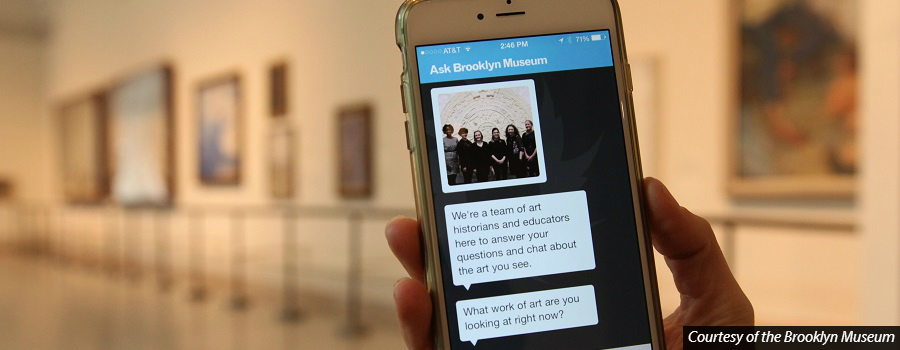
More empowered than ever, visitors to art museums typically enter these institutions equipped with digital tools that can mediate their experience of the objects within. [1] With an interest in how technology like smartphones could impact curatorship, I accepted a position as a visitor liaison during the summer of 2015 at the Brooklyn Museum. Officials there were reimagining the entire visitor experience preceding Anne Pasternak’s assumption of the museum directorship in September 2015. In June 2015 the museum unveiled an original smartphone app called ASK Brooklyn Museum, which makes it possible to chat with museum experts at any point during a visit without delay. [2] It was my role to encourage museum-goers to put this tool to use.
“So-Called Synonyms:” Translating Darío de Regoyos’s ‘España negra’
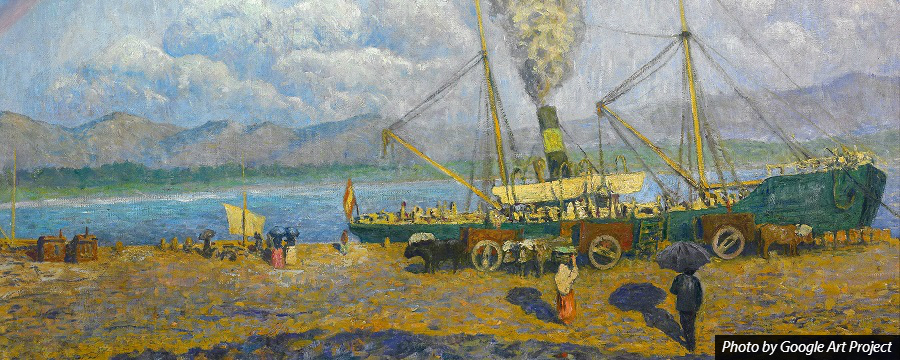
I first became familiar with the paintings of Spanish artist Darío de Regoyos (1857-1913) at a survey exhibition held at the Museo Thyssen-Bornemisza, in Madrid, on the centenary of his death. Captivated by the sun-dappled fields and villages of Regoyos’s Spanish landscapes, I also began reading his 1899 travelogue, España negra. Immersing myself in the words of an artist whose brushwork I was simultaneously getting to know led me to translate the text, as yet unavailable to English readers. As I would soon discover, both translation and art history are fundamentally acts of interface—the former, the transposition of writing in one language into another language, and the latter, the evocation of objects with words.
‘Camera Ottomana: Photography and Modernity in the Ottoman Empire, 1840-1914’
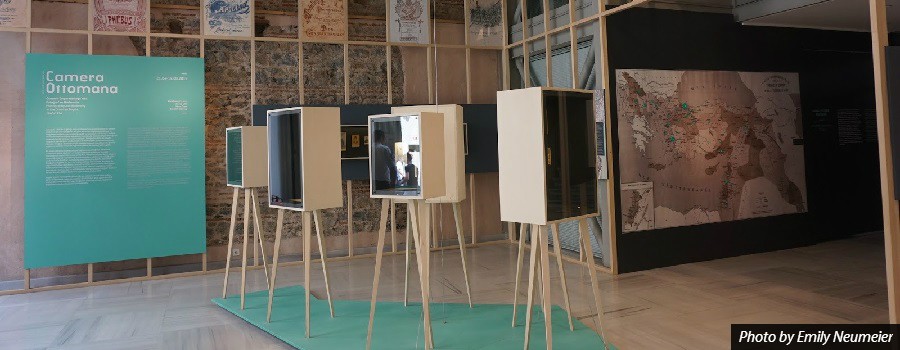
Camera Ottomana: Photography and Modernity in the Ottoman Empire, 1840-1914
Koç University Research Center for Anatolian Civilizations, Istanbul, Turkey
April 21 – August 19, 2015
Camera Ottomana, curated by Zeynep Çelik, Edhem Eldem, and Bahattin Öztuncay, on display during the summer of 2015 at Koç University’s Research Center for Anatolian Civilizations (RCAC) on Istanbul’s bustling pedestrian Istiklal Street, ambitiously took on the complex role of photography in the last years of the Ottoman Empire. The exhibition used one interface to explain another: a variety of tools—digital, cartographic, and written—were employed to help the visitor understand how an empire’s elites represented their dominion through photography. Freestanding light boxes and digital close-ups were just a few of the ways in which the exhibition exposed visitors to photographs in various forms, including studio portraits, post cards, newspapers, film footage, and albums. Through maps, timelines, and explanations of different image technologies in Turkish and English, the visitor could take-in ample artistic information without being overwhelmed. Supplementary explanatory and political text, which seemed lacking in the exhibition, is provided by the accompanying book of four essays on Ottoman photographic history, three of which were written by the curators.
Editors’ Introduction

The current issue of SEQUITUR takes as its theme the concept of interface. In its noun form, “interface” suggests a point of access, a mode of mediation, and a site of contact. As a verb, it refers to an interaction, connection or dialogic exchange between a range of entities — including individuals, institutions, disciplines, objects, and ideas. Broadly speaking, “interface” thus expresses a means or a site for the transfer, communication, or translation of knowledge, constituting an idea that is inextricably bound to the creation, study, and consumption of art and architecture. This issue’s contributors engage the theme in varied, provocative ways: they investigate how people have interacted with artworks and buildings in the past or the present; they meditate on the role of the artist and scholar in translation; and they explore how exhibitions may function as dialogues between artworks, museums and viewers. Moreover, our contributors showcase the ways in which both works of art and their scholarly consideration facilitate a deeper understanding of the intersection of art history and cultural life.
This issue’s featured essay, “Building Babel: The 1876 International Exhibition at the Philadelphia Centennial” by Kelsey Gustin, dissects the unusual floor plan of the Centennial’s arts exhibition, which included works from Europe and the United States, to reveal its underlying ideological agenda. As Gustin’s analysis illuminates, Chief of the Bureau of Installation, Henry Pettit, and Chief of the Bureau of the Arts, John Sartain, created an interface between nations and visitors by negotiating the space allocated to each country and arranging the pieces so as to invite visitors to compare the art of Europe and the United States. As planned by Pettit and Sartain, and encountered by fairgoers, the exhibition’s layout served to legitimize American art within a global context.
The reviews included within this issue analyze three exhibitions—two current shows in Boston and one recently closed exhibition in Istanbul. Bryn Schockmel reviews the first monographic presentation of Italian Renaissance painter Carlo Crivelli’s work to an American audience at Boston’s Isabella Stewart Gardner Museum. By highlighting certain curatorial decisions and fascinating comparisons, Schockmel draws attention to the ways in which an institution can shape the potential modes of interface between viewers and artworks. Elisa Germán reviews a second Boston exhibition: the Institute of Contemporary Art’s Leap Before you Look: Black Mountain College 1933-1957. Here Germán examines the first large-scale museum exhibition in the United States to treat this historic locus of artistic experimentation and exchange. Finally, in her review of Camera Ottomana: Photography and Modernity in the Ottoman Empire, 1840-1914 at Koç University Research Center for Anatolian Civilizations in Istanbul, Turkey, Lydia Harrington explores the exhibition’s various didactic elements. She examines how maps, timelines, and supplementary text are used to illuminate photography’s historic role as interface for the Ottoman Empire by portraying its riches to an international public.
This issue’s two research spotlights consider technology and translation as modes of interface. SEQUITUR Senior Editor Steve Burges examines ASK Brooklyn Museum, a smartphone app that invites curious visitors to ask questions or start conversations about the artwork they see on display. Burges illustrates how the app’s easy-to-use interface grants visitors access to the museum’s institutional knowledge by encouraging them to ask questions and supplying a team of experts—the museum’s own art historians and educators—to answer queries in real time. Meanwhile, Annemarie Iker explores the multilayered interpretation that accompanies the process of translating ideas across media. She reflects on her experience translating Spanish artist Darío de Regoyos’ 1889 travelogue, España negra, and considers how this process, and the range of voices and viewpoints embedded in the literature itself, manifest the notion of interface.
Finally, Gabriel Sosa’s visual essay, “Notebooks,” marks the introduction of a new feature to SEQUITUR. Sosa’s charcoal and oil pastel drawings are based on his work as a court interpreter. These frenzied images aim to fix an ephemeral moment—capturing, translating, and preserving the recollections of a witness on the stand. In various states of articulation and erasure, Sosa’s drawings elucidate the interfacing function of both the court interpreter and artist, as the vehicle through which the memories of others are given voice or visualization.
Our contributors have approached their investigations in myriad ways—they analyze exhibition design, explore the interaction of the museum with the public, and elucidate the role of the artist or scholar as translator. This, our first themed issue of SEQUITUR, thus unifies diverse subjects and perspectives under the central theme of interface. After all, the journal itself is a medium of communication and in its efforts to promote discussion and scholarly exchange it too can be seen as a mode of translation, interaction, and a site of interface.
Jordan Karney Chaim & Erin McKellar
‘Leap Before You Look: Black Mountain College, 1933–1957’

Leap Before You Look: Black Mountain College, 1933–1957
Institute of Contemporary Art, Boston
October 10, 2015 - January 24, 2016
Leap Before You Look: Black Mountain College 1933–1957, currently on view at the Institute of Contemporary Arts, Boston, features an elite and eclectic collection of works important to American and European modernism in the fields of art, film, dance, theater, music and literature. Curators Helen Molesworth and Ruth Erickson have succeeded in constructing a vivid testimony of the diverse artistic output that emerged from Black Mountain College, whose educational mission was born out of the vision of John Rice, a recently ousted college professor from Florida, who was inspired by American philosopher John Dewey’s views on education reform.
Crivelli Shines at the Gardner
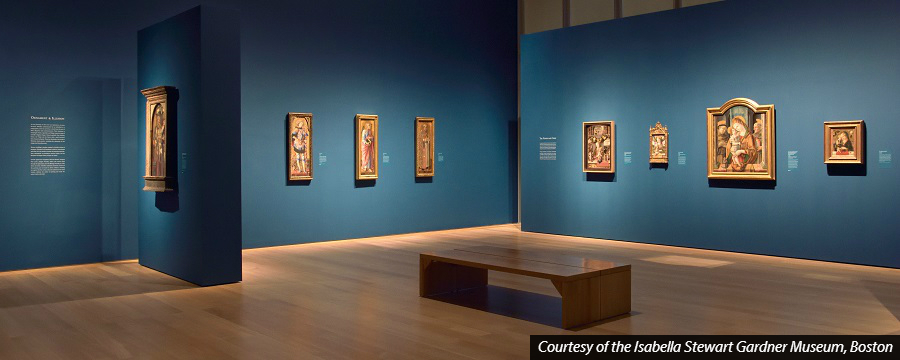
Ornament and Illusion: Carlo Crivelli of Venice
Isabella Stewart Gardner Museum, Boston
October 22, 2015 - January 25, 2016
The Isabella Stewart Gardener Museum of Boston, on the heels of last year’s outstanding show of sculptors’ drawings, has mounted another brilliant Renaissance exhibition: “Ornament and Illusion: Carlo Crivelli of Venice.” This monographic presentation, the first in the United States on the fifteenth-century painter, introduces audiences to an artist who may be unfamiliar, but quickly captivates.
Building Babel: The 1876 International Exhibition at the Philadelphia Centennial
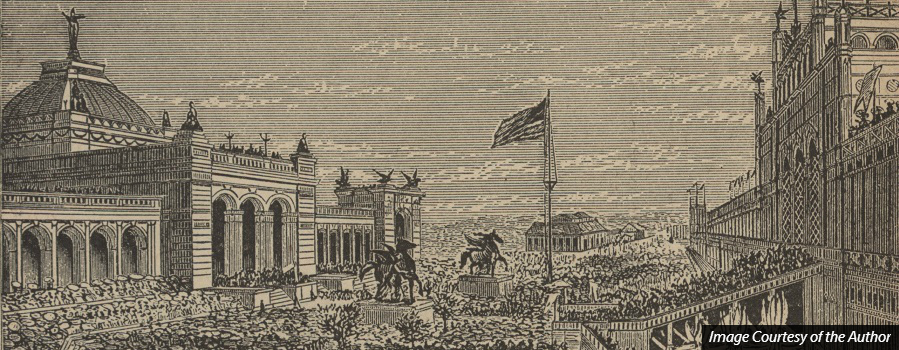
The Centennial Exposition opened on May 10, 1876, and attracted nearly 10 million visitors during its six months of operation. [1] Covering 450 acres of Fairmount Park in Philadelphia, the Centennial, officially titled the International Exhibition of Arts, Manufactures, and Products of the Soil and Mine, featured five grand structures and a collection of temporary pavilions that dotted its picturesque landscape. [2] The only building to survive is Memorial Hall, a permanent structure of glass, iron, and granite that housed the “Arts” display and functioned as one of the five exhibition halls of the fair (Fig. 1). The floor plan of the edifice and its annex reveals an unexpected layout of nations (Fig. 2). Instead of a strictly compartmentalized grid that clearly segregated each state, the plan suggests a scattered realization that frequently split countries between two buildings, often requiring them to share gallery space. In a few cases, narrow hallways featured art from two countries, their paintings literally facing off against each other. Within the context of a world’s fair, position in an exhibition generally corresponded to a predetermined order of importance. Rather than reserving the most desirable locations for its arts, the United States often shared covetous positions or yielded territory to other countries.