Beyond Debt Reprofiling: China’s Role in Global South Development

By Marina Zucker-Marques, Rosa He and Tianyi Wu
Since the onset of the COVID-19 pandemic, many developing countries have faced a financial deadlock: they must scale up social and climate spending to support social-economic development, but the lack of fiscal space, and resulting debt distress inhibit new investments. Multilateral solutions such as the G20 Common Framework have been slow and limited—just four countries have applied since its creation —because perceived costs often outweigh expected benefits. This impasse in advancing debt relief hurts both debtors and creditors, private and public sectors: healthier Global South economies would not only be better placed to service debt, but they would also expand trade and investment opportunities.
In this context, although China is not the root cause of Kenya’s debt distress (the country in fact only represents 13 percent of Kenya’s external debt), it can play a constructive role in supporting Kenya. China’s decision in late 2025 to take advantage of lower domestic interest rates to reprofile Kenya’s debt is a pragmatic and welcome step. By extending maturities and shifting from dollar-denominated loans into lower-cost renminbi (RMB) financing, China provided Kenya breathing space, even if future RMB appreciation could offset part of the savings. It is estimated the deal will save Kenya about $215 million a year in debt service and reduce nominal rates from around six percent per year to three percent.
Ultimately, however, improving Kenya’s long-term debt sustainability will require more than refinancing. It will depend on strengthening Kenya’s export capacity and attracting productive investment that supports structural transformation. Deepening China-Kenya trade ties—by promoting higher value-added exports from Kenya and increasing China’s manufacturing investments in Kenya—would bolster Kenya’s growth and strengthen its balance of payments, while also reducing China’s future repayment risks.
In a recent working paper, researchers from the Boston University Global Development Policy (GDP) Center outline five approaches China could take to revive development finance in the Global South:
- Refinance existing loans in countries facing debt distress.
- Exchange loans at risk of default for longer-term, RMB-denominated claims.
- Provide new long-term RMB lending for green growth.
- Engage in cooperative foreign direct investment (FDI) in countries with manufacturing capabilities.
- Expand trade with countries in the Global South.
China has already moved on some of these as Kenya’s deal exemplifies. Ethiopia, currently restructuring its debt under the G20 Common Framework, may follow suit. This blog provides a concrete assessment of the steps China took to improve Kenya’s debt sustainability prospects and outlines next steps both countries could consider. Although we use Kenya as an example, this discussion is not limited to Kenya; it is a case study showing how China’s relationship with the Global South could strengthen ties, support structural transformation and promote long‑term debt sustainability.
Cooperating with China would be strategic for Global South countries seeking to rekindle investment that supports growth and helps close infrastructure gaps. It could also be in China’s interest: in a shrinking space for trade and an increasingly contentious geopolitical landscape, helping Global South countries “clean their slate” can open overseas markets and serve China’s own strategic objectives.
Kenya: Current Challenges and Opportunities
Kenya’s debt pressures—like those in many developing countries—intensified during COVID‑19, when exports and growth fell sharply while budgetary needs rose. In the post‑COVID, risk‑averse environment, rolling over existing claims became very costly: Kenya paid around 10 percent to roll over its Eurobonds in 2024 (Figure 1), well above its 4.5 percent growth rate — a common benchmark for sovereign debt sustainability. Even though concessional loans from the International Development Association (IDA) carry interest rates of roughly 1.5 percent, the International Bank for Reconstruction and Development (IBRD— the World Bank’s non‑concessional arm) was charging as much as 6.6 percent for new lending to Kenya in 2024.
Figure 1: GDP Growth Rate and Average Interest Rate of Kenya’s New Debt, by Creditor, 2010-2024

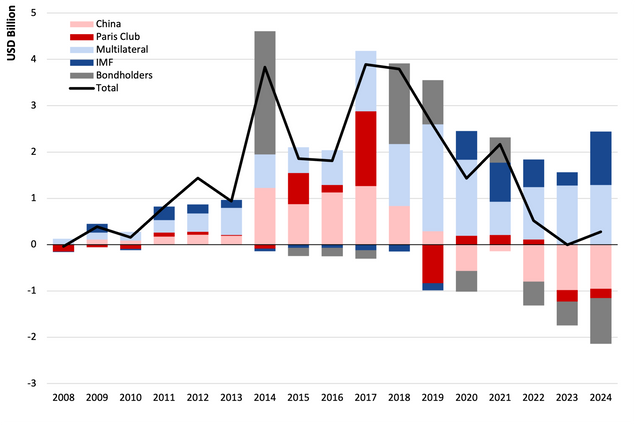
Beyond rising borrowing costs that squeeze fiscal space, Kenya’s main debt challenge is a mismatch between loan disbursement and repayment—not the size of China’s exposure, which accounts for just 13 percent of Kenya’s external debt (Figure 2B). As Figure 2a shows, Kenya has faced net negative transfers (debt service surpasses new disbursements) since 2020 from China, since 2021 from bondholders and since 2023 from other official creditors and the Paris Club.
Figure 2: Kenya’s Public and Publicly Guaranteed (PPG) External Debt
A. Net Transfers to Kenya, by Creditor, USD Billion
B. Debt Stock, 2024, by Creditor, Share Total

As Figure 3 shows, lending to Kenya has thus far been predominantly denominated in US dollars (USD). Since 2006, China has committed more than $7.5 billion in USD-denominated loans, compared to the equivalent of approximately $2.3 billion in RMB financing. However, by extending loans in US dollars, Chinese banks price them against US benchmark interest rates, plus a spread.
Figure 3: Kenya Total Amount of Loan Commitments from China by Currency, 2006-2024, USD Billion

From Kenya’s perspective, borrowing from China in USD when interbank rates were close to zero offered a pricing advantage—at least until the Federal Reserve monetary policy in 2022. This dynamic also suited China, which had accumulated large foreign exchange reserves—mostly in US dollars—and could recycle part of them into USD-denominated overseas lending, earning higher returns compared to purchasing US Treasuries.
Figure 4 shows the interest rate differential between the US dollar—using the London Interbank Offered Rate (LIBOR) and its replacement, the Secured Overnight Financing Rate (SOFR)—and the RMB interbank market, the Shanghai Interbank Offered Rate (SHIBOR). In 2022, this differential inverted, with US dollar rates exceeding those of RMB. Abstracting from exchange rate risks, this shift changed the relative cost of borrowing across currencies, making USD borrowing more expensive relative to RMB borrowing.
Currently, the SHIBOR stands at about 1.6 percent—just above IDA rates. This creates incentives for borrowers to consider RMB-denominated financing, as switching claims into RMB could lower nominal interest costs. As countries diversify away from the US dollar toward lower-cost alternatives, lower RMB rates may also support China’s strategy of advancing RMB internationalization.
Figure 4: USD and RMB Interbank Market Interest Rates—6‑month LIBOR/SOFR/SHIBOR, 2007–2026

China: Beyond Debt Reprofiling
Strengthening Kenya’s external debt position requires more than taking advantage of favorable RMB conditions to reprofile existing debt. Kenya and China should also deepen cooperation in ways that support long-term growth and stability. This includes expanding lending—potentially in RMB where pricing is favorable—for Kenya’s national energy and development priorities, expanding opportunities for FDI in sectors that increase domestic productive capacity and boosting Kenya’s exports to China.
Chinese lending has been associated with economic growth in recipient countries. By helping to close infrastructure gaps and reduce trade costs, it has also been linked to greater participation in global value chains. Reinvigorating this financing—more closely aligned with Kenya’s development priorities—could support growth, expand exports and strengthen the country’s capacity to service its debt. The focus, therefore, should extend beyond restructuring existing liabilities to channeling future financing toward projects that reinforce Kenya’s economic foundations.
Beyond that, Chinese FDI in Kenya could also be a driver of economic development. China has become a major FDI partner for Kenya, rising from $30 million in 2003 to $1.91 billion in 2024 (Figure 5A). China now accounts for about 12 percent of Kenya’s total FDI stock (Figure 5B), ranking behind South Africa (29 percent), Mauritius (21 percent) and the Netherlands (13 percent).
Figure 5: China’s FDI in Kenya
A. China’s Outward FDI to Kenya, Stock, 2003-2024, USD Billion

B. Kenya’s Inward FDI by Source Country, 2023

According to our analysis based on data from fDi markets ,Chinese FDI commitments in Kenya are heavily skewed toward construction and services rather than manufacturing. Accumulated data between and 2024 shows that housing and construction account for about $2.2 billion (67 percent), followed by hospitality and tourism at $500 million (15 percent), while manufacturing totals $172 million (5 percent) and energy only $24 million (3 percent) (Figure 6). FDI in the construction sectors can help countries produce more value-added goods, by creating domestic linkages in intermediate industries. Construction activities that increase connectivity further contribute to economic transformation.
With government incentives from both sides, Chinese FDI could increase in manufacturing sectors with domestic linkages. Sector choice matters because foreign investment boosts growth mainly when it transfers technology and skills—and when local firms can absorb and spread that knowledge beyond the foreign company.
Figure 6: Sectoral Distribution of Chinese FDI Commitments to Kenya, USD Million, 2003 – 2024

Evidence shows Chinese FDI’s nascent presence in light manufacturing such as ceramics, batteries and tissue, alongside ventures in automotive and machinery assembly and agribusiness. Nevertheless, a more complex industry through FDI machinery and automotives has yet to emerge, which could support productive capacity build-up, job creation and technology and knowledge dissemination.
Another important role for Chinese FDI would be to expand export-oriented manufacturing, strengthening domestic production and partially substituting for imports. This could help narrow Kenya’s persistent trade deficit (Figure 7), reduce external financing needs and improve the country’s capacity to service its external debt. A recent China-Kenya trade and investment deal shows movement in these directions. In January 2026, Kenya reached an early harvest arrangement with China that grants duty-free access to 98.2 percent of Kenyan exports. Furthermore, the partnership agreement lumped together a series of deals previously discussed bilaterally during Kenyan President William Ruto’s April 2025 trip to Beijing, including investment in special economic zones, steel production, smart mobility systems and the revival of hotels, alongside .
Figure 7: Kenya Total Trade Balance (Goods and Services) with China and World, USD Billion

Note: For the purpose of using the most current data, trade balance data is adapted from UN Comtrade, and service balance data is adapted from OECD Balanced Trade Statistics.
Kenya has experienced a persistent trade deficit over the past two decades. Although both imports and exports have been increasing, imports have grown at a much faster pace, further widening the deficit. In particular, China has been one of the largest contributors to Kenya’s trade imbalance. In 2024, Kenya’s trade deficit of goods stood at approximately $11.87 billion, with China accounting for $4.11 billion (35 percent of the total deficit) as the country’s largest trading partner.
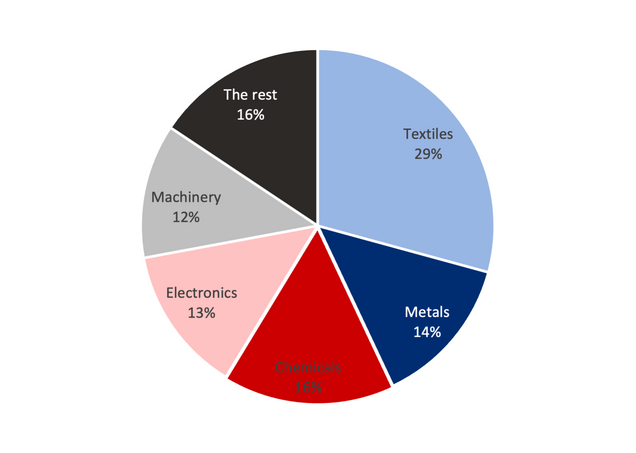
This result largely reflects the trade pattern between the two countries. As Figure 8B shows, mineral products make up 54 percent of Kenya’s exports to China, followed by agricultural goods at 34 percent. In contrast, Kenya’s imports from China are dominated by manufactured goods—textiles (29 percent), metals (16 percent), chemicals (16 percent) and electronics (13 percent). While these imports support consumption and provide inputs for domestic production, a trade structure centered on exporting lower-value goods—which are also subject to price fluctuation—and importing higher-value goods can, over time, strain the balance of payments.
Figure 8: Kenya’s Trade Bundle with China, by Sector, 2023
A. Kenya’s Gross Imports from China
B. Kenya’s Gross Exports to China

To begin shifting this pattern, Kenya would benefit from preferential access to the Chinese market—particularly in higher value-added sectors beyond its current concentration in minerals and agriculture. Although there is no free trade agreement between the two countries, the June 2025 Changsha Declaration signaled China’s intention to eliminate tariffs for 53 African beginning May 2026. This is an important first step. To translate it into meaningful gains, however, it should be paired with an active industrial policy in Kenya aimed at expanding and upgrading its export base.
Conclusion: From Refinancing to Development Strategy
China’s decision to take advantage of lower domestic interest rates to reprofile Kenya’s debt is a welcome and pragmatic step. By extending maturities and shifting into lower-cost RMB financing, China has provided Kenya with much-needed breathing space. There are risks—most notably that future RMB appreciation could offset some of the nominal interest savings. However, deeper trade and investment ties denominated in RMB could serve as a natural hedge.
Improving Kenya’s long-term capacity to service external debt, however, requires more than refinancing. It depends on strengthening the balance of payments and reducing the current account deficit. That, in turn, will require upgrading Kenya’s export basket—moving into higher value-added goods—and pursuing an active industrial policy supported by strategic cooperation with China.
Current global trade tensions add urgency to this agenda. As China redirects exports toward other emerging and developing economies, including in Africa, existing trade deficits could widen. A more sustainable approach would combine greater market access for African exports to China with targeted policies that support productive transformation in partner countries.
FDI can also play a central role—particularly if it expands into manufacturing and other sectors that build domestic capabilities, create jobs and support export growth.
Rebalancing China’s economic relationships with emerging and developing economies would be mutually beneficial. Stronger partner economies are better able to service their debts, while also offering expanded trade, investment and geopolitical cooperation opportunities. At a time when many advanced economies are looking inward, this moment presents an opportunity to deepen South–South cooperation in ways that support long-term development and financial sustainability.
Rosa He is a research assistant at the Boston University Global Development Policy Center.
*
阅读中文博客