
The COM Writing Center is happy to provide a series of Quick Guides — below and for download —that cover grammar and usage, using style guides, writing in different communications genres, and more.
Structure
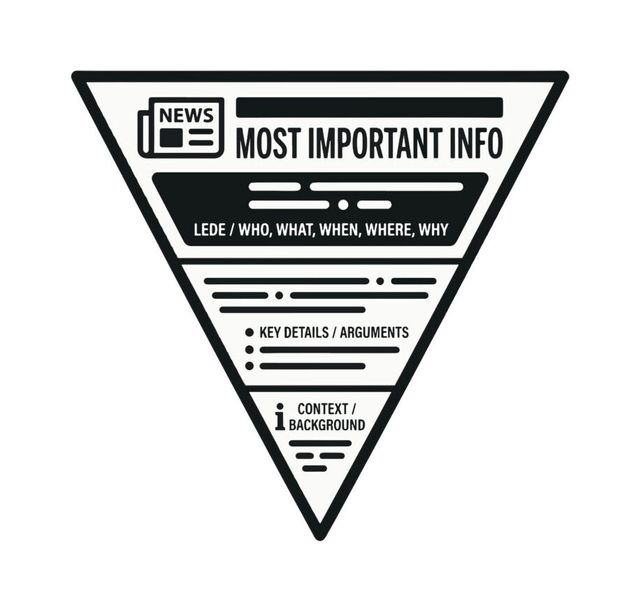
Use the Inverted Pyramid Method
Leads
Elements of a news lead (also called a “lede”):
- Five “W”s and one “H”: Who, what, when, where, why, how?
- Crucial for any news article, especially in a time where people get information from social media, print, broadcast, and online sources.
- Formulate your lead with a subject-verb-object order.
Examples:
A. New Hampshire Governor Kelly Ayotte said Friday she vetoed a bill regarding nuclear power because she has questions about its impact, but she plans to involve herself in final negotiations over a similar measure as New Hampshire’s 2026 legislative session draws to a close.
The Boston Globe, May 26, 2026, “N.H. Governor Ayotte blocks one nuclear power bill, will work with legislators on another”
B. The Supreme Court on Tuesday struck down the Trump administration’s executive order limiting the right to automatic citizenship for babies born in the United States.
The New York Times, June 30, 2026, “Justices Reject Trump’s Effort to End Birthright Citizenship”
Nut Graphs
The Nut Graph, also known as the “nut graf.”
- What does the reader need to know to understand the story?
- This graph is the necessary context of the story. Whatever questions you did not answer in the lead should be answered here.
Examples:
A. Ayotte, a Republican, said the language she vetoed also appears to be attached to legislation pending before a committee of conference — which is what the New Hampshire House and Senate form when trying to reconcile their differences after passing competing versions of a proposal — so she’ll work with the committee to pursue “an outcome that is protective of ratepayers.”
The Boston Globe, May 26, 2026, “N.H. Governor Ayotte blocks one nuclear power bill, will work with legislators on another”
B. Tyler Halley, 21, of Lawrence has been charged with murder and is expected to be arraigned in Lawrence District Court, prosecutors said in a release.
The Boston Globe, May 25, 2026, “Lawrence man to be arraigned for allegedly killing woman over the weekend.”
Supporting Information
What facts, studies, quotes, etc. will help shape the story but are not needed in the lead or nut graph?
- Gather this information, then put each piece in its own graph. It’s okay if there are some one-sentence graphs, as long as they are well structured.
- Elements you may search for: Defining terms, referencing past events, answering in details of why it’s newsworthy.
Quotes and attribution:
- Whenever you quote someone directly, indirectly or partially, you need to attribute the statement.
- Examples:
- Paraphrase: Jeb Jones, a resident of the trailer park, said the sound of the tornado was terrifying.
- Direct quote: “It sounded like a giant locomotive train coming through. I’ve never heard anything like it,” said Jeb Jones, who lives in the trailer park.
- Data reference: According to a 2017 study, 1 in 5 Americans hate coffee.
How to End
- Stop when the information stops. Journalistic writing does not need a conclusion or a “wrapping up” graph.
- Don’t repeat information. When in doubt, kicker quotes are a great way to end a story.
- You can also use a call to action: if you’re writing about a movie production, note when the movie is scheduled to premiere.
- If you’re writing about a coffee shop that holds pop-up events for students, make note of the next pop-up event.
Kicker quotes:
- The most common type of ending. Look for a quote that sums up the mood or main idea of the story.
- When you end with a quote, make sure attribution is included in the beginning of the kicker, because you don’t want readers to remember “he said” as the last words in the article. Example: “And that’s why I think Dunkin is the best place to buy coffee,” said Mr. Jones. “There’s no other coffee shop that provides quality drinks for cheap.”
Future-Action kickers:
- When you want to end the story with a “next step” in the development of an issue, this technique would work.
- It can be in the form of a statement or a quote.
There are three questions you should consider when writing a press release:
- What exactly are you announcing?
- Why is the announcement newsworthy?
- Who is your target audience? (Press, shareholders, legal, etc.)
Here’s a good example of a recent press release: Spirit Airlines announces it will close and cancel all flights following the company’s bankruptcy. No matter what you are writing about, keep in mind these basic principles:
- Remember your objective – The purpose of a press release is to get media coverage for your company.
- Keep the language simple — Sentence structure and paragraphs should be short and concise.
- Tailor your writing to your audience – You want to make it easy for a member of the media or shareholder to remember your main message.
Use the headline and subheadline as attention-grabbers. They should be short, informative and relevant.
Many press releases use direct quotes from members of the stakeholder company. “Half of news stories begin with material from press releases. This makes them a very useful tool for PR practitioners,” said Professor Y.
While press release formatting varies by company, short paragraphs and boilerplate are industry standards. A boilerplate is an informational paragraph attached to the bottom of nearly every press release that a company sends out. It is a summary of what the company or organization is/does, along with contact information; any member of the press who has more questions can easily contact the business directly to follow up.
MEDIA CONTACT: Name, title
Phone:
Email:
From advertising to journalism to film, chances are if you’re taking a class in COM, you’ll need to conduct interviews. Strong interviewing involves research and follow up; it’s a useful skill that takes practice. It’s OK to be nervous — but don’t be unprepared.
Choosing Good Interviewees
- Look up information about whom you want to interview (profession, background, publications, etc.). LinkedIn, faculty profiles, reliable websites, and public information are good places to start.
- Conduct research on your interviewee. You’re responsible for not only finding the interviewee but formulating solid questions.
- Have a backup plan. If the person does not want to be interviewed or is not available, is there someone else you can contact?
Setting Up the Interview
- Reach out to the person you want to interview. Reach out early!
- Send an email.
- Follow up in a few days with a phone call.
- Contacting via social media messaging is also an option.
- Avoid texting until you’ve established initial contact with the person.
- When setting a day/time, respect the interviewee’s schedule. Don’t start by telling the person your deadline. Choose a few time blocks to offer (Monday between 2-5 p.m. or Thursday between 10-12 a.m., or another time that works for the interviewee). “Sometime this week” is probably too broad.
- Include your contact information.
- In-person interviews are always best. If that’s not possible, phone and video call are OK.
- Never conduct an interview over email.
- If the person responds with a time, great!
- If the person doesn’t respond or says no, move on to your alternate source. Don’t continually ask someone who says no.
Before the Interview
- Conduct more research on the topic and person; take notes. The more prepared you are, the more comfortable you’ll feel and the better the interview will be.
- Start brainstorming what you want to ask the person.
- Write out a short list of bullet point questions, but not an exhaustive list. You don’t want to read questions word-for-word during the interview.
- As you research and continue to take notes, continue to ask yourself why you wanted to interview this person and what you’re hoping to gain from the interview.
Conducting the Interview
- Be early.
- Record the interview so that you can be accurate with your reporting and quotes.
- It’s illegal to record a conversation without consent, so don’t forget to tell the interviewee you’ll be recording.
- Be sure to take notes too as a backup.
- The more comfortable you and the interviewee are, the better the interview will be.
- Make friendly eye contact.
- Start by telling the interviewee why you’re interested in the topic and why you wanted to interview them.
- Warm up with simpler questions/ purely informational questions.
- Then ask the open-ended questions (why/how).
- A strong interview is more like a conversation. Avoid reading a script.
- Active listening and following up with related questions is as important as your original list of questions.
- Give the interviewee time to respond. Don’t be afraid of pauses.
- When you think you’re finished, ask “What did I not ask you that I should have?” or “What else do you want to add or talk about?”
After the Interview
- Send a short thank you message. Almost all interviewees are volunteering their time.
- Go over your recording, transcript, any footage,and notes.
- If you have follow-up questions, don’t hesitate to ask them.
Sample interview request email:
Dear Professor Becker,
My name is Sicheng Che, and I am a journalism major at the Boston University College of Communication. I am currently working on a feature story about technology in the classroom.
My story focuses on the changing nature of college writing assignments with the rise of generative AI. I’m interested in this topic as a student and a journalist, and I’m really curious about the perspective of COM faculty and staff.
Since you’re the COM Writing Center Director and also a faculty member teaching writing courses, I thought you’d be a good person to interview. I would like to schedule an interview with you as your schedule allows. Does this Friday sometime between 12-4 p.m. or next Monday between 4-6 p.m. work for you? If not, please feel free to suggest a day/time. Ideally I would like to conduct the interview in person and I am happy to come to your office.
I look forward to hearing back from you and hopefully meeting in person soon. I really appreciate your time.
Thank you.
All the best,
Sicheng Che
617-555-5555
Writing an academic Film Analysis requires careful attention to the formal elements and cultural significance of the medium. An ideal scene or film analysis will identify the formal elements of the medium and then synthesize how these elements function within the given text. Identification of various formal components alone will not suffice–a scene or film analysis must also state an argument about the text’s themes, narrative, or cultural meaning.
First Steps for a Film/TV Analysis
First Watch:
- Take shorthand notes while watching or immediately after.
- Focus specifically on themes or questions explored by the text and note any scenes or sequences that speak to these themes. Pay close attention to how formal techniques are utilized.
Brainstorming:
- Rewatch the scene or film after choosing a central theme or topic to write about.
- Identify your evidence–particular stylistic elements–and consider how you will utilize them to explore a text’s meaning or cultural significance
- Synthesize your observations and evidence to formulate a defensible argument. If necessary, explore external sources to supplement your argument.
Types of Film/TV Analysis
Consider what type of analysis you are being asked to write, and synthesize your ideas, notes, and thesis statement accordingly. Analyzing audiovisual media frequently requires an understanding of how a text’s formal elements create cultural meaning, necessitating a combination of the two modes detailed below.
Formal Analysis
This type of analysis directly examines the formal components of a text and how they are arranged to produce meaning. These analyses are focused on dissecting how the meaning of a text is conveyed by a complex synthesis of stylistic elements. Often, such analyses attend to a singular scene or sequence that functions as a microcosm of the text’s themes, narrative, or cultural meaning.
Cultural Analysis
This type of analysis examines a text’s relationship to its broader cultural context. Expanding upon analysis of a text’s formal elements, cultural analysis addresses the text’s engagement with its specific sociohistorical context. Such analyses interweave theoretical approaches to media analysis–such as Marxism, feminism, queer theory, etc.–to elucidate a text’s complex relationship to the circumstances of its production. Cultural analysis is particularly relevant to TV analyses.
Often, formal analysis provides the basis for effective cultural analysis.
Crafting Your Thesis Statement
A strong thesis statement for a film or TV analysis generally:
Makes a Claim: A thesis statement must posit a perspective, going beyond merely making an observation. A claim should inspire other points of view and thus, be arguable.
Determines the Argument’s Scope: A thesis statement should prepare the reader for the paper’s evidence, ideas, and thematic scope. Accordingly, every paragraph should connect back to the thesis.
Provides a Structure for the Argument: A thesis statement should signal to the reader how the argument will be presented.
Example: I Love Boosters (2026) uses a surrealist aesthetic to critique capitalist labor relations as demonstrated by (Point A), (Point B), and (Point C).
In this case, the author presents a thesis that engages with competing claims and prompts the reader to expect three crucial points to be addressed.
Basic Rules
When writing about film or television texts, remember to:
- Use the present tense;
- Italicize titles of films and TV series (e.g. Sinners, One Battle After Another, The Pitt, etc.);
- Enclose titles of individual TV episodes in quotation marks;
- When introducing a film or TV series, indicate the year of release;
- Refrain from making value judgements/using evaluative language;
- Describe your evidence/object of your analysis thoroughly (but not excessively).
AP Style refers to the “Associated Press Stylebook” and contains rules governing journalism and other communications-related areas. It is updated frequently, with changes often announced on social media and the main website. Did you notice that “Associated Press Stylebook” is in quotes above? That’s AP Style.
Numbers
- Spell out numbers one through nine; for 10 and up, use numerals. Example: The two fire engines circled the block 20 times.
- Spell out numbers that start a sentence. Example: Four protestors sat on the steps.
Abbreviations
United States
- When used a noun, United States. Example: The prime minister left for the United States yesterday.
- Spell out the names of the states in text when they appear alone.
- Abbreviate when they appear in conjunction with the name of a city, town, village or military base. Example: Needham, Mass., Oxnard Air Force Base, Calif.
- Do not abbreviate Alaska, Hawaii, Idaho, Iowa, Maine, Ohio, Texas and Utah (states that are five letters or fewer plus the two that are not part of the contiguous United States).
Academic Degrees
- Use an apostrophe in bachelor’s degree, master’s degree, etc. Notice that these are not capitalized.
- There is no apostrophe in Bachelor of Arts or Master of Science.
- Use abbreviations such as B.A., M.A. and Ph.D. only when the need to identify many by degree on first reference would make the preferred method cumbersome; use abbreviations only after full names and set abbreviations off with commas. Example: Samuel Cotton, Ph.D., lectured yesterday on bioethics.
Dates and Times
Dates
- Use numerals with dates, without any suffixes such as th. Example: February 4, not February 4th.
- When a month is used with a specific date, abbreviate months with more than five letters. Example: Oct. 3 was the day of her birthday. The public beach opens on May 30.
- When a phrase lists only a month and year, do not separate the month and the year with commas. Example: February 1980 was his best month.
- When a phrase refers to a month, day and year, set off the year with commas. Example: Aug. 20, 1964, started like many others.
Time
- Use numerals.
- Use a colon to separate hours from minutes. Include a.m. or p.m. with periods, no spacing between. Example: Every day I get out of bed at precisely 6:57 a.m.
Punctuation
Apostrophe (‘)
- For plural nouns ending ins, add only an apostrophe. the girls’ toys, states’ rights
- For proper nouns ending ins, add only an apostrophe. Example: James’ new job
- For singular common nouns ending ins, add ‘s. Examples: the hostess’s invitation, the witness’s answer
Colon(:)
- Capitalize the first word after a colon only if it is a proper noun or the start of a complete sentence.
- Colons go outside quotation marks unless they are part of the quoted material.
Comma(,)
- AP Style does not use the Oxford comma, so do not put a comma before the conjunction in a simple series.
- Use a comma to set off a person’s hometown and age. Examples: Kira Opanyu, Framingham, was arrested yesterday. Marco Beckwith, 34, was a finalist for Boston’s Best Chef.
Hyphen(-)
- Use a hyphen for compound adjectives before a noun. Example: well-known actor, full-time job, 20-year tenure
Dash(-)
- AP Style uses the em dash(—) but not the en dash(–). Put a space on either side of the em dash. Example: Fernandes offered a plan — it was unprecedented — to raise revenues.
- Use an em dash for an abrupt break between two independent clauses. Example: It’s time to state the truth about Methuen — the city is broke.
Parentheses ()
- AP Style advises avoiding the use of parentheses.
Titles
- Use quotation marks around the titles of books, computer games, movies, operas, plays, poems, songs, television programs, lectures, speeches and works of art. Example: Chris is reading “The Alchemist.”
- Newspaper and magazine titles do not use quotation marks. Example: Dianara is looking forward to reading the Sunday New York Times.
- AP Style does not use any italics.
Places
- Lowercase compass directions. Example: The warm front is moving east.
- Capitalize names of U.S. regions. Example: The Northeast depends on the Midwest for its food supply.
Racial, ethnic and cultural groups
- The term Black when referring to race or cultural group is capitalized.
- The term white when referring to race or cultural group is lowercase.
- The terms Asian and American Indian are capitalized.
Like Modern Language Association (MLA) Style, Chicago Style is commonly used for academic writing in the humanities. For COM courses, you may be asked to choose between Chicago and MLA style for an analysis or research paper.
Systems
Chicago-style source citations can take one of two forms:
- Notes & bibliography: Sources are cited as numbered footnotes (at the bottom of each page) or endnotes (at the end of the paper). Usually, sources are listed alphabetically in a bibliography that follows the paper. Humanities scholars tend to use this method.
- Author-date: Sources are cited parenthetically in-text with the author’s last name and the year of publication. Sources are listed alphabetically in a reference list that follows the paper.
In-text Citations
For Notes & Bibliography
Standard in-text citations for notes & bibliography system:
Insert a superscript number indicating a footnote or endnote after quoting or paraphrasing source information. Cite your source in the correspondingly numbered space at the end of the page or document.
If a source has already been cited, either in the footnotes or endnotes or in the bibliography, the source can be shortened.
- For example: Journal article
Footnote/Endnote
¹Blaine Allan, “Musical Cinema, Music Video, Music Television,” Film Quarterly 43, no. 3 (1990): 2-14, https://www.jstor.org/stable/1212631.
Shortened
²Allan, “Musical Cinema,” 6. - Chicago recommends using the shortened form rather than “Ibid” or “Idem” when citing the same source and page multiple times consecutively.
Avoid overlong footnotes or endnotes
For Author-Date:
Standard in-text citations for author-date system:
After quoting or paraphrasing source information, enclose the author’s last name, the year of publication, and the page number (if necessary) in parentheses. Author-date citations generally precede punctuation marks.
- For example: Book Chapter
Singin’ in the Rain allegorizes an American cultural anxiety “about stolen talent unrestored” (Clover 2002, 159).
If the author’s name is used earlier in the sentence, it is not necessary to repeat it in the citation. Include only the year and page number. - For example: Book Chapter
Clover argues that “Singin’ in the Rain’s morality tale of stolen talent is driven by a nervousness about just the opposite” (2002, 159).
Bibliography or Reference List
Basic Formatting:
- Start on a new page at the end of the work. If you are using the notes & bibliography system, center “Bibliography” at the top of the page. For author-date, center either “References” or “Works Cited.”
- Use the hanging indentation for all entries.
- Organize alphabetically by author last name.
If full details are given in the notes (i.e. the first time you cite each source, you include all publication information in the footnotes or endnotes), a bibliography is not required. However, a full bibliography can be helpful in clarifying sources used and in indicating the scope of your research.
Reference List:
Unlike a bibliography, a reference list is required. The primary structural difference between a bibliography and a reference list is the placement of the year of publication. In a reference list, it immediately follows the author’s last name.
- For example: Book
Bibliography
Monaco, Paul. Cinema & Society: France and Germany During the Twenties. Elsevier Scientific Publishing Co., Inc., 1976.
Reference List
Monaco, Paul. 1976. Cinema & Society: France and Germany During the Twenties. Elsevier Scientific Publishing Co., Inc.
General Guidelines for Both Systems
In-Text
- For sources with more than one author, use the name of the first author followed by “et al.”
Bibliography & Reference List
- If the author, editor, or translator is not available, begin your entry with the title.
- Nouns (“editor,” “translator,” etc.) are shortened (“ed.”, “trans.”). Verbs (“edited by,” “translated by”) are spelled out.
- For a source with more than one author, only the first author’s name is inverted.
- If you are accessing the book, book chapter online, or news/magazine article online, include either the URL or database in your bibliography or reference list entry.
- If citing a journal article, the page number is cited in text whereas the page range is included in the bibliography or reference list entry. If you access the journal article online, include the URL (one based on a DOI) in your citation.
Further questions? Ask a tutor or visit https://www.chicagomanualofstyle.org/home.html for more information!
Modern Language Association (MLA) Style is commonly used for academic writing in the humanities. For a COM course, you may be asked to use MLA Style for an analysis or research paper.
- Standard In-Text Citations for Quotes
- Use the author-page method of citation. For example: (Barthes 111).
- The author’s name can appear in or outside of the parentheses, but the page number should always be in the parentheses.
- If the source does not use page numbers (poetry is one instance of this), use the labeling or numbering system the source uses. This could include lines, chapters, or scenes, amongst others. For example: (lines 5-6).
- Author Attributions
- No author
- Use a shortened title of the work instead of an author name. Put quotation marks around the title if it’s a short work. Italicize the title if it’s the title of a longer work.
- Shorten the title to a noun phrase if possible. If not possible, cut the title after the first clause, phrase, or punctuation. For example: an article titled “The Impact of AI on Writing Centers” is cited as “Impact of AI” in the parenthetical citation.
- Still provide page numbers if available.
- Authors with the same last name
- Provide both authors’ first initials. If the authors both share initials as well, provide the authors’ full name.
- Multiple authors
- For a source with two authors, list both authors in the parenthetical citation, followed by the page number. For example: (Hasebrink and Hepp 363).
- For a source with three or more authors, list the first author’s last name followed by et al., and then the page number(s) if available.
- Multiple works by the same author
- Include a shortened title in quotes in the parenthetical citation. Use italics for books and quotation marks for articles. For example: (“Visual Studies” 63) or (Write to Learn 6).
- If the author’s name is not included in the sentence, include it in the parenthetical citation. For example: (Elkins, “Visual Studies” 63).
- No author
In-Text Citations
Works Cited
- Basic Formatting
- Start the works cited on a new page. Center the words “Works Cited” at the top of the page. Do not italicize them or put them in quotation marks.
- Use a hanging indent for all citation entries.
- Double space all citations.
- Author names are written with the last name first, then the first name, and then the middle name or middle initial when needed. When there is more than one author, use last name, first name format except for the final author, for whom you will use first name, last name format.
- Spell out months in the body of your paper but abbreviate them in your works cited list.
- Books
- Last Name, First Name. Title of Book. City of Publication, Edition (if relevant) Publisher, Publication Date.
- The City of Publication should only be used if the book was published before 1900, if the publisher has offices in more than one country, or if the publisher is unknown in North America.
- For example: Campbell, Joseph. The Hero with a Thousand Faces (The Collected Works of Joseph Campbell). 2nd ed., New World Library, 28 July 2008.
- Academic Journal Articles
- Author(s). “Title of Article.” Title of Journal, Volume, Issue, Year, pages.
- For example: Thorson, Kjerstin and Chris Wells. “Curated Flows: A Framework for Mapping Media Exposure in the Digital Age.” Communication Theory, vol. 26, no. 3, 2016, pp. 309-328.
- Web Sources
- An Entire Website
- Editor, author, or compiler name (if available). Name of Site. Version number, Name of institution/organization affiliated with the site (sponsor or publisher), date of resource creation (if available), URL, DOI or permalink. Date of access (if applicable).
- For example: Boston University College of Communication. Boston University, https://www.bu.edu/com/. 23 Jun. 2026.
- A Page on a Website
- Author (if available). “Name of Webpage.” Name of Site, Sponsor or Organization Publishing the Site (if available), Date of publication or last update (if available), URL (or DOI or permalink). Date of access (optional but recommended).
- For example: “The COM Writing Center.” Boston University College of Communication, Boston University, https://www.bu.edu/com/for-current-students/the-com-writing-center/. 23 Jun. 2026.
- An Entire Website
- Films or Movies
- Title of Film. Director, Film Studio or Distributor, Release Year.
- If relevant, list performer names after the director’s name.
- For example: Speed Racer. Directed by Lana Wachowski and Lilly Wachowski, performances by Emile Hirsch, Nicholas Elia, Susan Sarandon, Ariel Winter, and John Goodman, Warner Brothers, 2008.
- Television Shows
- Entire show
- Name(s) of Series Creators. Title of Series. TV Studio or Distributor, Year(s) of the series.
- If you want to emphasize a particular aspect of the show, include that relevant information. For example, if you want to emphasize a specific character, include the name of the performer in the citation.
- For example: Poehler, Amy, performer. Parks and Recreation. Deedle-Dee Productions and Universal Media Studios, 2009-2015.
- One episode
- “Title of Episode.” Name of Show, season number, episode number, Show Studio or Distributor, Release date. Name of Database or Streaming Platform, URL.
- If you want to emphasize a particular aspect of the show, include that relevant information. For example, if you want to emphasize the performance of the two main leads of a show, include the performer information in the citation.
- For example: “Sorry Baby.” Killing Eve, performances by Sandra Oh and Jodie Comer, season 1, episode 4, BBC America, 29 Apr. 2018. Amazon Prime, https://www.amazon.com/dp/B07C2QGSFZ.
- Entire show
American Psychological Association (APA) Style is primarily used for academic writing in the social sciences. In communications writing, you will generally use APA for research reports and literature reviews.
Punctuation Highlights
- Like MLA and Chicago, APA Style includes the use of the serial comma (for example: surveys, interviews, and observation).
- Like MLA and Chicago, APA Style uses both em (—) and en (–) dashes, without spaces on either side.
In-Text Citations
Standard In-Text Citations for Quotes
- Use the author-date method of citation. For example: (Jones, 1996).
- When quoting directly from the source, add the page number. This looks like, for example, (Jones, 1996, p. 258). Use an en dash and “pp.” instead of “p.” for page ranges. For example: (Jones, 1996, pp. 258–260).
- You can introduce the quotation with a signal phrase that includes the author’s last name followed by the date of publication in parentheses.
- A direct quotation 40 words or longer should be started on a new line, indented 0.5 inch from the left margins, and should not include quotation marks. It should still be double-spaced. The parenthetical citation should follow the ending punctuation mark, not precede it.
Paraphrasing
- If you are only referencing an idea from another source but not directly quoting it, you only need to include the author and date. Do not include the page number.
Author Attributions
- Two authors: Use the word “and” when referring to the two authors in the body text (for example: Wagner and Petty) and the ampersand when writing the parenthetical citation (for example: Wagner & Petty).
- Three or more authors: List the first author’s name and “et al.” in the parenthetical citation. For example: (Rivera et al., 2026).
- Authors with the same last name: Use the first initial of each author’s first name in addition to the last name. For example: (E. Johnson, 2001; L. Johnson, 2008).
- No author: Use the first word or two of the title in the parenthetical citation.
- Two or more works by the same author in the same year: Use lowercase letters (a, b, c) with the year to order the entries in the reference list. Use the lowercase letters with the year in the in-text citation. For example: (Rivera, 2026a) and (Rivera, 2026b).
Unknown Author, Unknown Date
- Use the first word or two of the source title followed by “n.d.” in the parenthetical citation. For example: (“Tutoring and APA,” n.d.)
References
Basic Formatting
- The reference list goes at the end of the paper. Start a new page and label it with the word “References” bolded and centered (without quotation marks). All text is double spaced.
- The author’s last name is written first, followed by the first initials of their first and middle names. If there is no middle name available, just use the first initial of the first name. For example: “Smith, J. M.” or “Smith, J.”
- Write the last name and first and middle initial of all author names up to 20 authors. If there are 21 or more authors, use an ellipsis after the 19th author, and then add the final author’s name.
- Reference list entries should be alphabetized by the last name of the first author.
Academic Journal Articles
Author last name, first initial. (Year). Article title. Journal Title, volume(issue), page numbers or article number. DOI or URL
Website Articles
Author last name, first initial. (Date). Title of page. Host site. URL
Other Basic Formatting Notes
- When referring to the titles of books, chapters, articles, reports, webpages, or other sources, capitalize only the first letter of the first word of the title and subtitle, the first word after a colon or a dash in the title, and proper nouns.
- Italicize titles of longer works (e.g., books, edited collections, names of newspapers, and so on).
- Do not italicize, underline, or put quotes around the titles of shorter works such as chapters in books or essays in edited collections.
Tables
- Tables go in the appendix. Arrange and number tables in the order they appear in the body text (Table 1, Table 2, Table 3, etc.).
- Use a short, descriptive table title. Italicize the title. Double space between the table number and title.
- Center table headings.
- Do not use vertical borders or borders around each cell. Only use borders and lines for clarity.
- Center-align entries in the table unless left-aligning them makes them easier to read.
- If a table is longer than one page, use your tables feature to make the headings row repeat on the second and any subsequent pages.
Figures
- Figures are graphical displays of information that are not tables. Common figures include graphs, drawings, maps, and photos.
- The figure title is written in italics and title case and is left aligned.
- Fonts in the figure should be sans serif and between 8-14 pt size.
- Notes describe the content of the figure. These should be double spaced and left-aligned.
- Figure legends should go within or underneath the figure, not to the side of the figure.
Dangling Modifier Error
A modifier dangles when what it is supposed to modify is missing from the sentence. An opening phrase or clause dangles from the rest of the sentence due to the missing modifier.
Incorrect
- Looking out the window at the Blandford Street stop, the COM lawn was buzzing with students.
“Looking out the window at the Blandford Street stop” is the modifier in this sentence. It cannot modify the COM lawn, however, because the COM lawn cannot look out the window. - After finishing the readings, a new Netflix show was watched.
“After finishing the readings” is also a modifier. The only word this could possibly modify is “Netflix.” However, Netflix cannot do readings!
Correct
Adding the correct pronoun to the sentence fixes most dangling modifier errors.
- Looking out the window at the Blandford Street stop, I saw the COM lawn buzzing with students.
- After finishing the readings, Lily watched a new Netflix show.
Misplaced Modifier Error
A misplaced modifier error modifies a different part of the sentence than the writer intended it to.
Incorrect
The professor assigns readings to her classes that are too long.
The writer intended for the readings to be modified by the phrase “too long,” but the placement of that phrase actually suggests that the classes are too long.
I wanted to take a class over the summer that was challenging because I had more time to dig into the material.
Here the writer intended for the class to be described as challenging, but the placement of the modifying phrase suggests that the summer was challenging.
Correct
Moving the modifying phrase closer to the subject it is modifying fixes these errors.
- The professor assigns readings that are too long to her classes.
- I wanted to take a class that was challenging over the summer because I had more time to dig into the material.
Interrupting yourself while writing can be tricky to navigate, but it’s sometimes necessary when making an argument or exploring multiple ideas simultaneously. Properly employing commas, parentheses, em dashes, and colons will allow you to clearly and efficiently use lists and sentence interrupters in your writing.
Lists
- When listing more than two simple items, separate them using commas.
- When listing items that are long or complex, or items with internal commas, separate them using semicolons.
- For example:
- I would like to visit London, England; Paris, France; and Rome, Italy.
- For example:
- A colon can be used to introduce a list that follows a complete sentence.
- For example:
- To make the recipe you’ll need a few basic ingredients: flour, butter, and eggs.
- For example:
- Maintain parallel structure. Parallel structure means using the same grammatical construction within the list. This shows that the items are equally significant.
- For example:
- The assignment must be done quickly, accurately, and thoroughly.
- For example:
Sentence Interrupters
An “interrupter” is a digression—often in the form of a word, phrase, or clause—that disrupts the flow of a sentence. There are many reasons to use interrupters; some of the most common are to signify tone or emphasis. Interrupters can appear throughout a sentence, but they must be properly punctuated to ensure clarity.
- Interrupters present relevant but nonessential information and are also referred to as non-restrictive clauses.
- For example:
- My brother, who is two years younger than me, is graduating from college.
- For example:
- Appositives and nouns of direct address can also be forms of interrupters.
- Appositives reaffirm the identity of the noun being discussed.
- For example:
- House of the Dragon, a popular television drama, airs on Sundays at 9 p.m.
- For example:
- Nouns of direct address invoke the person (or noun) being discussed by name.
- For example:
- Susan, what do you think?
- For example:
- Appositives reaffirm the identity of the noun being discussed.
- When a sentence starts with an interrupter, it must be followed by an independent clause, as in the example directly above. An interrupter that ends a sentence must also be separated from the independent clause by a comma.
- For example:
- I have a question, Yukio.
- When the interruptor is itself an independent clause, use an em dash or separate into two sentences.
- For example:
- Excuse me—I have a question.
- For example:
- For example:
- When an interruption occurs midsentence, offset it using a corresponding pair of punctuation marks.
- Semicolons are used to join two independent clauses. They are not used to punctuate interruptions, but they can be used to separate items in a list when said items are long or include commas themselves.
Punctuation
The most common ways to punctuate an interrupter is using commas, parentheses, or em dashes. These punctuation marks come before and after the interrupter, setting it off from the rest of the sentence.
- Commas are used to set off interruptions without truly disrupting the flow of the sentence.
- Parentheses more distinctly set an interruption off from the rest of the sentence. Use them to separate nonessential explanatory material or when using commas would make the sentence convoluted.
- For example:
- The cast was frustrated with the director’s input (or lack thereof).
- For example:
- Em dashes are often used to deliberately and dramatically emphasize an interruption. Use them sparingly to connote special emphasis. They can also be helpful in maintaining the clarity of a sentence when the interrupter itself contains an internal comma.
- For example:
- The bakery offers a selection of three types of cookies—chocolate chip, oatmeal raisin, and sugar—along with various pastries.
- For example: