Komal Pawar (COM’21) on Cannes Lions, Art Direction and Trusting the Process
Cannes may be a resort city in the south of France, but to the media world it may be best known as the epicenter for the best creators in film and advertising.
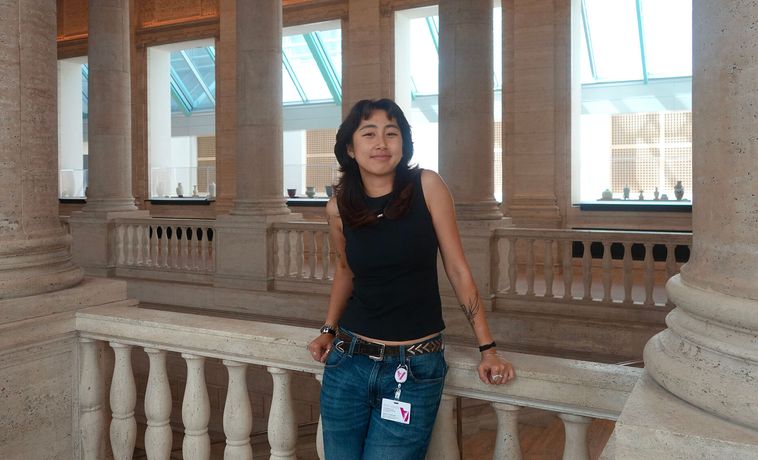
So when Komal Pawar, a 2021 graduate of COM’s master’s in advertising program, was named to the Cannes Lions “30 Under 30” creative academy, celebrations were in order.
But such recognition so early in her career was not on her mind when she earned her undergraduate degree in mass media at Jai Hind College in her hometown of Mubai, India. An exchange program sponsored by Rotary International sent her to a summer in Spain, where she took classes in branding and media design while learning Spanish.
“I had never been abroad or taken a flight and didn’t know what it meant,” Pawar recalls, “but for the young me, it gave me so much joy. I was trusting myself so much more, and it gave me the confidence that I really wanted to pursue a creative career, because I was surrounded by so much art and such amazing people.”
The experience convinced her to study abroad in pursuit of a career as a creative. Despite being told by a counselor Boston University may be too ambitious a goal, she applied and was accepted with a scholarship.
“I looked at the curriculum and at the alumni’s profiles, and I just felt drawn to it,” she says.
Today, Pawar works in New York as a senior art director for Area 23, an agency focused on the health care sector.
Q&A
With Komal Pawar
COM: What is the Cannes Lions 30 Under 30 Creative Academy?
Pawar: Cannes Lions is a big organization, and it’s very celebrated in our industry, especially if you work in advertising, marketing, PR, entertainment, ad tech and so on. It’s global, and the entire industry goes to Cannes in June. I didn’t know they had opportunities for young people. I knew there was an award show, brand activations, and sessions from highly experienced people, from the C-suite to anybody who identifies as working in the creative space. Then, three years ago, it popped up in my feed that there is something called the Cannes Lions 30 Under 30 Creative Academy.
When I heard “Cannes,” I thought, this is really big. It took me almost a year and a half to convince myself that I should apply, because it carries a lot of weight when you say Cannes. I applied the same way I applied to universities. I had to answer essay questions, and there is a video requirement about your “why,” meaning why you should be part of it. That carries a lot more significance than anything else, because you have to nail it. I also submitted my portfolio website. There’s also a requirement for character references.
You spend one week in the south of France, and it’s very intensive. There was career coaching, and a lot of behind-the-scenes wisdom is imparted to you, and at the same time they are equipping you with the skills you need. We also had sessions about AI, including a presentation from somebody from Anthropic. They customize it every year so it has the elements that are essential at that moment.
In the evenings I got to go to the award shows, see who was winning and the amazing work. The program is very intimate. It’s not recorded. It’s very hands-on, and it’s only for the 30 Under 30 cohort selected that year. It happens at the same venue as the festival but is completely separate. Nobody has access to it apart from the people in charge of the program, the speakers, and the workshop facilitators.
Of course they celebrate you, but there is so much learning. It’s highly enriching, and it opened doors to opportunities and people I never thought I would just bump into and have a chitchat with. It’s amazing. It’s one week, and you have to make the most of it, because there’s so much going on from morning till night. It gives you a lot, and it’s also about knowing why you want to go there.
COM: What are you doing now?
Pawar: Right now I work for a full-service advertising agency. I started as an intern, and I’ve been at the same company since, but at a different agency within it. In 2024 I moved internally to Area 23, where I work now. I have a lot of health and wellness clients. Right now I’m working on Johnson & Johnson.
My title right now is senior art director. It’s a highly conceptual role, and something I did not see myself doing when I joined the program. It’s been a long learning curve, because it helps me push my thinking in a visual way. It’s very important to me that I’m working on something that gives me meaning or pushes the bar, because that’s the core of who I am.
My day-to-day spans different mediums: social, digital, print, and sometimes websites with our UX team. Right now I’m working on a conference design for an event I didn’t think I would be able to work in such a creative way, especially in a space like healthcare, because it can be sensitive, given the kind of work you put out in the world. That was something I didn’t see coming.
I’m really glad I didn’t choose a specialization early on, because I would have closed myself off from other things I needed to do. From the beginning, I was very open to seeing where it would take me. I didn’t have the vision of being an art director when I started out, because I was still searching for what really resonated with me
COM: Is there anything from your time at COM that relates to what you’re doing now?
Pawar: I knew I wanted to do something in the creative industry, but I didn’t know what it was. So it was like going into the unknown, but I was very open to finding out. I remember that in my first semester, I took the design strategy and software class with Professor Joyce Walsh. It planted the seed. Then I took courses with Professor Doug Gould, and [they were} amazing, and it was these two who gave me the confidence to choose to become an art director toward the end of the program. I love writing, and I know I can write well. So it was about deciding which parts I was okay letting go of to become this.
Then there were the portfolio development and creative video development classes, the discussions within those classes, and the exposure to industry people through AdLab (COM’s student-run advertising agency). They really push you. Those classes are hard, and sometimes not easy, because you’re working on a brief, wearing different hats, and trying to think in a different way. What these classes did for me was question and push my thinking. As a professional, no matter what I’d be doing today, it was really important to keep pushing my thinking and asking the questions I was taught to ask. As creatives, our work is very subjective. It doesn’t follow a playbook or a rulebook. People want you on their team for your personality, but also for your thinking, for how you’re able to think about the work.
My role (now) is very conceptual. Designing is part of what I do, but mostly, if I can’t think or ideate in a way that is different, unique, or sounds like me, it would not do wonders for my career. So having those classes and working on those briefs and assignments really helped me.
It’s also crazy that we’re talking about this now, because I still remember bits and pieces from those classes, and the words of advice still ring in the back of my head. They’re not lost, even after five years. When I’m trying to problem-solve something, or something isn’t working, questions and words of wisdom from that time still come to me. They help me ground myself: okay, this is how I would have thought back then, or this is what this person would say. I still carry those learnings and words of wisdom to this day.
I was talking to a COM alum yesterday, and I repeated what Professor Gould would say. It just came naturally, and I thought, that’s the kind of impact professors and peers can have. You might not remember the entirety of the program, but there are nuggets that come to mind or spark your imagination. You carry those leftovers in some way or another.
COM: Is there an insight you’d like to share with current or prospective students?
Pawar: Everybody has a different goal when they apply to and get into a program, whether it’s a bachelor’s or a master’s. Staying open and trusting the process really helped me, because I did not come with a roadmap of what I wanted to do. It was more about connecting the dots. It can be fast-paced, especially for an international student, because there’s a lot you’re dealing with apart from the degree program. There is a different culture, and there’s a lot to get accustomed to. So have belief and faith in where it will take you. There were people in my program who had an end goal. I did not. I was very open and receptive to whatever the journey would unfold for me.