Alumni
Distinguished Alum Jerry Anderson Honored in Rome
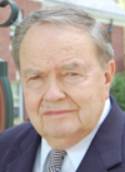 Gerald (Jerry) Anderson (STH’55, GRS’60) met Pope Francis, gave a lecture and received an honorary Doctor of Missiology degree from the Pontifical Urbaniana University in Rome on November 14. The degree was presented to him by Cardinal Fernando Filoni, the Chancellor of the university. It was the first time an honorary degree has been given to a Protestant by this university that was founded in 1627 and is owned by the Sacred Congregation for the Evangelization of Peoples. Dr. Anderson, a former UM missionary in the Philippines and president of Scarritt College in Nashville, is emeritus director of the Overseas Ministries Study Center in New Haven, CT, and resides in Hamden, CT.
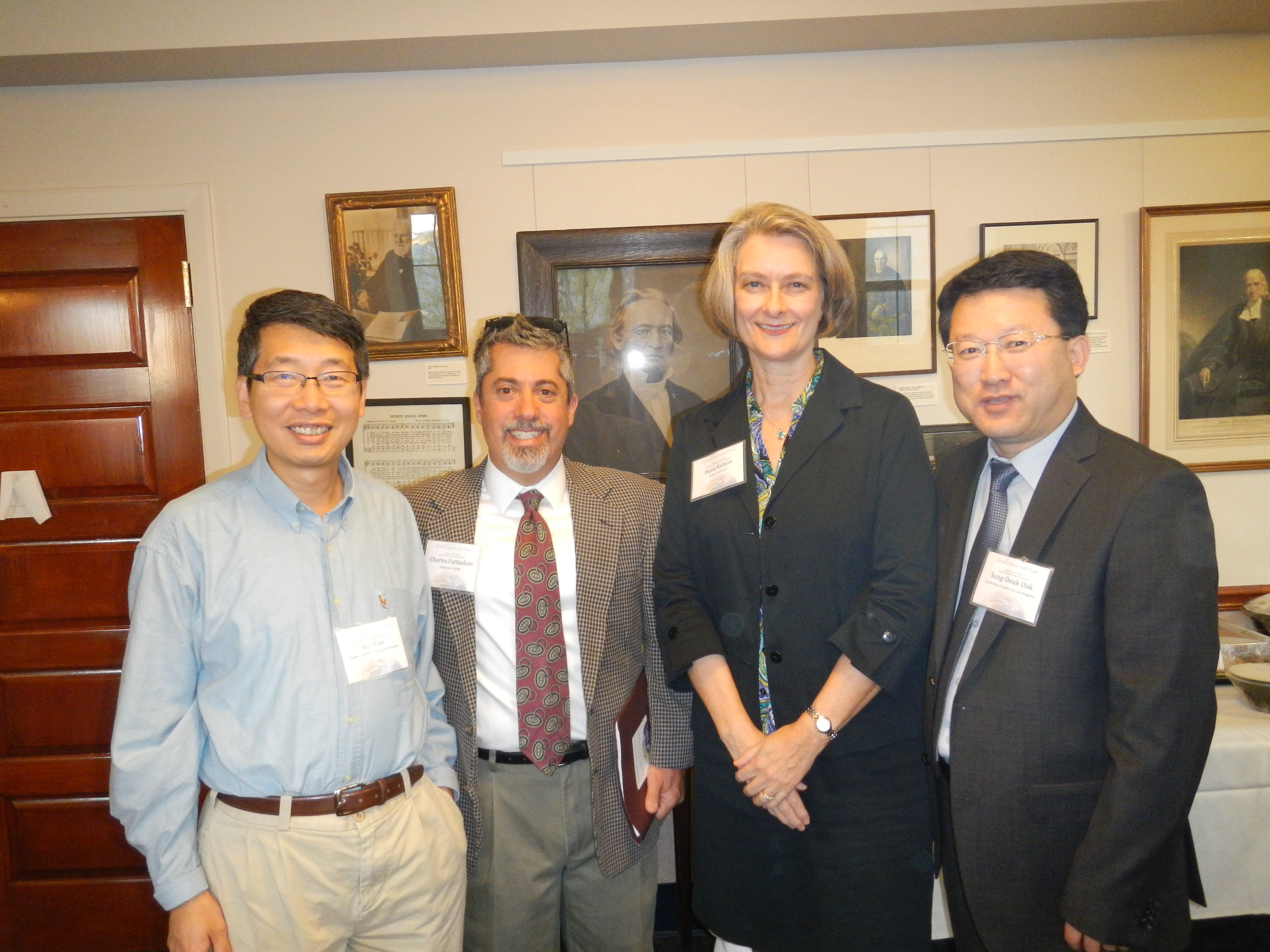
Dana Robert and BU Alums at the WCF
Three of Dana Robert's former students attended the World Christianity Forum last week and got together for a photograph with her before departing. From the left are Xiyi Yao, Charles Farhadian, Dana Robert, and Sung Deuk Oak.
Alumna Anneke Stasson Presents at Missio Nexus North American Mission Leaders Conference
Anneke Stasson, a 2013 graduate of the Division of Religious and Theological Studies at Boston University, presented at the North American Mission Leaders Conference hosted by Missio Nexus in Dallas on September 19. She was invited as a representative of the Evangelical Missiological Society, a co-host of the conference, and her presentation was entitled, “Walter and Ingrid Trobisch and a Missiology of ‘Couple Power.’” Through her presentation, Stasson explored the way in which the Trobisches exemplified what Dana Robert has called “the missiology of the Christian home.” She unpacked the historical features of the missiology of the Christian home and examined the way in which the Trobisches departed from their missiological predecessors. Although the Christian home has traditionally been the domain of women missionaries, the Trobisches’ missiology of “couple power” blurred the boundaries between men’s work and women’s work. Both spouses spoke in public, wrote books, and, at least initially, both took care of the children. By talking about the Trobisches’ division of labor on the mission field and their work-family balance, Stasson aimed to get a conversation started about these issues in current evangelical mission. Her presentation was followed by a vigorous discussion about the gendered expectations of missionaries and mission agencies and the need to think creatively about our division of labor on the mission field.
Titus Presler reports from Pakistan
Rev. Dr. Titus Presler, Principal of Edwardes College in Peshawar, Pakistan, sent the following report yesterday after the horrendous slaughter of people attending All Saints' Church there. We at CGCM grieve for those killed and with those injured.
After church bombing Edwardes closes for 3 days and empathy abounds
In both grief and protest, the churches of Pakistan have declared three days of mourning and solidarity for the victims of today’s bomb blast at All Saints’ Church, Kohati Gate, Peshawar, in which it is reported that at least 150 people were killed and at least 200 were injured, many of them critically.
To its great credit, the government of Khyber Pakhtunkhwa, the province of which Peshawar is the capital, promptly endorsed that move and declared three days of mourning in solidarity with the Christian community and stated that what it called “missionary institutions” would be closed for the three days. To its equal credit, the Federal Government of the Islamic Republic of Pakistan soon followed suit.
The bombing’s impact on Edwardes College itself is considerable. We’re not sure how many of our students were killed at the church, but there are at least several. A number of alums were killed. Victims also included students and teachers at Edwardes College School, a feeder institution located on our campus. More information will be forthcoming over the next day or so.
Following is the letter that I sent out to all faculty and staff:
Dear Edwardes Community,
We are all shocked and grieving in the aftermath of the bombing at All Saints? Church, Kohati Gate, on this Sunday, Sept 22. The scale of the atrocity is terrible. News is still coming in, but it is said that about 150 people or more were killed and 200 or more were injured. The news has gone around the world.
Information is emerging, but a number of our current students were killed as were a number of Edwardes College alumni. The same is true of Edwardes College School and, of course, other church institutions throughout the city.
The churches of Pakistan have declared that all church institutions throughout the nation will be closed for three days of mourning for the dead and in solidarity with the bereaved and with the Christian community. The Khyber Pakhtunkhwa Government has endorsed this closure.
Members of the Management Team have discussed the matter and are agreed on the College’s participation in this closure. Therefore as an institution of the Church of Pakistan, Edwardes College will be closed Monday-Wednesday, Sept 23-25. The present plan is to reopen on Thursday, Sept 26.
Let us join in reaching out to those who are mourning their lost loved ones.
May we all know the blessing of God in this troubled time.
Canon Titus
Followers of events in Pakistan will feel today’s attack on one religious minority resonating with other attacks on other minorities in Pakistan, most notably the attacks in January and February on Shia Muslims in Quetta, in Balochistan, in which about 200 people were killed. Unfortunately attacks on religious minorities are on the rise.
Being stateside at the moment, I first heard of today’s event in a text from a Muslim faculty member this morning: “Very sad news a blast in Kohati Gate church Peshawar. 30 casualties. May God put their souls in peace.” Missing the church reference, I responded: “Terrible. Tnks for letting me know. God bless the victims.”
My interlocutor responded: “Amen. I’m too very sad for my Christian brothers and sisters. It was a cruel incident. May God help us. Amen.” To which I replied: “Do you mean that Christians were the targets?” “I’m not sure,” he answered at that early hour. Now we know they most definitely were.
I was touched by his concern for the Christian community.
As I was by the following email from another faculty member:
Dear All:
It’s really matter of shame for all of us, what happened today at Church at Kohati Gate Peshawar.
Islam is peaceful religion, and in Islam there is no place for such people who create violence with anyone, regardless of their religion, at any cost. Personally all my sympathies are with those who suffered today. May Allah bless their souls and may they rest in heaven. At this crucial time we all are with the Christian community side by side, so please do not think you are alone.
Oh Allah forgive us. As we are not following the right path, forgive us.
Ameen.
Such ecumenical spirit is crucial in any place and time, but especially so in Peshawar and in Pakistan today. So I thank God for such compassion and generosity of spirit between people of different religions.
The Making of Korean Christianity
Dr. Sung-Deuk Oak, a School of Theology graduate in 2002, has recently published a new book on Korean Christianity, entitled: The Making of Korean Christianity: Protestant Encounters with Korean Religions, 1876-1915 (Baylor University Press, 2013). The book is the first volume of the Studies of World Christianity of Nagel Institute Calvin College and Baylor University Press.
More information on this exciting new publication can be found below:
Description:
A major catalyst for the growth of Korean Christianity occurred at the turn of the twentieth century when Western missionaries encountered the religious landscape of Korea. These first-generation missionaries have been framed as destroyers of Korean religion and culture. Yet, as Sung-Deuk Oak shows in The Making of Korean Christianity, existing Korean religious tradition also impacted the growth and character of evangelical Christianity. The melding of indigenous Korean religions and Christianity led to a highly localized Korean Christianity that flourished in the early modern era. The Making of Korean Christianity sorts fact from myth in this exhaustive examination of the local and global forces that shaped Christianity on the Korean Peninsula.
Table of Contents
Illustrations, Tables, Diagrams, and Maps
Preface and Acknowledgments
Abbreviations
Introduction
1 God: Search for the Korean Name for God, Hanănim
2 Saviors: Images of the Cross and Messianism
3 Spirits: Theories of Shamanism and Practice of Exorcism
4 Ancestors: Confucian and Christian Memorial Services
5 Messages: Chinese Literature and Korean Translations
6 Rituals: Revivals and Prayers
Conclusion
Appendix
Glossary
Bibliography
Index
Reviews:
"This groundbreaking study is the best book written on the development of Korean Christianity. Oak traces the early encounter between Protestant missionaries and Korean religions and moves the scholarship in new, deeper directions. The Making of Korean Christianity is required reading."
--Dana L. Robert, Truman Collins Professor of World Christianity and History of Mission, Boston University.
“The Making of Korean Christianity is the most comprehensive and significant contribution to the study of Protestant Christianity in Korea that has appeared in a generation. Oak challenges the received academic discourse on the first generation of Christians and shows how early Korean Protestants dealt with sophisticated issues in theology and religious practice to arrive at their own solutions in the process of cultural encounter. This book will be the principal source in English on this period of Korean Church history for many years."
--James H. Grayson, Emeritus Professor of Modern Korean Studies, The University of Sheffield.
"The Making of Korean Christianity is a remarkable book. Oak moves beyond the conventional stereotypical view of the early Christian missionaries in Korea and expounds a deeper understanding of dealing with the missionaries' encounter with indigenous Korean religions. I highly recommended this book not only for those who are interested in the history of Christianity in Korea but also for the scholars and students of Korean spirituality and religious traditions and inter-religious dialogue in Korea."
--Young-chan Ro, Professor and Chair, Department of Religious Studies and Director, Korean Studies Center, George Mason University.
Yale-Edinburgh Group meeting report by Daryl Ireland
 The Yale-Edinburgh Group held its 23rd meeting in New Haven, Connecticut, June 27-29, 2013. The theme, “Health, Healing, and Medicine in the History of Christian Missions and World Christianity,” inspired diverse papers, ranging from an investigation of John Wesley’s medical advice to the use of herbal medicine in Ghanaian Christianity.
The number of participants was capped at 80, so having six people from Boston University demonstrated its prominence in the field of global Christianity. Dr. Sung-Deuk Oak (Th.D, 2002), Associate Professor at UCLA considered how Christian medical missions in Korea moved, “From the Plough of Evangelism to the Fruit of Christian Love,” during the 1920s. Also looking at Asia, Daryl Ireland investigated a mission hospital in China and asked if medicine was “Christian, Secular, or yet Something Else?” Daewon Moon pointed to the “Ruanda Mission and its Contribution to the East African Revival,” while Michele Sigg explained the prominent role women have played in “Carrying Living Water” during the fifohazana revival in Madagascar. In addition, Eva Pascal introduced a new movie on Seventh-Day Adventist medical work around the world. Gina Bellofatto, a student in the joint ThD program between Boston University and Gordon-Conwell Theological Seminary also attended the conference.
Alum Profile: Casely Essamuah, Th.D. 2003
 Casely Essamuah is the Global Missions and Compassionate Outreach Pastor at the Bay Area Community Church in Annapolis, Maryland. Originally from Ghana, he is an ordained minister of the Methodist Church Ghana.
He received his Th.D. from the School of Theology at Boston University in 2003. His dissertation, “Genuinely Ghanaian: A History of the Methodist Church Ghana, 1961-2000,” examined the history of the Methodist Church in Ghana from 1961, the time of its autonomy from the British Methodist Conference, to the year of 2000, focusing on the missiological issues of contextualization. In this work, he argued that contextualization was one of the most important elements in understanding the history of the Methodist Church Ghana since Ghanaians, especially Fante people, have accepted Methodism on their own terms and have reshaped it to fit their needs. His dissertation was published in 2010 with the same title.
His current research interests include contextualization, over-contextualization, African Christianity, and reverse missions of the majority (or, non-western) world to the western world. In March 2011, he received the distinction of speaking at the Henry Center’s Scripture and Ministry Series, presenting “Missionaries and Over-Contextualization.” In this lecture, he gained wide attention by arguing that the Western churches, especially those in the U.S. are suffering from an “over-contextualizing of cultural forms.” In other words, what matters in the western world, is not the lack of contextualization but over-contextualization. With this concern, he raised a question, “How do you make the gospel understood where it is such a familiar presence as to be unremarkable?”
Essamuah’s interest is not limited to a scholarly one: as an active minister, he is also interested and actively engaged in planting immigrant churches in the U.S.
Bay Area Community Church: http://www.bayareacc.org/
by Hye Jin Lee
Alum Profile: Amos Yong, Ph.D. 1999
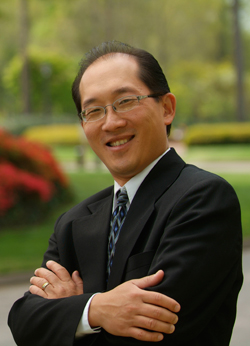
Amos Yong is one of the most prolific and active Pentecostal theologians in the academy. He was born in Malaysia, but immigrated to the U.S.A. when he was ten years old. He received an undergraduate degree from Bethany University of the Assemblies of God (1987), and master’s degrees from Western Evangelical Seminary (1993) and Portland State University (1995).
In 1999, Yong received a Ph.D. from Boston University in religion and theology under the guidance of Professor Robert Neville. His dissertation topic was “Discerning the Spirit(s): A Pentecostal-Charismatic Contribution to Christian Theology of Religions” In this in-depth work, he offered a three-fold thesis: First, he argues that the Pentecostal-Charismatic experience of the Holy Spirit instigates "Pneumatological imagination." Secondly, he claims that this imagination facilitates phenomenological, symbolic, and doctrinal comparisons across different religious traditions, allowing theological space for Christian participation in interreligious dialogue. By doing so, he encourages Pentecostals and Charismatics to engage in wider ecumenism and interreligious dialogue. However, he never forgets that the crucial task in Pneumatology should be discernment. Thus, he argues, thirdly, that norms for discerning the Holy Spirit from other spirits in the religions are intrinsic to the Penumatological categories themselves.
Yong was just appointed Dean of the School of Divinity at Regent University (Virginia Beach, VA). He formerly served as the J. Rodman Williams Professor of Theology and as the director of the divinity school's Ph.D. program. Yong is also a member of the Society for Buddhist-Christian Studies, the American Academy of Religion, the Christian Theological Research Fellowship, and the Society for Pentecostal Studies. In addition, he is working as a co-editor of PNEUMA and is co-editor of two monograph series: Pentecostal Manifestos (Eerdmans); and Studies in Religion, Theology and Disability (Baylor). He was also a president of the Society for Pentecostal Studies (2008–9) and the founding co-chair for the Pentecostal-Charismatic Movements Group for the American Academy of Religion (2006–2011).
His academic interest is not limited to global Pentecostalism and Pentecostal theology. It includes interreligious dialogue and comparative theology, theology of disability, political theology, dialogue between science and religion, and theology of love, etc.
He is an incredibly prolific writer: He published as many as 10 books in the last two years (2011 and 2012). Here is the list of those books. Spirit of Love: A Trinitarian Theology of Grace (Waco, Tex.: Baylor University Press, 2012), The Science and Theology of Godly Love (DeKalb, Ill., Northern Illinois University Press, 2012), Godly Love: Impediments and Possibilities (Lanham, Md.: Lexington Books, 2012), Pneumatology and the Christian-Buddhist Dialogue, Does the Spirit Blow through the Middle Way? Studies in Systematic Theology 11 (Leiden and Boston: Brill, 2012), The Cosmic Breath: Spirit and Nature in the Christianity-Buddhism-Science Trialogue, Philosophical Studies in Science & Religion 4 (Leiden and Boston: Brill, 2012), Pentecostalism and Prosperity: The Socioeconomics of the Global Charismatic Movement, Christianities of the World 1 (New York: Palgrave Macmillan, 2012), The Bible, Disability, and the Church: A New Vision of the People of God (Grand Rapids and Cambridge, UK: William B. Eerdmans Publishing Company, 2011), The Spirit of Creation: Modern Science and Divine Action in the Pentecostal-Charismatic Imagination,Pentecostal Manifestos 4 (Grand Rapids and Cambridge, UK: William B. Eerdmans Publishing Company, 2011), Who is the Holy Spirit? A Walk with the Apostles (Brewster, Mass.: Paraclete Press, 2011), Afro-Pentecostalism: Black Pentecostal and Charismatic Christianity in History and Culture, Religion, Race, and Ethnicity Series (New York: New York University Press, 2011).
By Hye Jin Lee
Alum Profile: Titus Presler, Th.D. 1995
 Titus Presler is Principal of Edwardes College in Peshawar, Pakistan and an author of several books on the theology and practice of Christian mission and the interaction of gospel and culture, with special reference to Africa. His books include Transfigured Night: Mission and Culture in Zimbabwe’s Vigil Movement (University of South Africa Press, 1999) and Horizons in Mission in the New Church’s Teaching Series (Cowley, 2001). His most recent book, Going Global with God: Reconciling Mission in a World of Difference (Morehouse, 2010), focuses on ecumenical mission trends today and on how engaging difference is the mark of mission.
He received a Th.D. degree in mission and New Testament from the School of Theology at Boston University (1995). His dissertation showed the cultural interaction between the Christian gospel and Shona Spirit religion by focusing on the pungwe movement in Zimbabwe. Since the practice arose from Shona Spirit religion, Presler argues that the pungwe movement is an effort to contextualize Christianity by ordinary Shona people who have translated the gospel into their culture through ritual practice. In his view, this pungwe practice demonstrates that a process of localization depends more on populist interaction with diverse cultural resources ready at hand than on proposals advanced by theological elites.
He has held several positions as teacher and minister: He was rector of St. Peter’s Church, Cambridge, Massachusetts, for 11 years and also served five terms as a deputy to the Episcopal Church’s General Convention and chaired the church’s Standing Commission on World Mission from 1997-2000. In addition, he served as president of the Seminary of the Southwest in Austin, Texas (2002-5) and academic dean at General Theological Seminary in New York (2005-9). Acknowledging his worldwide contribution as teacher and minister, he has received honorary Doctor of Divinity degrees from General Theological Seminary in New York (2003) and from Seabury-Western Theological Seminary in Chicago (2005).
Profile written by Hye Jin Lee.
Edwardes College in Pakistan: http://www.edwardes.edu.pk/
Alum Profile: Romeo del Rosario, Ph.D. 1981
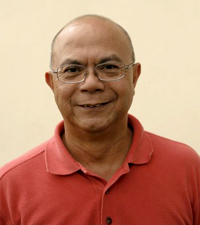
Dr. Romeo del Rosario is a missionary and the director of the Cambodia Mission Initiative in the General Board of Global Ministries of The United Methodist Church. He is also teaching at the Cambodian Methodist Bible School (CMBS), training numerous local leaders for the Cambodian Methodist Church. In addition, he is serving as the chair of the theological education committee, which is responsible for the continuing theological training of pastors and church workers in Cambodia.
He received his Ph.D. in theological and religious studies, with a major in ecumenics and mission, from Boston University in 1981. His dissertation analyzed and described the schism which occurred in the Methodist Episcopal Church in the Philippines in 1933, focusing on the struggle for autonomy and indigenization within the Methodist Episcopal Church in the Philippines.
After earning his degree, Dr. Rosario has served many countries as a missionary and teacher for more than 25 years since the mid-1980s: From 1985 to 1988, he taught at Theological Hall (now Sierra Leone Theological College) in Sierra Leone, West Africa. From 1989 to 1992, Dr. Rosario worked as liaison between the United Methodist Church and the Middle East Council of Churches in Jerusalem, West Bank. Then, he served as a lecturer and then dean of the Sabah Theological Seminary in Malaysia from 1992 to 2001. Before taking his current position in Cambodia, he worked for the Union Theological Seminary in the Philippines as an officer-in-charge.
Acknowledging his achievements, Boston University School of Theology named him as one of the four winners of the 2012 Distinguished Alumni Award. He is currently involved in a very important project for the future of the Methodist Church in Cambodia: With the goal of an autonomous Methodist Church in Cambodia by 2016, he is playing a leading role in writing the Book of Discipline in Cambodia.
Profile by Hye Jin Lee.