Alumni
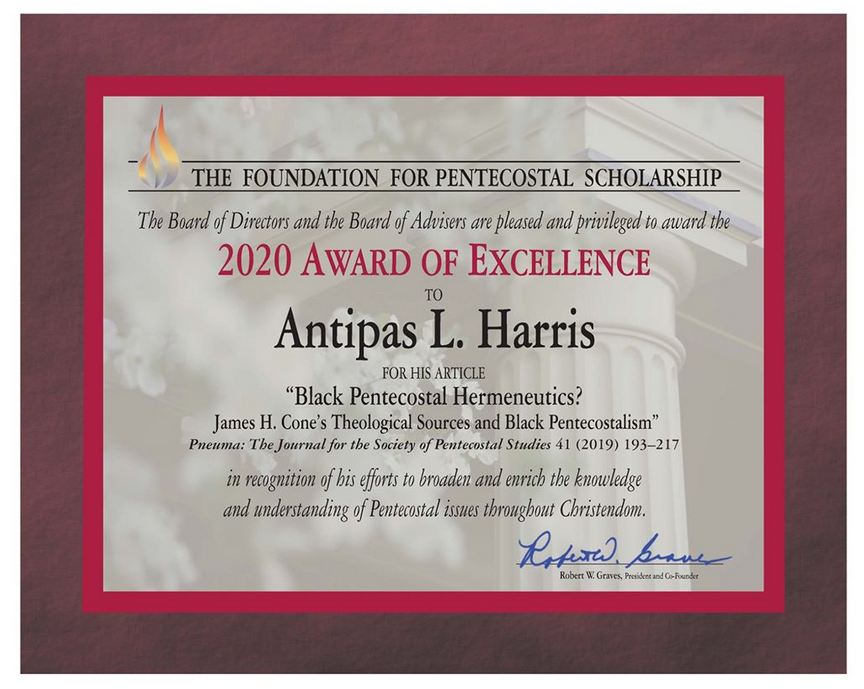
Award of Excellence
In a recent award-winning article in Pneuma, Antipas Harris ('08) advances hermeneutical insights for emerging black pentecostal scholars to consider. The salient question is, “What distinguishes black Pentecostalism?” This study revisits James H. Cone’s sources for black theology for insight into the role of blackness in shaping black Pentecostalism. On the one hand, the study dispels the myth that black Pentecostalism is inherently a spiritual alternative to the fight for social justice. On the other hand, it calls for critical dialogue between Cone’s sources for black theology and black Pentecostalism to advance scholarship on the formation of black pentecostal hermeneutics. This essay explains that blackness is more than a cultural and experiential reality. Blackness is a theological source that correlates with other sources in shaping black Pentecostalism. Blackness, moreover, legitimates black pentecostal proclivities for the integration of the faith, spirituality, and social advocacy. Theological blackness in Pentecostalism has historically distinguished black Pentecostalism from subsequent white Pentecostalism.
Remembering India’s Pioneering Missionary to Nepal
March 15, 2020 was Rev. C. K. Athialy's birth centenary day. He was the pioneering Indian missionary in Nepal. To honor his life, a thanksgiving meeting was planned in Nepal, but has been postponed due to the rapid spread of the coronavirus. Rev. C. K. Athialy's son, Jesudas Athyal, has been a Visiting Researcher at the CGCM and with his family produced a short documentary of his father's life. The video also features Bishop Abraham Mar Paulos, who earned his doctorate at the Boston University School of Theology in 1993.
The Future of Religion and Mission
March 30 - April 1, 2020
The Center for the Study of Global Christianity (CSGC) at Gordon-Conwell Theological Seminary invites you to an exclusive conference to celebrate the launch of the third edition of our seminal work, the World Christian Encyclopedia (Edinburgh University Press).
The conference will feature:
- Keynote addresses from leaders in mission and ecumenical organizations. Featured speakers include Casely Essamuah (Global Christian Forum), Mary Ho (All Nations), Todd M. Johnson (CSGC), Gina A. Zurlo (CSGC), Scott W. Sunquist (Gordon-Conwell Theological Seminary), among others.
- Panel sessions on world religions and mission
- Focus on gender in global Christianity
- Discussion of Evangelicals and social action
- Analysis of regional trends in Christianity
The conference will begin on Monday, March 30 with registration at 8am and will conclude at noon on Wednesday, April 1. For information on registration, housing, and conference schedule, click here or visit globalchristianity.org. For all other inquiries, please contact us at info@globalchristianity.org or (978) 468-2750.


The Past and Future of Evangelical Missions
Maryknoll 2019
 This year’s meeting of the Eastern Fellowship of Professors of Mission held at Maryknoll was attended by 57 people from a total of 16 institutions—a record number on both accounts. The theme of “Visualizing Mission” fired the imagination of presenters and participants alike. On Friday, Maryknoll Father Larry Lewis unveiled jewels of “God images” and signs of divine presence in several mainstream American and foreign films, emphasizing the mission of fully living out one’s humanity for God. After dinner, filmmaker James Ault played an excerpt of his new film project on Mechanic Manyeruke, considered a father of gospel music in Zimbabwe. Daryl Ireland (Boston University) prompted lively discussion with his fascinating findings on the portrayal of the cross in the CGCM’s digital Chinese poster collection (www.ccposter.com). Saturday morning, James Kim (New Brunswick Theological Seminary) showed excerpts of two Korean documentaries and highlighted some of the painful history of the coming of Christianity to Korea and the work of western missionaries. Finally, brief presentations by Meg Guider (Boston College), Michèle Sigg (Boston University), and James Taneti (Union Presbyterian Seminary) launched a plenary discussion on “Missionaries in the Movies.” Themes that emerged from the conversation included the importance of visual resources for churches in Africa, the ongoing challenge of negative portrayals of mission and missionaries in mainstream media, and the role of missiologists in evaluating these images within the evolving curriculum of mission studies and world Christianity programs.
100 Women of 2019
 Gina Zurlo ('17) was selected as one of the 100 women of 2019 by the BBC. She spoke in New Delhi at a BBC-sponsored event, discussing the role of women in religion. Her talk begins at 56:27.
Gina Zurlo (’17) Named as One of BBC’s 100 Women of 2019
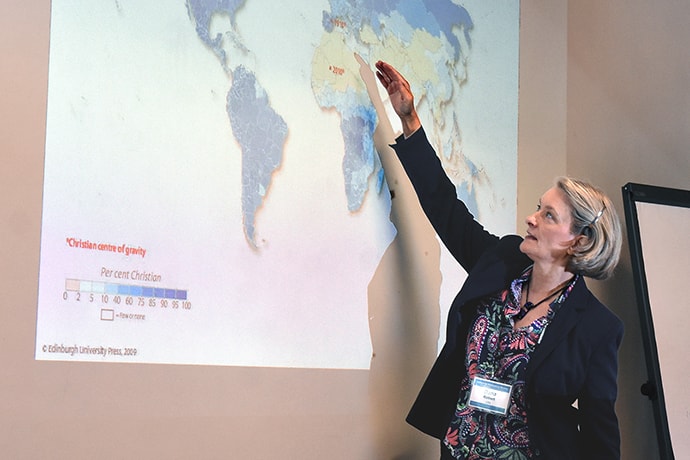
Dr. Gina Zurlo, Co-Director of the Center for the Study of Global Christianity, has been named one of the BBC's 100 Women of 2019. She is recognized as a scholar of religion and an expert in religion statistics. As a part of the BBC's 100 Women, Dr. Zurlo will be speaking in Delhi next week on the future of religion worldwide, especially the role that women play, as research consistently finds that women are more religious than men.
Mission and Adoption
Soojin Chung ('18) recently wrote an article for Christianity Today that traces the history of missionaries in transnational adoption.
CT Blogpost Highlights Work of Soojin Chung (’18)
|
Multicultural Ministries
Methodist Churches in Europe have responded to refugees, asylum seekers, and migrants, but the presence of new people has required congregations to think deeply about language, worship, and unity. The United Methodist Board of Global Ministries responded with a pilot project to train pastors and laity leading congregations affected by migration. The first session of the Institute for Multicultural Ministry was held Aug. 22-30 at The United Methodist Church of Germany Educational and Training Center in Stuttgart. Among the presenters were Dana Robert, and graduates John Calhoun, David Scott, and HiRho Park.