BU Students Tackle Clinical Problems through Code: A Look at BU’s 2026 MedAI Hackathon

On April 10th and 11th, Boston University hosted its first MedAI Hackathon, an intensive two-day competition that united students from a wide array of disciplines to use artificial intelligence and machine learning to solve real biomedical and clinical challenges.
Organized by Associate Professor of Medicine and Computer Science and founding member of the Faculty of Computing & Data Sciences Vijaya Kolachalama and Associate Professor of Computational Biomedicine Jennifer Beane-Ebel, the event was designed to connect computing, medicine, and engineering through hands-on work with de-identified datasets and faculty-generated research problems drawn from active clinical and scientific research.
 “Our goal was to build an intensive, fun, educational, and impactful experience where multidisciplinary teams could tackle genuine clinical problems with relevant biomedical data, learn from faculty and research computing experts, and see how their ideas could contribute to publications or improved patient care,” they shared.
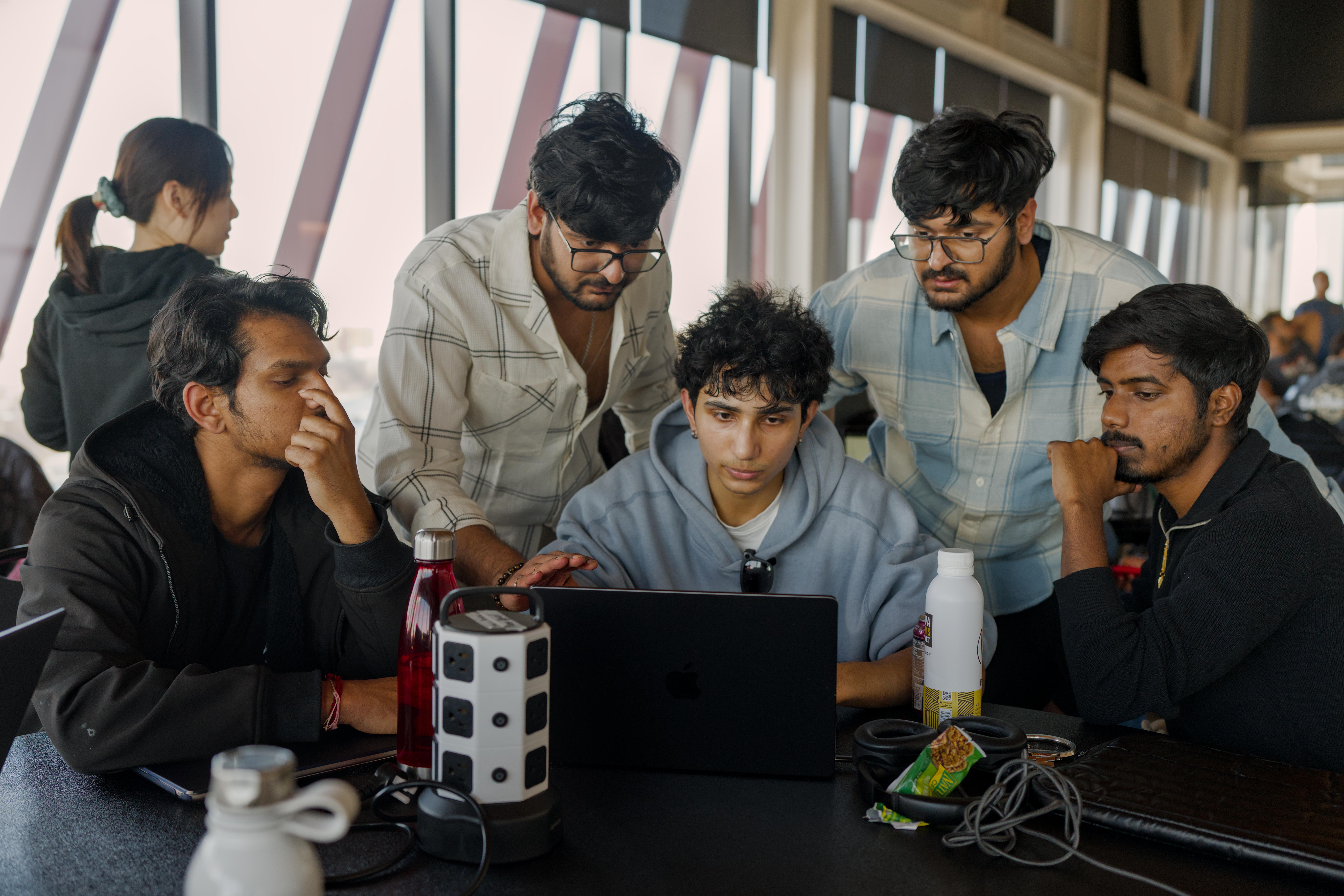
This year’s hack brought together 233 students across 30 teams competing for $10,000 in prizes. Cross-disciplinary teams included students from a variety of BU colleges and schools, including the Faculty of Computing & Data Sciences, Chobanian & Avedisian School of Medicine, Questrom School of Business, and many more programs across public health, engineering, dentistry, and the arts and sciences. This intentionally intellectually diverse group of hackers meant that students who rarely share the same classrooms got to share the same datasets and models.
“Teams competed across three research challenges: early lung cancer detection from pathology images, Alzheimer’s disease marker quantification from brain scans, and prediction of kidney injury using blood-based molecular data,” explained Kolachalama and Beane-Ebel. Grounded in real research--including Kolachalama's work on Alzheimer's and Beane-Ebel's on lung cancer--each team’s problems were drawn from ongoing projects pursued at the Hariri Institute for Computing, meaning students were contributing to active scientific questions rather than completing isolated exercises.
With support from Research Computing Services and BU’s Shared Computing Cluster, students ran nearly 10,000 jobs in a single day, used more than 40 GPUs, and collectively consumed about 265 CPU hours. Translation: nonstop hacking at scale.
 Kolachalama and Beane-Ebel explained that the inspiration for the event “came from a genuine desire to bridge the gap between CRC and MED…at BU, we have talent across computing, data sciences, medicine, and engineering, yet connecting students with opportunities to work directly with de-identified datasets from active research labs remains difficult.” They emphasized creating a space that was “intensive, fun, educational, and impactful,” where students could engage directly with meaningful clinical problems.
Looking ahead to future Hackathons, they noted, “We are exploring external sponsorships to increase the budget significantly, booking excess space early, potentially expanding the format to a full hackathon week, and opening participation to students from other local universities.”
Showcasing how quickly and effectively students can move when real clinical data, strong computational resources, and active research questions are on the table, the 2026 MedAI Hackathon was an inspiring success. Grounding machine learning work in ongoing biomedical problems, the event proved not only an exciting competition but a concentrated snapshot of how real-world problem-solving can and should intersect with data science education.
