
3 Questions with MassMutual’s Adam Fox
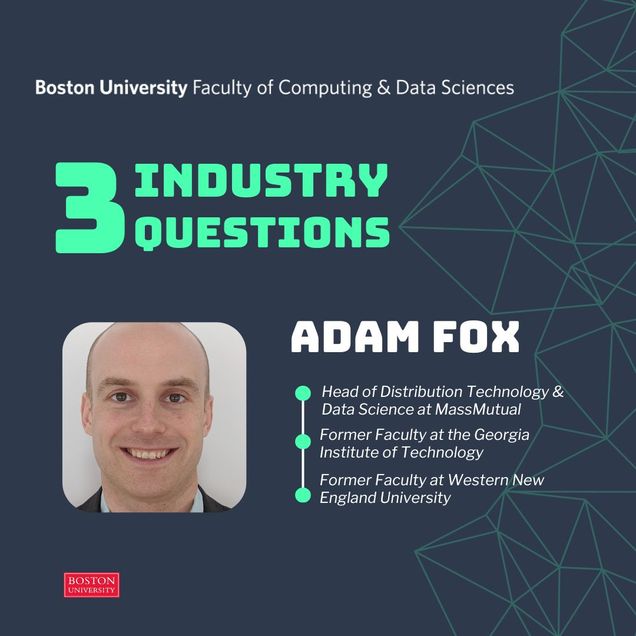 In this "3 Industry Questions" feature, Adam Fox, head of Distribution Technology and Data Science at MassMutual, talks about his college data science influencers, the importance of a strong academic foundation, and offers advice to those entering today's job market.
What inspired you to enter the field of data science?
Fox: In my senior year of college, I read a paper by Aaron Clauset examining the relationship between the magnitude and frequency of terrorist attacks across the world. He went on to develop several theoretical frameworks for this relationship and was able to test each by evaluating the simulated results against real world data. What I found most compelling about this work was its simplicity. Despite the complexity of terrorism – the myriad of political, sociological, and psychological factors involved – Clauset was able to model the behavior with a great deal of fidelity using a small set of variables. This really highlighted the power of data science to me; how incredibly complex societal challenges could be addressed by leveraging appropriate data and models.
How would you describe the data science job market today? And what skills do you think are critically necessary to possess before graduation?
Fox: The data science job market is highly diverse – there is no single definition for a “data scientist” and the skills and expectations will vary significantly depending on where you go. In more research focused fields, the market is incredibly competitive, and candidates will need to demonstrate significant work and/or research experience to be successful. In other sectors data scientists will be focused more on application and the expectations and competition are typically less significant.
I’d recommend that students ensure that they have a strong foundation in statistics and computer science. It’s important to have fluency in R and/or Python and SQL, as well as some data visualization tools (Tableau, PowerBI, Shiny, etc). Beyond that, the best thing to do is develop a portfolio – contribute to open source, solve some Kaggle problems, or identify your own.
What advice do you have for data science undergraduate and graduate students?
Fox: Demonstrate that you can solve a problem you care about with data. One of the best applications I saw as a hiring manager came from a college senior frustrated with his campus transportation system. The busses were chronically late which caused him to waste time waiting at bus stops. Fortunately, the bus system published the actual daily arrival times for each route and the student was able to scrape the data and perform some simple analysis to predict arrival time based on a small set of factors. In doing so he made his day a bit more efficient and pleasant.
This type of problem solving demonstrated that he could properly frame a challenge, identify relevant data to address the issue, and build a simple but effective model to solve the problem.
Learn more about CDS Industry Connections Lecture Series.