Tiny Flecks of Ancient Stardust Offer Clues to Solar System Origins


Tiny Flecks of Ancient Stardust Offer Clues to Solar System Origins
Boston University research scientist Nan Liu studies presolar grains that predate our world
The microscopic flecks of dust are mind-bogglingly old. They predate the Earth, and our sun.
“They’re ancient stardust grains,” says Boston University researcher Nan Liu.
Known as presolar grains, they’re the leftover bits of stars that died before our solar system even formed. That makes them more than 4.6 billion years old—and a window into a world before our own.
Liu studies these tiny grains—measuring less than 0.05 millimeters in size—for clues to the origin and development of our solar system and the chemical evolution of the interstellar medium, all the gas and material between stars. The grains are, she says, “the leftover building blocks” of the solar system.
“It’s amazing that they survived, that they finally made their way to Earth,” says Liu, a BU Institute for Astrophysical Research senior research scientist. “The coolest thing about these grains—and that’s my research interest—is understanding where they came from.”

The grains trace their origins to exploding stars—those novae and supernovae that went down with a giant bang. Thrown out as the stars died, the grains condensed and became part of the interstellar debris that would later form our sun and the planets that circle it. Many were heated or washed out of existence (they don’t play well with high temperatures or water). But some fragments were preserved in asteroids and comets—and when those fall to Earth as meteors, scientists have a chance to examine them.
One key element to the grains’ endurance: staying cool.
“For these grains to survive, everything had to remain cold,” says Liu, “and you can estimate the upper limit of temperature they experienced.”
All of that—not to mention their size—means presolar grains are not easy to find. The vast majority of meteorites don’t contain them and, if they do, the grains are a tiny proportion of their mass.
“You can’t just identify a presolar grain by looking at it,” says Liu, a cosmochemist (someone who specializes in studying the chemical makeup of the universe). “You have to know its chemical or isotopic composition.”

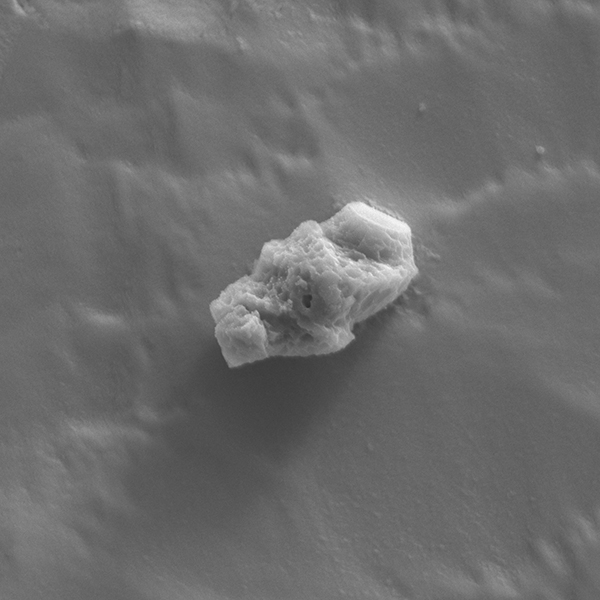

Above and top: Scanning electron microscopic images of presolar silicon carbide grains extracted from the Murchison meteorite, which landed in Australia in 1969.
Images courtesy of Nan Liu
Sometimes, Liu says she can analyze a meteorite with a powerful microscope that also scans its elemental composition. But often she has to resort to more drastic measures: dissolving samples from meteorites in acid. Despite their aversion to high temperatures and water, the grains are a rugged combination of silicon and carbon.
“Because this silicon carbide grain is really tough,” she says, “you can dissolve meteorites using different combinations of strong acids; at the end, you may get some residues—essentially, those are all presolar grains.”
The grains’ ingredients are also an insight into their otherworldly origins.
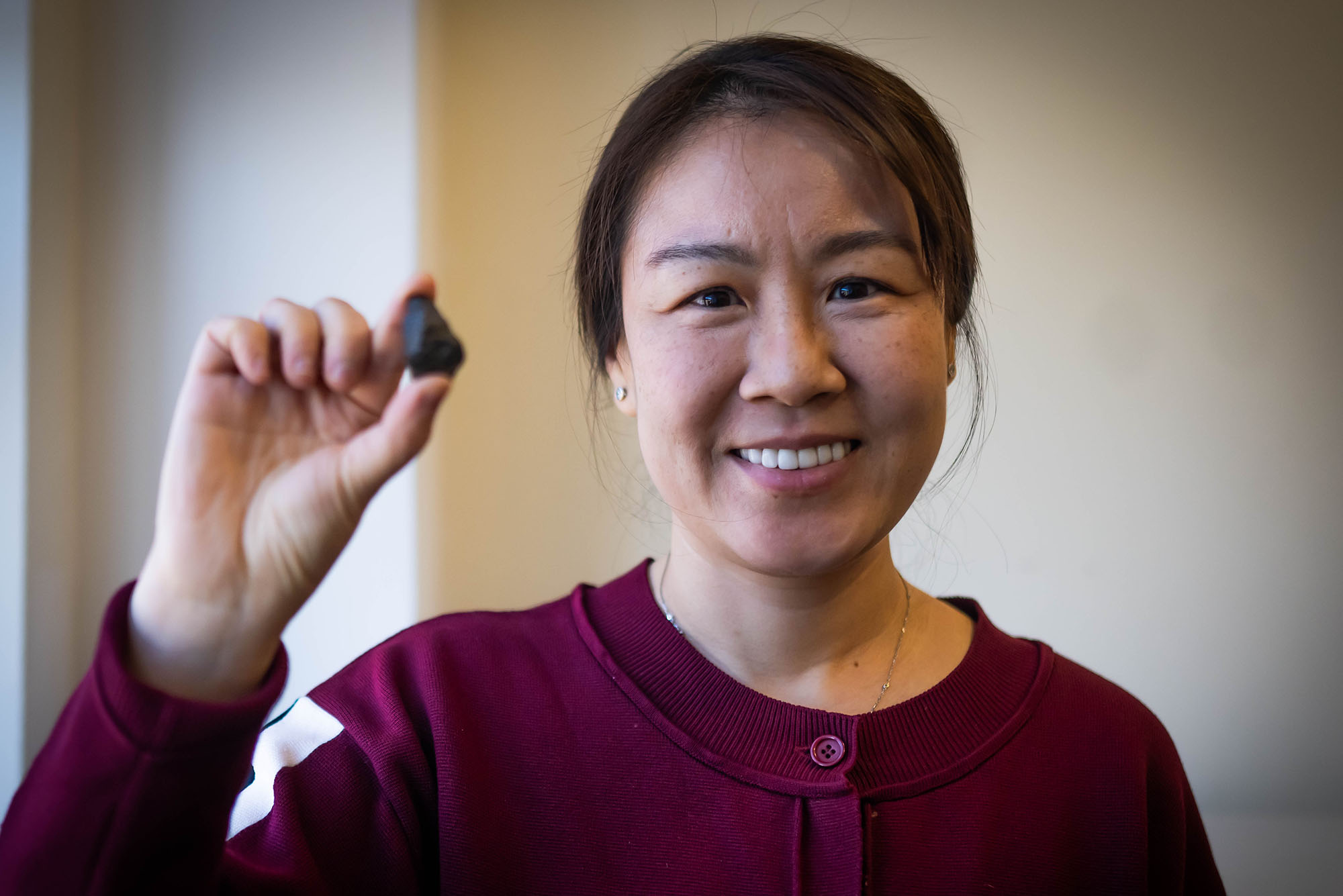
“These grains are carbon-rich—it’s impossible to produce such minerals naturally in the solar system,” says Liu. That means they can only have come from carbon-rich stars; most stars, including our own sun, have more oxygen than carbon.
In one recent paper, Liu and her colleagues studied “a bunch of grains coming from a supernova. We analyzed their composition and, based on the isotopic composition, we inferred the mixing processes occurring during the [star’s] explosion.” She also published a paper with BU undergraduate researcher Ananya Jain (CAS’27)—whose work was supported by BU’s Undergraduate Research Opportunities Program—on presolar dust from a giant molecular space cloud.
“By knowing which stars these grains originated from,” says Liu, “we can know which stars really contributed material for the formation of the solar system.”
