BU Researcher Wins Moore Foundation Award to Push “Boundaries of Experimental Physics”

The Gordon and Betty Moore Foundation named Maria (Masha) Kamenetska to its 2026 cohort of Experimental Physics Investigators; the honor comes with $1.35 million in research funding.
BU Researcher Wins Moore Foundation Award to Push “Boundaries of Experimental Physics”
Maria (Masha) Kamenetska draws on chemistry, physics, and engineering to study molecules and drive advances in imaging, sensing, and quantum technology
Individual molecules are almost incomprehensibly tiny—just a nanometer, or one-billionth of a meter, in size. A sheet of paper, by contrast, is 100,000 nanometers thick; a pinhead measures 1,000,000 nanometers across.
For Boston University researcher Maria (Masha) Kamenetska, the microscopic world of molecules is rich with giant possibilities. She investigates their meeting points, the intermolecular interface, studying how the particles interact with each other and what that means for biological systems and human-made devices. An associate professor of chemistry, physics, and materials science and engineering, Kamenetska creates new techniques and instruments to peer into this miniscule realm—and explores ways to influence it.
It’s work that she hopes to push in new directions with support from a major award. The Gordon and Betty Moore Foundation has named Kamenetska to its 2026 cohort of Experimental Physics Investigators. The honor, which the foundation says is given to a “distinguished group of mid-career researchers pushing the boundaries of experimental physics,” comes with $1.35 million in research funding. Kamenetska was among 21 investigators recognized by the foundation, which was established in 2000 by Intel cofounder Gordon Moore and his wife.
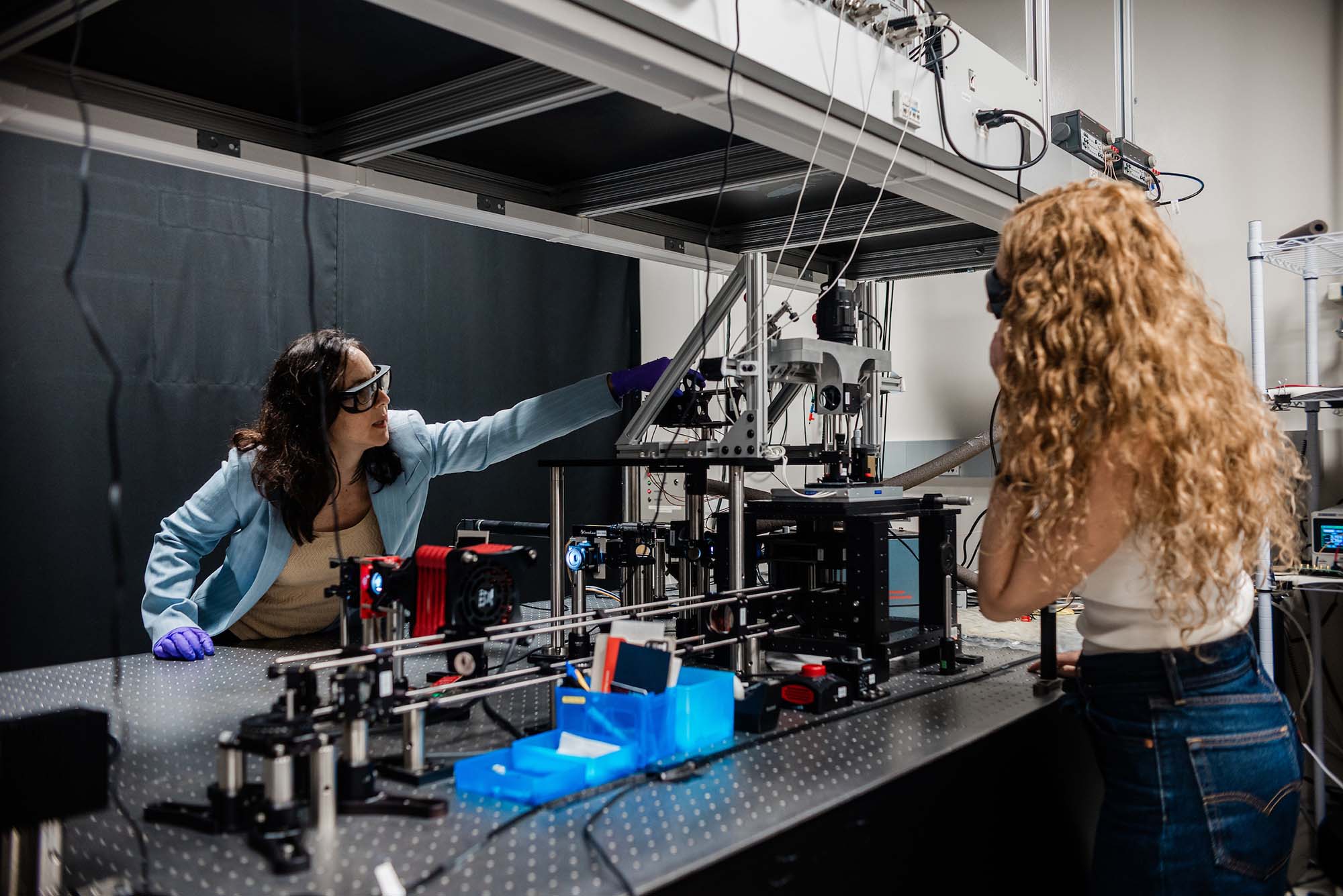
With the fresh support, Kamenetska and her team will use ultrafast laser spectroscopy to examine the interaction of light and matter at the nanoscale and beyond. Their research could have implications beyond improving imaging technology and our understanding of basic physics—it could potentially be used to advance quantum technology or to improve biological diagnostics.
“This work is important because it teaches us about the interaction of light and matter on the nanoscale,” she says. “These topics form the foundation of modern electronics and other emerging technologies.”
But like much boundary-breaking science, success is not guaranteed.
“These experiments are challenging; they have never been done before, and the outcome is not certain,” says Kamenetska, who’s affiliated with the BU Photonics Center. “It is inspiring to have a foundation take a chance on my ideas and to have an opportunity to make them real in the lab. It allows my team to develop new expertise and to think in new creative ways.”
These experiments are challenging; they have never been done before, and the outcome is not certain. It is inspiring to have a foundation take a chance on my ideas and to have an opportunity to make them real in the lab.
As well as bringing potential big rewards in terms of knowledge, she says, the funding will allow her to expand training opportunities for undergraduate and graduate students “at the forefront of modern quantum optics and materials research.” It will also reinforce her lab’s convergent approach, drawing on tools, techniques, and expertise from fields including experimental physics, synthetic chemistry, computational chemistry, and materials processing.
“I hope that this award draws attention to how critical it is to support fundamental science research and to maintain our fundamental science departments, like physics and chemistry, which form the backbone of many disciplines and draw the wonderful, bright young people to our university, enabling this kind of research,” says Kamenetska. “I would not be able to do this work without the amazing graduate and undergraduate students who work in my lab. This award is, in many ways, a recognition of their work and what it has allowed me to imagine my lab can do.”