Study of Trypanosome Parasite Maps Assembly Line for Rewriting RNA

The trypanosome parasite can cause potentially fatal illnesses. A BU-led study highlights one of its key genetic processes and could open the door to new treatments. Photo by Kateryna Kon/Science Photo Library
The Trypanosome Parasite is a Tiny Troublemaker. A New BU Study Delves Into its Inner Workings.
Research highlights an evolutionary quirk—and could open new routes of exploration for stopping life-threatening parasitic diseases
They’re tiny parasites that can cause big trouble. Trypanosomes measure under 30 micrometers—less than the thickness of a human hair—but can spark potentially fatal illnesses, like African sleeping sickness and Chagas disease.
For the past 30 years, Boston University molecular biologist Ruslan Afasizhev has been trying to figure out what makes these single-celled organisms tick. Now, along with an international team of researchers, he’s uncovered new insights into the molecular machinery that allows the parasite to edit genetic messages and create proteins. The findings, published in Nature, provide a fresh look at a key genetic process—and could open new avenues of exploration for future disease treatments. They also highlight an evolutionary quirk: how nature can borrow existing bits and pieces of cells to create something new.
“It offers insight into an essential biological process,” says Afasizhev, a BU Henry M. Goldman School of Dental Medicine professor of molecular and cell biology.
The study focused on ribonucleic acid (RNA), messenger molecules that help cells make proteins by translating the genetic instructions locked in DNA. Afasizhev revealed how trypanosomes edit RNA messages to correct mistakes that have accumulated in their DNA.
“In these parasites, many RNA messages are not ready to use when first made—they must be rewritten by adding or removing individual RNA ‘letters’ before they can produce essential proteins,” he says. “Scientists have known about this process for four decades, and its discovery changed the understanding of RNA. But the molecular machinery behind it remained a mystery. We captured the structure of the editosome that carries out this rewriting.”
Mapping the RNA Editing Machine
To map this RNA editing machine in 3D and determine its atomic structure, the researchers used a technique called single-particle cryogenic electron microscopy (cryo-EM), which freezes molecules, allowing highly detailed imaging. In this case, of trypanosome mitochondria—the part of a cell that provides its chemical energy. One of the central findings, says Afasizhev, was that the whole RNA editing operation was “coordinated within a single complex of multiple proteins”—not just a series of enzymes working away on their own. Enzymes are the proteins that drive biochemical reactions and help regulate important RNA processes, including its creation and repair.
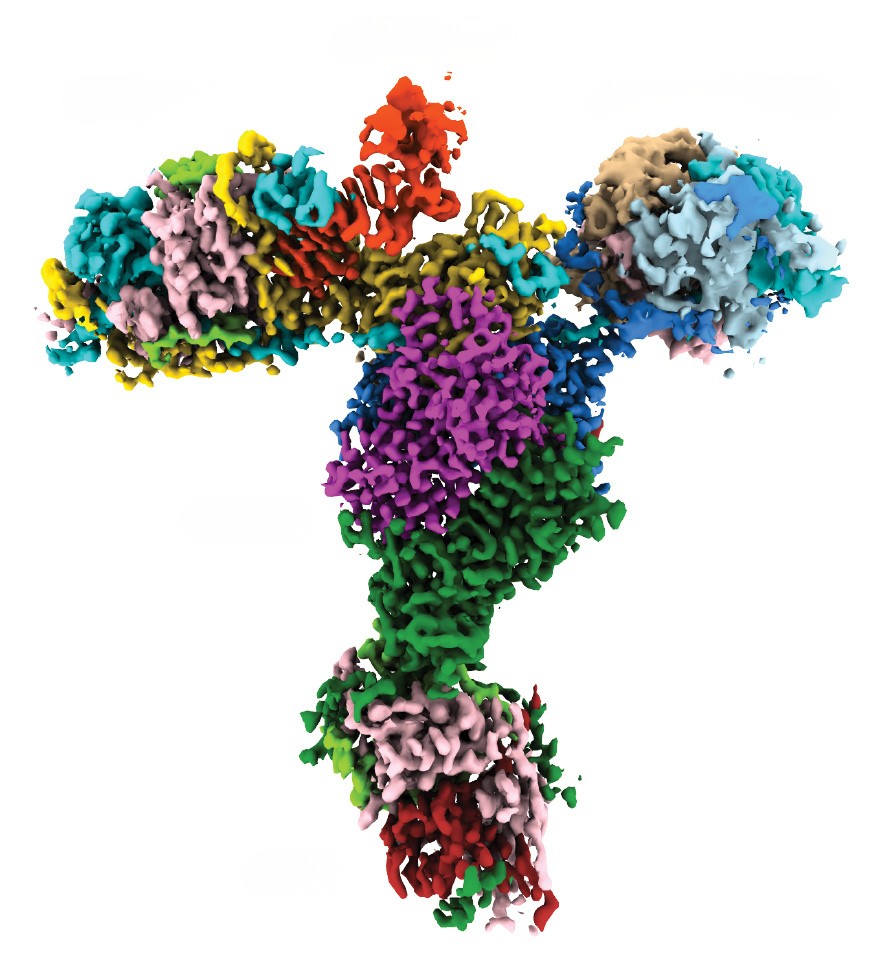
The findings “explain how genetic information can be altered after RNA is synthesized,” or created, says Afasizhev, who’s also affiliated with the BU Chobanian & Avedisian School of Medicine’s biochemistry and cell biology department.
He and his colleagues discovered that the editing machine looks a little bit like a dragonfly—with a head, thorax-like core, tail, and wings. The core grabs the RNA structure to be edited, three little arms distinguish the spots that need to have a letter—formally a uridine—inserted or deleted, the tail removes or adds the uridine, and the wings help seal everything up.
“Think of it as an assembly line,” says Afasizhev, comparing the RNA to a car rolling through the factory: at certain points, it stops and is held in place as robotic arms come in from different directions to add new parts.
His coauthor, Z. Hong Zhou of the University of California, Los Angeles, calls the findings “unexpected and beautiful,” saying they open “new avenues for targeted therapies against trypanosomes.” A professor and founding director of the Electron Imaging Center for NanoMachines at the California Nanosystems Institute, he’s an expert in the imaging technique the researchers used.
“By pushing cryo-EM limits to visualize these fleeting, ultra-complex editing complexes directly from mitochondria—rather than artificial reconstructions—we gain fundamental insights into how cells can massively reprogram RNA,” he says, “knowledge that could inspire broader RNA-based medicines and deepen our understanding of eukaryotic evolution.”
A Machine Made of Older Parts
The findings also provide evidence for a theory known as constructive neutral evolution. In Charles Darwin and Alfred Russel Wallace’s theory of natural selection, organisms that have adapted to their environment are more likely to survive, passing on those beneficial traits to their offspring—step-by-step, the organism positively evolves. By contrast, constructive neutral evolution happens more by chance or for no initially obvious reason. And that’s what seems to have allowed the creation of the RNA editing machine in trypanosomes.
“This study shows how a complex biological machine may have formed from older cellular parts that initially came together without any immediate purpose,” says Afasizhev. “When mutations in DNA made RNA repair necessary, this pre-existing machinery became essential for survival. In this way, evolution can build useful complexity not only by selecting improvements step-by-step, but also by preserving hidden potential created by neutral changes over long periods of time.” For example, transfer RNA—which makes sure amino acids used in creating proteins land in the correct spot—seems to have been co-opted into becoming a stabilizing scaffold in the editosome.
This doesn’t contradict Darwin’s theory, says Afasizhev, it just adds to it—neutral changes can provide the foundation for future selection.
As for the research’s potential to unlock new treatments for diseases like African sleeping sickness, Afasizhev says the knowledge generated by his team is “there for others to use.” For now, sleeping sickness is relatively well controlled—and a newly approved drug promises even better treatment—but he says it’s common for medicines to eventually lose their punch, necessitating fresh angles of attack: the disease “will come back, it always does.”
This research was supported by funding from the National Institutes of Health and the National Natural Science Foundation of China. Afasizhev’s coauthors included researchers from Boston University; University of California, Los Angeles; ShanghaiTech University; University of California, Irvine; and Shanghai Clinical Research and Trial Center.

Comments & Discussion
Boston University moderates comments to facilitate an informed, substantive, civil conversation. Abusive, profane, self-promotional, misleading, incoherent or off-topic comments will be rejected. Moderators are staffed during regular business hours (EST) and can only accept comments written in English. Statistics or facts must include a citation or a link to the citation.