Dazzling Photographs Capture the Magic of the BU Marine Program’s Trip to Belize
Morgan Bennett-Smith (GRS’25,’27) documented students as they explored coral reefs and conducted field research

Karina Scavo Lord (GRS’24), a CAS lecturer in biology, shows students in her Corals Across the Seascape course a small seahorse in the mangroves around Calabash Caye, Belize.
Dazzling Photographs Capture the Magic of the BU Marine Program’s Trip to Belize
Morgan Bennett-Smith (GRS’25,’27) documented students as they explored coral reefs and conducted field research
In his work as a marine biologist and underwater photographer, BU PhD student Morgan Bennett-Smith travels to places—and encounters creatures—that most people will never have a chance to see firsthand. With that access, though, comes significant responsibility.
Bennett-Smith (GRS’25,’27) studies the relationship (or “mutualism”) between sea anemones and clownfish (anemonefish, the species featured in Finding Nemo) across the tropics, from the Indo-Pacific to the Red Sea. Climate change–driven coral bleaching is central to his research.

“A lot of the work in our lab looks at how bleaching affects sea anemones, and how that bleach state of the sea anemone affects the fish that live in the anemone,” says Bennett-Smith, a student in the Marine Evolutionary Ecology Lab run by Peter Buston, a College of Arts & Sciences associate professor of evolutionary ecology and marine ecology. “We’re studying how the mutualism—the symbiosis—is disrupted by climate change and increasing sea temperature.” (The Brink, BU’s research magazine, featured his research earlier this semester.)


In November, Bennett-Smith spent two weeks in Belize with Boston University’s Marine Program (BUMP), which provides BUMP students with hands-on laboratory and field experience. As a teaching fellow for the third straight year, he helped lead a group of students as they conducted field research and snorkeled along the world’s second-largest barrier reef. He worked specifically with students in the Ecology of Coral Reef Fishes course, where students focus on designing and conducting research projects on reef fishes, including parrotfish, damselfish, and lionfish. He also captured images both on land and in the water—from a finger-sized seahorse drifting through a mangrove to a small snake baring its (fortunately tiny) fangs while being safely handled by a team member to striking drone footage of the coral reef from the sky.


Photography, Bennett-Smith says, is a vital part of modern marine science, and he encourages other researchers to pick up the skill.
“I give a lot of talks about how all marine scientists should be underwater photographers, because we’re in these amazing places, and there are so many benefits to taking better photos as a field scientist,” he says. “A lot of my work photography turns into the data that turns into the paper, so I’m sort of a natural historian in a lot of ways. I tell people if you’re not compelled to be a photographer, just think of it as straight-up data collection.”

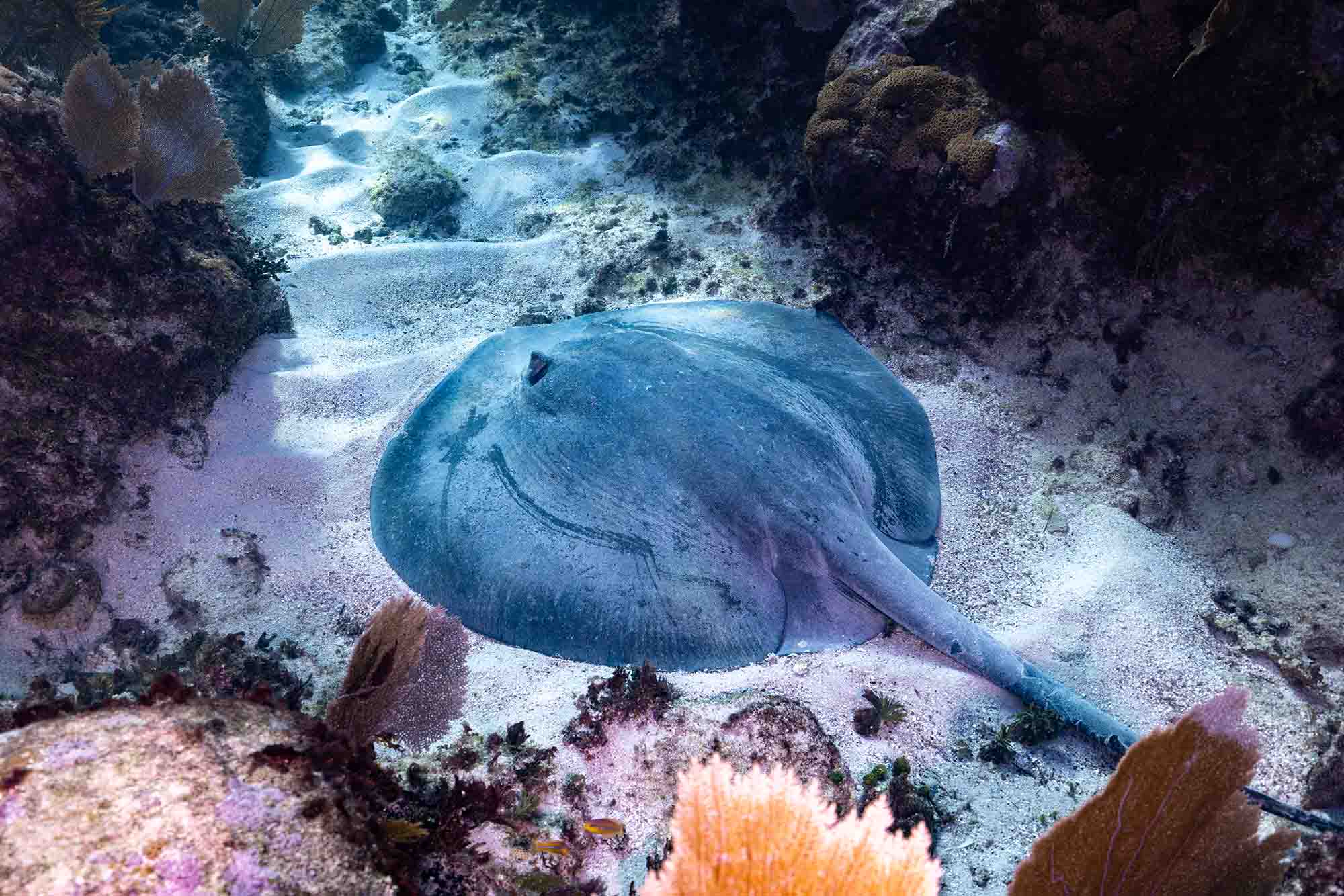

Bennett-Smith has won 11 international awards, including honors from Nature, the UK’s Royal Society, Ocean Conservancy, and the Rosenstiel School of Marine and Atmospheric Science. He runs the photography and videography company Red Sea Imaging, and his work has appeared in the Netflix documentary Horizons, National Geographic, the BBC, and Scuba Diving magazine. He also recently consulted on Blue Planet III, the BBC’s acclaimed underwater series.


He says he loves how photography allows him to share scenes most people will never witness, like a trip this summer to the southern Italian islands, where he and his team filmed underwater volcanic vents releasing giant masses of bubbling gas. “That was pretty cool,” Bennett-Smith says. “It also helps that you get out of the water and you’re eating Italian food on the beach.”


But much of his work now documents the devastating impacts of climate change. He points to long-term projects where he documents the same reef patches year after year. “It’s almost always sort of depressing these days,” he says. But he knows his photography has the power to be “an incredibly important and powerful tool to track those kinds of changes.”