Five Phone Calls That Changed History
Five Phone Calls That Changed or Documented History—After Alexander Graham Bell’s Invention
If Bell’s call on March 10, 1876, to Thomas Watson, while on paid leave from Boston University’s School of Oratory, was the most important call ever made, what were some other calls that helped shape history?
The most important telephone call in history was the first one, right? On March 10, 1876, Alexander Graham Bell, on paid leave from his faculty job at Boston University’s School of Oratory, successfully called his assistant, Thomas Watson. Standing in their Boston laboratory, Bell uttered these words, “Mr. Watson, come here—I want to see you.” Watson, from another room, heard Bell clearly, and the first successful phone call was completed.
In the ensuing 150 years, the number of phone calls (not to mention video calls) made, across wires, across countries and continents, and now without wires, is immeasurable. But there have been some calls between two individuals that changed the course of history or documented a historic moment.
It’s War
“They have attacked us at Pearl Harbor. We are all in the same boat now.”
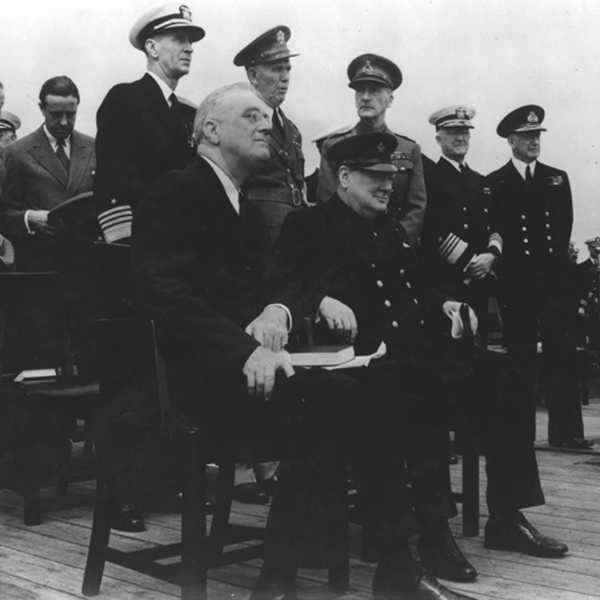
Hours after the Japanese bombed Pearl Harbor on December 7, 1941, U.S. President Franklin D. Roosevelt received a phone call that crossed the Atlantic Ocean. It was from his friend and fellow leader, British Prime Minister Winston Churchill. The two men were in constant contact leading up to that day, but it was during this call that they began to lay the foundation for the Atlantic Charter, strengthening their global alliance and aligning the postwar goals of both countries. Roosevelt famously told Churchill: “They have attacked us at Pearl Harbor. We are all in the same boat now.”

LBJ Calls Dr. King
“How worthy I’m going to try to be of all your hopes.”
On November 25, 1963, three days after President John F. Kennedy was assassinated in Dallas, Tex., the newly installed president, Lyndon B. Johnson, called Dr. Martin Luther King, Jr. (GRS’55, Hon.59). Johnson thanked King for his support and told the civil rights leader, “How worthy I’m going to try to be of all your hopes.” (You can hear the call here.) King replied, “Thank you very much, I’m so happy to hear that.” King told Johnson he could best honor Kennedy’s legacy by passing some of JFK’s most important policies into law. Less than a year later, the landmark Civil Rights Act of 1964, which prohibited discrimination in public places, provided for the integration of schools and other public facilities, and made employment discrimination illegal, became law. The following year, Congress passed, and the president signed into law, the Voting Rights Act of 1965, prohibiting racial discrimination in voting. It started with one phone call.

Calling the Moon
“This certainly has to be the most historic telephone call ever made from the White House.”
“This certainly has to be the most historic telephone call ever made from the White House,” President Richard Nixon said. The entire world watched on July 20, 1969, when, as Neil Armstrong and Buzz Aldrin took mankind’s first steps on the moon, they answered a phone call from Nixon. “Hello, Neil and Buzz, I am talking to you by telephone from the Oval Room at the White House,” Nixon said. He placed the call from Washington, DC, to NASA’s mission control center in Houston, Tex., where it was then beamed to space.

Wired to Wireless
“A personal, handheld, portable cell phone”
After Bell’s invention, for a century landline phones carried over wires were how we all made calls. On April 3, 1973, everything changed. Marty Cooper, a Motorola engineer, standing on Sixth Avenue in New York City, held a 9-inch-tall, 2½ pound cream-color device—with no wires attached. He punched in a telephone number and an employee at competitor Bell Technologies answered. Cooper, beaming with pride, boasted to everyone watching that he was calling from “a personal, handheld, portable cell phone.” Commercial phones, far more portable, would take another decade to develop, but a revolution had begun.

Saving Apple
“I’m going to turn this thing around.”
Steve Jobs had just returned to his position as CEO of Apple in 1997, to a company in dire financial condition. Bankruptcy seemed inevitable. Jobs placed a phone call to Bill Gates at Microsoft. In a biography of Jobs by Walter Isaacson, Jobs recalled: “I called up Bill and said, ‘I’m going to turn this thing around.’” Soon after, Gates agreed to invest $150 million in Apple stock. “Bill, thank you. The world’s a better place,” Jobs told Gates. Barely one year later, in May 1998, Apple rolled out the iMac, and the company was back on its feet. It’s fair to wonder if that iPhone in your pocket would be there if not for that one phone call between two tech titans.