Michael Chiklis: Good Cop, Bad Cop, Superhero
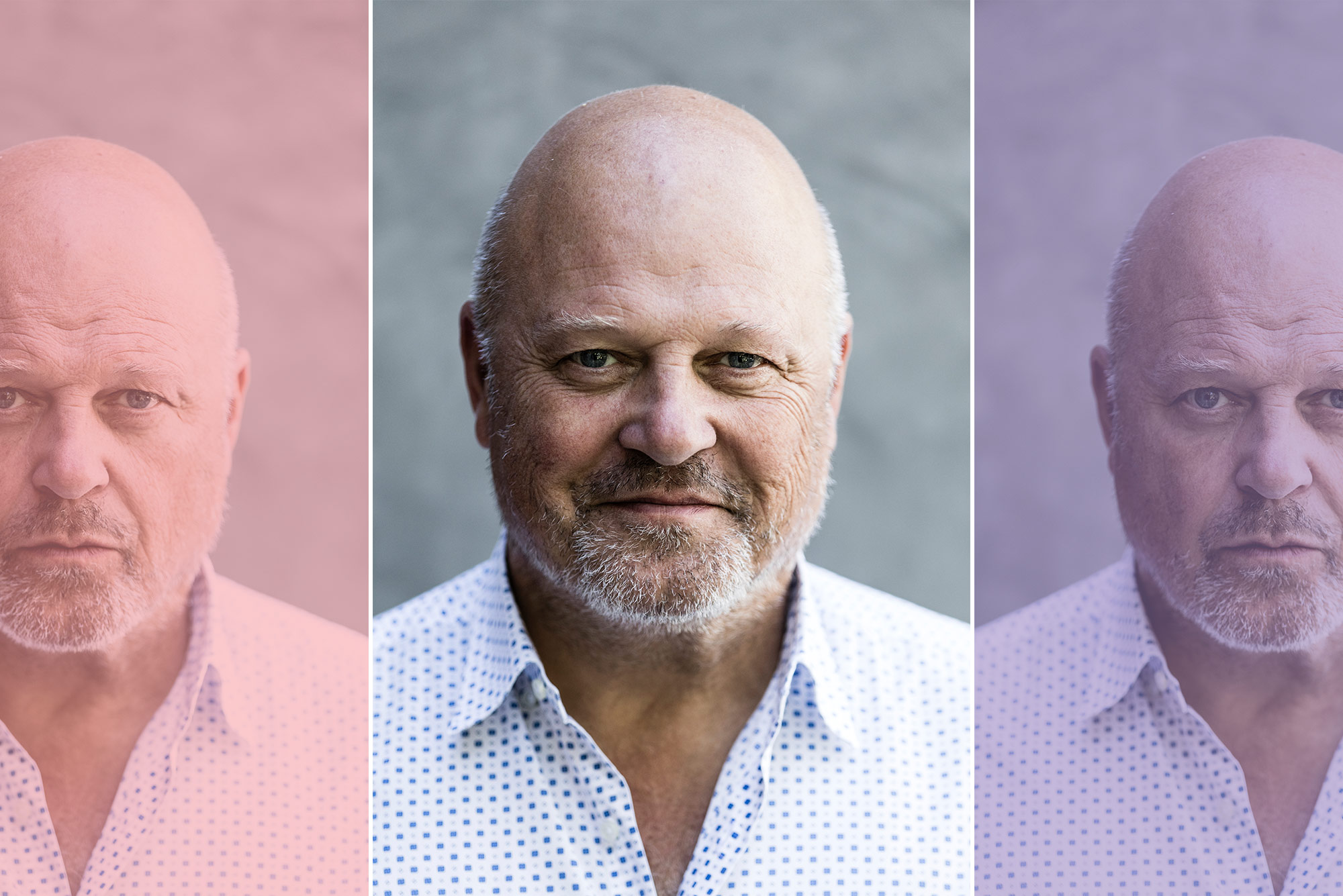
Michael Chiklis: Good Cop, Bad Cop, Superhero
The Emmy Award–winning actor, who has reinvented himself to stay on top in a fickle business, dishes about his new show, Coyote
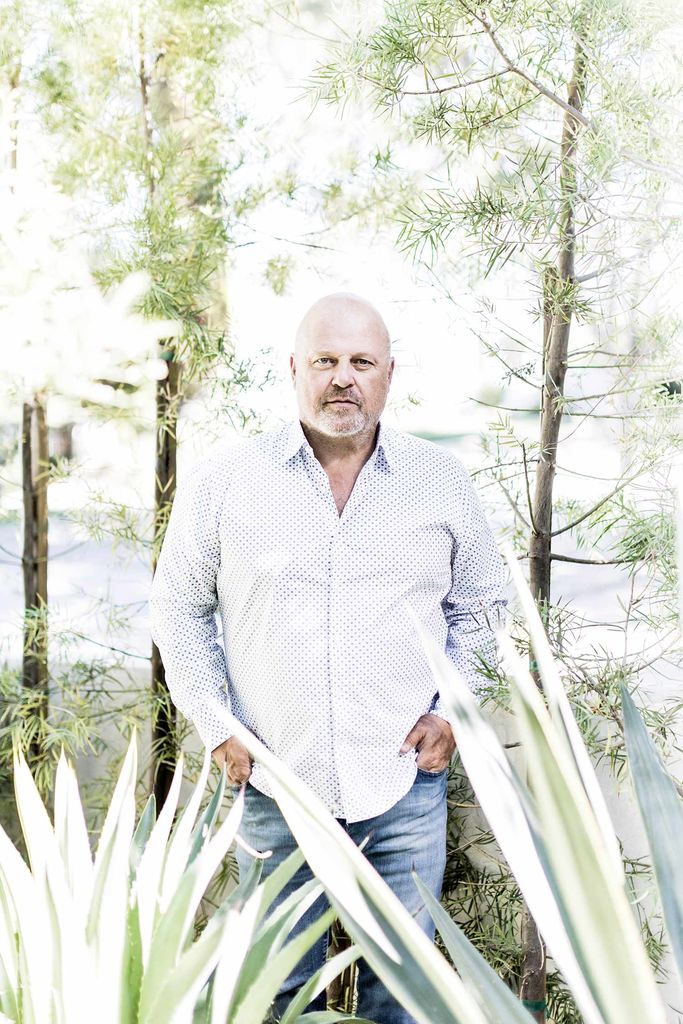
Photos by Patrick Strattner
In the 2002 pilot episode of the hit FX series The Shield, the show’s merciless and corrupt protagonist, Los Angeles Police Department detective Vic Mackey, played by Michael Chiklis, brutally beats a suspect and murders a fellow officer in cold blood—and it only gets worse from there. For the rest of the show’s seven seasons, Mackey displays increasingly disturbing and illegal behavior: torturing and killing suspects, stealing evidence, embezzling money. Not only did the events of that first episode make it onto Rolling Stone’s “The Shocking 16: TV’s Most Heart-stopping Moments,” but Entertainment Weekly also named Mackey one of its “16 Ultimate TV Antiheroes.”
It’s a role Chiklis (CFA’85) played with compelling, can’t-look-away grit and one that earned him critical acclaim—he won a 2002 Emmy Award for Outstanding Lead Actor in a Drama Series and a 2003 Golden Globe Award for Best Actor—Television Series Drama. And he’s bringing a similar captivating performance to his starring role in the new series Coyote. But before he got to the A-list, Chiklis had plenty of time out of the limelight, working in a host of small theaters, waiting a lot of tables, and even starring in a movie so controversial he thought he’d never act again.
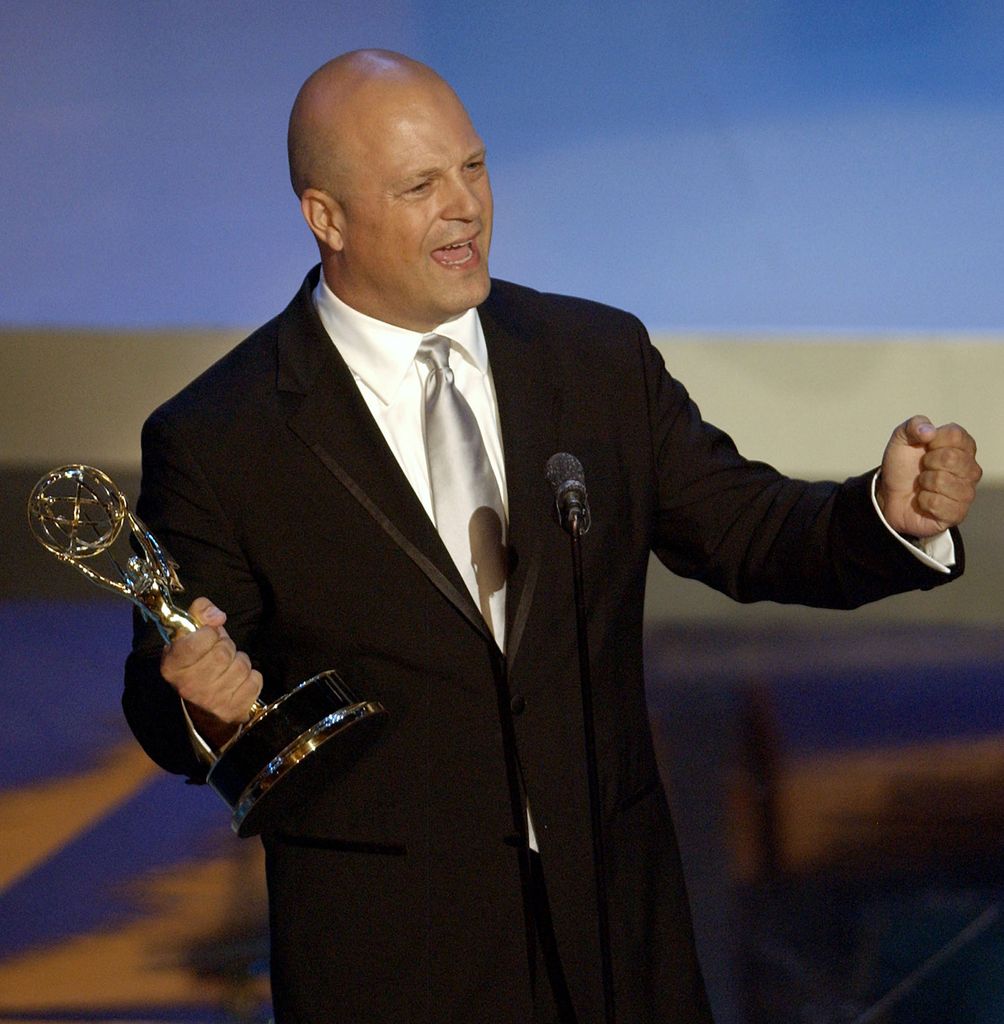
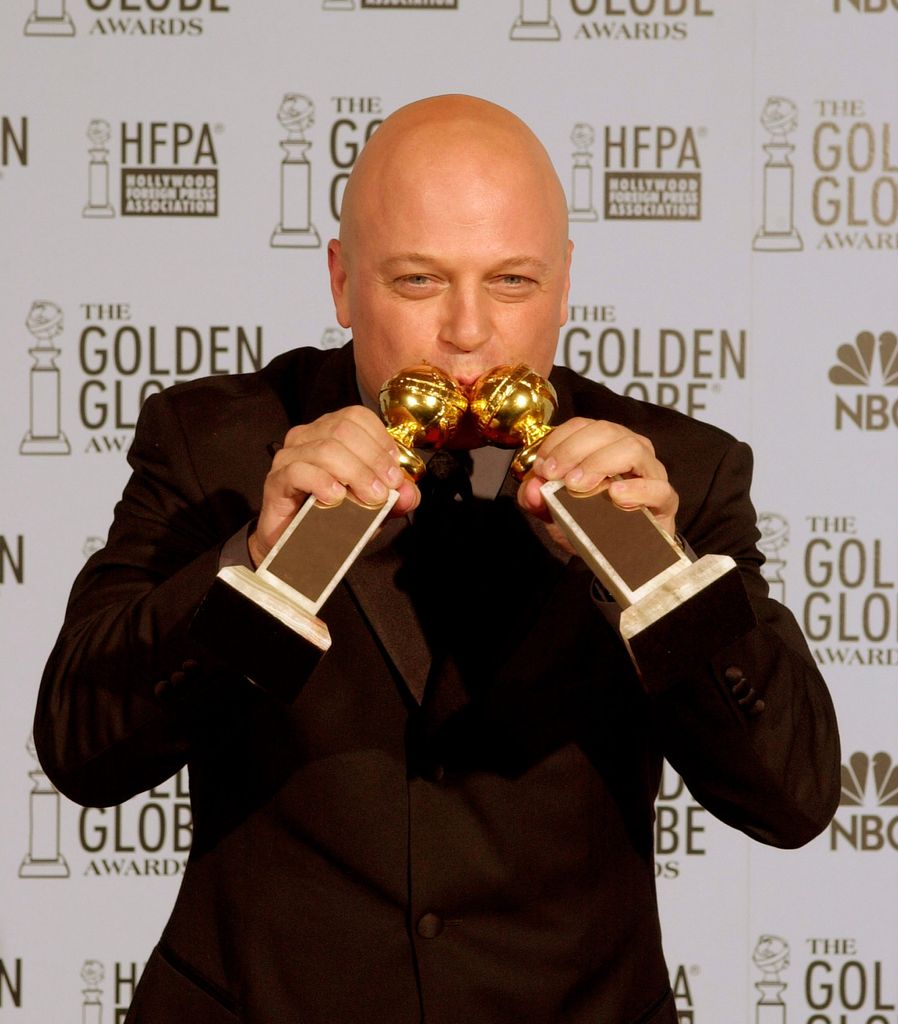
Michael Chiklis (CFA’85) earned critical acclaim for his role on The Shield, for which he won a 2002 Emmy and a 2003 Golden Globe. Photos by Reed Saxon/AP (left) and Kevork Djansezian/AP
The Acting Bug
“My parents used to tell me that I announced when I was five years old that I was going to be an actor,” Chiklis says. Growing up in Andover, Mass., he recalls watching The ABC Comedy Hour, which featured a group of comedic impressionists called The Kopykats that included the actors Frank Gorshin and Rich Little. Chiklis would walk around “imitating those two guys imitating other people” and make people laugh. “I think it was that response that made me feel like acting was my calling.”
That calling became a little more real during the ninth grade, when Chiklis starred as Hawkeye Pierce in his school’s stage production of M*A*S*H. “It was pretty racy for a high school play,” he says. His turn as the chief surgeon caught the attention of a casting director from a local summer stock theater, landing him a spot in a production of Bye Bye Birdie. The production’s director, Mark Kaufman, would become Chiklis’ first theatrical mentor. When Kaufman cofounded the Merrimack Repertory Theatre in Lowell, he cast Chiklis in a production of Romeo and Juliet during its first season.
“I gained incredible insight from watching Mark open a regional theater, from inception to fruition,” Chiklis says. “Seeing that process and getting to be onstage so much, it solidified my love for the theater and acting.” Kaufman also encouraged him to apply to Boston University’s theater program. It was the only school Chiklis applied to. “Now, I think to myself, ‘Oh my God, what if I didn’t get in?’ I don’t know what I was thinking.”
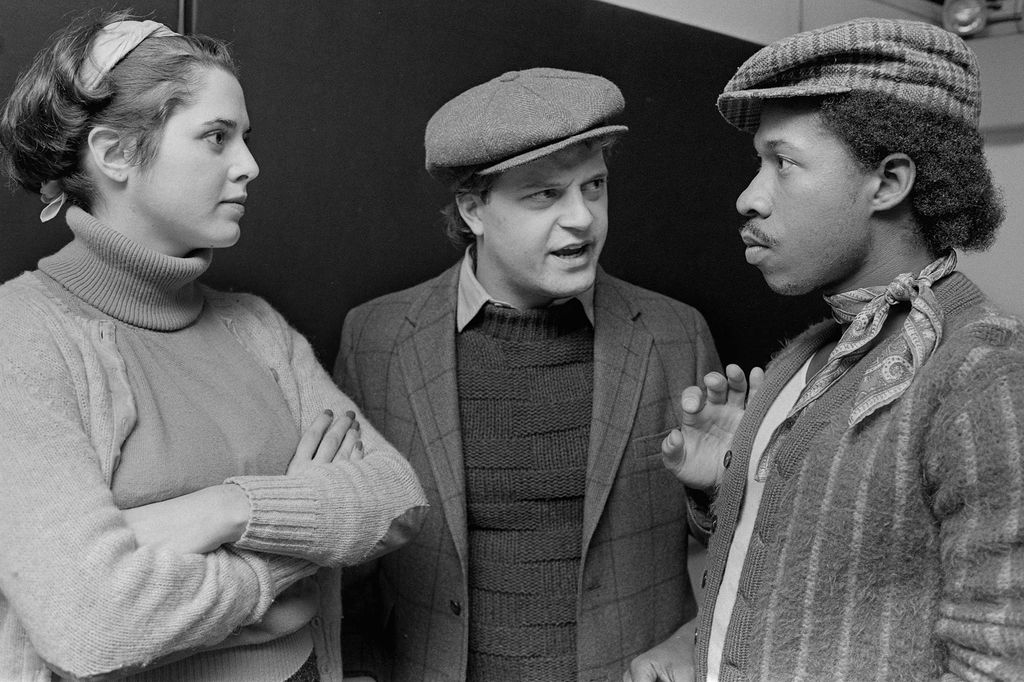
Chiklis attributes much of his success to the guidance he had as a young actor from people like Kaufman and—at the College of Fine Arts—the late Jim Spruill, who was an associate professor of theater. “Good mentorship can completely change the outcome in a person’s life,” Chiklis says. That kind of mentorship, he believes, extends far beyond acting advice. During his freshman year, he was blindsided by the news that his parents were divorcing. “My family broke. It really cracked my foundation and sent me into a kind of a spiral.” His grades and performances started to suffer and Spruill took notice. “He knew I was a good student, that I loved the craft. But all of a sudden, I was aimless and unfocused. He cared enough to say, ‘What’s up with you? What’s happening?’ He nurtured me through it. He cared enough to just ask a couple of questions.”
While Chiklis fondly recalls performing in shows like On the Razzle at the Huntington Theatre Company, which BU had established during his freshman year, he loved the rehearsals more than anything. “They were where I learned the most. At rehearsals, we were exchanging ideas—students from all over the country, from every race, creed, and walk of life. The truth is, we would go at it. Everyone was super opinionated and we discussed and argued about the shows.
“BU just opened my mind to so many things, so many people. It made me think, ‘Wow, there’s just so much to know.’”
Breaking Through
As graduation loomed, Chiklis envisioned himself heading to New York and getting a big break on Broadway. He moved to the city two days after graduating, ready to make headlines.
“I commend the School of Theatre for all the things I learned in terms of the craft and how to be the best actor that I could be. But what was lacking at the time was learning the vocational side of it—the business of show business,” he says. “That’s why I love coming back to BU and speaking to students, because I feel like I was that wide-eyed kid five minutes ago thinking, ‘Please give me some insight.’”
When Chiklis arrived in New York, Broadway was in a slump. “There were only maybe eight theaters lit,” he says. “It was all musicals and they were mostly revivals. There were almost no original musicals happening at that time.” He found some small off-Broadway and off-off-Broadway gigs, and did a few performances at La MaMa, the experimental theater group in the East Village. But he was mostly biding his time, waiting tables and bartending to make a living, and hoping that something big would come along soon. It would take two years.
I love coming back to BU and speaking to students, because I feel like I was that wide-eyed kid five minutes ago thinking, ‘Please give me some insight.’
Chiklis was working as a waiter at a West Village restaurant called Formerly Joe’s, alongside the late chef Anthony Bourdain and an up-and-coming Edie Falco. One day, his agent called the restaurant’s phone—Falco was the one who picked up: Chiklis had gotten a break. While he was still at BU, a casting director for a forthcoming film adaptation of Bob Woodward’s John Belushi biography Wired had spotted Chiklis in the senior theater showcase in New York City at Lincoln Center and offered him an audition for the role of Belushi. It took more than 12 auditions over the course of two years to finally get the role.
Things were looking up.
Reinvention
Until they weren’t.
Woodward’s book had reaped its fair share of controversy when it was released, with Belushi’s friend and Saturday Night Live costar Dan Aykroyd claiming it misquoted him and misrepresented Belushi. When the film adaptation was announced, there were plenty of vocal opponents: Chiklis has long maintained that at least one of them warned casting directors not to hire anyone from the movie. Wired’s coproducer Edward Feldman told Time magazine months before the film was released that “word was put out that this was a project not to be touched.”
“Here it is, I got a huge break playing an icon in a big feature film with an Academy Award–winning producer. It was a completely exciting, life-changing moment,” says Chiklis. “And then, by the time I’m not even finished filming the movie, I find out that I’m going to be blacklisted from making movies. My career seemed like it was over.”
For a little more than a year, Chiklis says, he was snubbed: “I couldn’t get seen for anything,” he says. “It was a horrible, fretful time.”
When the film eventually appeared on screens, Chiklis says it was “cut to pieces to avoid the onslaught of lawsuits pending against it.” The movie was panned. Moviegoers walked out of the 1989 Cannes Film Festival premiere.
Chiklis returned to New York and played some small parts in stage productions while trying out for guest roles in popular television series. Finally, the television doors opened when the late Burt Reynolds advocated for him to get a part in an episode of his show B.L. Stryker. A cameraman who had worked on Wired was now working on B.L. Stryker and arranged for Chiklis to meet with Reynolds. In a 2015 interview with the Television Academy Foundation, Chiklis says Reynolds told him he “didn’t believe in blackballing and thought I was a great talent, and he wanted to hire me, so he did.” Guest starring roles in some of the biggest shows of the time, like Murphy Brown, L.A. Law, and Seinfeld, followed. Networks were even considering him for his own show.
In 1991, he landed the starring role in The Commish, in which he played Tony Scali, the affable police commissioner of a small town in New York. He was encouraged to gain weight for the role; although he was in his late 20s when the show started filming, he was playing someone more than a decade older. The show ran for a successful five seasons, but Chiklis felt stuck, pigeonholed by the part. “Everybody thought that I was a 50-year-old, roly-poly nice guy.”
At his wife’s encouragement, Chiklis shaved his thinning hair and hit the gym, ready to reinvent himself. “At this point, no one would have hired me to play Vic Mackey. I did what I had to do to change minds,” he says. “It’s a very fickle industry. Listen to the lyrics of Frank Sinatra’s song ‘That’s Life’: ‘Riding high in April, shot down in May.’ That is exactly the life of an actor.”
Striking Gold
In 2019, the Guardian reminisced about The Shield, writing, “If you talk about the golden age of TV without mentioning The Shield, you’re doing it wrong.” The newspaper lauded the show for maintaining its quality all the way through its last episode and not petering out with a disappointing final season like other programs have. It praised Chiklis’ “magnificent performance” of a character who, despite his amoral deeds, still garners sympathy. Playing Mackey, which has arguably become Chiklis’ best-known role to date, was “an amazing, life-changing experience,” he says.
“We knew we were doing something special. It was artistically just such an incredible time. The show felt very relevant. It still feels so relevant because a question we were asking at the time through the show was, ‘What are we willing to accept from law enforcement in post–9/11 America to keep us safe?’ And, as it turns out, a lot of us were willing to accept way too much.”
His turn as Mackey opened up other parts, like Ben Grimm/The Thing in Fantastic Four and Fantastic Four: Rise of the Silver Surfer (passion projects for Chiklis, a lifelong comic book fan) and more recent roles in American Horror Story: Freak Show and Gotham.
Now, Chiklis brings a Mackey-esque tough-guy edge to his starring role in the new series Coyote on CBS All Access. He plays Ben Clemens, a longtime US Border Patrol agent who, on the same day of his mandatory retirement, finds a tunnel used for smuggling black market goods into the United States from Mexico. Through a series of events, he becomes a coyote, someone who smuggles people across the border. Chiklis, who also serves as a coexecutive producer on the series, worked with the show’s director and executive producer Michelle MacLaren for more than two years to polish the series and get it ready for development.
“This show is about a collision of cultures. It’s very timely, but the show is not political,” says Chiklis. Half of the show’s writing staff, he says, are South and Central American and Mexican, while the other half are from the United States. He is drawn to playing the complex Clemens, a character whose “viewpoint has been galvanized through echo chambers. But he starts questioning his views. It’s very disillusioning for him and very disorienting.”
Filming for the show started in November 2019, mostly around Baja California, Mexico, and Chiklis often faced rigorous shoots—including one that landed him in surgery. While shooting a scene in the Sonoran Desert during the first couple of weeks of filming, he was running up a mountain face and hopped over a prairie dog hole to avoid it. “Unfortunately, I landed right above the hole, where the tunnel was, and it collapsed. My knee completely hyperextended.” He kept going and finished the take. Although he knew he was hurt, he continued filming through the next few months with two tears in his meniscus.
Then, in March, six and a half episodes into filming, production had to suddenly shut down because of COVID-19. “We had to stop in the middle of this amazing experience that we were having. It was horrible,” says Chiklis. Still, he was inspired by how the cast and crew adapted.
“The postproduction on those episodes was done entirely remotely, which was just an extraordinary and arduous experience. But it was the only way to be able to do it. I really think this will change the way the industry does business in the future.”
Chiklis says filming Coyote brought back memories of making The Shield.
“Sometimes, when people watch something on TV, they’re watching with this benign, removed attention,” he says. But he’s not interested in that. “I want to affect people. I want to make people feel something. It’s so satisfying when I make something that entertains people, but also gets them thinking, gets them engaged, and maybe makes them see things in a different way.”
All members of the BU community are invited to the webinar A Conversation with Coyote Star Michael Chiklis: From Comm Ave to Hollywood on Thursday, January 21, at 3 pm. Register for the event, which will be moderated by Harvey Young, dean of the College of Fine Arts, here.
This article as originally published in the fall 2020 issue of CFA Magazine.
Comments & Discussion
Boston University moderates comments to facilitate an informed, substantive, civil conversation. Abusive, profane, self-promotional, misleading, incoherent or off-topic comments will be rejected. Moderators are staffed during regular business hours (EST) and can only accept comments written in English. Statistics or facts must include a citation or a link to the citation.