At the Helm of a Historic School

David Barth (Pardee’92), on the campus of Perkins School for the Blind, is the 11th leader in the school’s 197-year history.
At the Helm of a Historic School
Pardee alum David Barth, who leads Perkins School for the Blind, wants to offer children with disabilities a joyful journey
Traversing the leafy, 40-acre campus of Perkins School for the Blind, David Barth radiates pride and reverence as he points out the history, objects, and buildings of the renowned institution he’s led for the past year.
A small museum in the campus’ main Howe Building showcases nearly 200 years of history at the groundbreaking school in Watertown, Mass. On display are letters and other curios from prominent figures connected to Perkins: Charles Dickens, Henry David Thoreau, Alexander Graham Bell, and Julia Ward Howe. “Dickens comes over for his first trip to the New World, to America, and he just hates absolutely everything about America—except he loves Perkins,” Barth (Pardee’92), the school’s president and CEO, says with a laugh. “It’s amazing.”

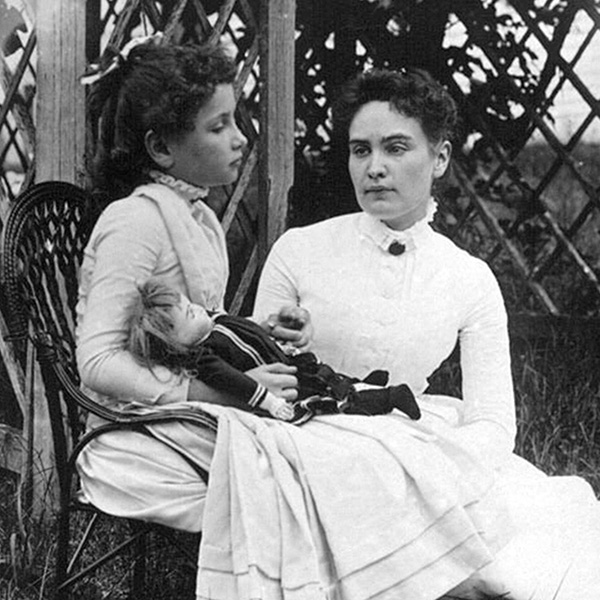
A large tactile globe—with its raised country borders and mountain ranges—that taught blind children geography in the mid-19th century is here. “If you want luck, touch Tuscumbia, Ala. That’s where Helen Keller was from,” Barth says of the school’s most famous student.
Nearby is a modern brailler, invented at the school in 1951. Despite the advent of far sleeker digital technology, the 11-pound, steel brailler is still preferred in most places, and nearly a half million of them are in use around the world. Even the pathways across campus are designed with purpose. Each one has a different texture, “because that’s how you learn your cane skills,” Barth says as we walk. “The campus is a classroom.”
Barth, the 11th leader in Perkins’ 197-year history, was appointed to the position in September 2025. He has big plans to lead Perkins into its third century, calling on his background as a US diplomat and global development executive—and his own family’s history. He and his wife, Sally, had a son, Andrew, who was born with multiple disabilities, including cerebral palsy and cerebral/cortical visual impairment, which left him paralyzed, blind, and nonverbal. Andrew died in 2023 at age 17.
In his first-floor office in the Howe Building—a Gothic structure with a 180-foot tower—Barth calls attention to an aerial painting of Perkins’ South Boston campus from a century ago, before the institution moved to its current Watertown location. “We started out as a school [only], and that is the space [in South Boston] where we learned everything we could capably learn about this population we’ve chosen to serve—children with multiple disabilities, particularly with other disabilities connected to visual impairment,” he says. “Spreading out from that school, at the center, is our ability to influence the way the world sees these children and the way the world provides for these children.”
A Global Perspective
In the early 19th century, specialized care and education for blind and deaf children were virtually nonexistent. That changed when physician John Dix Fisher chartered the nation’s first school for the blind—modeled after a pioneering institution in Paris—in Boston in 1829.
Named for a benefactor who early on donated the use of his home for the school, Perkins soon formed a campus in South Boston, which Keller would call home each winter between 1888 and 1892. By the mid-19th century, the school was printing accessible books using its proprietary Boston Line Type, a braille alternative. In 1912, the school relocated to farmland on the banks of the Charles River in Watertown, the spires of its tower now a familiar sight for commuters along the Massachusetts Turnpike.

Today, Perkins teaches almost 200 students ages 3 to 22 on its campus and sends specialists to public schools across Massachusetts to work with hundreds more visually impaired students. But its work also extends across the globe: Perkins shares the teaching practices it’s developed over the past two centuries worldwide, through teacher training, sustainable education programs, and the development of new technologies.
The school, in announcing Barth’s appointment, cited his international experience and his “deep belief in the power of education to change lives.” Barth’s internationalism began in his childhood home. His father emigrated from the Germany-France border and became a dairy farmer in Wisconsin; his mother was born in Detroit to immigrant parents from Galicia, an independent community in northwest Spain that was part of the Austro-Hungarian Empire until 1918. Barth and his older brother were born in Detroit and raised in blue-collar Randolph, N.J., 40 miles west of New York City. He says his family’s history instilled in the brothers an appreciation of the opportunities America offers that simply aren’t replicated everywhere.
“[The 1980s] was an exciting time, but it was a time of a lot of geopolitical change, social upheaval,” Barth says. “We were still in the Cold War, there was the anti-apartheid movement, the nuclear winter fears. My parents strongly encouraged both my brother and me to think about what it means to have a meaningful role in society, about being part of a community that gives value to life—not merely the act of acquisition, but the act of participation.”

At BU, where Barth majored in international relations, he found many avenues for social participation. He spent his free time reading to older patients at Beth Israel Deaconess Medical Center, mentoring young people through Big Brothers Big Sisters of America, and eventually coaching a basketball team with the Special Olympics. He recalls being immersed in the joy of the young people he coached, who were “dying to have you be in their lives and be supportive.” To this day, he laments that his Special Olympics team advanced to the state finals, only to lose on the last play of the game. “It still replays in my head,” he says with a smile.
After finishing BU in three and a half years, Barth earned a JD at the George Washington University Law School. He joined the US Foreign Service, where he would spend the next two decades—first working as an attorney, then heading up global education programs with the US Agency for International Development (USAID), where he launched the agency’s first Office of Middle East Programs. For 17 years, Barth lived overseas, in the Middle East, North Africa, the Balkans, and Central America. At USAID, where he rose to deputy chief of staff and deputy assistant administrator for legislative and public affairs, Barth’s work always included launching and running programs that served people with disabilities.
Barth retired from the Foreign Service after 20 years. He moved on to the Ford Foundation in New York City, focusing on education and youth international work and directing its global grants program. After three years at the foundation, Barth moved back to Washington, D.C., in 2018 to serve as vice president of international programs with Save the Children US. Seven years later, he was presented with the “extraordinary opportunity” to take the helm at Perkins.
“You see it when you step on campus,” he says. “Special doesn’t begin to capture how rare this place is. It has a 200-year history. It has a pure, virtuous objective. It’s staffed with unbelievable people who are where they belong, in all the right places, doing what they do best.”
Barth’s agenda includes maintaining the programming for which the school has become known and celebrated around the world, with operations in 42 countries and “deep engagement” with another 16. But as Perkins gears up for its big bicentennial celebration in 2029, he is applying lessons he’s learned and connections he’s made in his career working internationally to expand Perkins’ research, teaching, and training divisions in those countries. “The children we serve are the same everywhere,” Barth says, even if the opportunities abroad are not equally distributed. “Ultimately, the attention, the discipline with which you can provide them care, the way you protect and create space for them, is enriching for entire communities. I want to see that multiply.”
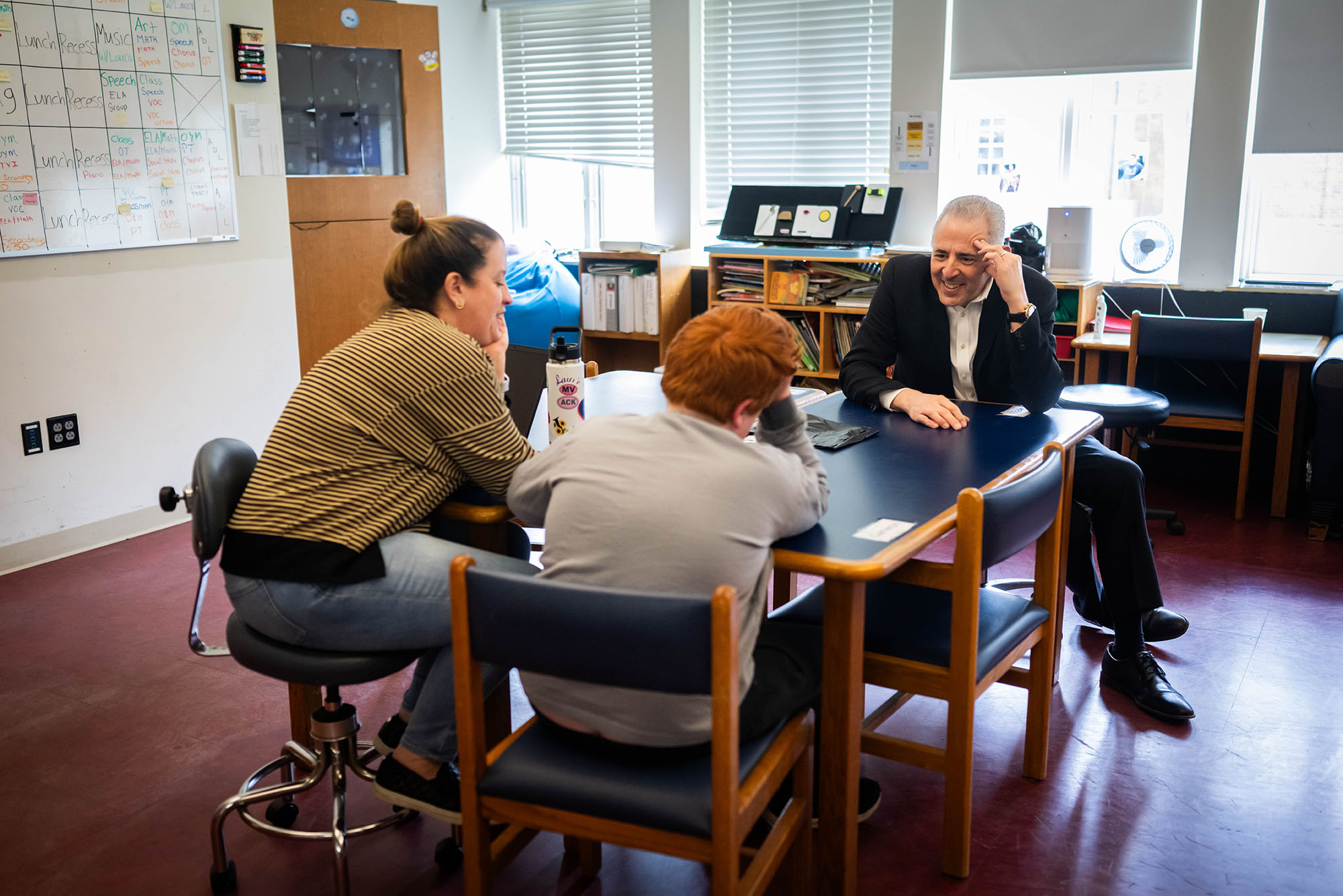
The disability community has made extraordinary progress over the last several decades, Barth adds. But he worries about decreasing funding for specialized education and a diminishing pipeline of qualified teachers and caregivers for children with visual impairments.
There’s an underlying issue, however, that’s harder to tackle, he says. “Most people simply don’t think about disability until it enters their lives,” he says. “That indifference isn’t malicious—it’s just human—and it’s the thing Perkins has always been in the business of changing.”
Finding Answers, and Joy
When disability enters a family’s world, it can be terrifying at first. That’s when, as Barth sees it, Perkins’ magic kicks in. Each Tuesday and Thursday morning, moms, dads, and children pile into a bright classroom for the school’s infant-toddler play group for kids up to three years old. All of the children have been diagnosed with a visual impairment, which could include deafblindness or total blindness, and many of them have additional disabilities that will require lifelong care. They all gather to learn from Perkins teachers and staff who are trained to help the hardest cases, and also to meet other parents grappling with a difficult diagnosis. Barth says these structured settings are as vital for parents as they are for the children.
“It’s really important for moms and dads, who a year ago had one set of expectations, and who now are feeling wholly unprepared for a journey that is going to be complicated and may feel sad some days,” he says. “But it’s also going to be really joyful. They don’t know yet how it’s going to go. We do know how it’s going to go, because we’ve got 197 years of experience with blindness and visual impairment. So we can be among the first to take their hands and show them a path that will be different, but wonderful.”
Barth knows firsthand what’s in store for these families. He says leading the school for the last year has offered a sort of healing for him and his wife, Sally. And he believes their late son, Andrew, would be proud of him.
“It’s not something I would tell people that they would choose,” he says. “But when a child like Andrew comes into your life, your life becomes beautiful in whole different ways you didn’t anticipate. We have children at Perkins who are very, very medically fragile, but their journey will be a joyful one if you allow it to be.”