Sons of Serendip’s Kendall Ramseur Goes Solo
Latest project from the alum—a cellist and composer—is a concerto celebrating America’s democracy

Kendall Ramseur (CFA’12), a cellist, composer, and former member of the musical quartet Sons of Serendip, at his home on August 4, 2026. His latest piece, A Nation Becoming: The Democracy Concerto, cowritten with the artist BLKBOK, will have its world premiere on August 28. Photo by Jackie Ricciardi
Sons of Serendip’s Kendall Ramseur Goes Solo
Latest project from the alum—a cellist and composer—is a concerto celebrating America’s democracy
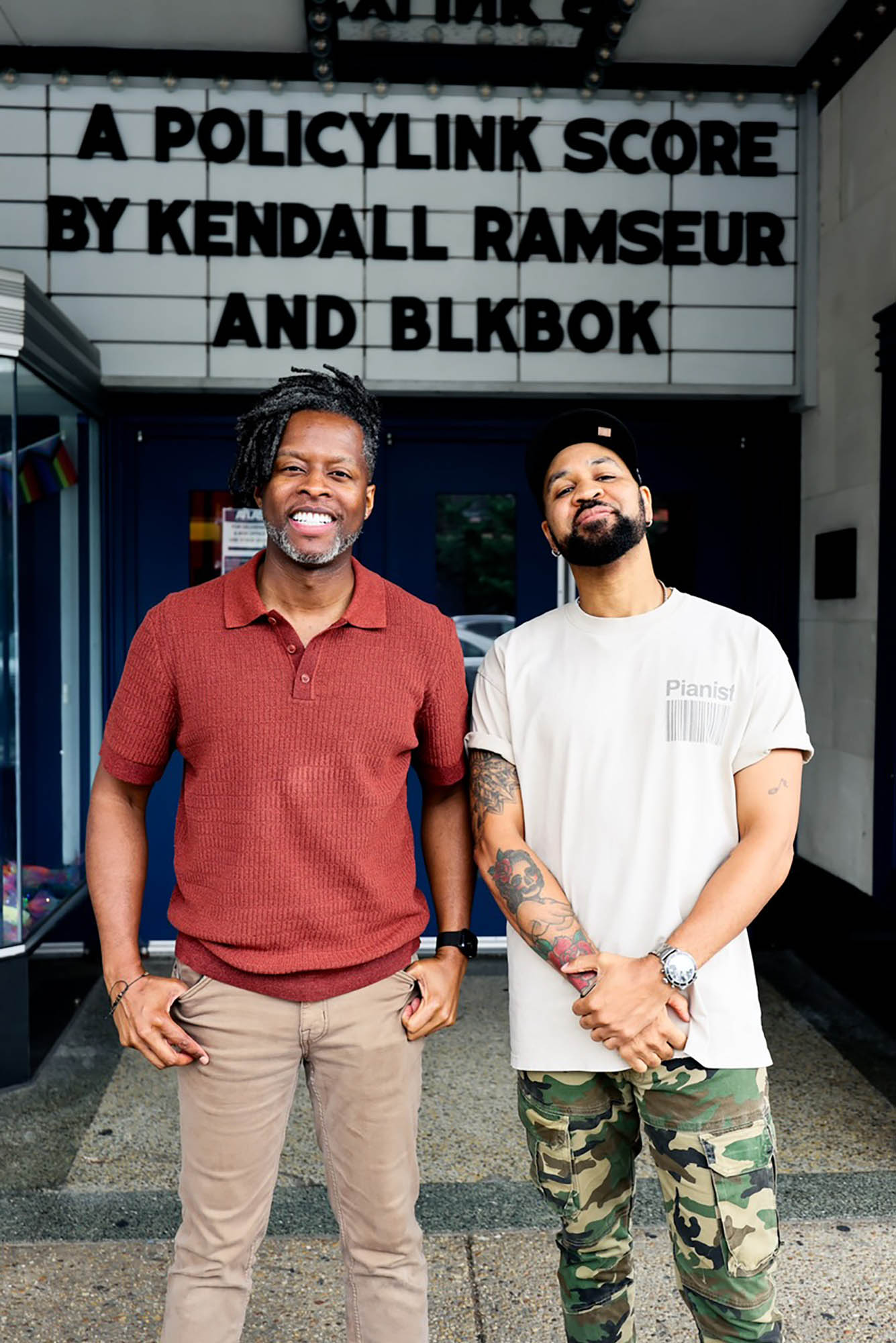
It’s the moment cellist and composer Kendall Ramseur has been anticipating for months. On August 28, his latest work, cowritten with the pianist and composer BLKBOK (Charles Wilson III), will have its world premiere before an audience of 2,500 just outside Washington, D.C. A Nation Becoming: The Democracy Concerto is one of the most ambitious to date for Ramseur (CFA’12), who shot to fame as a cofounder of the musical quartet Sons of Serendip 12 years ago, when the band won an audition to appear on America’s Got Talent and advanced to the finals. They went on to release several albums and tour widely, appearing with the Boston Pops, the Cincinnati Symphony Orchestra, and Wicked singer and actor Cynthia Erivo.
Ramseur left the group in 2022 and has pursued a solo career since then, composing scores for podcasts, large-scale concert works, and multidisciplinary collaborations that blend music, film, and storytelling.
The Democracy Concerto, comprising three movements for full orchestra and a 50-member choir, draws on many musical influences, from Johann Sebastian Bach and Mozart to early American composers and more contemporary artists, such as jazz greats Thelonious Monk and Louis Armstrong and gospel singers Richard Smallwood and Smokie Norful.
“There’s classical and baroque in the first movement,” Ramseur says. “The second movement introduces some jazz elements, and the third movement introduces more classical influences, along with contemporary gospel and soul.
“So many musical artists throughout history really inspired this piece,” he adds. “It’s not like we were pinpointing specific composers and saying we wanted the concerto to sound like this or that. It was more a case of these artists had been a part of our upbringing.”
Ramseur and BLKBOK began work on the concerto in November 2025, writing the score for piano and cello, with Ramseur later creating the orchestration for other instruments in his studio in Woburn, Mass. It took the duo seven months to finish the concerto. Earlier this summer, they traveled to Washington, D.C., for a series of workshops where they refined it, rehearsing with a 40-piece orchestra and a small choir.
“That gave us the opportunity to hear what was working, what wasn’t, and a chance to fine-tune the concerto,” Ramseur says.
Exploring the idea of democracy
A Nation Becoming: The Democracy Concerto was commissioned by the nonprofit research institute PolicyLink. Ramseur and BLKBOK were introduced to the organization’s CEO, Michael McAfee, when they were guests at the 2024 Hatch Summit, an annual gathering of innovative thinkers, artists, and changemakers from around the globe.
McAfee says he was immediately impressed by Ramseur’s musical talent and his “remarkable ability to connect people emotionally across differences.
“When I witnessed the emotional power of Kendall’s music, I knew his gifts could help advance our Governing for All agenda—our long-term effort to redesign America’s democracy and economy so they truly serve everyone,” he says.
McAfee had been looking to create an experience that could move people across various political ideologies to imagine a different future together when he commissioned Ramseur and BLBOK to create a piece of music that would explore the idea of democracy. The concerto will debut as part of PolicyLink’s annual summit.
In the video above, composers Kendall Ramseur (CFA’12) and BLKBOK talk about their work, A Nation Becoming: The Democracy Concerto, commissioned by the nonprofit research institute PolicyLink. The piece will have its premiere at PolicyLink’s annual summit on August 28 in Oxon Hill, Md. Video courtesy TEAMTRI
“The Democracy Concerto doesn’t simply commemorate America’s past,” McAfee says. “It invites each of us to become coauthors of its next chapter.”
Each movement traces a different part of the nation’s history, as well as its future, says Ramseur. The first hearkens back to the founding of America and captures the hope and desire that the young nation held out for a democracy that would work for everyone. It then explores the tension that occurred when it became apparent that not everyone would benefit equally. The second movement evokes a sense of lament that democracy has failed some people, and the third returns to a sense of hope. Ramseur describes the final movement as “epic—the choir just soars along with the orchestra, and the piece concludes with a sense of inspiration—that we really can accomplish democracy for all if we do the work together.”
In the end, he says, the concerto is about people: “It’s about belonging, it’s about stories and hope. It’s about our shared humanity. Our hope is that the concerto will invite people to listen differently to one another and to reflect on who we are, who we’ve been, and who we can still become.”
Growing up with music
Ramseur grew up in Charlotte, N.C., surrounded by music. “My dad was always playing Motown. He loved to act like he was DJing in the front room. And I would wake up to my mom singing songs of worship.” After his father purchased an upright piano for him, Ramseur began creating his own melodies. At the age of 10, he heard a teacher play the cello and was smitten.
“It was almost as if it had its own soul,” he recalls.
After graduating from the University of the North Carolina School of the Arts, he began searching for a master’s program. A former professor urged him to contact Marc Johnson, a renowned cellist and professor of music at BU’s College of Fine Arts School of Music, who died in 2014. Ramseur traveled to Boston for a lesson with Johnson and was struck by his talent and his humility.
“I also shared with Marc that I was a composer, and asked if he’d be open to me bringing original pieces and working on those,” says Ramseur. “He was so open and excited by the idea. He wasn’t just interested in developing a classical musician, he was interested in developing a whole musician.” Based on that first meeting, Ramseur decided to study for a master’s in cello performance at CFA.

Fame came two years after graduating from BU. Ramseur was living in Cambridge, Mass., when he got a call from BU classmate Micah Christian (STH’13), who asked if he was interested in helping put together a group to audition for the hit TV show America’s Got Talent. Mason Morton (CFA’12) and Cordaro Rodriguez (LAW’12) agreed to join the group, which they named Sons of Serendip.
The four had never performed altogether. But at their audition, before an audience of 3,000 at New York’s Madison Square Garden, they wowed the judges with their soulful rendition of the song “Somewhere Only We Know.” They went on to become finalists, and then signed with talent agency IMG Artists.
“It launched our career in a way we had only dreamt of,” Ramseur says. “We were able to perform nationally and internationally and create several Billboard-charting albums.”
He decided to leave Sons of Serendip when the demands of traveling got to be too much. “There was a time when we were on the road more than we were home, and I was married and had a young son,” says Ramseur, who today has two boys. There were also “things I wanted to express musically and stories I wanted to tell that needed a different angle and platform, including writing large-scale orchestral works.”

Now, he runs his own company, KYOM Productions, and composes original music for films, podcasts, and Netflix trailers. He was recently named Gordon-Conwell Theological Seminary’s first Artist-in-Context. During his residency, he’ll complete another concerto, Songs from the Wilderness.
At the same time, Ramseur is working on his second solo album, Zoë. “What I’m hoping to accomplish with the album is the revelation that we’re not called to do life alone, that life becomes much more beautiful and fulfilling when we do it in community,” he says.
One of the singles from the album, “Where Light Rises,” has already been released. The piece was commissioned by McLean Hospital in Belmont, Mass., and focuses on the themes of hope and healing in the face of mental health challenges. It is designed to honor the resilience of the hospital’s patients, as well as their families and clinicians.
Another current project has a BU tie. Ramseur is writing part of the soundtrack for a documentary about Howard Thurman (Hon.’67), a mentor to Martin Luther King, Jr. (GRS’55, Hon.’59) who, when appointed dean of BU’s Marsh Chapel in 1953, became the first Black dean at a mostly white American university. The documentary, The Psalm of Howard Thurman, by filmmaker Arleigh Prelow, features a narration by Emmy-winning actor Sterling K. Brown and is seeking distribution.
Prelow had heard the music Ramseur had composed for the Holy Ghost Stories podcast and was blown away.
“I felt the full power of Kendall’s musical voice as a composer,” Prelow says. “His musicality and the depth of feeling he brought to that work profoundly moved me.” She was searching for a composer who could provide “music that would give audiences not just an intellectual understanding of Thurman’s story, spiritual growth, and the times in which he lived, but a visceral, felt sense of it—something that would move them rather than simply inform them.”
Ramseur, who says his music is intimately informed by his religious faith, says he knew nothing about the theologian’s life before watching the documentary. “I was so moved by how Thurman shared his faith, and the way in which he saw God,” he says. “I was inspired, but also intrigued by the depth to which he understood scripture.”


Ramseur took up painting several years ago. He describes his work as “more abstract, with spiritual undertones,” and says he’s enjoying exploring how music and painting “can work together to tell a richer, more immersive story.” Photo by Jackie Ricciardi
Soon, perhaps, Ramseur’s work will be influenced by a new pursuit. “I’ve spent much of my career telling stories through music, and over the last few years painting has become another creative language for me,” he says. “I’m exploring how music and painting can work together to tell a richer, more immersive story.” He hopes to mount an exhibition of his artwork with musical pieces he’s written to accompany them.
But first there is the premiere of the Democracy Concerto. Ramseur says when he’s on stage that night—he will perform the solo cello parts—he’ll be thinking about those who have shaped and influenced his life.
“It’s not just going to be me on that stage,” he says. “There are going to be all my previous cello instructors, my grandparents, who have passed away who told my Dad I was going to be somebody. It’s going to be such a full circle experience for me, and I’m incredibly humble and grateful to be a part of it.”