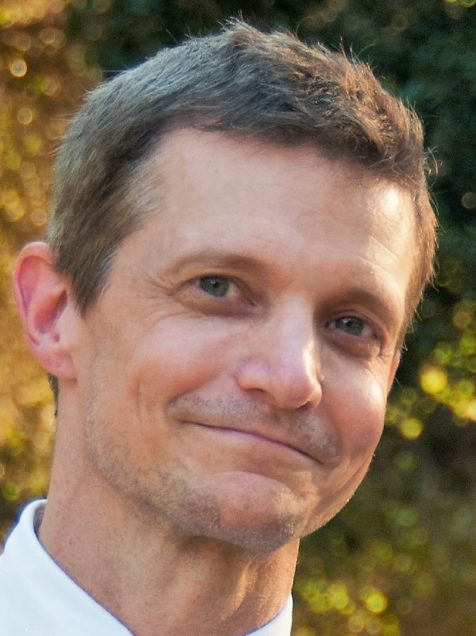
Associate Professor of German & Comparative Literature
Convener of German
Spring 2026 Office Hours: Mondays 3:45-5:45, Mondays 12:20-1:20, and by appointment.
Professor Waters teaches courses on German literature, Comparative Literature, translation, German linguistics, advanced German language, and the Humanities sequence of BU’s Core Curriculum. His research interests center on poetry and poetics, and his special expertise is the poet Rainer Maria Rilke; he is the author of Poetry’s Touch: On Lyric Address (Cornell University Press) and numerous scholarly articles on poetry. He has been the recipient of yearlong or multi-year fellowships from the National Endowment for the Humanities, the Mellon Foundation, and the German Academic Exchange Service (DAAD); has been awarded nearly $4 million in grants for critical-language education at BU (he was founder, PI and executive director of the nine-year federal grant Project GO-BU); and has been a visiting professor at the University of California at Berkeley. At BU he has been honored with the National Endowment for the Humanities Distinguished Teaching Professorship, the Templeton Prize for Excellence in Student Advising, and the Outstanding Teaching Award from the quondam Honors Program of the College of Arts and Sciences. From 2007 to 2013 he served as the founding chair of his department (now called WLL, formerly Modern Languages and Comparative Literature). From 2012-2020 he was also Associate Director of Boston University’s Center for the Study of Europe.
Excerpts from some reviews of Poetry’s Touch:
This is one of those wonderful volumes that reminds us all why we got involved with literature in the first place. [Waters’s] study is lucidly written with linguistic and philosophic density, and feelingly presented despite its formal precision. . . . Waters lifts us out of our theoretical smugness to deposit us on a higher emotional and intellectual plane generated by the poetry itself. It is a liberating experience. The whole volume is a tour de force of poetic criticism and theory. – Comparative Literature Studies (2005)
Waters’ eigene analytische Arbeit . . . erst ist das Licht, das die (für jedes der zitierten Gedichte spezifische) Möglichkeitsbedingung singulärer Rezeption erhellt und die Verantwortung für das praktiziert, was die Gedichte sagen. Auf diese Weise öffnet sich die verschlossene, umherschweifende Schrift des Gedichts und wird im dialogischen Bezug lebendig. Jenseits der üblichen Frage nach den Kommunikationsstrukturen des Gedichts vermag diese bedeutsame, luzide Studie gehauchten Formen der lyrischen Adressierung Kontur und Überzeugungskraft zu verleihen. – Arcadia (2007)
My summary cannot do justice to the careful and sensitive readings that flesh out ‘‘a criticism that hopes to give voice to the movements of the mind and emotion in reading as it is experienced, rather than as abstractly theorized.’’ – Poetics Today (2006)
Given the contemporary absorption in theory and cultural studies, this is a very unusual, out-of-era book. . . . [Waters] is aware of contemporary theory, but . . . everything depends on the intensity of his readings and the responsiveness of the poets chosen. . . . Waters repeatedly impels the reader to think again about the anxiety-ridden semantic gestures we call poems [and] bring[s] poems to new life by interweaving their rhetorical gestures. – German Quarterly (2005)
Waters’ central thesis and supporting arguments [enlist] close reading . . . of dozens of canonical and less well-known texts in at least four languages. . . . Throughout this book, Waters lucidly highlights the skill and subtlety with which each poet exploits the lexical and syntactic resources of the language in which he or she writes. . . . Waters uses a wide range of linguistic approaches (syntactic or metrical analyses in some cases, applications of discourse theory in others) to frame or sharpen his readings; at the same time, he never allows technicalities to obscure his overall goal of enriching his readers’ experience of the poetry. – Comparative Literature (2005)
Because the academic engagement with contemporary criticism, theory, and linguistics is carried out largely in footnotes, Waters is able to dedicate the body of his text to a series of thoughtful and thoroughly knowledgeable analyses of the poems, which uncover a variety of techniques poets use to reach out to the addressee. The elegance of Poetry’s Touch lies in Waters’s ability to both present and exploit those techniques as he renders the meaningful urgency of poetic address. – Virginia Quarterly Review (2004)