Carborundum Printmaking: Henri Goetz and His Legacy
February 14 - April 6, 2003
A
selection of work by the French Modernist printmaker Henri Goetz
and his contemporary followers, Dikran Daderian, Hélène
Laffly and Denise Zayan highlighting the importance of the Carborundum
printing process.
Opening
Reception: Thursday, February 13, 6-8 pm
BOSTON-
Fifty years after the French-American artist Henri Goetz (1909-1989)
last exhibited in the United States, at the Circle and Square
Gallery in New York, his work returns to the United States at
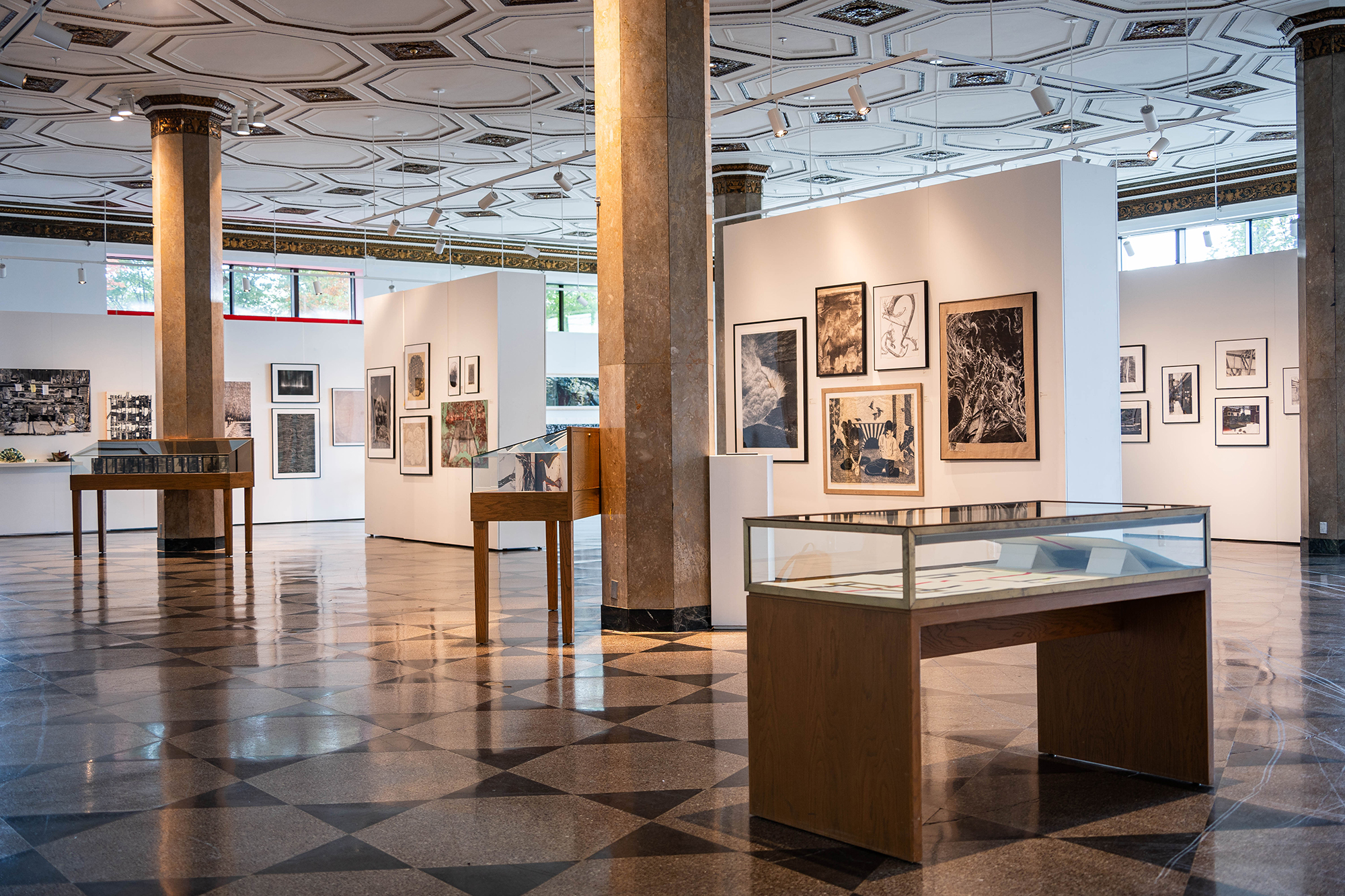
the Boston University Art Gallery in Carborundum Printmaking:
Henri Goetz and his Legacy. A focal point in post-war Paris, as
the artist's studio was a gathering place for artists and friends,
it was in his role as a printmaking teacher beginning in 1950
that Goetz made his most lasting impact. Goetz was considered
a virtuoso in his application of traditional printmaking techniques
to his non-traditional visual style. An accomplished printmaker
in virtually every technique, he also contributed richly to the
advent of new techniques, most notably the Carborundum printmaking
process. An engraving technique requiring the use of an abrasive
ground to create a granulated and textured surface, printmakers
worldwide have since employed this process. Over thirty vintage
works by Goetz will be on view and accompanied by a contemporary
selection of works in the Carborundum process by artists Dikran
Daderian, Hélène Laffly and Denise Zayan.
After
studying at Harvard and MIT Goetz left America for Paris in 1930,
where he worked in the Montparnasse painting academies frequented
by American art students. Rooted in the Surrealist tradition,
Goetz made his debut in Paris at the Salon des Surindépendants
in 1935. Goetz's first experiences with engravings date from the
outbreak of the war and he soon became a master. As the war began
to escalate in Europe, Goetz and his wife, the painter Christine
Boumeester, worked with the French Resistance. They were forced
to leave Paris for Southwestern France where Goetz met and mingled
with members of the Belgian surrealist group that included Rene
Magritte and Raoul Ubac. He also exhibited his work with Hans
Hartung and Pierre Soulages.
Returning
to Paris after the Liberation, Goetz co-founded the "Graphis
Group" in 1949 and began teaching at the Ransom Academy and
then at the Grande-Chaumière, where he opened two ateliers
in 1955. From 1953 to 1966, Goetz was also director of an atelier
in the American Conservatory at Fontainebleu. He founded the atelier
Goetz (Goetz workshop) in 1965. In 1949, Goetz and his wife Christine
Boumeester became naturalized French citizens. Goetz died in Paris
in 1989.
Dikran
Daderian was born in Beirut in 1929. His abstractions are derivative
of richly brocade fabrics, with subtle shifts in tone and weight,
composed of vibrant color. His work is often thought of as unclassifiable,
as it prefers to relay a meaningful presence over a tangible form.
French artist Hélène Laffly's prints play with the
idea of subtle shifts in texture, often forsaking color for this
purpose. Denise Zayan was born in Cairo, Egypt in 1946. Her international
roots are strongly visible in her work evidenced through the use
of lush tropical colors intermingled with the careful refinement
of French floral painting. All three artists were students at
the Goetz Academy.
This
exhibition was organized by the Boston University Paris Program
in conjunction with independent curator, Nelly Chadirat to celebrate
the renaming of the Paris campus street to rue Jean Pierre-Bloch.
A personal friend of Goetz, Bloch, like Goetz, was a prominent
member of the French Resistance.
This
spring, the Boston University Art Galleries will focus a season
spotlight on Printmaking. Other print shows on exhibit will include:
the Boston Printmakers 2003 North American Print Biennial
and The Third Arches Student Print Show at Boston University's
808 Gallery, as well as Lines of Site 2003: Confluent Visual
Cultures at the University of Alberta at the Sherman Gallery.
All of these exhibitions are part of the 2003 Southern Graphics
Conference Making Histories: Revolution and Representation.
The conference will be held at Boston University April 2-5, 2003.
For more information, visit the conference website at http://www.bu.edu/cfa/visual/index.html
or www.sgcprintconference2000.org.
Gallery
Talk
Saturday, February 15, 2pm: James Stroud, Artist & Director,
Center Street Studios, will discuss Goetz's work and the carborundum
process
Information
The
Boston University Art Gallery
855 Commonwealth Avenue
Boston, MA 02215
(617) 353-3329
www.bu.edu/ART |
Gallery
Hours:
Tue-Fri 10-5pm
Sat-Sun 1-5pm |
The Boston University Art Gallery (BUAG)
is a non-profit art gallery geared toward an interdisciplinary
interpretation of art, and committed to a culturally inclusive
viewpoint that expands the boundaries of the museum. Exhibitions
focus on international, national and regional art developments
chiefly in the 20th century, seek to present the cultural and
historical context of art, and to acknowledge the artistic contributions
of under-recognized sectors of the population. BUAG is located
at 855 Commonwealth Avenue, inside the College of Fine Arts
at Boston University (BU West T stop on the B Green Line). Hours
are Tues.- Fri., 10-5pm and Sat. & Sun., 1-5pm. The Boston
University Art Gallery is free and fully accessible to the public.