news
Jean-Jacques Lequeu: Visionary Architect. Drawings from the Bibliothèque nationale de France
The Morgan Library & Museum, New York City
January 31–September 13, 2020
by J. Cabelle Ahn
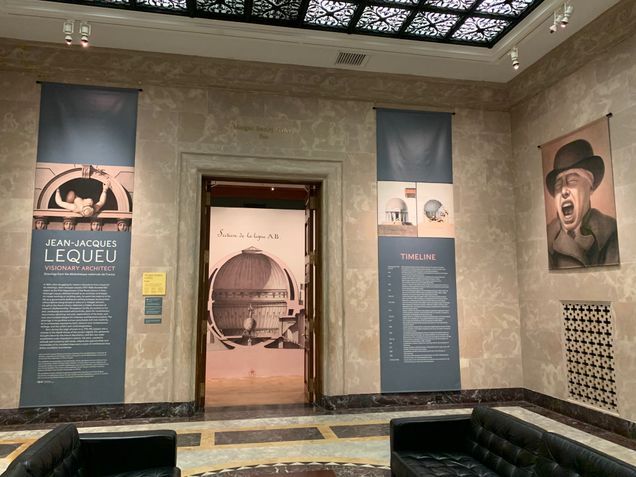
Architects and scholars Robert Venturi and Denise Scott Brown introduced the idea of the “duck” and the “decorated shed” in their influential and controversial publication Learning from Las Vegas (1972).1 These two rivaling concepts speak to the continuity and disjunction between the architectural interior and the exterior. Venturi and Brown question the accepted relationship between space, structure, program, and ornament by undertaking a close study of the Las Vegas Strip and its gaudy monuments. Preceding Venturi’s “duck” by two centuries, the architectural designs by Jean-Jacques Lequeu are equally reminiscent of the campiness of the Strip. Cow-shaped barns, butter churns atop gothic spires, a gate groaning under the weight of an oversized Gallic Hercules, temple entrances carved in the shape of smoke—these are some of the tame offerings by the enigmatic French architect, whose career spanned a period of great political instability. While none of his proposals were realized, the sheer eclecticism of his architectural inventions has posthumously invited adulation and interrogation, from his canonization as a forerunner of twentieth-century modernism to suggestions that he might have been Marcel Duchamp’s (1887–1968, France) alter ego.2 The exhibition at the Morgan Library & Museum, however, evades modernist preoccupations to firmly root him in his contemporary moment as well as within the machinery of the French Enlightenment.
The exhibition at the Morgan is the final iteration of a show first mounted at the Petit Palais in Paris, which was almost entirely drawn from the collection of drawings Lequeu donated to the Bibliothèque Nationale de France (BnF) six months before his death.3 Less than half of the drawings from the Petit Palais travelled to the Morgan, and the reduced format and the new layout promote a different narrative—a difference encapsulated in the title change from Builder of Fantasy to Visionary Architect.
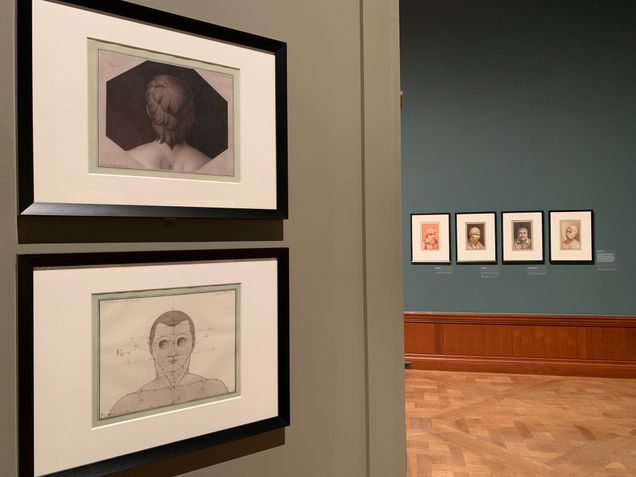
The show examines five aspects of Lequeu’s graphic production: his physiognomic preoccupations (fig. 2), his unpublished architectural treatise (Architecture civile), his responses to the French Revolution, his erotic drawings, and his ingenuity as an engineer. His unconventional designs for civic infrastructures and the unrestrained fantasy behind his speculative projects spotlight his deviation from the monolithic dogma of architectural conventions established by the Royal Academy of Architecture in Paris. By beginning the exhibition with his portrait and physiognomic studies, the Morgan exhibition immediately highlights how his approach to drawing was rooted in his interest in the body over academic doctrine—an interest echoed in a separate section displaying his erotic drawings.
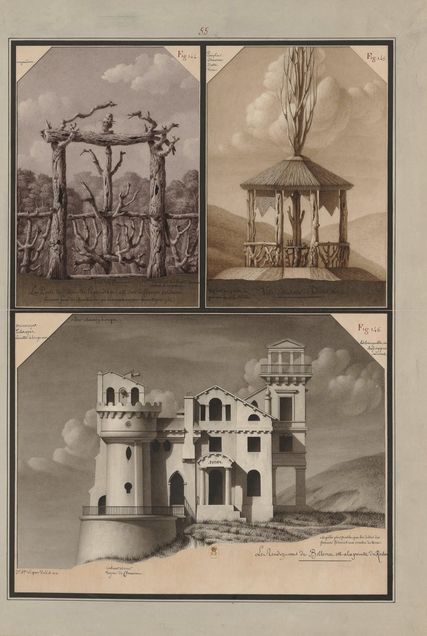
Architectural drawings are particularly governed by graphic requirements in terms of color, shading, and compositional perspectives.4 Lequeu was undeniably well-versed in both architectural theory and technical draftsmanship. Plate 55 from the Architecture civile (fig. 3), which Duboy once speculated to be a preparatory study for Duchamp’s Bottle Rack (1914), reads as an index of his architectural erudition. The rustic hermitage likely references the origin of architecture as naturally borne of tree trunks, a standard feature in architectural theory since Vitruvius.5 The diverse forms and subsequent shadows on the façade of the Bellevue confirm his mastery of sciography—a technique of shading in orthographic projections, often in grey wash.6
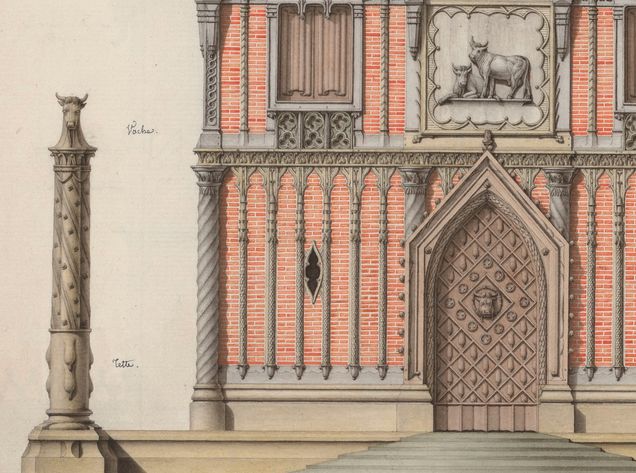
The Morgan’s rearranged array of sheets from Lequeu’s Architecture civile particularly emphasizes how he reinterpreted the eighteenth-century notion of convenance (architectural decorum). The sequential display of his projects ranging from an invented architectural order featuring a chained aristocrat to a minimalist spherical “temple of equality” reveals how Lequeu responded to the erosion of legible architectural codes during the French Revolution. In the successive section, the exhibition stresses the sensorial specificities of his buildings. The side-by-side presentation of the gothic dairy covered in cow udders (fig. 4) and the cow-shaped stable (fig. 5) are not only emblematic of Venturi and Brown’s “ducks,” but also of his architectural eclecticism.
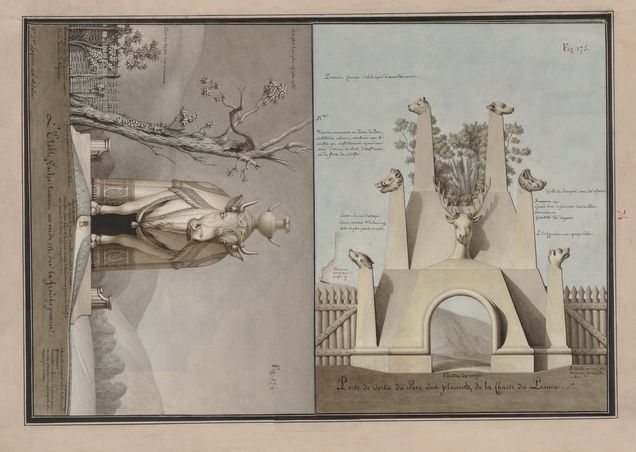
For Lequeu, it was not enough that form followed function. Instead, all five senses were to be engaged. Nearly all of the drawings are replete with annotations in his tidy bureaucratic hand. Where pertinent, the exhibition didactics helpfully point out several of his written remarks that range from quotes by Voltaire, Herodotus, and Pliny; self-compiled lists of animals, wines, and tree species; and recipes for perfume and pastes. An example is a recipe included in his hunting-gate design (fig. 5) for “Pierre de porc” (Pork Stone), which was a paste that would make the gate smell of urine and rotten egg, thus sensorially conveying its function. Additional translations of Lequeu’s notations might have further clarified his peculiar fixation on the smell, taste, sound, and tactility of buildings, which mirrored the period’s preoccupation with sensationalism.7
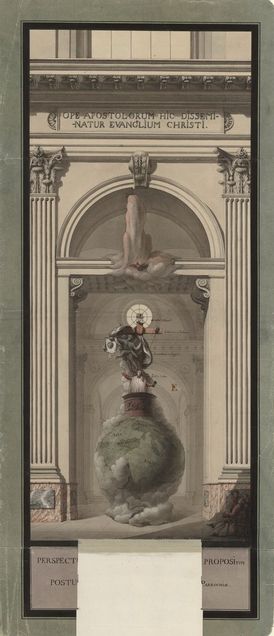
While the Morgan exhibition invites close consideration of Lequeu’s graphic prowess, there are a few sheets from the Paris exhibition that are particularly missed. One is Lequeu’s design for the pulpit of Saint-Sulpice (fig. 6). His design of a globe instead of a shell vertically attached to a pillar, as was custom, demonstrates his early departures from academic constraints and would have explicitly linked him to his eighteenth-century contemporaries.8 Additionally, many of the pornographic anatomical drawings that belonged to the restricted section at the BnF (dubbed later as “L’enfer” [hell]), did not travel to the United States, which dampens the physiological and psychosexual dimension of his architectural praxis.9 Yet, the Morgan’s focus on Lequeu’s role as a “visionary architect” rather than a conveyor of fantasies stresses his unbound graphic imagination rather than positing them as unnatural curiosities.
In the Encyclopédie, the architect and professor Jacques-François Blondel (1705–1774) asserts that “a good architect is not an ordinary man,” and that he must be accomplished in literature, history, mathematics, stereotomy, technical drawing, as well as “an inborn aptitude, intelligence, taste, enthusiasm, and creativity.”10 Lequeu’s drawings reveal that he was an extraordinary architect who went above and beyond Blondel’s requirements. His strange, poignant, and absurd drawings thus challenge and naturalize the unnatural role of the architect during this period of political transformations in France.
____________________
J. Cabelle Ahn
J. Cabelle Ahn is a PhD Candidate in History of Art and Architecture at Harvard University and the current Samuel H. Kress Predoctoral Fellow at the Drawing Institute of the Morgan Library & Museum, NY. Her dissertation is titled “Multiple Exposures: The Exhibition of Drawings in Eighteenth-century France.
____________________
Footnotes
1. In contrast to decorated sheds, Venturi and Scott Brown termed buildings whose form explicitly referenced their function as “ducks,” a nickname inspired by The Long Island Duckling drive-in that was literally in the shape of a duck: “The duck is the special building that is a symbol; the decorated shed is the conventional shelter that applies symbols,” Robert Venturi, Denise Scott Brown, and Steve Izenor, Learning from Las Vegas, rev. ed. (Cambridge, MA, and London: The MIT Press, 1977), 87.
2. See Emil Kaufmann, Von Ledoux bis Le Corbusier: Ursprung und Entwicklung der autonomen Architektur, (Vienna and Leipzig: Rolf Passer, 1933); see Philippe Duboy, Jean-Jacques Lequeu: une énigme, (Paris: Hazan, 1987). Sol LeWitt and Claes Oldenburg additionally studied Lequeu’s drawings via the 1967 exhibition Visionary Architects, a presentation of eighteenth-century French architectural drawings that was supported by the Menil Foundation which travelled to the Metropolitan Museum of Art, New York.
3. The exhibition in the Petit Palais (December 11, 2018–March 31, 2019) was curated by Corinne Le Bitouzé and Christophe Leribault in collaboration with Laurent Baridon, Jean-Philippe Garric, and Martial Guédron, and is accompanied by the following catalogue: Laurent Baridon, Jean-Philippe Garric, Martial Guédron, and Corinne Le Bitouzé, Jean-Jacques Lequeu, Bâtisseur de fantasmes, (Paris: Norma, 2018). The exhibition subsequently travelled in a reduced format to The Menil Collection (October 4, 2019–January 5, 2020) which was co-curated by Édouard Kopp and Kelly Montana. The Morgan show was curated by Jennifer Tonkovitch, Eugene and Clare Thaw Curator of Drawings and Prints. The entire collection of Lequeu’s drawings at the BnF have been digitized and the Morgan show is presently accompanied by an online exhibition.
4. An important eighteenth-century manual for architectural drawings was Nicolas Buchotte, Les règles du Dessin et du Lavis, (Paris: Charles-Antoine Jombert, 1721).
5. Anthony Vidler, “Rebuilding the Primitive Hut: The Return to Origins from Lafitau to Laugier,” in The Writing of the Walls: Architectural Theory in the Late Enlightenment, (New York: Princeton Architectural Press, 1987), 7–22.
6. Similarly suggested by Valérie Nègre in Baridon, Garric, Guédron, and Le Bitouzé, Jean-Jacques Lequeu, bâtisseur de fantasmes, 78.
7. Eighteenth-century sensationalism was spearheaded by Condillac and later by Le Camus de Mézières in architecture. See also Lequeu’s posthumous inventory for a glimpse at his sources in Werner Szambien, “L'inventaire après décès de Jean-Jacques Lequeu,” Revue de l’Art no. 90 (1990): 104–107.
8. The drawing responded to an open concours which was held to replace the provisionary wooden pulpit designed by Giovanni Niccolò Servandoni. The commission was eventually awarded to Charles de Wailly for his Bernini-esque design.
9. For more on this, see Ewa Lajer-Burcharth, “Lequeu’s Corpus: Lascivious Architecture,” in Self and History. Essays in Honour of Linda Nochlin, ed. Aruna D’Souza (London: Thames & Hudson, 2001), 25–42.
10. “Un bon architecte n’est point un homme ordinaire . . . les dispositions naturelles, l’intelligence, le goût, le feu & l’invention,” Jacques-François Blondel, “Architecte,” Encyclopédie ou Dictionnaire raisonné des sciences, des arts et des métiers, vol. 1 (Paris: Briasson, 1751), 616.
Editors’ Introduction
by Colleen Foran
When the editorial staff of SEQUITUR agreed on the theme “UnNatural” for this issue over five months ago, we considered it a thought experiment. It was an exciting and productive thought experiment, certainly, but nonetheless abstract. But the first half of 2020 has been a cultural turning point, alongside devastating health, political, and economic challenges. As a global society, we have been forced to rapidly reevaluate our relationship to technology, to ecology, and certainly to each other. What felt natural, suddenly, no longer does. The previously unnatural is now our everyday. Almost every facet of how we relate and interact with the fundamental aspects of our world has been called into question. Indeed, how we relate and interact with one another has been upended, perhaps permanently.
And yet—the need for connection remains. When it could no longer be physical, interaction moved online or to conversations held six feet apart. Art has played a pivotal role in sparking new connections, offering points of reflection or refraction as we attempt to understand this moment in history. The creation of art, and our conversations around art past and present, will be vital as we shape new visions of the future.
The prefix “un” suggests a rigid demarcation between nature and technology, between nature and humans, between what is considered correct and incorrect behavior. The term “unnatural” is a severance between yourself and others. But, as the authors and artists of “UnNatural” reveal, these dividing lines are far more malleable and permeable than we commonly admit. Art gives us a focal point to evaluate the faulty lines we draw between ourselves and the world around us, particularly in moments of crisis and disruption.
This issue’s wide-ranging feature essays reflect the stimulating ways in which art and architecture have challenged the seeming dichotomy of the unnatural in human creative production. Each offering poses questions that blur this divisive line in ways that feel vital at this juncture, during which our preconceived notions of how things “should” be are called into question. In a discursive and personal mediation, Kristina Bivona disquiets the notion of who feels at ease within the latent power dynamics of art spaces as she moves through an installation by multidisciplinary American artist Malcolm Peacock that holds space within an academic art institution. Joonsoo (Jason) Park situates American installation artist Alan Sonfist’s controversial land-art work Time Landscape in its historical and urban context as sculpture. He tracks what was deemed acceptable maintenance for the piece over time to show that sculptural maintenance is not a neutral concept or a neutral act. Kate Hublou explores the materiality of naturalness in the design work of nineteenth-century British designer Thomas Jeckyll and his use of wrought over cast iron, as inspired by Ruskinian thought at a moment of ecological upheaval. Kristina Centore examines conflicting representations of the Aswan Dam by Egyptian modernists, as well as the propagandistic way that art can been used to naturalize technology’s reshaping of our environmental and human landscape. Finally, Francesca Soriano contends that alchemy is not necessarily the unnatural process of combining discordant objects. In the work of María Magdalena Campos-Pons, Soriano finds a potent visualization of the space of the Black Atlantic, its disparate parts, and the healing whole it forges.
In his research spotlight, Manuel van der Veen discusses augmented reality (AR), its connection to the much older artistic technique of trompe l’œil, and the way in which AR replicates this deception of the eye. Through his research, van der Veen underscores how contemporary artistic and industrial usages of AR offer a false promise of a new natural while, in fact, offering only a new overlay of the unnatural.
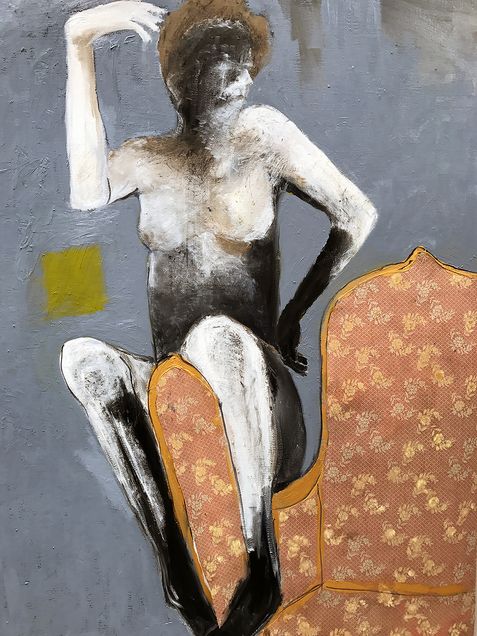
In her visual essay, Elizabeth Rankin uses the medium of painting to present and re-present the images that defined a famous Australian murder case. By exploiting notions of the uncanny and the abject, Rankin makes plain our societal acceptance of mass-media depictions of violence done to female bodies as normal and natural.
Two exhibition reviews examine recent reconsiderations of several outsized personas’ art-historical legacies. J. Cabelle Ahn revisits a show of Jean-Jacques Lequeu’s infamous fanciful drawings at the Morgan Library & Museum where she considers which aspects of Lequeu are emphasized by the exhibition: His innovative integration of the bodily into architectural plans, or his “unnatural” interests as a man and an architect. Shannon Bewley and Chahrazad Zahi discuss an exhibition at the Museum of Fine Arts, Boston, of self-portraits by Lucian Freud that span his career. For the reviewers, the curator’s sharply delineated approach reveals some of the artist’s most productive preoccupations rather than simply focusing on his celebrity.
Danielle Ezor reviews a recent publication by art historian Anne LaFont on the ways in which depictions of Black bodies in eighteenth-century European art have shaped Western notions of race. In so doing, Ezor offers a call-to-arms for more scholarship which critically engages with art and art history’s role in both the construction of race and in perpetuating racism.
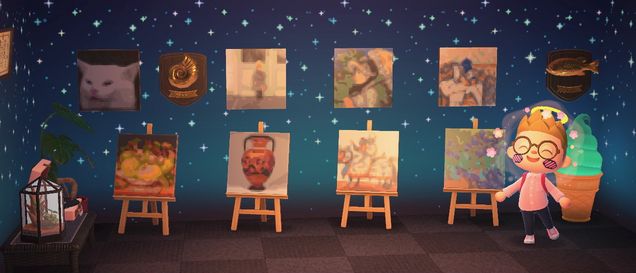
During social distancing, I have found surprising humor and grace in the Instagram challenge of recreating famous artworks with household items. This, alongside many similar trends, has been a reminder that art is not rarefied or frivolous (or, at least, it does not have to be). Art remains at the center of our consciousness, even in periods of duress. It is something that we share globally, and that can now be shared with an increasingly wide audience through technologies that allow for communication despite distance. Art is what we turn to for both comfort and discomfort, the thing that we look toward to feel better and bonded with others, as well as to ask the tough questions: What will our world look like when this is over? Right now, the myriad ways that at-home artists have used toilet paper in their recreations remind us that, even without physical spaces, the unifying connections made through art continue.
This creativity, discussion, and enthusiasm surrounding art over the past few months shows that it not only continues, but thrives in quarantine. But art rarely exists in isolation. Art posits a viewer, it invites discourse and engagement. Ultimately, art creates connections between people. We hope this issue of SEQUITUR will serve as a connection point for you.
Seeing Invisible Mxn
by Kristina Bivona

Section One
The Crusher
I went to the exhibition alone, as I usually do. I had to wiggle my way through a gallery filled with work I really wanted to care about but hardly could. See, I am deeply informed by my time as a sex worker and smothering my way through higher education.1 This experience colors the lens through which I view art. For years, the kinky requests of privileged men gave way to my agency through pay and self-exploration. I regurgitated food onto erections and zapped testicles with cattle prods for a livelihood. That money kept me alive and educated. The upward mobility from sex work to the Ivy League allows me to write from my advantage today. I humored egos in sex and witness that similar function in art. I found my first stabilities in myself and in the world this way.
The invitation for Invisible Mxn implied a repositioning of Ralph Ellison’s Invisible Man with the queer lens of East Coast underground sex (fig. 1).2 The last line disclaimed, “Unlike other parties of our nature, CELLPHONES & WATCH LIGHTS ARE ALLOWED but we urge you to consider the consensual photography of others.”3 I found my place between art, sex, and the underground when I went to see Invisible Mxn by Malcolm Peacock that night. So, I wound around the gallery past a massive zoetrope and saw paintings with too much green.
What caught my eye in the short journey around the gallery were the gestures and looks from potential johns in that academic space.4 I noticed men viewing the formal works of art whose posture and wandering eye crept up from behind privilege and confidence. Often, I can catch that glance zipping out from that soft place in between where power, denial, and insecurity thrive. I notice the ways men wield their vulnerability and see it as it moves the gaze from desire to pay. I am not above that line. I too dream of things I do not control. I let my sight drift to thoughts of at least five johns enjoying the comfortable works around the crowded gallery, folks who could detach enough from their human connection and their sexual prowess so that only a professional can suss out satisfaction. I am that ho.
Finally, tucked toward the back and almost intentionally quarantined off, I entered Invisible Mxn, a multi-room installation by Malcolm Peacock. I was greeted with a notorious hand towel. While I was unsure about the intended use for this towel I drew on experience to define what it meant for me. This was the cum towel. The one given to me that day was neat and clean but not new. Still, these little terrycloth squares were unlike the self-laundered dungeon towels of my history, which always kept their musk.
This distribution was crucial. It denoted that the viewer was walking into an establishment of sex despite the connotation of an art show established within the confines of an institution of higher education. The immediate reference to a sexual establishment filtered through my experience as an artist, student, and lapsed sex worker.
I finally felt like I was meant to be somewhere in an art space, somewhere my sensibilities about art, engagement, sex, and viewership aligned. I also identified that this space was not catered for me (a short white lady with a well-refined badditude) though my place as an outsider was open and gracious. Upon entry into this staged sex club I could reflect on how spectators and participants may view consent in institutions and underground spaces. This charged my reception of Invisible Mxn with fortitude and candor. I felt safe.
Section Two
A Stark White Room
I felt safe . . .
And I favored a small white room.
The only thing missing in its authenticity was the distinct musk of oxidized semen. The door to this room was left ajar. Inside was a bare twin mattress and a fine drawing of two men hung unadorned above. The space intimidated me more than captivated me. The room spoke more to my notions of work than pleasure. It was a cheap and fast mystique, precisely what it was meant to be. I found a nook outside of the room with a worn-in vibrating chair under dim rose lighting. It was a disturbing space for anonymous viewing/interaction with the interior of that stark white room. I found it inviting.

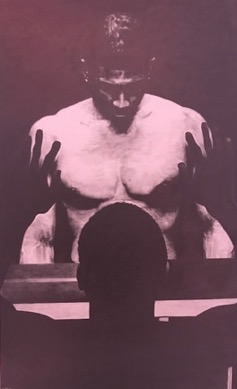
So, I approached not the room, but that small outside corner. It was slender and reserved for a single body. There was a waist-high hole cut into the wall that beckoned me into the private space and the lascivious acts I could imagine in between me and that wall. This consciousness reminded me of Bruce Nauman’s (b. 1941, United States) Body Pressure, where the viewer was invited to press their body against a wall as directed by the artist (fig. 2).5 Nauman first presented this one-page instructional text in 1974. He directed the viewer to concentrate on their body and its many parts contacting the wall and invited their senses into a potentially erotic experience. This silver-dollar-sized hole in Invisible Mxn gave me a bit of that fantasy. The more and more I pressed my body and knelt down to peer through the hole the more I made a choice to see through a glory hole.

What I saw were artworks in high-rendered detail pinned around the room (fig. 3). The one over the bed was about twenty feet from my vantage point but felt pressed into my space by the hole framing my perspective. The men in the drawing were in the grandeur of pleasure. The drawings were beyond the detail of a camera and on the level of decadence imposed by the great masters and their select protégés. Here, D’Angelo and Usher were in various states of composure (fig. 4).6 The smooth carbon of their detail hung in a curious but bold fashion inside that room. The works were tacked up, frameless, with punctured corners and clear push pins. One just floated above a stripped mattress with a bottle of hand sanitizer on the floor. There were sweepings of pencil dust, condom wrappers, and hair nearby. These captivated me most, the tender and filthy leavings of a fleeting intimate space.
Section Three
Étant Donnés and A Carcass
“Those sheets are dirty and so are you.”7

The drawings and their environment were a fetching simulacrum (fig. 5). The show offered up an underground sex space in an academic gallery but its content kept close to stigmatized reality. This enabled the viewer to handle the idea like a mirror and see themselves in it. Invisible Mxn then built up and offered an independent expression. That hole and the room to gaze upon relayed the shortcomings of a previous artistic voyeuristic exercise: Marcel Duchamp’s Étant Donnés (fig. 6).8 This final work by Duchamp (1887–1968, France) was made in secret from 1946 to 1966 and now exists as an unfinished posthumous installation at the Philadelphia Museum of Art.9 Duchamp’s work begins with the viewer as voyeur. A wooden barn door features two eye holes. Beyond that, in the guts of his installation a woman is laid bare in a pile of brush. She is both languid in her sexual moment and preserved in someone else’s sight. Her position is completely absent of blessing—you are not her lover. Here, the viewer looks on to the genitals first and body second. The face is not visible.
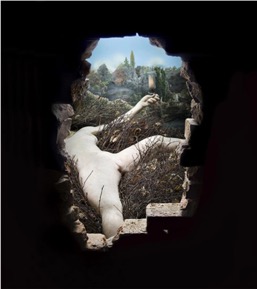
Duchamp shared his salacious sightline with an acute awareness of posed voyeurism. Peacock built on this in Invisible Mxn by requiring viewers to move through their thoughts and become implicated in this imagined but real space. Invisible Mxn asked one to bask in more than the funk and rigor of modernity and decide this was indeed a better hole. This fresh work smacks of risk. The blurred lines of implied consent take the viewer into their own knowledge and engagement. This risk is in fact an act of care. It was a measure of understanding and choosing intimacy over respectability.10
I digested my thoughts, I let myself imagine Usher and D’Angelo as two anonymous men fucking for money. This work left enough space for me to project sex work. It was playful but severe. To me, these figures were just getting down in a safe space following a hard day of jacking off johns for occasional good tips. I saw myself playing pretend and felt the resistance to a canon of fine art dominated by white men. I do not care about their art, those canonized men who pay sex workers but perpetuate our criminality. Art and theory often require me to detach from life experience. This is an exclusionary tactic of cultural oppressions. More often than not, when folks of color and sex workers work their way into the verified spaces of institutional thought it is exploited. Ideas are put in the stead of lived experience and a distanced supremacy of abstraction takes precedent over the bodily and lived knowledge. More often than not this is perpetrated by someone who has more relationship to the john than the sex worker: it is the oppressor hushing the oppressed.11
That stark white room gave me space for honesty. For once, I did not feel separated. I knew little and cared less about the rules in art and life. I cared less and less about the purposeful exclusionary tactics in fine art. This kind nihilism galvanized and bettered my experience in this academic gallery. It weaponized that exclusion, turned it double agent, and made something obscure so tender and clear. Thank you.
Section Four
Echoes and Ripples
I was taken out and washed off. It made sense to go see the pool next. Yes, the pool—in a gallery, staged with great care (fig. 7). It was in a room made of four roughly fabricated walls framed with wooden scaffolding. There were manholes cut to climb through and peek up to a second floor. I chose to climb up first and look around. I felt disembodied, like a magician had severed me in half. I stood waist high and viewed rudimentary childlike caricatures and an odd collection of action figures. The school-daze doodles were contrasted by more rendered drawings. The drawings in this light revealed a wash of carbon so rich that they shined and dipped into dark monochrome like a lithograph. Neither the renderings or caricatures were treated as better than the other, all were hung with tacks and tape.
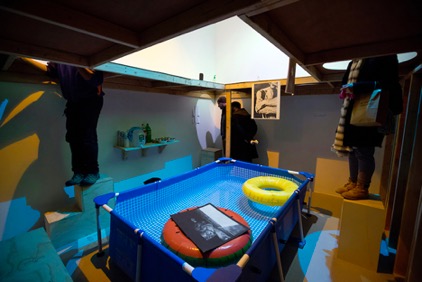
The pool featured a drawing set on top of a cheap plastic watermelon inner tube (fig. 8). The drawing lived on a thin membrane; in it, an adolescent reached toward the picture plane, foreshortened on a black-and-white checkered kitchen floor. His underage body was well drawn and presumably created over many tedious hours. All that labor atop a pool of water.
This repositioned the art. It endangered what is so often cherished. A well-made thing was left to float and, hopefully, not sink. I thought about our security, about what an unsafe place the art world is: the inhospitality of our schools with their slick prison pipelines, ideas of jobs framed out by insurmountable and regenerating social barriers, and most of all the staunch collections of museums reflecting the bias and trends. In these spaces, you cannot help but be co-opted if you want to stay afloat. And on that thin membrane of plastic, it was clear how much complexity there was in this danger. This pool was ominously tranquil. It was a powerful force turnt out into a trope. The devices Peacock used held the reaching boy from the playful and destructive liquid below.

Peacock positioned his work as both viewer and destroyer. The danger is not the water; it is that he brought the water into the formal space. Then put drawings that he labored on for weeks on top of that water and pinned others up with tacks and tape. Like a teenager in the bedroom of his parents' house, it was self-aware and existed on this destructive membrane. It was an unsafe space where discussion about disease and criminality are part of a queer archive but never the sustainable lifeline in art.12 It is just the daily math where you and I are added to life in a deficit and then expected to thrive. Galleries are spaces of mistrust; they are white in appearance and rule. They are the ruthless modernist dregs of Duchamp’s money shot here to fetishize your labor and turn your art into something of which you can never be a part.13
All you can do is get tough.14
I still had my towel in my hand.
Section Five
Lunch
“I do not know if we can teach someone like this?”
This was a quote from one of Malcolm’s educators. It came up in a discussion over lunch between Malcolm, Alexa Smithwrick of Recess Gallery, and me. That day Malcolm had finished his thesis installation and we sat down to eat a meal and be present and supportive as Malcolm processed the idea of a complete but lonesome MFA. He said to Alexa and me, “Do you know what so-and-so said to me when I started here? They said, ‘I do not know if we can teach someone like this?’”15 Malcolm had attended that school to work with that artist. I have been teaching for ten years and a student and an artist for far longer so I know the double sting of that statement, what it is like to be told you are beyond help and without community.
Yet, I also know the perspective of a teacher feeling work that moves as fast as cutting wind, unstoppable and irreverent. That force is cataclysmic in a classroom. None of the other students know how to keep up and you hardly do yourself. It is not that you cannot teach that, train that, domesticate that—but why would you want to? To change the direction of an incredible nature? To shift or wield that? I like to stand back and watch it go, let it live. It is important to understand what bell hooks stated in “Against Mediocrity,” that the separation between what one already knows and what one ought to know puts folks in camps and creates conflicts.16 Knowledge and its impact can be weapons but if intuitive and lived experience is already doing that work, why interrupt?
Invisible Mxn filled that gallery. It brought me to the precipice of human pleasure and pain. I wanted to both be in it and run from it. It shared with me a climax of human experience that with the smallest misstep will retreat into the confines of one’s self and never offer its reprieve. I do not get pleasure often. I get to work. This space was a pleasure. It was the visual messiness and clarity of climax. It is something one struggles so hard to get to and tries so desperately to hold once you’re there.
So, maybe so-and-so was right. Do not try to teach that or put that in a camp.17 You cannot guide someone into their own joy or what defines that, no matter how good you are. Do, however, be a support and a resource. Make yourself warm to those who refuse to be told they are not allowed to live as themselves.18 After all, the mere pressure of not belonging is enough to make one fracture and fray.19 No, you do not teach it, you nurture the almost painful process of simply trying to be authentic.20 You create safety and support where none existed because we are all destined to fail and it hurts. If your presence in a life can offset odds of opposition then risk is the only option. Risk your comfort by not teaching but modeling radical kindness.
Interlude
Alexa’s Joy
“What is your race? Brooooonze!”21
Alexa's ignition of laughter. An uproarious molten gold of happiness. It flowed through the air and seethed. There is power in this laughter. Alexa’s joy was a cardinal direction pointing to pure volcanic black rock and the edges outlined her wealth in the face of hate.22 I sat while she and Malcolm and another sweet friend named Brendan talked and sang to Destiny’s Child. I sat comfortably in my discomfort, at ease in their happiness. It is a pleasure to be around happy people. And that cadence of singing and laughter filled the fabricated and exposed walls of Malcolm’s exhibition.
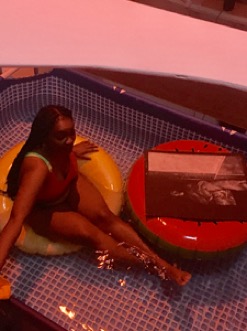
We sat after hours in the gallery and drank that night (fig. 9). The work surrounding did not jump nor excite for anyone else. It fully allowed us to embrace it and for us to crumble and be rebuilt. We were in the power of what a person can do with their own two hands and we were in that together. That is where I witnessed Alexa’s joy. The giggles that undermine white supremacy.
See, there is casual violence in every day. In passive aggressions and invisible labors. It is the murder of black folks by cops and the hasty amnesia of the white world.23 Because until everyone had a camera on their phones not one media outlet cared about folks getting killed by the cops. The videos of Freddie Grey, Philando Castile, Sandra Bland, Michael Brown, Eric Garner, Alton Sterling, and so many more changed things for a moment.24 Yet, every time a video would surface the media and its willing audience would abide by the hysteria for a few weeks and then patiently wait for another black or brown body to be maliciously killed and recorded. It was gross. Watch it on the news, act like you care for two weeks then move on. The vapid pseudo-consciousness should be met with a mass and fearless inventory of our cultural value system. Where are those videos today? Why aren’t they on the news? Like the decades before, black boys and men are still being killed by the cops.
Section Six
Dreams
I sat in the pool at Invisible Mxn. I was in my bikini with my roller-derby muscles and bruises and Alexa in her racy one-piece composed of tenuous strips of spandex. I kept thinking about the reach of our bodies. I kept thinking about these bodies, how they become the signs for privilege or oppression, most often not by choice. In this exhibition so full of choice and consent, taboo and risk, I thought about how we become ourselves under these circumstances.
I played with that sticky hate I have for how mean whiteness is. I chewed on it and on my disdain for respectability, pulling it in between my teeth and cheeks, wondering what it is made of, like old gum. Did you hear that cum is mostly sugar and fat? I heard it too. It was the only thing not in the exhibition, but it was everywhere. It was in the tender and sweet references to coming of age and learning to be. It was everywhere in between protected sex, raw sex, voyeurism, jail, sex work, consent, and so on. It was the intimacy of peeking through a hole and handmade adornments.
That force of life, spunk, cum, semen, jizz, all of it. From the drawings tacked and taped to the wall to the slick and dangerous surface that art lives on, to the little bits of curly dark hair sweeping across the floor. It was everywhere and for the first time I swallowed it all up and left with my belly full.
Conclusion
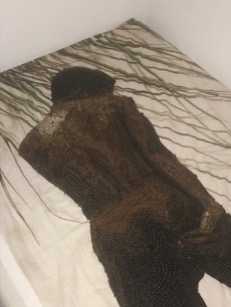
Invisible Mxn recreated a way of thinking about one’s place in the world as full of pain and eros among risk and pleasure. I was troubled, I bore visible scars. The exhibition saw this in me and others. It was presented in the darkened back room was dark where there was a mattress with a well-laid sheet and a full-size figure embroidered on it (fig. 10). The person was laid down, sick, and was pulling his ass to one side with his head tucked down. It was not a place of pleasure. But as I moved through the space it became a place of healing. There were pillows scattered about and in each satin pillowcase there was a recording. I sat and listened to a man—a family member of the artist—reflect on life and jail. I saw a stack of books in the dark and read some pages from No Tea, No Shade.25 I did not feel better but I was alive and present in this vulnerable low note.
Candor like this does not play with the exclusivity of institutions. A life of fortitude with the ideals of class, gender, and queer exclusivity. It cannot vie for attention amongst the fronts of inclusive feminism foregrounded white supremacy. It does not pander to exclusion of sex workers and trans persons by Gloria Steinem.26 And it most certainly belies cultivation by the systems of white men.
There are notable dangers upheld by the pervasiveness of white women in the arts and activism. Those perpetuating the legerdemain of good intentions and no accountability are backed by racist ideology. This is the monster of people hiding in microaggressive shadows. They will come at you from those dark spots. I like to take note of this when I am comfortably tucked into my bed at night. I try not to forget that I may have cleared out my closet but I may have left something scary under my bed. Ideology rooted in ignorance may consume someone in their lifetime despite all good intentions. Just ask your neighbor in her pussy hat, how did she act when she got on the crowded DC train after the Women’s March and she had to share her space again? If you will not even slightly compromise your own advantage to help someone else you are truly invested in life?
____________________
Kristina Bivona
Kristina Bivona is a first-generation college graduate. She is currently enrolled as a doctoral student at Columbia University and holds a MFA and BFA in Printmaking. She uses critique formats informed by lived experience to enlighten the bridge between art practice and scholarship.
____________________
Footnotes
1. Smothering references a BDSM activity that reinforces the dominant/submissive relationship.
2. See Ralph Ellison, Invisible Mxn (New York: Vintage Books, 1989).
3. Malcolm Peacock, Invitation to Invisible Mxn (Rutgers University, 2019).
4. A man who purchases sex or sex acts is referred to in slang terminology as a john.
5. Bruce Nauman, Body Pressure, 1974, performance, variable dimensions.
6. D’Angelo and Usher are both musicians and performers. D’Angelo’s song “Untitled (How Does it Feel)” (2000) and Usher’s song “Confessions Part II” (2004) were both referenced in Peacock’s artworks.
7. Descendants, “Clean Sheets,” recorded 1987, track 1 on All: New Descendants LP, SST Records, 1987, vinyl LP.
8. Michael R. Taylor and Andrew P. Lins, Marcel Duchamp: Étant donnés (Philadelphia: Philadelphia Museum of Art, 2005).
9. During the twenty-year-plus timeline for the creation of this work of art, most assumed Duchamp had left his art practice solely to play professional chess.
10. See Alison Reed, “The Whiter the Bread, the Quicker You’re Dead: Spectacular Absence and Post-Racialized Blackness in (White) Queer Theory,” in No Tea, No Shade: New Writings in Black Queer Studies, ed. E. Patrick Johnson (Durham, NC: Duke University Press, 2016).
11. By either holding a relationship to the oppressor over the oppressed, or by being the oppressor.
12. See Michel Foucault, The History of Sexuality (New York: Pantheon, 1978) for more on this idea of disease and criminality; Melody Pennell, “Queer Cultural Capital: Implication for Education,” Race Ethnicity and Education 19 no. 2 (2015): 324–338.
13. See Mark Wigley, White Walls, Designer Dresses: The Fashion of Modern Architecture (Cambridge, MA: MIT Press, 1995).
14. Audre Lorde, “The Uses of The Erotic,” in Sister Outsider (Berkeley, CA: Crossing Press, 1984), 87–91.
15. Malcom Peacock, in conversation. February 15, 2019.
16. bell hooks, “Against Mediocrity,” in Writing Beyond Race: Living Theory and Practice (New York: Routledge, 2013), 165–166.
17. bell hooks, “On Being Black at Yale: Education as the Practice of Freedom,” in Talking Back: Thinking Feminist- Thinking Black (Boston, MA: South End Press, 1989), 63.
18. See Lauren Berlant, “Cruel Optimism,” in Cruel Optimism (London: Duke University Press, 2012).
19. Ibid., 6.
20. hooks, “On Being Black at Yale,” 63.
21. Malcolm Peacock, quote from Instagram Live video, February 20, 2019.
22. Audre Lorde, “Power” in The Collected Poems of Audre Lorde (New York: W.W. Norton & Company), 215.
23. Joni Boyd Acuff, “Failure to Operationalize: Investing in Critical Multicultural Art Education,” Journal of Social Theory in Art Education 35 (2015): 30–43.
24. Jasmine C. Lee and Haeyoun Park, “15 Black Lives Ended in Confrontations with Police: 3 Officers Convicted,” The New York Times, May 17, 2017, https://www.nytimes.com/interactive/2017/05/17/us/black-deaths-police.html; this article documented men and women assassinated by the police in the early 2010s.
25. See E. Patrick Johnson, ed., No Tea, No Shade: New Writings in Black Queer Studies (Durham, NC: Duke University Press, 2016).
26. Rachel Cargle, “Unpacking White Feminism” (lecture, The Pennsylvania State University, University Park, PA, March 20, 2019).
Lucian Freud: The Self-Portraits
Museum of Fine Arts, Boston
September 13, 2019–May 3, 2021
by Shannon Bewley and Chahrazad Zahi

The portraits of Lucian Freud (1922–2011) dominated the discourse of the figurative genre of painting throughout the twentieth century, specifically in the Anglo-American realm.1 As a member of the influential group of figurative artists in the 1970s, known as the School of London, Freud’s life and his career ran parallel to the late abstract expressionists.
In partnership with the Royal Academy of Arts, the Museum of Fine Arts, Boston (MFA), presented Lucian Freud: The Self-Portraits, curated by Akili Tommasino, Associate Curator of Modern and Contemporary Art at the MFA (fig. 1). This exhibition was the first to explore Lucian Freud’s self-portraits over the course of his lifetime. The exhibition opened with Freud’s first self-portrait painting, Self-Portrait (1940), then moved through a chronology of his paintings, leading visitors in an oval towards his last self-portrait in 2002’s Self-Portrait. The exhibition showcases the artist’s ability to reveal a broad range of human emotions through different techniques as he shifts from cool-colored, detailed works to the pink, fleshy toned paintings typically associated with his mature style (fig. 2).

The chronological sections of the exhibition, which include “Reflections in the Studio,” “Late Self-Portraits,” and “Drawing,” also trace Freud’s experimentation with different media. His reputation as a magnetic philanderer receives only a quick mention in section-text panels in favor of attention to his professional practice. Instead, the curatorial approach emphasizes the artist’s own fascination with changes in his interior and exterior self-image. The exhibited paintings allow for close visual comparison of his experiments in mirrors, materiality, and nudity in portraiture.

The exhibition points to how the thickly impastoed skin of his subjects, as seen in the 2002 oil painting Self-Portrait, Reflection, reveals the artist’s occupation with the fragility of the aging body (fig. 3). The emphasis is on the artist’s technical tour de force as revealed in his look at the sensual and the scabrous. Yet, self-portraits which trace one’s physique as it morphs over decades are profoundly narcissistic and introspective. This undertones of this fascination with the self-image remains unexplored in the exhibition. Equally unaddressed is Freud’s unsettling emotional relationship with his sitters, implicit in Flora with Blue Toe Nails (fig. 4). Here, the artist’s shadow encroaches on the bed upon which a young woman reclines. The shadow, similar to the mirror, turns the canvas into a double space enclosed by two temporalities: an initial instance of the artist as producer of the scene and a second time when the artist places himself alongside the sitter as a subject of the painting.2 Addressing the uncanniness of this doubling would have provided a useful framework to understand the creative process of the artist in relation to his command of the medium and its materiality, as it enhances the emotional charge of the painting.

The mirrors hung in the “Self-Portrait Studio” room encourage visitors to snap and share selfies from the exhibition, but the space fails to connect these selfies to Freud’s deeper exploration of self-fashioning. Freud’s paintings suggest that we should be skeptical of a consistent, internalized self-image; that we should try to apprehend ourselves the way others see us—as fragments captured from different angles. The exhibition depicts the self without giving viewers much space for a deeper contemplation of the historic and present-day self-portraiture.
The exhibition succeeds in uncovering one of the most iconic twentieth-century Western painter’s interests in materiality and aging. The MFA has pulled back the curtain to the lifestyle of an art-world celebrity, while revealing his obsession with the vulnerability of the aging human form.
____________________
Shannon Bewley
Prior to entering Boston University as a PhD student in the History of Art and Architecture, Shannon Bewley was the Provenance Research Fellow in the departments of American and European Art at the Birmingham Museum of Art. Her research areas include photographs of conceptual art, modernist sculpture, and exhibitions histories.
Chahrazad Zahi
Chahrazad Zahi was an independent curator before she joined the department of History of Art and Architecture at Boston University. Since 2012, she has been concerned with stimulating the publishing of art histories of the MENA region, beyond the western canon.
____________________
Footnotes
1. Museum of Fine Arts, Boston, Lucian Freud: The Self-Portraits, exhibition introductory section text panel.
2. The impossibility of representing a living subject is one of Lucian Freud’s central themes, as the portrait has long been viewed as failing to capture the presence of the sitter's subjectivity. Discussing the process of being represented, Roland Barthes writes of a sense of inauthenticity: “I am neither subject nor object but a subject who feels he is becoming an object;” Roland Barthes, Camera Lucida: Reflections on Photography, trans. Richard Howard (London: Fontana, 1984), 14. The artist circumvents the objectification of the subject by using mirrors and de-doubling, in Barthes’s terms, the subject.
L’art et la race: l’African (tout) contre l’œil des Lumières
Anne LaFont
L’art et la race: l’African (tout) contre l’œil des Lumières
Dijon: Les presses du reel, 2019. 476 pp.; 132 color ills., 8 b/w.
€32.00
9782378960162
by Danielle Ezor

In 2017, Anne Lafont boldly pointed out that art history, as the study of the visual, is a “remarkably efficient tool” for studying race as a construct likewise rooted in the visual.1 With her 2019 book L’art et la race: L’African (tout) contre l’œil des Lumières, Lafont demonstrates both how right she was and just how much more work there is to do.
In the introduction to her book, Lafont poses the question of how to address the development of the image of the African over the long eighteenth century—a topic as large, important, and difficult as that of the depiction of race. This book is intended to address this topic, primarily though not exclusively in the French context, in order to both to bring to the fore images of Black people in the long eighteenth century and to discuss how these images and objects contributed to ideas about race during a time when race as a function of physical appearance was unstable.
Lafont argues that her first chapter necessarily addresses whiteness because whiteness also existed as a race. Furthermore, in the eighteenth century, the increasing awareness of race created a great imperative to depict racial whiteness, most clearly expressed in the portraits of white women accompanied by Black slaves. At the end of the seventeenth century and beginning of the eighteenth, whiteness had to be actively performed. However, Lafont devotes most of her attention in this chapter to images of Africans with white skin who captivated Europe: those with vitiligo and albinism. For Lafont, the images of these people are more interesting than those displaying the whiteness of white Europeans precisely because Europeans understood Africans with vitiligo or albinism as proof that whiteness was the “true” color of humans and thus blackness was a stain, which marked Africans as less than white humans. Lafont also considers how paintings and prints depicting these people focus on women and on the depiction of their bodies as curiosities.
Lafont’s second chapter focuses on the collaboration of the visual arts with the sciences and the study of humans in the last decades of the eighteenth century and during the first half of the nineteenth century. Lafont argues that the images that accompany the works of these anthropologists are more telling of their theory and had a stronger effect on society than their texts. She focuses on Camper, both because he believed in monogenesis (a single origin for all humans) and because he was a trained artist, doctor, and anatomist. His drawings, Lafont argues, set the standard for the anthropologists to come with their use of “scientific” methods and calculation. She also argues that Camper is the visual origin for the neoclassicism of the 1790s and early 1800s, drawing a particularly effective line between Camper and Flaxman. The rest of her chapter focuses on anthropologists in the first half of the nineteenth century and the desire to construct race through the skeleton, in addition to other physical traits. She argues that the anthropological theorization of how to measure race and record it visually was central to how race was depicted in art, and she refers to the influence of anthropological theory on art in later chapters.
Lafont’s third chapter considers the construction of blackness in portraiture. Although portraits of Black people were quite unusual at this time, Lafont highlights one pastel painting and one sculpture from 1741 and 1761 respectively, both of which were made also as portraits of their white slaveowners. For each object, Lafont discusses the history of the family and the model and analyzes the image of the Black slave in contrast to that of the white owners. Lafont contends that these unusual portraits provided the artists with an opportunity to play with portraiture, as they were not beholden to a patron, which resulted in more intriguing objects than the corresponding portraits of their white slaveowners. Lafont concludes this chapter with Girodet’s Portrait of Jean-Baptiste Belley (1797), which for this reader was a refreshing discussion of this painting that is often favored in discussions of race in eighteenth-century France. With this portrait, the author argues, Girodet inserts himself into the debate discussed in the second chapter. It is not race that is an issue but the hierarchy of races, which Girodet adeptly evens out by placing the bust of the abolitionist Raynal and Belley at the same height. Lafont argues that this portrait simultaneously presents a paradigm of binary contrasts and of equality.
With chapter four, Lafont turns towards the French colonies and North America. She focuses on two comparative case studies, one in colonial America and one in revolutionary Haiti. In both cases she considers the depictions of—or rather lack thereof—revolutionary Black men: Crispus Attucks, who was killed in the Boston Massacre, and Toussaint Louverture, who led the Haitian Revolution. In both cases, neither was depicted in their lifetime, but a lively print culture arose after their deaths. This stands in contrast to the painted depictions of two well-educated and formerly enslaved men: Yarrow Mamout and Jean-Baptise Belley. Lafont uses these contrasting cases to return to her overarching question of how Black people were depicted over the course of the long eighteenth century. The actual heroes were never subjects of works of art in their own lifetimes, but Belley and Yarrow Mamout had academic portraits done. However, she argues that these portraits deny the violence of their former status as slaves. Altogether, these cases demonstrate how art history reveals, through both presence and absence, the taboos of an era—in this case, the fear of the truly heroic Black male body.
Lafont begins her chapter on material culture and race in the long eighteenth century by questioning the lack of research on depictions of people of African descent, or Africanerie, as she calls it. The aim of this chapter is to reconsider decorative art objects, particularly luxury objects, through the lens of Africanerie. She begins with textiles, arguing the centrality of textiles to the eighteenth-century colonialism, both in the East and in the West. The remainder of her chapter is devoted to exploring the fantasy of Africanerie in clocks. Lafont begins this section by illustrating to technological relationship between timekeeping, slavery, and colonialism in the seventeenth and eighteenth centuries. Then she considers the trend of clocks depicting people of African descent beginning in the 1780s and continuing through the 1830s. These clocks, she argues, are vestiges of rococo design. As such, they are evocative of the fantasy of the distant other, likening her term Africanerie to chinoiserie or turquerie, but noting the late date of this addition to the European repertoire of the exotic other.
In the last chapter, Lafont directly addresses images of violence, specifically when and why the image of Black bodies transitioned from one of luxury and opulence, most clearly demonstrated in the portraits of white people with Black slaves as accessories, to sites of violence. She focuses on images of violence from the last quarter of the eighteenth century, particularly in the colonies and in early America to argue that violence was a new means of understanding the Black body during and in the wake of revolution and war.
Chapters three and four have the most robust arguments, with the fourth chapter clearly emerging from the third. They address the heart of what Lafont is interested in exploring: how the Black body is not only depicted visually but also how these depictions of the Black body informed how blackness was perceived in the long eighteenth century. In both chapters, she considers the overarching motives of white European artists in making portraits of Black people, specifically Black men in these chapters, as well as how they construct an image of blackness. These motives vary widely—from artistic curiosity to philosophical debate, from taming the Black male body to posthumously commemorating the Black revolutionary—but each element contributes to the larger picture of how racial blackness was visually expressed at the time when our modern conception of race was in formation. Understanding how race was conceived of in this era is critical for understanding race today.
While each chapter is well-developed and organized, some feel as though they are merely the tip of the iceberg, particularly in her chapters on whiteness, anthropology, and material culture. Each of these chapters has the potential to develop into devoted monographs, and I would like to see these topics explored further. Perhaps these chapters with their multiple avenues for new research best illustrate Lafont’s point: Art history plays a powerful role in understanding the historical construction of race, but art historians have yet to explore this role fully, despite our moral and social obligation to do so.
____________________
Danielle Ezor
Danielle Ezor is a doctoral candidate in the RASC/a: Rhetorics of Art, Space and Culture Ph.D. Program in Art History at Southern Methodist University. She received her B.A. in art history and studio art from Wellesley College and her M.A. in art history from the Williams Graduate Program in the History of Art. Her research focuses on eighteenth-century French visual and material culture with a concentration in race, gender, and materiality, and her dissertation addresses the construction of white femininity through women’s vanity items in eighteenth-century France and the French Caribbean.
____________________
Footnotes
1. Anne Lafont. “How Skin Color Became a Racial Marker: Art Historical Perspectives on Race,” Eighteenth-Century Studies 51, no. 1 (Fall 2017): 109.
Future Tense: Hamed Owais and the Aswan High Dam
by Kristina Centore

In 1952, tensions that had long been implicit within Egypt’s complex colonial power structures were brought to the fore. The 23 July Revolution of 1952, which led to the political rise of Gamal Abdel Nasser, succeeded in both overthrowing the British occupation that had been in place in Egypt since 1882 and in refuting the wide-ranging French influence that had existed since Napoleon’s invasion in 1798. The 1952 revolution, followed soon after by President Nasser’s nationalization of the Suez Canal in 1956, marked a critical turning point in the history of modern Egypt and became an impetus for decolonial revolution throughout Africa and Asia. Egyptian nationalism, as well as the broader pan-Arabism and the Non-Aligned Movement that it galvanized, signaled that freedom from a long history of control by colonial powers was finally possible.1
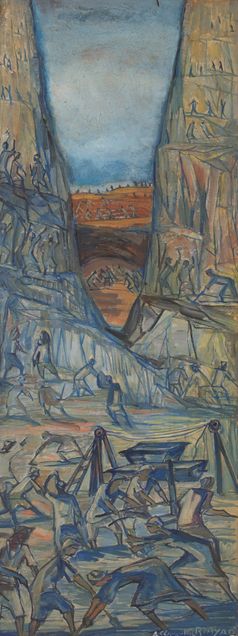
The nationalization of the Suez Canal removed the waterway from Western control, and had occurred in order to raise revenue for the building of the Aswan High Dam (al-Saad al-Aali) (fig. 1). The High Dam was to secure Egypt’s self-sufficiency by impounding the Nile River in a vast reservoir, coined Lake Nasser, in order to convert its flowing water into hydroelectric power that would contribute to the newly sovereign nation’s independence. Initiated during this time of optimism, the construction of the High Dam was depicted widely in painting, photography, and other media. The Egyptian government provided sponsorships and grants to artists to render both the dam and the villages of Nubia, sited on the land to be submerged.2 Though government sponsored, this program allowed for a multiplicity of artistic styles and even subtle critiques of the state to come through in the works.3 For instance, in Aswan (1964), Ragheb Ayad’s (1892–1982) depiction of the dam, the viewer is placed near ground level, slightly pulled away from the midst of the construction by a mass of workers (fig. 2). Ayad’s painting does not glorify the worker in the name of the state, but rather—connecting the worker to history—evokes the backbreaking work of building the ancient pharaonic monuments.4 However, unlike the laborers in Ayad’s painting, who toil in the shoveling of earth, workers in At the Aswan Dam (1965) by the Egyptian social realist painter Hamed Owais (1919–2011) are instead integrated with the futuristic machinic parts that make up the electrical towers of the power station adjacent to the dam (fig. 3).5 At the Aswan Dam captures how social collectivity during these revolutionary years was redefined by technological imperatives connected to the building of the High Dam.
Owais’s painting depicts the construction of the dam in a style that shows the influence of Mexican muralism and edges towards the geometric compositional structure of a constructivist photomontage.6 Through Owais’s mechanized forms and collapsing of space into nearly flat geometry, the overall appearance of At the Aswan Dam bears a resemblance to the systems that governed the electrical grid generated by the dam’s turbines.
Constructed between 1960 and 1970, the building of the dam harnessed Soviet-engineered modern technology (and was ultimately largely financed by the USSR as well as designed by the Hydroproject Research Institute in Moscow, or “Gidroproekt”) to generate hydroelectric power and, in the process, control the flooding of the Nile that had occurred annually for millennia.7 This intervention was both an intrusion that reshaped the natural landscape of Egypt and a radical blow to the lived experience of the Nubian people, who were forced to evacuate their villages on the banks of the Nile to make way for the dam.8

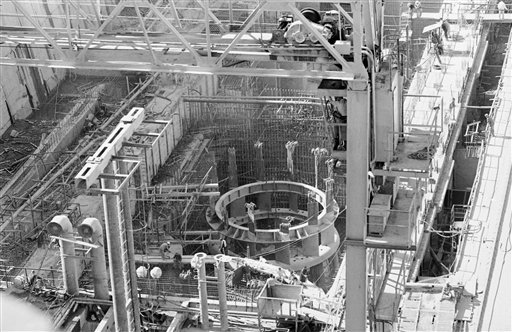
The application of Soviet expertise to the project included the construction of a control room, located deep within the dam itself, which regulated the processes of the dam’s electrical substations (fig. 4).9 Similar to the internal workings of the dam, the lines and connections of Owais’s electrical towers are interwoven in such a way as to be almost schematic, like a circuit board large enough to encompass the human figure. At the same time, Owais’s landscape also contains a subtler but no-less-real invocation of the processes of an engineered modernity. The smooth ultramarine blue of Owais’s rendering of the reservoir masks any sign of the Nubian villages that were in actuality submerged beneath it, raising the question of how Owais may have rationalized this concealment. In the landscape itself, we see new construction that completes the erasure of the villages. These structures, which may be temporary dwellings or day shelters for the workers, dot the riverbank along with construction vehicles and equipment. There also appears to be a tower for a telephone line with perhaps a bullhorn attached to it to announce the start and stop of work.10 The scene eschews the possibility of a singular perspectival reading, appearing untethered from a terrestrial logic; the scopic confusion of this fragmented, re-imagined modern landscape reconfigures space and is infused with impositions of timekeeping and labor.11

The attempt to harness the power of nature by way of the dam had unintended effects, as was made apparent by the massive flooding of the Temple of Ramses II (1260–50 BCE) and other ancient monuments, that was caused by the project.12 The deluge sparked a massive intervention by UNESCO to disassemble, relocate, and reassemble the pharaonic structures in new locations on the shores of Lake Nasser.13 Similar to this remapping of history, the dam itself was comprised of granite from Aswan’s geologically unique rock formations.14 This granite, likely visible as the sandy-brown rocks in the foreground of At the Aswan Dam, was quarried and removed from its location in the geological record in a physical process that historian Nancy Y. Reynolds relates to the idea of time turned upside-down.15 Such a sense of dislocation echoes throughout the compositional fragmentation of Owais’s forward-looking vision.
The building of the dam replaced these ancient sites with a giant power station that extended the electrical power grid throughout Egypt (fig. 5). Because of the dam, it became a new normal for the average Egyptian home to have a television set and to be connected to new experiences of the simultaneity, to borrow from Benedict Anderson, of national broadcasts.16 As Elizabeth Bishop surmises, these broadcasts formed a “control room” in a different sense, spreading condoned values through the government’s choice of programming.17 In this way, the dam contributed to a new definition of Egyptian national identity at the same time as its ripple effects impacted the politics and culture of the greater Arab world.18 The dam itself certainly occupied a prominent place in popular culture. In the words of art historian Avinoam Shalem, the ’60s in Egypt were “born, so to speak, under the sign of the Aswan Dam.”19 Revolutionary songs about the dam were broadcast continually over the radio, and Nubian men could be seen with its image embroidered on their skullcaps.20 Many international dignitaries and even Jean-Paul Sartre and Simone de Beauvoir came to see the dam firsthand.21
The construction of the dam was transformative in many, perhaps unintentional, ways. Art historian Anneka Lenssen suggests that the apparent propagandistic goals of Owais’s At the Aswan Dam are tempered by the loss of a human element that had been a crucial part of Owais’s previous works.22 In 1947, after returning from studying at the Royal Academy of Fine Arts of San Fernando in Madrid and subsequently taking a position at the Faculty of Fine Arts in Alexandria, Owais had co-founded the Egyptian Group of Modern Art along with other well-known Egyptian artists such as Gamal el-Sigini, Gazbia Sirry, Zeinab Abdel Hamid, Salah Yousri, and Youssef Sida.23 In a 1984 interview, Owais described the Group of Modern Art to Karnouk as follows: “We believed that revolutionary ideology should be reflected in art. We, the Group of Modern Art, rejected ‘surrealism,’ because it was essentially rebellion, or an art which did not aim at the consciousness of the people at large.”24 Here, Owais emphasizes his stance that art should focus on social collectivity, with the goal of evoking the essential inner spirit of the Egyptian people. This goal is made particularly visible in Owais’s Factory Workers (1953). Though in this painting workers are shown looking somewhat tired and subdued as they file home from a day’s labor, Owais’s realism allows for a sense of their character and dignity to show through.
Fundamentally, the Group of Modern Art also rejected the idea of the past as a tool to shape the future and instead embraced the new and the now as a concrete aspect of Egypt’s revolutionary moment.25 At the Aswan Dam extends this notion a step beyond Owais’s earlier humanist representations. The integration of the worker with both the physical and symbolic dimensions of infrastructure in At the Aswan Dam reconfigures Owais’s focus on social projects to one that emphasizes a greater reliance on technology and systems. The workers depicted in the painting, two with their faces concealed by their helmets and one with face obscured by orange goggles, may well have been Nubian men from the now-absent village below and are incorporated into their new environment as the old one disappears.26 Yet, these workers do not “speak,” and like any other individuals, would have viewed the project in complex ways.27 The promise of the dam and its aura of progress was surely pervasive and brought with it new possibilities of modernity and freedom from the past.
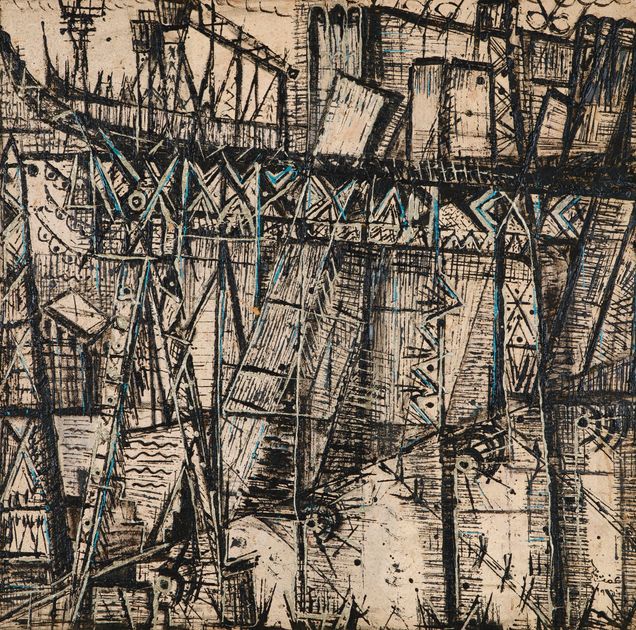
These possibilities, however, brought liberation into negotiation with the real-world effects of the dam. Effat Naghi’s (1905–1994) The High Dam from 1966 provides an apt metaphor for the disjuncture between the plans for the dam and the myriad physical consequences of its construction (fig. 6). Naghi depicts the dam’s scaffolding as an intersecting, tenuous mass of lines that perhaps indicates the ambiguities and precarities of the project itself.28 The dam as an ambitious plan that would bolster Egypt’s freedom soon materialized as a massive work of infrastructure that signaled the integration of the newly independent nation with large-scale technological systems.29
A version of this text is included in Centore’s MA thesis, “Technology, Time, and the State: The Aesthetics of Hydropower in Postcolonial Egypt” (Tyler School of Art and Architecture, Temple University, May 2020).
____________________
Kristina Centore
Kristina Centore is a writer and artist based in Philadelphia, PA, USA. She is a May 2020 graduate of the Master’s program in Art History at the Tyler School of Art and Architecture. Her research focuses on technology, temporality, and political non-alignment in art during the Nasser years in Egypt.
____________________
Footnotes
1. For a history of non-alignment, see Christopher J. Lee, ed., Making a World After Empire: The Bandung Moment and its Political Afterlives (Athens: Ohio University Press, 2010).
2. Sultan Sooud Al Qassemi, “The Politics of Egyptian Fine Art: Giving a Voice to the People,” The Century Foundation, May 16, 2017, https://tcf.org/content/report/politics-egyptian-fine-art/?agreed=1.
3. Al Qassemi, “The Politics of Egyptian Fine Art.”
4. This observation is based on a description of the work in “Aswan, Ragheb Ayad,” Barjeel Art Foundation, accessed February 20, 2020, https://www.barjeelartfoundation.org/collection/ragheb-ayad-aswan/.
5. Alternate spellings of the artist’s name include “Hamed Ewais,” which is, for example, used by the Barjeel Art Foundation as well as on listings for sales of the artist’s work by the auction house Christie’s, and “Hamed Oweis,” which is used in Liliane Karnouk, Modern Egyptian Art 1910–2003 (New Revised Edition) (Cairo and New York: The American University in Cairo Press, 2005). For a description of At the Aswan Dam, see Anneka Lenssen, “Exchangeable Realism,” in Postwar: Art Between the Pacific and the Atlantic, 1945–1965, ed. Okwui Enwezor, Katy Siegel, and Ulrich Wilmes (London and New York: Prestel Publishing Ltd., 2016), 430–435.
6. See, for instance, Aleksandr Rodchenko’s propagandistic photo series in the Soviet periodical USSR in Construction (SSSR na stroike), which was mainly active in the 1930s. I thank Dr. James Merle Thomas for pointing me in this direction. More on USSR in Construction, in comparison to contemporaneous American New Deal photography, can be found in Timothy A. Nunan, “Soviet Nationalities Policy, ‘USSR in Construction,’ and Soviet Documentary Photography in Comparative Context, 1931–1937,” Ab Imperio no. 2 (April 2010): 47–92.
7. Avinoam Shalem gives the dates for the construction of the dam as 1960 to 1970 in “Man’s Conquest of Nature: Al-Gazzar, Sartre, and Nasser’s Great Aswan Dam,” Nka: Journal of Contemporary African Art no. 32 (Spring 2013): 25. For more on the role of the Soviet government in the construction of the dam, see Elizabeth Bishop, “Control Room: Visible and Concealed Spaces of the Aswan High Dam,” in Landscapes of Development: The Impact of Modernization Discourses on the Physical Environment of the Eastern Mediterranean, ed. Panayiota Pyla (Cambridge: Harvard University Press, 2013), 74.
8. The Nubian people are a Muslim African population that are often considered to be directly descended from pharaonic Egypt. See Anne M. Jennings’s 1995 anthropological study of a Nubian community north of Aswan (for whom, therefore, eviction was not obligatory during the High Dam construction) for more information on Nubian culture and architecture (Anne M. Jennings, The Nubians of West Aswan: Village Women in the Midst of Change (Boulder and London: Lynne Rienner Publishers, Inc., 1995)). According to Jennings, fifty thousand Nubians were resettled in Kom Ombo as a result of the High Dam construction; Jennings, The Nubians of West Aswan, 28.
9. Bishop, “Control Room,” 81.
10. I thank Dr. Emily Neumeier for pointing out the presence of the bullhorn, which signals the notion of timekeeping.
11. Pertinent to the notion of temporalities in Egypt are On Barak’s analyses of the effects of the imposition of the Gregorian calendar over the Hijri with the establishment of the telegraph in Egypt; On Barak, “Outdating: The Time of ‘Culture’ in Colonial Egypt,” Grey Room no. 53 (Fall 2013): 6–31.
12. Shalem, “Man’s Conquest of Nature,” 25.
13. Ibid., 26.
14. Nancy Y. Reynolds, “Building the Past: Rockscapes and the Aswan High Dam in Egypt,” in Water on Sand: Environmental Histories of the Middle East and North Africa, ed. Alan Mikhail (New York: Oxford University Press, 2013), 194–197.
15. Ibid., 182.
16. For more on the dam and its connection to television, see Bishop, “Control Room,” 81. Similarly, Benedict Anderson describes the “simultaneity” of the national press, in which the same information is read by all within a nation’s boundaries, as a defining characteristic of how national identity is constructed; Benedict Anderson, Imagined Communities: Reflections on the Origin and Spread of Nationalism (London: Verso, 2006), 24–25.
17. Bishop, “Control Room,” 81.
18. Here I combine Bishop’s assessment of the dam’s relationship to television with Shalem’s observations on the effect the dam had on culture overall; Shalem, “Man’s Conquest of Nature,” 21.
19. Shalem, “Man’s Conquest of Nature,” 25.
20. Reynolds, “Building the Past,” 187, 194.
21. Shalem, “Man’s Conquest of Nature,” 21–22; as Shalem relays, Sarte and de Beauvoir also viewed a celebrated painting, The High Dam by Abdel Hadi al-Gazzar, while in Egypt.
22. Lenssen, “Exchangeable Realism,” 434.
23. Nadia Radwan, “Hamed Owais,” Mathaf Encyclopedia of Modern Art and the Arab World, accessed April 2, 2020, http://www.encyclopedia.mathaf.org.qa/en/bios/Pages/Hamed-Owais.aspx.
24. Karnouk, Modern Egyptian Art, 80. Surrealism was a prominent art movement in Egypt during the interwar years and throughout WWII; see Sam Bardaouil, Surrealism in Egypt: Modernism and the Art and Liberty Group (London and New York: I. B. Tauris & Co. Ltd., 2017). Surrealist aesthetics were also employed by the Egyptian Contemporary Art Group, which included al-Gazzar, after WWII. Manifestos of the Contemporary Art Group are reproduced in English in Modern Art in the Arab World: Primary Documents, eds. Anneka Lenssen, Sarah Rogers, and Nada Shabout (New York: The Museum of Modern Art, 2018), 113–116.
25. Karnouk, Modern Egyptian Art, 78.
26. Here I take the idea that the Nubian men from the villages that were being destroyed were also employed in the dam’s construction from Reynolds, “Building the Past,” 194.
27. Here I reference Gayatri Spivak, “Can the Subaltern Speak?” in Colonial Discourse and Post-Colonial Theory, ed. Laura Chrisman and Patrick Williams (New York: Columbia University Press, 1994), 66–111.
28. This observation is made in a description of the work on the Barjeel Art Foundation’s website; see “The High Dam, Effat Naghi,” Barjeel Art Foundation, accessed December 10, 2019, https://www.barjeelartfoundation.org/collection/effat-naghi-the-high-dam/.
29. For more on the environmental and social effects of the Aswan High Dam, see Patrick Kane, The Politics of Art in Modern Egypt: Aesthetics, Ideology, and Nation-Building (London: I.B.Tauris & Co Ltd., 2013), especially Kane’s discussion of “representations of the Aswan Dam in Egyptian arts as a discourse on the dialectical relation of the state, region, and labor” (p. 139) in Chapter 6: “Conflicts in the Arts Over Upper Egypt: ‘Abd al-Hadi al-Gazzar and His Contemporaries,” 139–171, and Timothy Mitchell, Rule of Experts: Egypt, Technopolitics, Modernity (Berkely, Los Angeles, and London: University of California Press, 2002).
Notes about Contributors
J. Cabelle Ahn is a PhD Candidate in History of Art and Architecture at Harvard University and the current Samuel H. Kress Predoctoral Fellow at the Drawing Institute of the Morgan Library & Museum, NY. Her dissertation is titled “Multiple Exposures: The Exhibition of Drawings in Eighteenth-century France.
Shannon Bewley was the Provenance Research Fellow in the departments of American and European Art at the Birmingham Museum of Art prior to entering Boston University as a PhD student in the History of Art and Architecture. Her research areas include photographs of conceptual art, modernist sculpture, and exhibitions histories.
Kristina Bivona is a first-generation college graduate. She is currently enrolled as a doctoral student at Columbia University and holds a MFA and BFA in Printmaking. She uses critique formats informed by lived experience to enlighten the bridge between art practice and scholarship.
Kristina Centore is a writer and artist based in Philadelphia, PA, USA. She is a May 2020 graduate of the Master's program in Art History at the Tyler School of Art and Architecture. Her research focuses on technology, temporality, and political non-alignment in art during the Nasser years in Egypt.
Danielle Ezor is a doctoral candidate in the RASC/a: Rhetorics of Art, Space and Culture Ph.D. Program in Art History at Southern Methodist University. She received her B.A. in art history and studio art from Wellesley College and her M.A. in art history from the Williams Graduate Program in the History of Art. Her research focuses on eighteenth-century French visual and material culture with a concentration in race, gender, and materiality, and her dissertation addresses the construction of white femininity through women’s vanity items in eighteenth-century France and the French Caribbean.
Kate Hublou is Research Associate of Applied Arts of Europe at the Art Institute of Chicago. In May 2019 she graduated with an M.A. in Art History and Museum Studies from Case Western Reserve University where she focused her studies on modern British and Scandinavian art and design.
Joonsoo (Jason) Park is a PhD candidate in art history at Binghamton University. His research traverses the late twentieth century, particularly focusing on the intersections of art, environment, and ecology in the postwar period.
Elizabeth Rankin is an Australian artist born in the Blue Mountains west of Sydney. She is interested in drawing both still and moving and in the importance of visual narrative in the genre of noir. She studies at the National Art School in Sydney where she completed her MFA in 2017.
Francesca Soriano is a PhD student in the History of Art and Architecture at Boston University. Her research focuses on late nineteenth to early twentieth century American Art, with a particular interest in acknowledging artistic ecological sensibilities and cross-cultural understandings.
Manuel van der Veen is a PhD candidate in art science at the State Academy of Fine Arts Karlsruhe, Germany. He studied arts and philosophy to work at the intersections of practice and theory. His research focuses on the confrontation of traditional procedures, like trompe-l’œil and sculptural relief, with the more recent one of augmented reality.
Chahrazad Zahi was an independent curator before she joined the department of History of Art and Architecture at Boston University. Since 2012, she has been concerned with stimulating the publishing of art histories of the MENA region, beyond the western canon.
Unnatural Return: The Feminist Uncanny
by Elizabeth Rankin


.jpg)
In a recent publication, Alexandra Kokoli explores the concept of the uncanny in feminist thought and in contemporary art practice.1 My doctoral research employs Kokoli’s theories to re-conceptualize representations of women in crime narratives through a close reading of the murder coverage of Linda Agostini in Albury, Australia, 1934. For Kokoli, the uncanny addresses an aggressive defamiliarization of the familiar and is redefined by a range of art practices that resist patriarchal social reproduction. Kokoli delineates the relationship between the abject and the uncanny and argues that each may be present in the actions of the other. According to Kokoli the uncanny profoundly displaces the viewer by recalling the hidden, but may fall short of the utter revulsion felt in confronting the abject.
My painting series, The Pyjama Girl: Imaging the Violence in Narratives of Crime Against Women, investigates how photographs of Linda Agostini’s body that circulated at the time of her murder amplified already existing social codes. These codes objectified the female body within a representational politics of abjection. Abjection when used in this context refers to a projection of taboo and revulsion, one focused on a leaking puerile state of bodily contaminants—the blood of violence and menstruation, urine, decomposition—where the contamination is associated with sexual presence.
Photographs of Agostini’s mutilated body were published locally, nationally, and internationally. This visual display conjured images of her dead body as well as the archival remnants of the crime, in particular the yellow pyjamas she was wearing during the incident. Her identity at this point was unknown, contributing in part to the level of mystification around the case. Her body operated merely as a symbol in the public discourse. The circulation of these symbolic representation operated in conjunction with a performative display of her body in a large container of formalin at the University of Sydney from 1934 to 1944 in the hope that visitors might identify the corpse. Visitors who came to gaze over the preserved corpse were often photographed, furthering this spectatorial archive of her body.
As a child, I was exposed to the archive of this case, including photographs of the victim, facsimiles of her clothes, and death masks of her face, at the Sydney Royal Easter Show’s Police Tent. This evidentiary diorama terrified me. Much of the impetus to develop this project emerges from that tangible fearful memory.

My work considers how the circulation of these images, as well as my own memory of the archive, constructs a visual discourse over the female body as abject within crime. Through the materiality of painting, I unravel the archival power of that childhood moment at the Easter show and the continuing spectacle of abject representations. My process uses strategies of the uncanny to invert the semiotic codes that underwrite the visual order, particularly those embedded in the initial crime photographs and early carnival representations. Using lurid complementary colors, I deconstruct the male body into a visceral state of castration. The violence of this palette allows me to enact an aggressive gaze over the patriarchal lens of what I term “archival power”, the way that artifacts and archives inform societal values and shape collective thought.

Based on a 1944 newspaper image, my painting Anthony and the Dicks (2019) depicts Linda’s husband standing with detectives after he was arrested for her murder. He is wearing Linda’s pajamas like a gruesome skin. He and the detectives are painted with ambiguous genitalia in a symbolic act that undermines the gaze of masculine police surveillance. This image also underscores the relation between the arrestor and the arrested. Both represent the patriarchal formula that continues to define and confine the female victim as an abject sexual object. In Underpants (2019), I reverse the codes of control, embedded in the representational archive, by transforming the male body into an abject, leaking body. Here on display, his body leaks the semiotic codes that define him. The man’s presence remains menacing in his abject state of decay, though stripped of power. This confusion re-orders the symbolic codes that have defined the archival position of the female victim in Western media.

The Pyjama Girl works were shown at Articulate Project Space, Sydney (2020) and MAMA Regional Gallery, Albury (2019).
____________________
Elizabeth Rankin
Elizabeth Rankin is an Australian artist born in the Blue Mountains west of Sydney. She is interested in drawing both still and moving and in the importance of visual narrative in the genre of noir. She studies at the National Art School in Sydney where she completed her MFA in 2017.
____________________
Footnotes
1. See Alexandra Kokoli, The Feminist Uncanny in Theory and Art Practice (London and New York: Bloomsbury Academic, 2016).
The Occupation of the Natural by the UnNatural: About the Operation of the Superimposition in Augmented Reality and Trompe-l’œil
by Manuel van der Veen
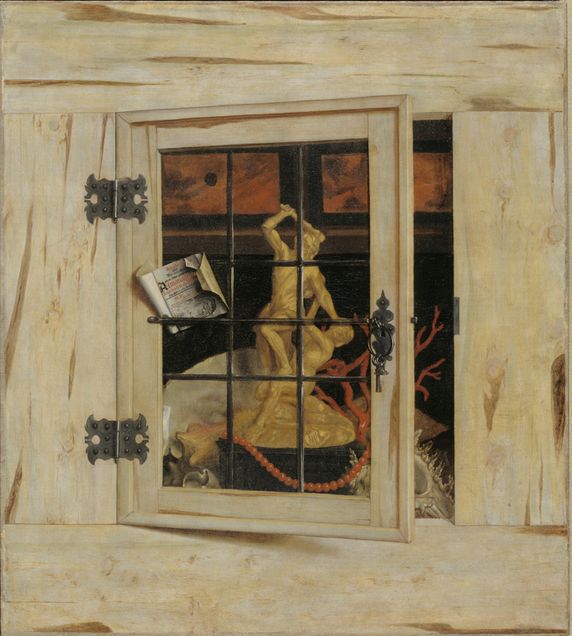
This brief research report concentrates on the operation of visual superimposition, which today attains an unexpected topicality through the technology of augmented reality (AR). My doctoral research project relates the art-historical procedure of trompe-l’œil to AR.1 Both techniques want to embed images naturally into the real environment, and subtly make the natural unnatural.2 It is important to note at the outset, that in many exhibitions and reproductive representations of trompe-l’œil, the pictures are ripped out of their constitutive context, making this effect hard to see. In this text, I will focus on three examples in which objects from the real surroundings are superimposed by an interior.
I begin with a trompe-l’œil of Cornelis Norbertus Gjisbrecht, An Open Cabinet of Curiosities with a Hercules Group from 1670 (fig. 1). Its frame is camouflaged with a wooden edge, which physically attaches the trompe-l’œil into the real wooden wall. Then there is a small door, slightly opened, which integrates the space in front of the picture, but also refers to the space behind. The door creates a three-dimensional space. Therefore, the surface of the picture plane, as indicated by the wooden edges, is only the core level within a total of three spatial layers. With the door slightly open the trompe-l’œil invites viewers from the physical space in front of the picture to see what is visible in the depicted space behind the wall. While the frame is camouflaged, the inside of the cabinet is an ordinary illusion. Here, the trompe-l’œil takes advantage of its connection to the real environment to centrifugally amplify the center until it immerses into reality. Since it is not obvious where the picture begins or ends, the reality outside is also centripetally transformed into a pictorial being. Perhaps the boundaries arise with the hinges as thresholds, which mediate between the picture world and the real environment, but this remains uncertain. As theorist Bernard Siegert notes, “It is this oscillating between the transparency of the imaginary pictorial space and the opacity of the material carrier, and more importantly, it is the re-entry of the latter into the former, that keeps generating the trompe-l’œil.”3 The picture object concurrently appears as a ripped reality; as a flat surface (the wood, the glass, and the lead bars); as a real opaque object in the room (the open door, the hinges, the folded note); and finally as a picture superimposed upon the real environment to cave a fictitious interior into the solid wall.

My research pursues the theory that these strategies of trompe-l’œil are reactivated in contemporary art, and simultaneously investigates their relationship to the phenomenon of AR. The artist Cayetano Ferrer continues the tradition of trompe-l’œil by focusing on the entanglement of object and environment. In the series Western Imports, he affixes high-resolution photographs of an environment onto cardboard boxes placed in the space (fig. 2). The photographs have been processed in such a way that the surface of the package intermittently disappears but the fonts and logos printed on them are still visible. Subsequently the logos seem to float in space, while also marking the surface of the box. Hence, the object itself seems to be semi-transparent. As if seen through water, the materiality of the package itself is liquefied. As such, we observe an object that can assert itself as an object but is caught in the moment of its own disappearance. As in trompe-l’œil, the surface is maintained on the one hand and denied on the other.

A popular strategy within AR is to superimpose real objects with their own inside—visualizing the actual but also invisible interior. This is used in various applications, including the next example which is drawn from industry (fig. 3). The internal structures of the machine are superimposed upon its surface in order to make its functionality transparent and more comprehensible.4 A dynamic image of the inside is therefore etched into the machine. If one touched this representation, they would clash with reality. The semi-transparent quality of a digital screen (which allows both touching and looking through it) is transferred to the now semi-transparent object. Consequently, reality is mediated but not dissolved as such. AR makes use of different evidence production processes, like the fixed position of the animation above the machine, calculated light incidence, or interactive communication, to imply presence but it does not guarantee the reality of the image.
The techniques employed in each of these case studies make visible a layer of reality, which could not be seen without them. However, this superimposed multiplicity of events, all now located at one place and time, reduces them to a singular one in relation to the present.5 These superimpositions are in a way so excessive and immersive that they occupy the natural with the unnatural.6 Images cave themselves into reality, liquefy its consistency, or etch themselves into the material. Therefore, one of the most important challenges we encounter with AR is to constantly point out its very narrow boundaries. Since our field of vision is ripped apart, natural and unnatural are interwoven.
____________________
Manuel van der Veen
Manuel van der Veen is a PhD candidate in art science at the State Academy of Fine Arts Karlsruhe, Germany. He studied arts and philosophy to work at the intersections of practice and theory. His research focuses on the confrontation of traditional procedures, like trompe-l’œil and sculptural relief, with the more recent one of augmented reality.
____________________
Footnotes
1. The working title of my PhD project is “Augmented Reality. Trompe-l’œil and Relief as Technique and Theory.”
2. This is also the case with the image below, which is all the more important because the trompe-l’œil does not want to show up as a work of art. Instead its goal is to show up as a thing beside other things.
3. Bernhard Siegert, Cultural techniques: grids, filters, doors, and other articulations of the real (Fordham: Fordham University Press, 2015), 191.
4. The visible inner structure is also used for maintenance work. This allows one to refer to invisible parts and additionally enrich the field of view with references, instructions, and annotations.
5. In her text about AR applications, which register historical data and images into the real field of vision, Edith Blaschitz also emphasizes the reduction produced by this superimposition; Edith Blaschitz, “Mediale Zeugenschaft und Authentizität. Zeitgeschichtliche Vermittlungsarbeit im augmentierten Alltagsraum: Augmented Realities—Augmented Spaces. Digitale Texturen sozialer und kultureller Räume,” Hamburger Journal für Kulturanthropologie (HJK) no. 5 (2017): 3–13.
6. A term used by Louis Marin as excessive mimesis; Louis Marin, “Representation and Simulacrum,” in On Representation, trans. Catherine Porter (Stanford, CA: Stanford University Press, 2001), 316.
Editors’ Introduction
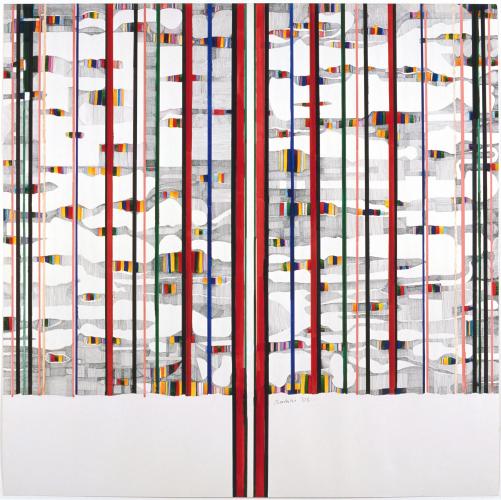
Our newest issue of SEQUITUR explores ideas around historiography, representation, and canonization through the theme “re/vision.” The essays and exhibition reviews in this issue reflect on varying tactics that expand the thematic and temporal variety in art and architectural history. Moving from gender politics to mass-housing policies, environmental crisis to archeological reproduction, the range of topics explored reflects the commitment to rebuild narratives prevalent in current trends of art and architectural history.
In the first of two feature essays, Maria V. Garth investigates the ways photography and photorealist painting reveal their radical potential to represent gender expressions. Through the works of Franz Gertsch and Lissa Rivera, the essay problematizes the dichotomous understanding of fact and fiction, and seeks tactics to subvert normative power structures. The next essay explores the 2016 Istanbul Design Biennial’s contextualization of design as a reverse operation of archeology. In this essay, Ecem Arslanay centralizes design to examine the contemporary condition of human experience and environment. By bridging the gap between organic and synthetic systems and futurism and nostalgia, Arslanay offers a design-centric view on death and destruction.
In his research spotlight, Stephen Kerr challenges the methodologies in looking at interwar mass housing developments in architectural history. Through oral histories, Kerr reveals the political significance of interior decoration in shaping collective memory, adapting an integrated research methodology for architectural historiography.
Naz Onen’s visual essay utilizes the cyanotype photography printing technique to communicate the plastic-waste problem in the marine environment. By utilizing photography’s indexical capacity to preserve the past, the artist articulates the plastic evidence as the fossils of the Anthropocene.
This issue includes four reviews that survey exhibitions covering a broad range of temporalities and geographies. Laura Stowell reviews an exhibition of body-oriented sculptural works by Alina Szapocznikow, held at Hauser & Wirth gallery in New York City. Chloe Lovelace discusses spolia, noting the different forms of reproduction and reuse of archival material in an exhibition held at the American School of Classical Studies at Athens. Constanza Robles and Althea Ruoppo review an exhibition at the Museum of Fine Arts, Boston, which seeks to revisit the narratives of 20th century American art by elevating the work of women artists, offering an institutional framework towards a more inclusive canonization of art. Lastly, Kimberly Windham weaves a connecting thread through David Levinthal’s varying photographic practice and critiques the Smithsonian American Art Museum’s institutional position as perpetuating the myth of the American West.
In this issue our authors bring a spectrum of perspectives to the concept of re/vision while reminding us of the urgent need to provide multi-temporal, inclusive, and diverse strategies within art and architecture historiography and canonization practices. At SEQUITUR, we are delighted to hold an open platform where dominant institutional narratives are challenged, and histories are multiplied, becoming more porous and mobile, inviting participation in a discourse that is as varied and inclusive as possible.