news
Phillippa Pitts interviews Mingqian Liu and Amanda Thompson
Editors’ Introduction
by Rebecca Arnheim and Bailey Benson
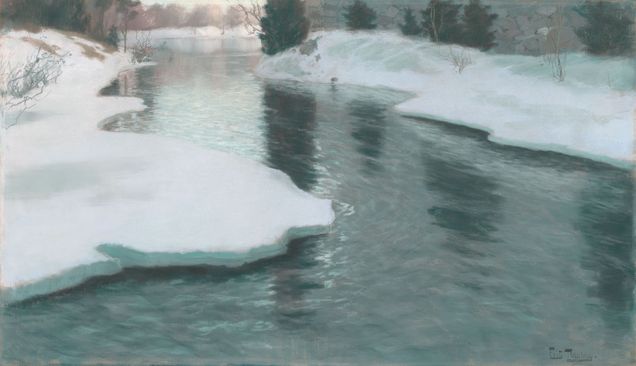
When the theme of “Environment” was selected for the 36th Annual Boston University Graduate Symposium in the History of Art & Architecture, we could not imagine how profoundly relevant it would be for the year 2020. The year began with bushfires in Australia that burned more than 46 million acres of land. Intense monsoons severely impacted several countries in Asia and abnormally heavy rainfall in Sudan and Ethiopia resulted in devastating flooding. In the United States, wildfires rage more frequently and with greater intensity in the West of the country, tornado season in the Midwest is getting progressively longer, and tropical storms and hurricanes regularly ravage the southern and eastern coastlines. These are only a few examples of the increasingly common natural disasters that have occurred this year. Then, a novel coronavirus hit the world stage.
Global concerns surrounding COVID-19 reached a fever pitch in early March, just weeks before the symposium was scheduled to take place. The venue was set, speakers had booked their travel, and all things appeared to be proceeding as planned. Almost overnight the whole situation changed. It became increasingly apparent that this event, as with so many others, would not be able to take place as scheduled. After serious deliberation with both the faculty members of the History of Art & Architecture Department at Boston University and representatives from the Museum of Fine Arts, Boston, the difficult decision was made to cancel the symposium. This special edition of SEQUITUR features papers from that canceled symposium.

This year’s graduate symposium was planned for March 28, 2020, at the Museum of Fine Arts, Boston. This event was intended to explore the relationship between the environment and artistic and architectural production (fig. 1). Six graduate students from across the country were invited to share their research, and a keynote address was to be presented by Professor Christopher P. Heuer (University of Rochester). The graduate student presenters were: Tobah Aukland-Peck (The Graduate Center, CUNY), Rachel Kase (Boston University), Mingqian Liu (Texas A&M University), Carolyn Russo (American University), Amanda Thompson (Bard Graduate Center), and John White (University of Massachusetts Amherst). The speakers were to be divided into two panels of three presentations each. The morning session, “Reclaimed by Nature,” was to feature papers focused on nature overcoming human creation and artists’ corresponding reactions. While the morning session focused on nature’s triumph, the afternoon was expected to explore human accomplishments against nature’s forces in a session entitled “Claiming Spaces.”
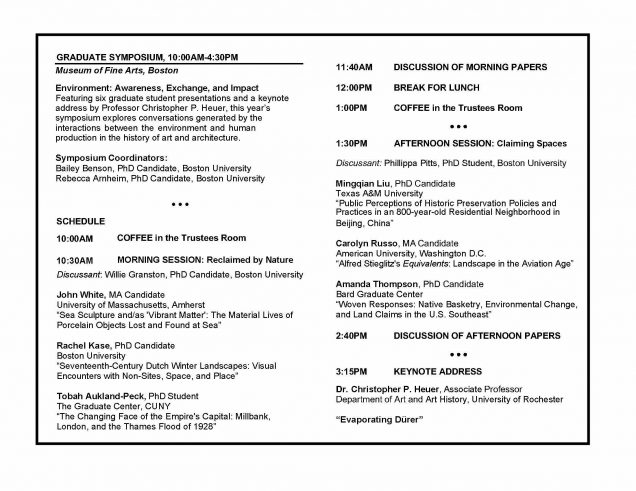
The present issue of SEQUITUR features papers from four of the presenters. The organization of this issue is intended to reflect that of the event itself (fig. 2). The two parts mirror the two panels, and the papers are presented in the order they would have been delivered at the symposium. Two video Q&A sessions were also recorded in which the authors and the original session moderators, Willie Granston and Phillippa Pitts respectively, further discuss the papers.
The issue begins with Rachel Kase’s paper, which investigates the Little Ice Age’s artistic representations in Dutch art. Kase demonstrates how the monochromatic representations of winter-obscured landscapes disoriented viewers and created instances of “non-sites” in Netherlandish artistic productions. Tobah Aukland-Peck uses miniature displays of World War I battles on display in the Imperial War Museum in order to explore how British citizens dealt with and understood war events that occurred on foreign soil. The choice of materials used to create these models ultimately came to play a central part in how the war was presented to the British citizenry.
Mingqian Liu looks at the built environment, discussing the impacts of preservation efforts on the residents of an 800-year-old historic neighborhood in Beijing, China. Her paper uses interviews with those residents to argue for a bottom-up approach to preservation practices, one that considers the residents and their daily interactions with their built urban environment. The concluding paper of the issue is by Amanda Thompson and deals with the relationships between objects, their makers, and the collections they become a part of—in this case, the British Museum. Thompson uses the example of an eighteenth-century Cherokee basket to demonstrate Native relationships to the environment through the act of weaving and how baskets come to function as objects of land claims as they move into settler spaces.
We hope that this special issue of SEQUITUR invites readers to rethink their own relationships with their environments, both natural and human-made. How does our environment shape us, and how do we shape our environment? The papers featured in this issue serve as good starting points for conversations that can continue outside of the print medium, generating new dialogues and avenues of investigation.
A Sustaining Cherokee Basket: Colonial Inscription and Indigenous Resistance
by Amanda Thompson
One of my Cherokee elder aunts tells me baskets are living things. She believes the materials she uses in her weaving give the baskets everlasting life. “When we weave a basket, it is held close to our body so as to impart our spirit into the basket. When you give a basket, you give a part of your spirit,” she says.[1]
—Author and poet MariJo Moore (Eastern Cherokee, Dutch, and Irish ancestry) in “The Spirit of a Cherokee Basket”
A large Carolina basket made by the Indians of splitt canes some parts of them being dyed red by the fruit of the Solanum magnum Virginianum racemosum rubrum & black. They will keep any thing in this from being wetted by rain. From Coll. Nicholson Governor of South Carolina whence he brought them.[2]
—Earliest catalogue description of a Cherokee basket acquired by the British Museum in 1753
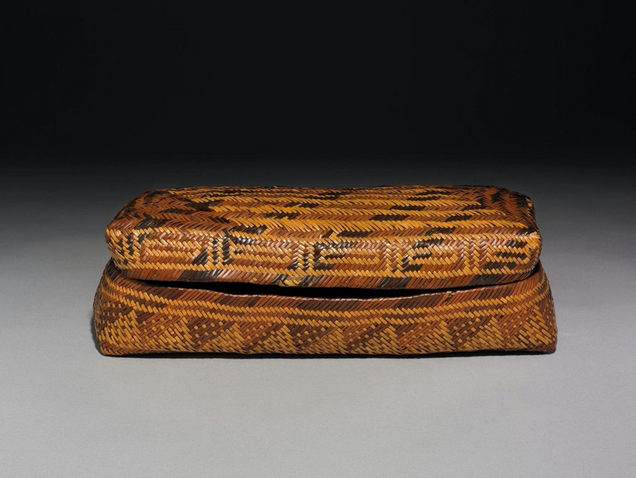
The two texts which begin this essay communicate disparate understandings of a Cherokee basket.[3] Although written centuries apart, cultural rather than temporal differences separate them. The first presents the conceptions of generations of the author’s Eastern Cherokee ancestors that a basket is a living thing, with a continuous, intimate, and inextricable connection to the sources of its natural materials and to its maker. The second, written to identify an object in the British Museum’s collection, represents the basket, its materials, and its maker as colonized subjects. Considering the object life of that eighteenth-century doubleweave Cherokee basket in the collection of the British Museum (fig. 1–2), I will draw on the tension between these two ways of understanding a basket to weave an essay which unsettles the authority of a colonial institution’s collecting and cataloguing of a Native-made basket and exposes that authority as an agent of settler colonial violence.

Guided by the counsel of Tuscarora art historian Jolene Rickard that “even the most ‘traditional’ form, like basket weaving, is actually a demonstration of Indigenous renewal, survival, and political and environmental awareness,” I aim to access Cherokee basket makers’ “strategic cultural resistance,” and to illustrate how colonial agents acted to neutralize and erase this resistance, conforming to the “elimination of the Native” required by the settler colonial structure.[4] I conclude by considering the maker and, responding to an archival lack, imagine her agency in entering the basket into the colonial networks of exchange and demonstrate how the maker’s act of “strategic cultural resistance” has lived on to renew Cherokee political and cultural agency. As a non-Native scholar, this imagining is in the form of queries, shaped—like all my scholarship—--by what I have learned from many Native thinkers. This mode of narration is influenced by African-American scholar Saidiya Hartman who “exploit[s] the capacities of the subjunctive… both to tell an impossible story and to amplify the impossibility of its telling.[5] My queries aim to illuminate other ways of considering the unknown maker’s agency, without speaking for her.
“The Spirit of a Cherokee Basket”
Basketry is woven into Cherokee cosmological, ecological, ancestral, and community relationships. Historically, women made baskets to be used for trapping, harvesting and processing food, storage, transporting goods, and bartering, among other subsistence activities.Baskets also had ceremonial purposes, such as to protect and contain the power of ritual tools and garments. They feature prominently in Cherokee stories, such as that of Selu, the Corn Mother, who used baskets to catch the corn and beans which she shook from her body to nourish her children, and of Kanane-ski Amai-yehi, or Spider-Dwelling-in-the-Water, who wove a basket to bring fire to the earth.[6] In these stories and practical uses, baskets are sustaining vessels central to Cherokee ways of being.[7]
Basketry has also supported Cherokee continuance. For instance, following the Indian Removal Act of 1830 and subsequent forced migration of thousands of Cherokees, Cherokee Nation scholar Karen Cooper Coody describes:
Upon arrival in Indian Territory, bereft of adequate household items, the vast majority of Cherokee women would have immediately set to work producing a needed array of workbaskets. … Most women were faced with endless tasks of tending sick and weakened families, feeding them, sewing and mending worn-out clothing, weaving new cloth and making quilts, planting household gardens, cooking and foraging in unfamiliar Ozark woodlands or grasslands for plants suitable for food, medicine and craft materials [such as basketry].[8]
After devastating loss, Cherokee women managed their survival by adapting their ancestral art to the materials available in unknown territory.[9] Returning to their tradition of weaving allowed for the renewal and resurgence of peoples—not just through a basket’s utility, but also through ensuring that cultural knowledge could live on, changed but resilient.
Basketry also provides rhetorical means for renewal and decolonization. Cherokee/Appalachian author Marilou Awiakta identifies a doubleweave basket as the “natural form” of her book Selu: Seeking the Corn-Mother’s Wisdom:
As I worked with the poems, essays, and stories, I saw they shared a common base—the sacred law of taking and giving back with respect, of maintaining balance. From there they wove around four themes, gradually assuming a double-sided pattern—one outer, one inner—distinct, yet interconnected in a whole. … Reading will be easy if you keep the weaving mode in mind: over… under… over… under. A round basket never runs “straight-on.”[10]
The complicated process and ultimate strength of doubleweave enables Awiakta to reckon with modern environmental destruction and reweave a restorative vision of futurity for her readers. Similarly, Qwo-Li Driskill uses doubleweave as a structure in their 2016 book Asegi Stories: Cherokee Queer and Two-Spirit Memory, which weaves together personal and theoretical writings to create a third space (“between the basket walls”) in which to decolonize Cherokee-specific traditions of gender and sexuality.[11] Thusly, basketry has sustained Cherokee life and culture through baskets’ practical uses, in the perpetuation of traditions of knowledge, and by providing a framework for resurgence and decolonization—all despite colonial efforts to decontextualize baskets and disenfranchise their Native makers through collecting and cataloguing.
“A large Carolina basket”: Collecting and cataloguing as settler colonial inscription
The catalogue cited at the start of this essay is the earliest known record of the British Museum’s doubleweave basket.[12] Although the writer is unidentified, the language they use to describe the basket illuminates a colonial framework for their knowledge, with idioms encoded to naturalize colonial power. The basket is first identified as a product of a place inscribed with a colonial name: Carolina. The colony of Carolina was granted its charter and named by King Charles II of England in honor of his father, erasing the historic and ongoing identifications of lands by the peoples native to them and instead providing an Anglo-monarchical ancestry.[13] The basket is secondly identified by the generic “Indians” who made it, eliding the diverse Native polities of North America into one undistinguished other.[14] The plant whose dyes provide the basket’s contrasting design is called after Britain’s supposed virgin queen, Elizabeth I, literally overlaying British power onto plants indigenous to the colony, in an act of “linguistic imperialism” which classified and so claimed the plant life of the world.[15]
This cataloguing enacts epistemic violence we now identify with settler colonialism. Citizen Potawatomi Nation scholar Kyle Powys Whyte writes that settler colonialism necessitates “homeland inscription,” as “settlers can only make a homeland by creating social institutions that physically carve their origin, religious and cultural narratives, social ways of life and political and economic systems (e.g. property) into the waters, soils, air and other environmental dimensions of the territory or landscape. That is, settler ecologies have to be inscribed into indigenous ecologies.”[16] Settler colonialism has been inscribed into the archive of this basket by renaming its homelands and the natural materials from which it was woven and by flattening the diverse peoples of Native North America into a single, othered, Indian. This inscription supports the “structural genocide” of settler colonialism through appropriation of lands and assimilation of peoples.[17]
As its maker and community has been excised from its archival record, the written provenance of this basket begins with its ownership by a colonial agent. South Carolina governor Francis Nicholson possibly collected it as a gift from Native delegations, such as when he negotiated the first colonial treaty with Cherokees in 1721. In meetings with the multiple Native communities of South Carolina, Nicholson sought to gain information and establish boundaries and trade relations, while Native delegations took the opportunity to affirm their sovereignty. Gifts like maps and baskets asserted rights by demonstrating Native territories, resources, geographical and ecological knowledge, and existing trade and political relationships. While Native people strategically gifted maps and baskets to make political, economic, and territorial claims in their meetings with colonial authorities in the eighteenth century, other Southeastern Native nations—such as the Chitimacha and the Coushatta—have used baskets to strategically advance land claims into the twentieth century.[18]
Rather than acknowledging the rights asserted with these maps and baskets, Nicholson entered them into a collection supportive of Britain's empire-building project by transferring them to Sir Hans Sloane. A leading London intellectual, Sloane used his position and wealth to comprehensively collect flora and human-made objects from throughout the empire, supported by British agents acquiring local specimens.[19] Sloane collected in order to build knowledge, which in turn supported Britain’s expanding empire and commercial interests.[20] Botanical knowledge enabled the classification, cultivation, and capitalization of the natural products of colonized lands.[21] Objects made by peoples throughout the empire educated British people about colonized subjects and supported an imagined hierarchy of civilization with British culture at the pinnacle and other cultures below.[22]
Upon Sloane’s death, British Parliament complied with his testamentary wishes that the collection be kept together and made publicly accessible by establishing the British Museum in 1753. This progressive move towards public education enabled all those able to visit to observe and learn about world cultures. But the London museum also facilitated the expansion of the logic of colonialism, as visitors could imagine their place at the center of empire and internalize hierarchies of a civilized center superior to uncivilized others which Sloane created in his collection. By spreading the logic of colonialism amongst the public, subjugation, resource extraction, and dispossession were normalized as an inevitable—and benevolent—right of Britain. The transformation of a Native diplomatic gift into an object in a national collection at the center of empire enacted settler colonialism by providing proof of ownership of Native land and of the incorporation of Native peoples at the seat of colonial power.[23]
Conclusion
In resistance to the epistemic violence of settler colonialism which severed this basket from its cultural context, I believe it is powerful to acknowledge the part of the unidentified maker’s spirit given with the basket, recalling the opening words of MariJo Moore. What if she intended this basket to demonstrate Cherokee rootedness in their homelands? What if she staked a claim by mobilizing the knowledge of generations of ancestors who learned to cultivate the land and transform its plant life into a watertight basket? What if she meant to build a relationship through the gifting of this basket, with the expectation of reciprocity and respect, in line with Cherokee relationship-based governance? What if this basket was woven as a material manifestation of Cherokee sovereignty? The intentions and expectations of the maker’s spirit have been excised in the basket’s collection and cataloguing in order to inscribe settler colonialism onto the peoples, land, and ecology from which it came, in another deliberate act of dispossession.
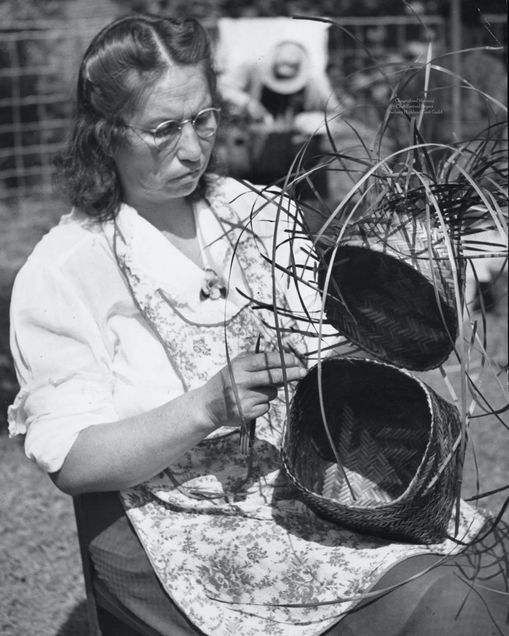
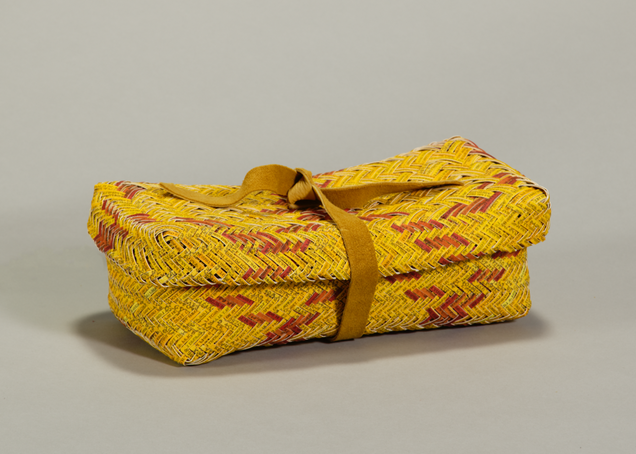
In 1940, Eastern Cherokee basket maker Lottie Stamper used images of this basket to further her knowledge of the doubleweave technique and then teach it to others (fig. 3).[24] In this way, Stamper refused the co-option of the basket by the colonial state, and instead accessed the ancestral knowledge embodied in the basket to enable the technique’s renewal in the community. Eastern Cherokee artist Shan Goshorn, who passed away in 2018, drew from the knowledge revitalized by Stamper and used strips of treaty texts, historical photographs, and other documents to weave paper baskets which spoke powerfully to the injustices of the United States against Native peoples (fig. 4). Goshorn’s basketry demonstrates how an eighteenth-century basket continues to sustain Indigenous renewal and strategic cultural resistance.[25]
____________________
Footnotes
[1] MariJo Moore, “The Spirit of a Cherokee Basket,” Fiberarts 28, no. 4 (February 2002): 25.
[2] “Basket,” British Museum, accessed March 9, 2020, https://www.britishmuseum.org/collection/object/E_Am-SLMisc-1218-a-b.
[3] Cherokee peoples are indigenous to homelands throughout the Southeast of the territory now known as the United States. In the nineteenth century, the United States government forcibly moved thousands of Cherokees to Oklahoma to open up land to settlers. Today, there are three recognized tribes of Cherokees: the United Keetoowah Band of Cherokee Indians and the Cherokee Nation, both in Oklahoma, and the Eastern Band of Cherokee Indians in North Carolina—all of whom maintain basketry traditions. In this paper, I refer to the culture both generally and pre-removal as Cherokee.
[4] The basketry quotation comes from Jolene Rickard, “Uncovering/Recovering: Indigenous Artists in California” in Art, Women, California 1950-2000: Parallels and Intersections, ed. Diana Burgess Fuller and Daniela Salvioni, (Berkeley, Los Angeles: University of California Press, 2002), 145. The term “strategic cultural resistance” is drawn from Jolene Rickard, “Visualizing Sovereignty in the Time of Biometric Sensors,” South Atlantic Quarterly 110 (Spring 2011): 474. While in the latter essay, Rickard engaged with contemporary “Haudenosaunee artists [who] visualize sovereignty through key episodic ‘traditional’ or historical moments” (474-75), I find the idea broadly useful in thinking politically and critically about historic and contemporary Indigenous arts. The term “elimination of the Native” comes from a foundational text of settler colonial theory by Patrick Wolfe, “Settler Colonialism and the Elimination of the Native,” Journal of Genocide Research 8, no. 4 (December 2006): 387-409. Wolfe asserts a “structural genocide” (403) as concomitant with settler colonialism, enacted not just by mass killings but also removal from lands, removal from tribes, enforcement of a grammar of race, and assimilation.
[5]Abridged for length in the body of my essay, I think it necessary to include this quotation in its powerful entirety: “By advancing a series of speculative arguments and exploiting the capacities of the subjunctive (a grammatical mood that expresses doubts, wishes, and possibilities), in fashioning a narrative, which is based upon archival research, and by that I mean a critical reading of the archive that mimes the figurative dimensions of history, I intended both to tell an impossible story and to amplify the impossibility of its telling”;Saidiya Hartman, “Venus in Two Acts,” Small Axe: A Caribbean Journal of Criticism 12, no. 2 (June 1, 2008): 11.
[6] James Mooney, Myths of the Cherokee (Washington, DC: Government Printing Office, 1902), 242, http://www.gutenberg.org/files/45634/45634-h/45634-h.htm#s2. Still today “these stories and the teaching that come from them create and maintain the everyday reality for the Eastern Cherokees”; Sandra Muse Isaacs, Eastern Cherokee Stories: A Living Oral Tradition and Its Cultural Continuance (Norman, OK: University of Oklahoma Press, 2019), 100.
[7] For information on Cherokee basketry, see M. Anna Fariello, Cherokee Basketry: From the Hands of Our Elders (Charleston, SC: History Press, 2009) and Sarah H. Hill, Weaving New Worlds: Southeastern Cherokee Women and Their Basketry (Chapel Hill, NC: University of North Carolina Press, 1997). It is likely the British Museum basket is actually two separate pieces—a basket and a tray—miscatalogued as one piece due to the similarity of sizes and technique. Anthropologist Betty Duggan believes they might represent the work of two different makers, and resists an absolute attribution to a Cherokee maker, rather than to other peoples indigenous to the region; Betty J. Duggan, “Baskets of the Southeast” in By Native Hands: Woven Treasures from the Lauren Rogers Museum of Art, ed. Stephen W. Cook and Jill R. Chancey (Laurel, MS, Seattle, WA: Lauren Rogers Museum of Art, University of Washington Press, 2005), 36.
[8] Karen Coody Cooper, Oklahoma Cherokee Baskets (Charleston, SC: The History Press, 2016), 27.
[9] Cherokee makers experimented with the different plants found in Oklahoma and adjusted to their qualities and gathering seasons. Eventually, buckbrush root became the primary basketry material of Oklahoma Cherokees, combined with oak stays. Similarly, Eastern Cherokee basket makers had to adapt to environmental changes wrought by settlers. As cane became less prevalent Cherokee women innovated basketry techniques and designs in oak and root runners in the early nineteenth century, the introduced or invasive Japanese honeysuckle root runner in the later nineteenth century, and fast-growing maple in the early twentieth century. Contemporary makers use all these materials to continue to innovate new forms and designs.
[10] Marilou Awiakta, Selu: Seeking the Corn-Mother’s Wisdom (Golden, CO: Fulcrum Pub, 1993), 34.
[11] Qwo-Li Driskill, Asegi Stories: Cherokee Queer and Two-Spirit Memory (Tucson, AZ: The University of Arizona Press, 2016), 5.
[12] Cataloguing is a practice that museums use to describe objects. It is a step in the acquisition process, as knowing creates ownership. Its classifications impose culturally contingent knowledge upon objects, which continue to determine understandings and access to objects to the present; see Ramesh Srinivasan, Robin Boast, Jonathan Furner, and Katherine M. Becvar, “Digital Museums and Diverse Cultural Knowledges: Moving Past the Traditional Catalog,” Information Society 25 (2009): 265-78 and Hannah Turner, “Decolonizing Ethnographic Documentation: A Critical History of the Early Museum Catalogs at the Smithsonian's National Museum of Natural History,” Cataloguing & Classification Quarterly 53 (August 2012): 658-76.
[13] The colony of Carolina was chartered in 1663 and split into two colonies—North and South Carolina—in 1712. As the singular “Carolina” is used in the catalogue description, it is likely that in England the two colonies were still referred to as one despite their administrative division.
[14] See Jodi A. Byrd, The Transit of Empire: Indigenous Critiques of Colonialism, First Peoples: New Directions in Indigenous Studies (Minneapolis, MN: University of Minnesota Press, 2011) on the collapsing of diverse Indigenous polities into a racial Indianness as a tool of settler colonialism in the United States.
[15] Londa L. Schiebinger, Plants and Empire: Colonial Bioprospecting in the Atlantic World (Cambridge, MA: Harvard University Press, 2004), 195. The acts of classifying plants and cataloguing objects similarly subordinate local knowledge to that of the empire.
[16] Kyle Powys Whyte, “Indigenous Experience, Environmental Justice and Settler Colonialism” in Nature and Experience: Phenomenology and the Environment, ed. Bryan E. Bannon (London, New York: Rowman & Littlefield International, 2016), 171-72.
[17] Wolfe, “Settler Colonialism and the Elimination of the Native”: 403.
[18] See Ian Chambers, “A Cherokee Origin for the ‘Catawba’ Deerskin Map,” Imago Mundi 65, no. 2 (June 2013): 207–16; Denise E. Bates, Basket Diplomacy: Leadership, Alliance-Building, and Resilience among the Coushatta Tribe of Louisiana, 1884-1984 (Lincoln, NE: University of Nebraska Press, 2020); and Daniel H. Usner, Weaving Alliances with Other Women: Chitimacha Indian Work in the New South (Athens, GA: The University of Georgia Press, 2015).
[19] See James Delbourgo, Collecting the World: Hans Sloane and the Origins of the British Museum (Cambridge, MA: The Belknap Press of Harvard University Press, 2017) for a history of Sloane’s collecting and the founding of the British Museum anchored in the recognition that Sloane’s wealth in part derived from his slave-holding, demonstrating the foundational link of the British national collection to profits from the subjugation of people and the realities of Britain’s slave-based economic power. For early research specifically into Sloane’s ethnographic collections, see David I. Bushnell, “The Sloane Collection in the British Museum,” American Anthropologist 8, no. 4 (1906): 671-85; H. J. Braunholtz, “The Sloane Collection: Ethnography,” The British Museum Quarterly 18, no. 1 (1953): 23-26, https://doi.org/10.2307/4422413.
[20] See Edward W. Said, Orientalism (New York: Vintage Books, 1979), a foundational work of postcolonial theory on how the creation of knowledge enabled imperial power as a form of epistemic violence working in tandem with imperialism’s brute force and material superiority.
[21] See Londa L. Schiebinger, Plants and Empire: Colonial Bioprospecting in the Atlantic World (Cambridge, MA: Harvard University Press, 2004).
[22] See T. J. Barringer, and Tom Flynn, eds., Colonialism and the Object: Empire, Material Culture, and the Museum, Museum Meanings. (London , New York: Routledge, 1998); Elizabeth Edwards, Chris Gosden, and Ruth B. Phillips, eds., Sensible Objects: Colonialism, Museums and Material Culture, Wenner-Gren International Symposium Series (Oxford , New York: Berg, 2006); Amiria J. M. Henare, Museums, Anthropology and Imperial Exchange (Cambridge, UK , New York: Cambridge University Press, 2005); George W. Stocking, ed., Objects and Others: Essays on Museums and Material Culture, History of Anthropology, (Madison, WI: University of Wisconsin Press, 1985).
[23] See Curtis M. Hinsley, “Collecting Cultures and Cultures of Collecting: The Lure of the American Southwest, 1880-1915,” Museum Anthropology 16, no. 1 (1992): 12-20. As Indigenous communities and formerly colonized countries today demand the repatriation of objects collected under conditions of unequal power, these assumed hierarchies of knowledge and authority endure particularly in debates over rightful ownership and claims that objects will be in jeopardy if returned to their community of production; see Chip Colwell-Chanthaphonh,“Repatriation and the Burdens of Proof,” Museum Anthropology 36, no. 2 (2013): 108-9,https://doi.org/10.1111/muan.12024; Rosemary Coombe, “The Properties of Culture and the Possession of Identity: Postcolonial Struggle and the Legal Imagination” in Bruce H. Ziff and Pratima V. Rao, eds., Borrowed Power: Essays on Cultural Appropriation (New Brunswick, NJ: Rutgers University Press, 1997), 74-96; and Neil G.W. Curtis, “Universal Museums, Museum Objects and Repatriation: The Tangled Stories of Things,” Museum Management and Curatorship 21, no. 2 (January 1, 2006): 117-27.
[24] The technique of doubleweave was not dormant in the Eastern Cherokee community at the time, as at least a few women still used the technique. Stamper, however, learned the technique in order to teach it and therefore spread and revitalize its use; Fariello, Cherokee Basketry, 40-43.
[25] See curatorial statement by Heather Ahtone in INTERTWINED, Stories of Splintered Pasts: Shan Goshorn & Sarah Sense (Tulsa, OK: Arts & Humanities Council of Tulsa, Hardesty Arts Center, 2015), https://issuu.com/ahhatulsa/docs/int_cat_issuu, for more on the work of Goshorn.
Public Perceptions of Preservation Policies and Practices in Historic Residential Neighborhood: A Case of Dongsi, Beijing, China
by Mingqian Liu
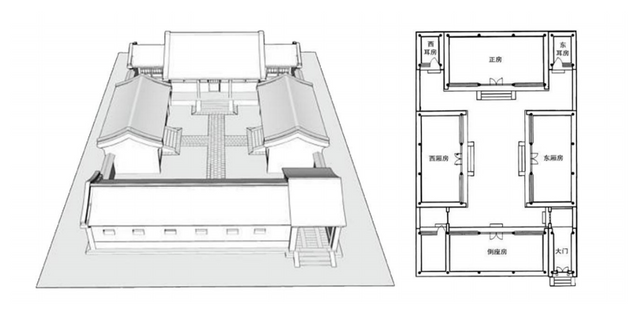
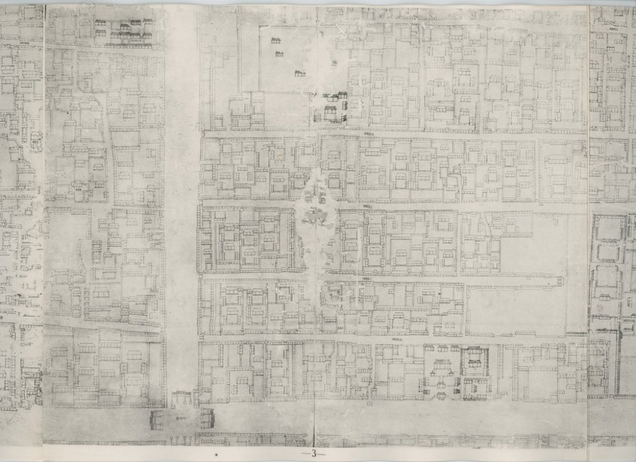
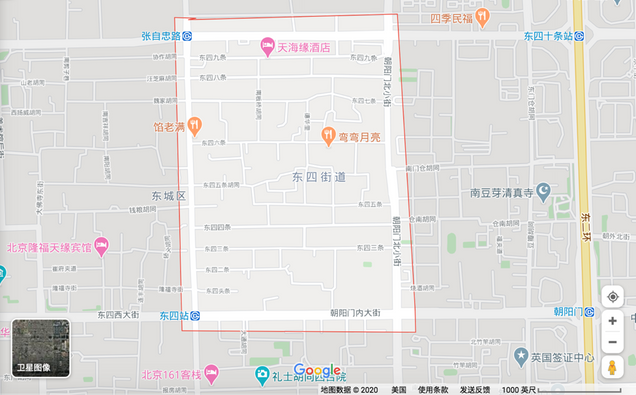
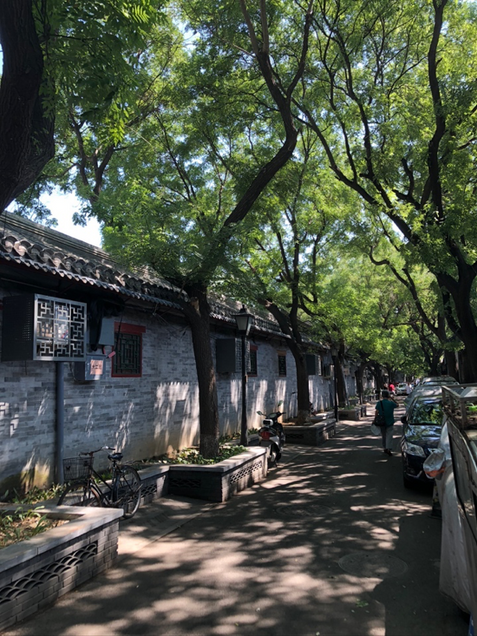
State-led built heritage preservation efforts started in China in the 1980s, when China joined the UNESCO World Heritage Convention as a State Party and received its first designations on the World Heritage List, including the Forbidden City and the Great Wall.[5]However, similar to the history of preservation in the Western world, it took decades for the Chinese government and preservationists to realize that tangible remains of the built environment were not the only asset worth preserving. Intangible aspects, including cultural identities and living traditions associated with heritage communities and the built environment, had to be taken into consideration as well. Although there was a set of state-issued guidelines regarding strategies and treatment of historic artifacts and buildings (much like the Secretary of Interior’s Standards for the Treatment of Historic Properties in the United States), the official Chinese version of preservation guidelines did not touch much on how to protect the human aspects of the many diverse types of historic built environments.[6] This illustrated that the lack of emphasis on human factors in historic preservation is a global concern.
Since the turn of the twenty-first century, the global field of historic preservation has seen an emerging trend called “people-centered approach."[7] This shift’s roots date back to the Nara Document on Authenticity (1994), where construction techniques and living traditions were deemed worth preserving, especially in non-Western contexts. A people-centered approach suggests that preservationists should not solely care about preserving brick and mortar for future generations, but should instead make people’s wellbeing the central goal of all preservation work. This approach is more sustainable because it involves more stakeholders, pays more attention to the interactions between people and their environments, generates diverse and inclusive solutions for treatment and renovation, and helps to dismantle the oftentimes expert-defined official discourse in heritage values and significance. The United Nations Sustainable Development Goals, published in 2015, included preserving culture as an important part of building sustainable cities, suggesting that people-centered preservation has already become a globally recognized concept. This paper, which takes a people-centered approach in historic preservation, attempts the first step toward understanding residents’ perceptions of historic preservation and policies, and how they could be more involved in the process. It uses Dongsi, an inner-city historic neighborhood in a developing country, as a case study. Although current residents are not the only stakeholders or human factor in people-centered preservation, they are the group that experiences long-lasting impacts first hand. Taking a bottom-up approach, this paper argues that residents see infrastructure and life quality improvement as the most pressing preservation needs in their neighborhood, and that preservationists need to establish long-term relationships with the community in order to carry out sustainable preservation practices.
Previous scholarly literature has clearly shown that historic preservation is an interdisciplinary field. Architects, urban planners, archaeologists, historians, social workers, and museum and tourism industry professionals work in a collaborative forum where theories, research methods, and working mechanisms intersect. However, this field also lacks a unified framework within which researchers and practitioners can operate.[8]
Previous scholarly writings have demonstrated the importance of the human aspect in heritage conservation and historic built environment preservation. As Dongsi has been designated as a protected area since 1990, the focus of this discussion is on residents’ post-designation concerns and involvement in the continuation of this preservation work. Urban planning scholars have focused on how involving more stakeholders in preservation could help in democratizing the heritage discourse, in other words, extracting diverse values from the built heritage and dismantling the traditionally expert-centered discussion around the “whys” and “hows” regarding our treatment of historic neighborhoods.[9] Because historic neighborhoods are often protected from the real-estate market and are considered part of the public well-fare, scholars of preservation law have emphasized that property owners are not the only demographic impacted by historic preservation.[10] Social scientists and urban policy-making scholars have contributed to the discussion of a people-centered approach, using the concept of “sense of place.”[11] This concept demonstrated how people behave differently in different physical environments (e.g., public versus private spaces). Therefore, one integral aspect of the physical environment (in this case, hutongs and courtyard house neighborhoods) is people’s experience associated with the environment. The “sense of place” literature emphasized intangible aspects, including experience, traditional lifestyle, and practices, as essential values of built heritage. To localize these concepts in a Chinese city, studies have been done in how heritage conservation, especially historic neighborhood preservation, served as an important tool for urban identity and image-building in Chinese cities.[12]
Previous studies have been done on other designated protection areas in Beijing regarding preservation schemes, tourism, and neighborhood change.[13] However, most of the studies took a top-down approach, looking at preservation as solely a government-led effort, instead of as a bottom-up or interactive process in which different stakeholders played different roles.[14] This paper aims to access the public perceptions of historic preservation policies and practices with a focus on residents’ opinions on how neighborhood changes affected their lives, and what impacted their involvement in historic preservation.
As a researcher, I believe that before proposing treatment and accessing the effectiveness of preservation policies and practices, the unavoidable first step is to get to know how residents think of preservation-related issues. They are the group of stakeholders whose lives would be most directly impacted by any kind of preservation action. Therefore, this study utilizes a bottom-up approach to access long-term historic neighborhood residents’ experiences, perceptions, and opinions, using a qualitative analysis method.[15] My study asked the following questions:
- How have existing built heritage preservation policies and practices engaged or failed to engage residents of living heritage communities?
- How have residents been involved in preservation and how can their perceptions contribute to informed actions in future preservation work?
Conversations with the residents often started from an expert point of view, such as values defined in the 2002 conservation planning document approved by the Beijing municipal government.[16] The first two of the five overarching principles of preservation work in these neighborhoods were focused on style and aesthetic features, including preserving the authenticity of streets, historic buildings, traditional courtyard houses, and architectural components. The third principle suggested that renovation or alteration should be done as “microcirculation,” meaning large-scale demolition and construction should be avoided. The fourth principle stated that preservation should work on improving the neighborhood living environment and infrastructure. The last principle made it clear that public involvement should be actively encouraged in historic preservation. In the past two decades, government-led preservation practices have been largely committed to these principles, perhaps with the exception of the third principle, as some large-scale renovations in historic neighborhoods were nowhere near “microcirculation.”
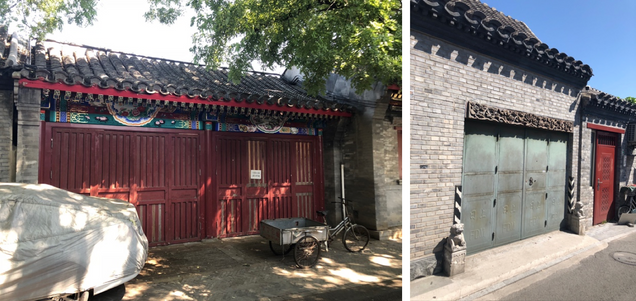
While all the residents interviewed agreed that style and aesthetic features, as shown by the appearance of courtyard houses’ external facades, are important, they did not possess the knowledge to identify what specific style and features are historically appropriate and significant. Many residents admitted that they could distinguish between a traditional and a non-traditional style (figs. 5 and 6) as people continued to make renovation to their houses, and they understand that the historical significance of Dongsi was the primary reason why the neighborhood was designated as worth preserving. However, residents were more concerned about tangible issues in the community, such as infrastructure and life quality improvement in the neighborhood, instead of building appearance or facade changes.
More than half of the interviewees spoke about how preservation practices improved the hutongs they lived in as a desirable public space. The narrow alleyways are not only used for through traffic, but also a place for human interaction, social gathering, and for some residents, their easiest access-point to get in touch with nature.[17] Therefore, when asked about tangible changes brought to Dongsi by government-led preservation campaigns, such as landscape renovation,[18] parking regulation changes,[19] and various measures regarding hygiene and trash collection,[20] residents focused on how such changes affected their use of the hutong as a public space.
Preservation practices did not stop at the public space. Based on the preservation principles, there is more flexibility to change the interior and more private spaces according to the residents’ preference and needs. The interior features of their courtyard houses have been renovated over the years to a contemporary standard, whether renovation was done by the residents themselves or led by various government-initiated campaigns. Inside of the courtyard houses, there were several government-led actions that were widely discussed, such as heating in the winter,[21] electronic wires re-arrangement,[22] and the recent weekend clean-up campaign to check and eliminate fire hazards.[23] This clean-up campaign originated in Dongsi and was promoted throughout the entire district, whereas infrastructure improvements, such as heating, were measures widely implemented in many historic districts with single-floor courtyard houses.
These improvements were mentioned and welcomed by a majority of the interviewees, because they resulted in environment and life quality improvement either in the streets or inside of the residents’ courtyard houses. Some of the changes added additional elements to the physical space, but they were never too conspicuous to interrupt the overall style and features of the historic environment. Compared to treatment and direct actions taken toward buildings and facades, the residents were more likely to understand and support preservation practices targeted at providing much needed functions and spaces for everyday use.
The fifth principle, as previously mentioned, encouraged the active involvement of the public in preservation works. Although it is widely agreed that stakeholder participation is an effective and essential tool in urban planning and people-centered preservation, the degree or level of involvement is often far from being clearly defined. When asked about how preservation practices engaged residents in the process, residents agreed that relationship-building among all stakeholders is important, in order to obtain their understanding and support regarding certain preservation policies and practices.[24]
There were three factors residents suggested really impacted their involvement in preservation. The first was whether there was a commitment to long-term engagement from the government, that include planners, social workers, residents, and other institutions and services in the community. The second factor was how much guidance and recognition residents received from the local administration regarding their involvement in preservation. How residents described the implementation of these two factors suggested that historic preservation was still perceived as a predominantly government-led effort in such neighborhoods, but the residents were willing to work with the public sector as long as they received proper instructions and positive feedback. The third factor many residents pointed to was that implementing a fix-all approach was not helpful. Residents feel that it is important to have professionals come into the neighborhood to work with each individual courtyard house, discuss long-term solutions, and follow up with the residents.
In conclusion, the first step of bottom-up historic preservation research is to understand current residents in addition to the historic physical environment and, furthermore, to support informed actions. This study provides the first step to center people, their experiences, perceptions, opinions, and needs in the process of preservation. Results showed that neighborhood residents care more about infrastructure and the improvement of life quality than the neighborhood’s appearance, style, or facade changes. The latter factors are closely related to the urban history and historic values of this neighborhood. However, even if history and values were conveyed to residents, people who actually live in the neighborhood did not directly benefit from these factors other than having a sense of pride. Residents recognized preservation efforts when appearance changes impacted quality and functions of life. This significant difference is not only a value judgement, but also suggests the potential gap between government-led preservation efforts and the residents’ involvement in both voicing concerns and taking actions to contribute.
Results also showed that various universal and local factors need to be taken into consideration. Conservation planning may follow universal principles, but the social, political, and economic contexts in inner-city historic neighborhoods remind us that the mechanisms of working with local communities need to be specifically designed every time. Planners and preservationists will benefit from getting actively and continuously involved with their target community. Practitioners need to work with each city and its communities’ development patterns, and align preservation with the interests of that particular population.
____________________
Footnotes
[1] See Nancy S. Steinhardt, “The Plan of Khubilai Khan’s Imperial City,” Artibus Asiae 44, no. 2/3 (1983): 137-158.
[2] See Hou Renzhi, Beijing Historical Maps (Beijing, China: Beijing Chubanshe, 1988). [侯仁之,《北京历史地图集》(中国北京:北京出版社,1988)].
[3] See Nancy S. Steinhardt, “Why were Chang’an and Beijing so Different?,” Journal of the Society of Architectural Historians 45, no. 4 (December, 1986): 339-357.
[4] See Beijing Municipal Commission of City Planning, Conservation Planning of 25 Historic Areas in Beijing Old City (Beijing, China: Beijing Yanshan Chubanshe, 2002). [北京市规划委员会,《北京旧城25片历史文化保护区保护规划》(中国北京:北京燕山出版社,2002)]; the jurisdiction of Dongsi Subdistrict (the most local level of government in Beijing Municipality, under Dongcheng District) has a population of 43,731 according to the 2010 Census. The designated protection area is from Dongsi Santiao to Batiao (the Third Alleyway to the Eighth Allyway).
[5] See Yu Kongjian, “China Faces the Challenge of World Heritage Concept: Thoughts after the 28th World Heritage Convention,” Journal of Chinese Landscape Architecture 11 (2004): 68-70. [俞孔坚,《世界遗产概念挑战中国:第28届世界遗产大会有感》(《中国园林》,2004)].
[6] See Jin Hongkui, “The Content and Theoretical Significance of the Principles for the Conservation of Heritage Sites in China,” in Conservation of Ancient Sites on the Silk Road: Proceedings of the Second International Conference on the Conservation of Grotto Sites, ed. Neville Agnew (Los Angeles, CA: Getty Publications, 2010), 75-84; and ICOMOS China, Principles for the Conservation of Heritage Sites in China (Beijing, China: Wenwu Chubanshe, 2015). [中国古迹遗址保护协会,《中国文物古迹保护准则》(中国北京:文物出版社,2015)].
[7] See Jeremy C. Wells, “Valuing Historic Places: Traditional and Contemporary Approaches,” School of Architecture, Art, and Historic Preservation Faculty Papers 22, (2010).
[8] See Randall Mason, “Assessing Values in Conservation Planning: Methodological Issues and Choices,” in Assessing the Values of Cultural Heritage, ed. Marta de la Torre (Los Angeles, CA: The Getty Conservation Institute, 2002); Jeremy C. Wells, “Heritage Values and Legal Rules: Identification and Treatment of the Historic Environment via an Adaptive Regulatory Framework,” Journal of Cultural Heritage Management and Sustainable Development 6, no. 3 (2016), 345-364; and Jeremy C. Wells and Barry L. Stiefel, Human-Centered Built Environment Heritage Preservation: Theory and Evidence-Based Best Practices, (New York, NY: Routledge, 2018).
[9] See Randall Mason and Erica Avrami, “Heritage Values and Challenges of Conservation Planning,” in Management Planning for Archaeological Sites, (Los Angeles, CA: Getty Publications, 2002).
[10] See J. Peter Byrne, “Historic Preservation and its Cultured Despisers: Reflections on the Contemporary Role of Preservation Law in Urban Development,” in George Mason Law Review 19, no. 3 (2012): 665-688.
[11] See Fatima Bernardo, Joana Almeida, and Catarina Martins, “Urban Identity and Tourism: Different Looks, One Single Place,” Proceedings of the Institution of Civil Engineers – Urban Design and Planning 170, no. 5 (October 2017), 205-216; and John Schofield and Rosy Szymanski, Local Heritage, Global Context: Cultural Perspectives on Sense of Place (Farnham, U.K.: Ashgate Publishing, 2011).
[12] See Ren Xuefei, “Forward to the Past: Historical Preservation in Globalizing Shanghai,” City and Community 7, no. 1 (2008), 23-43.
[13] See Hu Yingjie and Emma Morales, “The Unintended Consequences of a Culture-Led Regeneration Project in Beijing, China,” Journal of the American Planning Association 82, no. 2 (2016), 148-151; Charles S. Johnston, “Towards a Theory of Sustainability, Sustainable Development and Sustainable Tourism: Beijing’s Hutong Neighbourhoods and Sustainable Tourism,” Journal of Sustainable Tourism 22, no. 2 (2014), 195-213; Placido G. Martinez, “Authenticity as a Challenge in the Transformation of Beijing’s Urban Heritage: The Commercial Gentrification of the Guozijian Historic Area,” Cities 59 (November 2016), 48-56; and Hyun Bang Shin, “Urban Conservation and Revalorisation of Dilapidated Historic Quarters: The Case of Nanluoguxiang in Beijing,” Cities 27 (2010), S43-S54.
[14] See Dai Linlin, Wang Siyu, Xu jun, Wan Li, and Wu Bihu, “Qualitative Analysis of Residents’ Perceptions of Tourism Impacts on Historic Districts: A Case Study of Nanluoguxiang in Beijing, China,” Journal of Asian Architecture and Building Engineering 16, no. 1 (2017), 107-114; and Wang Fang, Liu Xiaoyu, and Zhang Yueyi, “Spatial Landscape Transformation of Beijing Compounds under Residents’ Willingness,” Habitat International 55 (July 2016), 167-179.
[15] From summer 2018 to summer 2019, twenty Dongsi residents were invited to do semi-constructed, face-to-face interviews in Mandarin Chinese. According to the study’s IRB protocols, the interviews were done anonymously as participants’ names were not recorded. Questions were centered around two sets of topics: opinions on actions and issues, and resident involvement. I first encountered the study participants during community meetings and events. Through a screening questionnaire, residents who expressed interest were then individually contacted. The only condition in the screening process was that the participants had to have resided in this neighborhood for a minimum of ten years. In summer 2018, this meant that the interviewees would have been living in the neighborhood around or before the time of the 2008 Beijing Olympic Games. The interviewees’ demographic background, such as age, gender, income, profession, and property ownership status, were not included, since those are not variables and would not be used to establish any correlations with the results. Upon agreement, an audio recording was done during some of the interviews, and the others were transcribed into written notes. The content of these interviews was then sent back to the residents to review and verify, both before and after data analysis. The coding process was done by theme, instead of keywords or frequency. A certified Chinese-English translator reviewed the interview protocols, transcripts, and data analysis, and a few additional rounds of peer reviews were conducted to ensure the clarification of these transcripts and analysis.
[16] See Beijing Municipal Commission of City Planning, Conservation Planning of 25 Historic Areas in Beijing Old City (Beijing, China: Beijing Yanshan Chubanshe, 2002). [北京市规划委员会,《北京旧城25片历史文化保护区保护规划》(中国北京:北京燕山出版社,2002)].
[17] “I don’t have much space at home. I would love the hutong in front of my house a quiet and pleasant place to be, so I can sit out under the trees, talk to my neighbors, and not to worry about the chaos outside of the neighborhood,” interview with the author, June 5, 2018, Dongsi, Dongcheng District, Beijing, China.
[18] “The wheeled flower pots provided by the subdistrict were such a great invention. They are mobile, so I can put them wherever I need. When I need to hold the space for my family’s car to park in front of the house, I can put them there. When I need to put out a table and some chairs to play chess or have a cup of tea with my neighbors, I can move the pots somewhere else and set up something in that space. The plants and flowers make them look a lot nicer than traffic cones, but at the same time, they are easy to take care of,” interview with the author, June 5, 2018, Dongsi, Dongcheng District, Beijing, China.
[19] “Parking used to be a huge problem in Dongsi and in many other old neighborhoods. These streets were not designed for cars, but nowadays, car traffic and parking in the hutongs are unavoidable. The hutong began to look like a parking lot, and we sometimes had to walk our way through the cars. When some drivers couldn’t make it through, they honked and we all had to come out and figure out whose car was blocking the way. This year, the subdistrict started to survey the whole neighborhood and try to figure out how many families had cars and how many parking spots we could allow in each hutong. The rules and charges may be unfair to some people, but at least we were trying to work something out with our parking situation,” interview with the author, July 19, 2018, Dongsi, Dongcheng District, Beijing, China.
[20] “We used to have huge trash cans in the hutongs. But nobody wants them in front of their house, under their windows, or around their street corner. In summer times we couldn’t sit in the streets because the trash can was not far away and the smell was so bad. The free gym equipment provided to us was not used because nobody wanted to work out with trash smell on the side. Same with those benches. Now that the subdistrict has designated time each day to pick up individual trash bags from each courtyard house, we don’t have to live with this problem anymore,” interview with the author, July 18, 2018, Dongsi, Dongcheng District, Beijing, China.
[21] “I remember growing up with coal-fired heating in hutongs. Every winter, children had to help their parents to move beehive coal briquettes around. When you burn these briquettes, the smoke and cinder remain in the neighborhood for the entire winter. Since the early 2000s, this municipal wide campaign to transition from beehive coal briquettes to electronic heating and providing free electronic heaters to all families living in old neighborhoods really helped us a lot. Some people say the electronic ones were not strong enough, but you can always buy your own ones for extra heating. They are in many ways much better than coal burning, saving us a lot of work every winter and are good for the environment,” interview with the author, July 19, 2018, Dongsi, Dongcheng District, Beijing, China.
[22] “Electronic wires were a major threat to our wooden roof. Over the years, we had electricity, cable TV, telephone, and Internet added to our neighborhood at different times. Each company came and had their own wires set up. At the end, all wires ended up as a huge mess on the wall and nobody could tell which is which. They went everywhere and there was no way to trace them. We’ve had many accidents and power outage due to lightning. The lack of planning and coordination among all these utilities was a big problem. Luckily, since last year, the subdistrict had started to hire teams to fix this problem, re-arrange all the electronic wires, put them into ground or designed boxes to covered them up in case of rain,” interview with the author, July 18, 2018, Dongsi, Dongcheng District, Beijing, China.
[23] “The weekend clean-up campaign started in 2016 and the original idea was only to clean up decade-old random garbage in the courtyard houses one-by-one. They were led by the community workers from the subdistrict and a lot of the local Party Members volunteered every Saturday. At first, some people didn’t want outsiders to touch their stuff even though those were really just garbage, but when they saw the post-clean-up scene of their courtyard, they realized how much free space they could have enjoyed over the past decades. Also we saw that after each clean-up, the subdistrict followed up with each courtyard to see if there were any fire hazard that needed to be addressed,” interview with the author, June 5, 2018, Dongsi, Dongcheng District, Beijing, China.
[24] “In the past two years or so, we were invited several times to sit in meetings where subdistrict officials and urban planners discuss residents’ opinions regarding certain projects. First, I have to say that we were invited partially because they (officials) knew us personally and they knew that we would probably agree with many of their ideas. Secondly, while I think that more people should be invited to these meetings and these meetings should be more publicized, I also understand why the subdistrict was hesitate to bring in random residents. They would probably only care about impacts on their own houses instead of issues that are important to the whole neighborhood,” interview with the author, July 18, 2018, Dongsi, Dongcheng District, Beijing, China; “We have people coming to Dongsi every once in a while and ask us about historic neighborhood preservation. We don’t feel comfortable talking to them when we don’t personally know them. I can talk to you because you are referred to us by the subdistrict office. I know that you won’t twist my words. But others, maybe not. Who knows what they would put on paper after our conversation? I’d rather talk to people that really care about us, and not take our words for their own purposes,” interview with the author, July 19, 2018, Dongsi, Dongcheng District, Beijing, China; “I really think the subdistrict should work with us one-by-one (courtyard house by courtyard house). We have different situations in different homes. For example, I own my house because my family have been here for generations. But here is not the typical situation. There are many other dazayuan (one house with multiple families and more complicated property ownership situations) where people can’t even agree on actions among themselves. Of course it is easier to satisfy me or my family, but it can be really difficult to satisfy all. Unless you work with them individually and figure out what would be the best solution for everyone going forward,” interview with the author, July 19, 2018, Dongsi, Dongcheng District, Beijing, China.
Seventeenth-Century Dutch Winter Landscapes: Visual Encounters with Non-Sites, Space, and Place
by Rachel Kase

Hendrick Avercamp’s Winter Landscape with Ice Skaters, dated about 1608, is typical of the bustling winter scenes for which Dutch artists are known (fig. 1). Current scholarship generally regards such works as illustrations of the extent to which the Dutch enjoyed winter or how the ice leveled class distinctions.[1] The Dutch Golden Age coincided with the coldest stretch of the Little Ice Age, a period of global cooling during which time Holland endured an increased frequency in storms and the most frigid winters in its recent history.[2]This paper addresses the varied ways that seventeenth-century Dutch artists represented the conditions of winter and the possible cultural associations that winter landscape representations held for contemporary viewers, specifically recent reports of Dutch voyages to the Far North.[3] Recently, Christopher Heuer has drawn attention to the ways that the Arctic’s cold terrain, which appeared indifferent to cultural production or national identity, irked Dutch travelers.[4] This paper expands his discussion, asking if pictorial and geographic vagueness or placelessness was any more acceptable at home. I argue that the Dutch winter landscape challenged local artists to grapple with the blank slate that they observed in their natural surroundings.[5]
The first northern artist to specialize in the “ice scene,” Avercamp’s paintings and drawings referenced relatively new local weather patterns.[6] During the Little Ice Age, average temperatures in the Netherlands were nearly two degrees Celsius colder than today. While the Dutch lacked modern meteorological tools, they quantified the weather changes that they observed using natural landmarks.[7] The Dutch, unlike their European counterparts, responded creatively and effectively to climate change.[8] The hub of a maritime trade empire, the Dutch Republic relied primarily on wind rather than solar energy to power its economy, allowing its sailors and merchants to keep moving even as the world around them froze solid.[9] The frigid weather, however, was not without consequences. Many of the narrative details in Avercamp’s Ice Scene, dated circa 1610, reference serious challenges that the Little Ice Age posed to Northern Europe’s inhabitants. On the left-hand side, a woman washing her clothes in a small hole in the ice demonstrates one of the hardships that the season’s lack of water presented. Not far to her right, a man bears a load of sticks on his back, a reminder of the difficulty of obtaining firewood in snow-covered terrain.
Avercamp and his contemporaries’ images of winter were enormously popular in the seventeenth-century Netherlands. Produced primarily for the open market, they were purchased by a socio-economic cross-section of the population. It is difficult to know precisely why these works held so much popular appeal. There are few, if any, existing seventeenth-century documents that explicitly discuss their cultural significance, and few of the original owners of Avercamp’s paintings or drawings are known.[10] Perhaps such pictures appealed to contemporary viewers for their representations of the communal hardship and cultural resilience that they subtly referenced. They may have also been valued as a novel image type or for the ways that they depicted an environment that viewers prided as distinctively Dutch.[11]
In addition to referencing hardships of the local environment, early seventeenth-century images of winter also call attention to the ways that the weather complicated contemporary conceptualizations of space and place. Louisa Mackenzie considers the importance of such spatial classifications in early modern minds. Place, she explains, is a “meaningful location,” a space invested with emotional attachment, whereas space is “raw material” that cultural or social processes have not yet transformed.[12] Therefore, the town squaremight be considered a place, nestled within the city in the far distance of Avercamp’s A Scene on the Ice, dated circa 1610. How, then, do we classify the vast icescape in the foreground of this work? It would be impossible for travelers to distinguish the space from the middle of the ocean. If sailors were to make a topographic profile of the ice village, as they often did to assist in the recognition and navigation of foreign coastlines, there would be nothing to distinguish the flat expanse except from the presence of two bare masts. Winter, I argue, forced Dutch citizens to navigate terrains that were neither firmly places nor spaces, but rather embody a distinct placelessness.[13] Marked by generic skylines and lacking landmarks, many seventeenth-century Dutch icescapes give the impression that they could be located anywhere.
In the early seventeenth century, images of placeless, frozen landscapes may have also evoked for Dutch viewers descriptions of the recently discovered Arctic.[14] During this period, the Dutch were engaged in a competitive rivalry with the French, English, and Danish to be the first to find a northern sea route to Asia.[15] In 1596, Dutch navigator Willem Barents set out in search of such a northeast passage. After mistiming the ice, his ship was frozen in Novaya Zemlya, where the crew survived for nine months in a temporary settlement made from driftwood and ship parts.[16] Two years later, Gerrit de Veer, one of the crewmen, published his illustrated diary of the journey. De Veer’s vivid accounts of the crew’s trials, ranging from perpetual darkness to scurvy, fascinated and terrified European readers. As John Richard observes, the book’s popularity ensured that “awareness of the Arctic burst upon the European consciousness.”[17]
Cartographically ambiguous and culturally and ecologically empty, the Far North was disturbingly lacking in many of the features characterizing other recent discoveries such as the New World. “I find in all the countrie nothing… there is nothing to consider,” lamented an Arctic voyager.[18] English sailor Thomas Ellis’s 1578 description and drawings of an iceberg he encountered near Baffin Island further materialize how Arctic topography eluded traditional rhetorical and pictorial strategies.[19] Apologizing that the iceberg he encountered could not be “shewn” as a totality, he represented its varied contours as it appeared from several angles in four separate drawings. The images demonstrate the extent to which the polar landscape’s icy topography and overwhelming whiteness confounded European imaginations, challenging established notions surrounding geography, navigation, culture, and vision.[20]
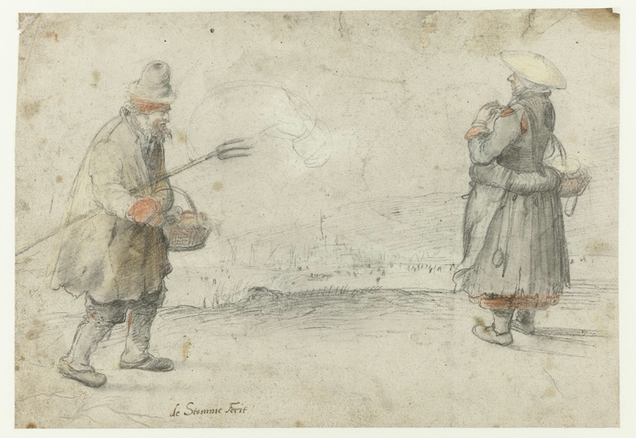
Like the voyagers, Dutch artists also registered the distant polar environment, creatively responding to its congruence with the local one that they sought to represent.[21] A watercolor drawing by Avercamp locates the desert-like bareness described by Arctic voyagers on Dutch soil. A man and woman stand at the edge of an overcast and indeterminate landscape (fig. 2). Their layers of clothing and the bare ground serve as a barometer of the weather. Winter has transformed the sky, ground, and river into the same frosty medium.[22]Does the couple know where they are or where they are headed? The woman pauses as if to get her bearings. Such an image of placelessness recalls a common point of comparison for those who visited the Arctic: the desert. In Avercamp’s drawing, the two travelers similarly seem to confront an unknown expanse that might inspire fear or awe now associated with the sublime. Serving as a graphic double for the artist, the couple charts a terrain that challenges visual discernment and pictorial description.
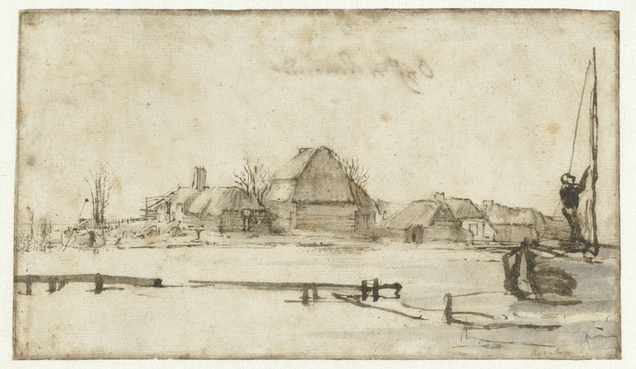
In two unusual drawings made around 1650, Rembrandt modifies Avercamp’s pictorialism while relying on the whiteness of the artworks’ surface to evoke winter's visual and auditory emptiness. Rembrandt represents the stillness of the winter landscape with the sparseness of line (fig. 3). A break in his line and an expanse of unworked paper evokes a drift of snow that will soon bury the fence in the foreground. The specific subject matter of a second Rembrandt drawing, now in the Harvard Art Museums, has been the longtime subject of debate among scholars. Did Rembrandt intend to capture a farmstead in winter, with the roof and field covered in snow? Or, is it a springtime landscape bathed in bright light? Nevertheless, that the drawing was reflexively named “winter” underscores how the image’s remarkable blankness evokes the topographical and temporal obscurity associated with the season.
While it is difficult to judge the extent to which Rembrandt had the Arctic in mind when he created these drawings, the disorienting spatial conditions he represents recall the unsettling conditions described by Dutch voyagers.[23] Travelers to the Arctic were particularly troubled by how its whiteout conditions occluded clear vision. “We could not see out of our eyes […] could not distinguish day from night by reason of darkness,” reported de Veer of he and his fellow crewmen.[24] Yet, in the seventeenth-century, at the height of the Little Ice Age, the disorienting monotony and non-sites of the snow-capped Arctic, Rembrandt demonstrates, could be found at home.[25]
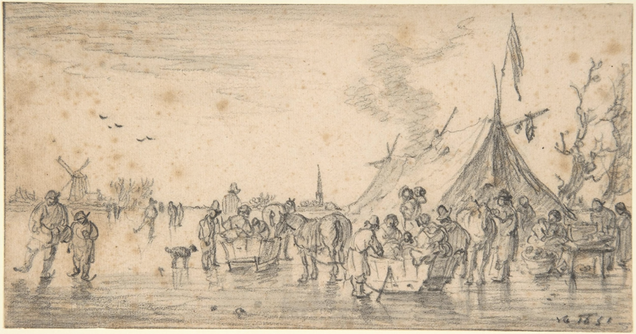
In some cases, Dutch artists seem to confront and resolve geographic vagueness in the local landscape by depicting figures who appear to have intentionally stopped in no-man’s land outside city walls. While the duck hunter in Avercamp’s undated watercolor drawing appears in a vast winter desert, the small mound of marsh upon which he stands establishes a meaningful spatial center point. He and his canine are within a landscape, Avercamp seems to say, not beyond its boundaries. Similarly, Jan van Goyen’s River Landscape in Winter with Figures Skating and Sleds depicts figures in an icy zone of geographical uncertainty (fig. 4).[26] Despite the absence of civic infrastructure, however, the figures on the right busily prepare and sell food. The icescape, therefore, becomes a culturally significant location where quotidian activity unfolds as naturally as if it took place within the visually identifiable boundaries of a neighborhood. Such an image exemplifies the ways in which Dutch artists resolved the competing placelessness of the local winter landscape with a communal yearning for a topography that was dotted with culturally significant sites.[27]
Increased snowfall, a hallmark of the Little Ice Age, must have contributed to the distinctive placelessness of the local environment this paper has considered. However, as the images discussed above demonstrate, Dutch winterscapes almost never represented this common winter weather condition. This widespread pictorial decision could not have been accidental. Snowfall and its blinding effects could transform places, or known locations, into space: unsettling terrains of cartographic uncertainty, not so different from the Arctic.[28]Perhaps Dutch artists were reluctant to picture the white, wintry deserts where travelers lost their way. Perhaps, with their snowfall-less images, they sought to demonstrate that they had seen and captured the winter landscape with unobscured visual clarity. Nevertheless, the artists examined in this paper–Avercamp, Rembrandt, and van Goyen–pictorialize winter’s whiteout conditions through the absence of weather. Thus, their artworks in both what they do and do not represent, subtly express the cultural legacy of arctic voyagers and contemporary visual concerns surrounding the representation of winter.
Avercamp’s watercolor drawing of the two travelers vividly pictures how the placelessness of winter, both in the Far North and at home, challenged and thematized image-making in the seventeenth-century Netherlands. Leaving much of his panel untouched, Avercamp calls attention to the way in which winter mirrors the opacity of an artist's blank surface. Here, where there is little to be seen, both the physical and represented landscape, site specificity and spatial vagueness, collapse onto one another. Despite the fear and anxiety that was associated with these northward-bound voyages, seventeenth-century Dutch artists demonstrate that ice, often associated with unnavigability and placelessness, with impoverished land and fear, also produces important imaginative terrain.
____________________
Footnotes
[1] For various interpretations, see Ronni Baer, ed., Class Distinctions: Dutch Painting in the Age of Rembrandt and Vermeer (Boston, MA: Museum of Fine Arts, 2015), 250; Joseph Koerner, Bosch and Bruegel: From Enemy Painting to Everyday Life (Princeton, NJ: Princeton University Press, 2016), 323; Peter C. Sutton, Masters of Seventeenth-Century Dutch Landscape Painting (Boston, MA: Museum of Fine Arts, 1987), 252; Mariët Westermann, A Worldly Art: The Dutch Republic 1518–1718 (New Haven, CT: Yale University Press, 2007), 106.
[2] The World Meteorological Organization (WMO) defines climate change as “a shift in the mean or variability of weather that lasts at least thirty years.” Dagomar Degroot, “War of the Whales: Climate Change, Weather and Arctic Conflict in the Early Seventeenth Century,” Environment and History (2019): 5. While the Little Ice Age lasted about six centuries, from 1250 to 1850, its coldest periods are known as the Grindelwald Fluctuation (1560–1628) and the Maunder Minimum (1645-1720). During these periods, average global temperatures were approximately one degree Celsius below average temperatures in the twentieth century. For more on this, see Dagomar Degroot, The Frigid Golden Age: Climate Change, the Little Ice Age, and the Dutch Republic, 1560–1720 (Cambridge: Cambridge University Press, 2018), 2, 256.
[3] While the catalogues for the 2001 exhibition at the Mauritshuis, “Holland Frozen in Time,” and the 2009 exhibition at the Rijksmuseum, “Hendrick Avercamp: Master of the Ice Scene,” briefly address the relationship between contemporary weather trends and innovations in image-making, their observations are mainly to draw attention to the existence of unusually cold weather patterns in the seventeenth century. The relationship between these two phenomena, therefore, has only been scratched on the surface.
[4] Christopher Heuer, Into the White: The Renaissance Arctic and the End of the Image (New York: Zone Books, 2019), 16. As an archipelago of islands and ocean, the Far North, Heuer observes, was a “non-site:” or a terrain that was present but “physically and ontologically unmoored.” I apply Heuer’s observations about primarily sixteenth-century polar geography to the seventeenth-century Netherlands. As an environment that was constantly changing, the Dutch landscape, I argue, also contained non-sites: swampy marsh and polderland submerged under water and then re-emerged; waterways that froze, unfroze, and refroze, and coastlines that ebbed and flowed. How did this further challenge artists who sought to represent it?
[5]As Joseph Koerner has observed, in the sixteenth century, the occluding effects of snowfall, seen, for example, in Pieter Bruegel the Elder’s Adoration of the Kings in the Snow (1563, Am Römerholz), could parallel Reformation whitewash. Koerner, Bosch and Bruegel: From Enemy Painting to Everyday Life, 285-286. In the seventeenth century, I argue that it was the weather, not religion or Reformation polemics, that challenged and thematized image-making. Furthermore, unlike Bruegel’s painting, seventeenth-century Dutch pictorializations of winter seldom represent falling snow–an indication that Dutch artists wished to represent winter differently from sixteenth-century precedents.
[6] Avercamp’s early seventeenth-century artworks–secular images with lowered horizon lines–were foundational to Holland’s vibrant winter landscape tradition, which was then quickly developed by artists including Esaias van de Velde, Jan van Goyen, and later, Jacob van Ruisdael and Aert van der Neer. The only precedent was Pieter Bruegel the Elder’s winter scenes, made in the southern Netherlands in the sixteenth century, which combined Flemish villages and imaginary mountainous terrain, typically in the distinctive world landscape tradition.
Pieter Roelofs, ed., Hendrick Avercamp: Master of the Ice Scene (Amsterdam: Rijksmuseum, 2009), 25.
[7] In some communities, governments systematically installed landmarks that helped them contextualize changes in water levels. This demonstrates that the Dutch were aware, to at least some extent, that they were living through a climatic anomaly.
[8] Dissimilar to the Dutch Republic, whose global trade network shielded it from climatic vulnerability, the vast majority of early modern Europe depended on agriculture. The climatic extremes of the Little Ice Age, therefore, caused widespread crop failure, inflation, famine, and social unrest in much of Europe. For more on this subject see Wolfgang Behringer, “Climatic Change and Witch-hunting: The Impact of the Little Ice Age on Mentalities,” Climatic Change 43, no. 1 (1999): 335-51; see also Degroot, The Frigid Golden Age, 109-111.
[9] Degroot, The Frigid Golden Age, 57; Dutch sailors took advantage of high wind speeds and made boats that could withstand sea ice. They also innovated countless ways, including ice yachts and ice wagons, to transport people and goods over frozen waterways inshorter distances.
[10] While the owners of specific works are almost entirely unknown, the inventories of many prominent citizens in Amsterdam and Kampen, Avercamp’s hometown, list works by “the Mute” or “the Mute of Kampen,” the nickname by which he was commonly known due to his inability to speak. His work was also in the collections of several artists including Jan van de Capelle and Gerard ter Borch; Roelofs, ed., Hendrick Avercamp Master of the Ice Scene, 11-12, 119.
[11] Connoisseurs may have also recognized the relationship of Avercamp’s work to those of sixteenth-century Flemish master Pieter Bruegel the Elder, whom he deliberately referenced in a number of his paintings.
[12] Louisa Mackenzie, The Poetry of Place: Lyric, Landscape, and Ideology in Renaissance France (Toronto: University of Toronto Press, 2011), 24; given the degree to which mental and physical terrain were blurred in the Renaissance, such distinctions may have held even greater cultural capital.
[13] Dana Leibsohn, “Assessments,” in Landscape Theory, eds. Rachael DeLue and James Elkins (New York: Routledge, 2008), 252. As Leibsohn has observed, placelessness is what lies beyond identifiable boundaries and is at once nowhere and nearby.
[14] Relatively little is known about Avercamp’s life. There exist no documents, to my knowledge, that speak directly to his awareness of Arctic imagery. This is something I plan to further research.
[15] These powers specifically sought a sea route free of Spanish or Portuguese control. Dutch merchants were also lured to the Far North with the promise of profits to be made from Arctic whaling. John Richards, The Unending Frontier: An Environmental History of the Early Modern World (Berkeley: University of California Press, 2003), 589.
[16] Heuer, Into the White: The Renaissance Arctic and the End of the Image, 143.
[17] De Geer’s journal was published in 1598 and translated into French, German, Italian and Latin by 1600 and English by 1609. It sold out of its initial run of more than fifteen-hundred copies; see Richards, The Unending Frontier: An Environmental History of the Early Modern World , 590 and Heuer, Into the White: The Renaissance Arctic and the End of the Image, 137.
[18] Heuer, Into the White: The Renaissance Arctic and the End of the Image, 77.
[19] Heuer, Into the White: The Renaissance Arctic and the End of the Image, 10. Printed in 1578, Ellis’s account of his attempted journey to discover a northeast passage contained the world’s first description of an iceberg. The four-part image that was also printed was made after Ellis’s original drawings; see Thomas Ellis, A True Report of the Third and Last Voyage into Meta Incognita: Achieued by the Worthie Capteine, M. Martine Frobisher Esquire (London: Thomas Dawson, 1578), sheet before fol. A1r, Huntington Library, San Marino, California. For other late sixteenth century European images of the Arctic, see the printed illustrations from Gerrit de Veer’s diary, printed by Cornelis Claesz in 1598, now housed at the Rijksmuseum, Amsterdam (e.g. NG-1977-278).
[20] Heuer, Into the White: The Renaissance Arctic and the End of the Image, 55 and 77.
[21] What the Arctic supplied to European cultural production Stephen Greenblatt has termed “imaginative energies.” That is to say, its geography sparked new ways of looking and thinking about the world. See Stephen Greenblatt, “Shakespeare Bewitched,” in Shakespeare and Cultural Traditions: The Selected Proceedings of the International Shakespeare Association World Congress, Tokyo (Newark, NJ: University of Delaware Press, 1991), 29.
[22] For more on early modern perceptions of snow, ice, and glaciers, see Eric Wilson, The Spiritual History of Ice (New York: Palgrave Macmillan, 2003). While such environments and weather conditions were generally feared, Wilson notes that unmapped spaces such as the poles were more apt to inspire fantasy and notions related to the sublime. While the aesthetic parameters for the sublime were not mapped out until the eighteenth century, its origins and expression in seventeenth-century Dutch visual and rhetorical experiences of remote landscapes is considered by Jan Blanc in his 2016 essay, “Sensible Natures: Allart Van Everdingen and the Tradition of Sublime Landscape in Seventeenth-Century Dutch Painting,” Journal of Historians of Netherlandish Art 8, no. 2 (Summer 2016), and briefly addressed by scholars including Christopher Heuer and Peter Fjågesund.
[23] Rembrandt’s extensive collection of natural exotica and closeness with Nicolaes Ruts, a Russian fur trader, makes it likely that he was familiar with, and interested in, discoveries in the Far North.
[24] Heuer, Into the White: The Renaissance Arctic and the End of the Image, 146; such conditions, Heuer explains, often caused de Veer himself to doubt the validity of his own eye-witnessing.
[25] Heuer, Into the White: The Renaissance Arctic and the End of the Image, 10 and 55; while sailors often relied upon topographical profiles to assist in recognizing foreign coastlines, Dutch navigators commented upon the uselessness of established navigation methods in the North.
[26] Note that these locales depart significantly from the recognizably Flemish villages seen, for example, in Pieter Bruegel the Elder’s sixteenth-century winter landscapes.
[27] For more on how local artists were concerned with the representation of landscapes that appeared to be familiar and characteristically Dutch, see Walter Gibson, Pleasant Places: The Rustic Landscape from Bruegel to Ruisdael (Berkeley, CA: University of California Press, 2000).
[28] Heuer, Into the White: The Renaissance Arctic and the End of the Image, 159; snow and ice, Heuer observes, defamiliarized city and country. Furthermore, snowfall, a form of natural Reformation whitewash, also could transform pictorializations of the landscape into anti-images: panels of white.
Acknowledgements
by Rebecca Arnheim and Bailey Benson
We would like to extend our gratitude to all the people who have been involved in the original planning of the in-person symposium, and then to those who lent their time and support to bringing this special issue of SEQUITUR to light. Thank you to the Boston University Center for the Humanities; the Boston University Department of History of Art & Architecture; and the Museum of Fine Arts, Boston, for your generous support. Thank you to Dalia Habib Linssen and Sophia Walter for their logistical support in arranging the venue and catering for the event. Thank you to Alina Imas for her beautiful poster design.
A special thanks must be extended to Professors Cynthia Becker, Alice Tseng, Greg Williams, and Michael Zell, without whose unwavering support and guidance this publication would not have been possible. Thank you also to the editors of SEQUITUR for agreeing to host this special issue and for their help in the copy-editing process. And, thank you to the issue’s anonymous peer reviewers.
Thank you to all the presenters originally scheduled to deliver papers at the symposium, and thank you to those who agreed to participate in this publication. It has been a joy working with all of you. We would also like to thank Professor Christopher P. Heuer for agreeing to present the keynote address at the 36th Annual Graduate Symposium, although he was unable to participate in the publication. And, thank you to the moderators, Willie Granston and Phillippa Pitts, for the time and effort they put into both the symposium and then the publication.
Last, but most certainly not least, we would like to thank the graduate students from the History of Art & Architecture Department at Boston University who volunteered their time to work on the CFP committee and the abstract committee, as well as those who were planning to assist on the day of the event. Without the collaboration of our fellow graduate students, this symposium would not be possible.
Willie Granston interviews Rachel Kase and Tobah Aukland-Peck
Notes About Contributors
Rebecca Arnheim is a fifth-year Ph.D. candidate in History of Art & Architecture at Boston University. Previously, she received her BA and MA in History of Art from the Hebrew University of Jerusalem and a Diploma in Curatorial and Museum Studies from Tel Aviv University. She is currently working on her dissertation, “Ephemera Made Permanent: Collection and Display of Portrait Drawings in Early Modern Italy,” which focuses on highly finished portrait drawings and the circumstances of their creation, commission, purchase, collection, and display from the mid-fifteenth century to the late-sixteenth century.
Tobah Aukland-Peck is a fifth-year PhD student in Art History at the Graduate Center of the City University of New York. Her dissertation research focuses on images of extraction (including mines, miners, and mining infrastructure) in interwar Britain. She locates the figure of the miner as an alter-ego for the artist, tracing the way in which both instances of labor are engaged with the translation of landscape and raw material into productive commodities.
Bailey Benson is a fourth-year PhD candidate at Boston University in the History of Art & Architecture Department. Her dissertation, entitled “In the Eye of the Beholder: Memory, Identity, and the Role of Viewer Reception in Roman Imperial Portraiture, 193-284 CE,” investigates the changing memory landscape of the Roman Empire during the third century and the role that imperial portraiture played in crafting and articulating individual commemoration and memory formation. She has held positions at the Museum of Fine Arts, Boston, Isabella Stewart Gardner Museum, and the Princeton University Art Museum.
Willie Granston is a fifth-year PhD candidate in the History of Art & Architecture Department at Boston University, where his studies focus on American architecture of the late nineteenth and early twentieth centuries. His dissertation, “‘Like it Growed There’: Resort Architecture and the New England Landscape, 1875-1915” considers how environment awareness and anxieties relating to the landscape influenced the design, construction, and reception of New England’s late nineteenth-century resort buildings. He obtained a BA from Trinity College in Hartford, Connecticut, and has an MA from the University of Delaware, where he studied in the Winterthur Program in American Material Culture.
Rachel Kase is a fourth-year PhD candidate at Boston University, specializing in seventeenth-century Dutch painting with advisor Michael Zell. She received her M.A. from the History of Art & Architecture Department at Boston University in 2017. She has held positions in the Art of Europe department at the Museum of Fine Arts, Boston, Old Master Paintings at Sotheby’s in New York, and at the Philips Collection in Washington, D.C. Her dissertation, entitled “Against the Rising Tide: Picturing Severe Weather and a Changing Landscape in the Seventeenth-Century Netherlands,” takes an ecocritical approach to seventeenth-century Dutch landscape painting.
Mingqian Liu is a PhD candidate from the Department of Architecture and Center for Heritage Conservation at Texas A&M University. She also works as a Graduate Assistant for the College of Architecture Diversity Council and Center for Teaching Excellence at Texas A&M. Her research interests include architectural and urban history, historic preservation, heritage tourism, and public education in museums. Mingqian held an M.A. in History of Art and Architecture from Boston University, and a B.A. in International Studies from the University of Iowa.
Phillippa Pitts is a PhD student and Horowitz Foundation Fellow for American Art at Boston University. Her research questions the presentation of ‘American’ identity in the nineteenth and early twentieth century, examining the ways in which these constructions are underpinned by ideas of expansion, immigration, and xenophobia, as well as discourses of indigeneity. Before returning to doctoral work, Phillippa worked in museum exhibitions, interpretation and technology for almost a decade, and remains passionate about equity, inclusion, and accessibility in the arts. Phillippa's work has been generously supported by grants and fellowships from CASVA, the Kress Foundation, and the Center for American Art, among others.
Amanda Thompson is a PhD candidate at the Bard Graduate Center working in Native American arts and critical craft studies. Her dissertation research is tentatively entitled “Florida Seminole and Miccosukee Patchwork: Craft, Sovereignty, and the Mediation of Settler Colonial Encounters, ca. 1918- present.” Before returning to research, Amanda spent fifteen years working in museum collection and exhibition management at institutions including the New-York Historical Society, the Museum for African Art, and The Jewish Museum. She currently sits on the Board of Directors and chairs the Collections Committee of the Tomaquag Museum, Rhode Island’s only Indigenous museum. Amanda is a 2020-2021 Smithsonian American Art Museum Research Fellow and her dissertation research has been generously funded by the American Philosophical Society.
Wrought from Nature, Cast by Design: An Ecocritical Study of Thomas Jeckyll’s Norwich Gates
by Kate Hublou

… go to Nature in all singleness of heart, and walk with her laboriously and trustingly, having no other thoughts but how best to penetrate her meaning, and remember her instruction, rejecting nothing, selecting nothing, and scorning nothing; believing all things to be right and good, and rejoicing always in the truth.1
The above quote, taken from John Ruskin’s (1819–1900) first edition of Modern Painters (1843), is often considered a mantra of the Pre-Raphaelite Brotherhood.2 This principle of “truth to nature” served as Ruskin’s call-to-action for young artists, specifically painters, to base their practice upon close observation of the natural world. The passage inspired artists such as John Everett Millais (1829–1896) and William Holman Hunt (1827–1910) to painstakingly record the idiosyncrasies of every veined leaf and bent branch in their paintings. Likewise, designers experimented with similar visual effects with diverse materials and utilitarian object-forms.
This essay explores the early work of one such designer, Thomas Jeckyll (1827–1881). Jeckyll first gained prominence with the display of his Norwich Gates, a pair of cast and wrought-iron gates, at the 1862 London International Exhibition. Little is known of this elusive architect-designer, but his friendship with the painter Frederick Sandys (1829–1904) and association with Dante Gabriel Rossetti (1828–1882) connect him with the Pre-Raphaelites and, in turn, the writings of Ruskin.3 Such connections lay the groundwork for this essay’s assertion that Jeckyll’s Norwich Gates serve as a bold expression of Ruskinian naturalism. His design oeuvre has been vastly understudied, with the bulk of existent scholarship discussing the influence of Japonisme on his work of the late 1860s and 1870s.4 Returning to the beginning of Jeckyll’s prolific career, this essay argues that the designer’s allegiance with Ruskin’s philosophy can be found in the abundant use of naturalistic details and employment of wrought iron instead of modern cast iron for ornamentation of his Norwich Gates. Analysis of the gates, their display and reception at the International Exhibition, and their ultimate home at the royal countryside estate of Sandringham, further reveals that these gates were emblematic of burgeoning ecocritical thought spurred by Ruskin’s pervasive writing.

In tandem with his “truth to nature” tenet, Ruskin placed great significance on “truth to materials.” In his 1849 publication The Seven Lamps of Architecture, Ruskin takes specific issue with the ubiquitous use of cast-iron ornamentation. Believing the mass-production of such objects through the use of molds to be unnatural and deceitfully imitative of authentic and traditional hand-forged wrought iron, Ruskin pleads for the craftsman’s return to “the common iron of the middle ages [which] was as simple as it was effective.”5 Jeckyll’s Norwich Gates reflect Ruskin’s concerns by using cast iron only for the underlying structure and wrought iron for the entirety of its ornamentation.6
As the only gates at the International Exhibition that combined wrought iron with a cast-iron skeleton, Jeckyll’s Norwich Gates were visually and structurally different from the other ironwork on display. Indeed, they even contrasted with the actual building, given that the Crystal Palace was constructed entirely of cast iron and glass.7 Although the other exhibited gates of gilded iron would have gleamed brightly in the sunlight streaming through the large glass panes of the Crystal Palace, the Norwich Gates reveled in their cool galvanization. Jeckyll made no attempt to veneer the stark surface of the gates; instead he opted to expose the material’s raw beauty. This decision lent a sense of purity and allowed visitors to more fully appreciate their design and craftsmanship without distraction. One reviewer noted the historical significance of these choices, stating “These gates are a fine example of the blacksmith’s craft. They are made entirely by the hand, with hammer and pincers, as they would have done 500 years ago. . . .”8 Given the awe at their level of craftsmanship, it is not surprising that Jeckyll’s Norwich Gates were awarded a medal “for excellent workmanship in wrought and cast-iron park gates.”9

In addition to praising the quality craftsmanship of the gates, critics and visitors alike were enthralled by the astounding accuracy of the foliage decoration. Comprising a variety of indigenous plants, including hawthorn, ivy, wild rose, convolvulus, bryony, smilax, and periwinkle, the gates evoked an English garden and were a fitting design for a park environment.10 The faithful depictions of England’s native vegetation were made possible by the method of production Jeckyll encouraged as designer and superintendent. Critic J.B. Waring was privy to this process, which he detailed in his 1863 account Masterpieces of Industrial Art and Sculpture at the International Exhibition, 1862:
[the workman] endeavouring to follow, as nearly as possible, the design prepared for him, at the same time keeping before him actual specimens of all the natural productions which he was to represent; and thus each leaf and flower is characterized by individuality and truth to nature.11
Waring’s description reveals a work environment which emphasized close observation of and fidelity to the natural world, a clear alignment with Ruskin’s 1843 call-to-action.
While the construction and initial reception of the Norwich Gates reveals a reverence for nature based in materiality and design, their subsequent use challenges this association from an ecocritical perspective. During the International Exhibition, the gates were purchased by the public and presented to Albert Edward, then the Prince of Wales, as a wedding gift.12 Soon after, they were installed at the entrance to Sandringham, his royal estate in Norfolk. In their new home, the gates primarily functioned as a boundary device in this cultivated park-like setting, dividing the private estate’s surrounding environment. To aid in this new purpose, cast-iron fencing sectionals were added to span the estate’s entrance. This new fencing denoted a clear border between public spaces and restricted access. Multiple iron castings from the same molds had been used for such a purpose since the early eighteenth century in churches and cemeteries.13 The Norwich Gates were therefore participating in a long history of visual language and material culture that was understood by the Victorian individual.
As boundary devices, whether installed for reasons of safety or propriety, cast-iron gating became increasingly common in parks and other natural settings during the nineteenth century. In discussing the miles of cast-iron railings used at seaside resorts, researcher Paul Dobraszczyk argues that they served to differentiate “between the built-up urban resort and the uncultivated beach and sea.”14 Dobraszczyk goes on to discuss several Victorian authors who considered the railings and their environments to be democratic spaces for introspection. Ruskin was not in agreement with his contemporaries. Instead, he took great offence to cast-iron railings used as boundaries, proclaiming them to be anything but inspiring. As early as 1858, Ruskin lectured on “The Work of Iron, in Nature, Art, and Policy,” exclaiming:
. . . we cast our iron into bars—brittle, though an inch thick— sharpen them at the ends, and consider fences, and other work, made of such materials, decorative! . . . If it were asked of us by a single characteristic, to distinguish the dwellings of a country into broad sections . . . the uncomfortable and unprincipled parts of a country would be the parts where people lived among iron railings, and the comfortable and principled parts where they had none.15
Ruskin’s issues with cast-iron railings extended to their material, their function, and even their obstruction of a “free sight of nature.”16
Scholar David Carroll asserts that Ruskin’s frustrations with cast-iron railings were deeply personal.17 As a devout man, Ruskin viewed the application of such fencing onto natural landscape to be a sacrilege. To Ruskin, it marked the end of society’s reverence for “Nature,” then understood as the earthly manifestation of God’s work. Carroll contends that this belief becomes especially apparent in Ruskin’s later writings. Citing passages from his Fors Clavigera letters (1871–84) and autobiography Praeterita (1885–89), Carroll writes “Iron railings become a potent symbol for Ruskin’s wide-ranging anger and despair, especially later when they begin to invade nature’s sacred sites . . . the marking out of the sacred by the profane implies and incites danger and contagion.”18 By the end of the nineteenth century, Ruskin felt strongly that God’s Arcadia had become defiled by urban industry epitomized by cast-iron boundary devices.

Although Ruskin was a proponent of banning all iron railings and fencing from the British landscape, he conceded that for other architectural devices much of vegetation’s “quaint beauty of character,” when rendered in wrought iron, was “majestic and impressive to the highest degree.”19 As this essay has examined, this sentiment was apparent in the foliage ornamentation on Jeckyll’s Norwich Gates, despite later augmentation of cast-iron fencing and subsequent complacency in the contagion Ruskin so despised. Designed for a park environment, Jeckyll anticipated the permanent home of the gates to be among leaves, branches, and wildflowers. In accordance, he purposefully incorporated accurate translations of these plants in wrought iron. This adherence to Ruskinian naturalism is ultimately what garnered the Norwich Gates wide admiration at the 1862 London International Exhibition, upending the period’s fervent criticism of iron. Jeckyll’s thorough understanding and application of Ruskin’s ecocritical principles is ultimately what launched his career and forged his path to becoming one of the most prolific British designers of the 1860s and 1870s.
____________________
Kate Hublou
Kate Hublou is Research Associate of Applied Arts of Europe at the Art Institute of Chicago. In May 2019 she graduated with an M.A. in Art History and Museum Studies from Case Western Reserve University where she focused her studies on modern British and Scandinavian art and design.
____________________
Footnotes
1. John Ruskin, Modern Painters (London: Smith, Elder and Co., 1843), 418.
2. Tim Barringer, Reading the Pre-Raphaelites, rev. ed. (New Haven: Yale University Press, 2012), 57–95.
3. One thoroughly researched monograph on Thomas Jeckyll has been published, see Susan Weber Soros and Catherine Arbuthnott, Thomas Jeckyll: Architect and Designer, 1827–1881 (New Haven: Yale University Press, 2003); for more on Jeckyll’s social circles during the 1850s and 1860s, see Soros and Arbuthnott, Thomas Jeckyll, 30–47.
4. Soros and Arbuthnott, Thomas Jeckyll, 207–236; Paul Dobraszczyk, Iron, Ornament and Architecture in Victorian Britain: Myth and Modernity, Excess and Enchantment (Burlington, VT: Ashgate, 2014), 58–59, 257–260; Linda Merrill, The Peacock Room: A Cultural Biography (New Haven, CT: Yale University Press, 1998), 20–27; and Stephen Calloway and Lynn Federle Orr, eds., The Cult of Beauty: The Aesthetic Movement, 1860–1900 (London: V&A Publishing, 2011), 153–155.
5. John Ruskin, The Seven Lamps of Architecture (New York: John Wiley, 1849), 46.
6. Ruskin was not the only critic appalled by the over abundant use of cast iron in architectural design, however for the purposes of this essay I have chosen to focus on his statements. For a detailed listing of primary source material expressing displeasure with cast iron see Dobraszczyk, Iron, Ornament and Architecture in Victorian Britain, 11–13.
7. For more on the reception of the Crystal Palace’s decorative ironwork, see John W. Stamper, “London’s Crystal Palace and Its Decorative Iron Construction,” in Function and Fantasy: Iron Architecture in the Long Nineteenth Century, ed. Paul Dobraszczyk and Peter Sealy (New York: Routledge, 2016), 25–48. After the 1851 International Exhibition, the Crystal Palace was dismantled and reinstalled at Sydenham where the subsequent London international exhibitions were held. For more on the Crystal Palace’s history after 1851, see Kate Nichols and Sarah Victoria Turner, eds., After 1851: The Material and Visual Cultures of the Crystal Palace at Sydenham (Manchester: Manchester University Press, 2017).
8. Robert Hunt, Handbook to the Industrial Department of the International Exhibition, 1862, vol. 1 (London: Edward Stanford, 1862), 400.
9. J.B. Waring, Masterpieces of Industrial Art and Sculpture at the International Exhibition, 1862, vol. 2 (London: Day & Son, 1863), unpaginated.
10. Cassell’s Illustrated Exhibitor… The International Exhibition of 1862 (London: Cassell, Petter & Galpin, 1862), 23.
11. Waring, Masterpieces of Industrial Art, unpaginated.
12. Soros and Arbuthnott, Thomas Jeckyll, 207.
13. Marian Campbell, Decorative Ironwork, (London: V&A Publications and New York: Harry N. Abrams, 1997), 23–24.
14. Dobraszczyk, Iron, Ornament, and Architecture in Victorian Britain, 137.
15. John Ruskin, “Lecture V: The Work of Iron, in Nature, Art, and Policy: A Lecture delivered at Tunbridge Wells, February 16th, 1858,” in The Works of John Ruskin, vol. 16, ed. E.T. Cook and Alexander Wedderburn (London: Longmans, Green, and Co., 1904), 388.
16. See footnote no. 1 in Ruskin, “The Work of Iron, in Nature, Art, and Policy,” 391.
17. David Carroll, “Pollution, Defilement and the Art of Decomposition,” in Ruskin and Environment: The Storm-Cloud of the Nineteenth Century, ed. Michael Wheeler, (Manchester, UK: Manchester University Press, 1995), 58–75.
18. Ibid., 67.
19. Ruskin, “The Work of Iron, in Nature, Art, and Policy,” 394.
Sugar to Rum: Alchemy of the Atlantic
by Francesca Soriano
Alchemy of the Soul, Elixir for the Spirits (fig. 1), a sculptural installation made from glass, metal, and liquid by the Cuban-American artist María Magdalena Campos-Pons, is designed to evoke memories of the Cuban sugar and rum industries. When it was exhibited at the Peabody Essex Museum in Salem, Massachusetts, in 2016, the installation was comprised of six sculptures, each a different color: blue, yellow, dark green, brown, clear, and a greyish-pink.1
The sculptures have many connected components—bulbous shapes lead into cylindrical shapes, which lead into pill-like shapes. They recall the elevated silos and containers that would have held sugar or rum during industrial production. Some of the shapes resemble the cylindrical pots which hold the boiling fermented sugarcane, separating alcohol from water. But there is also something anthropomorphic about them, especially the way that the smaller components connect together to form larger organic shapes.2 The sculptures are almost reminiscent of bodies with limb-like protrusions.
Campos-Pons grew up in a former slave barrack in Mantazas, the center of the Cuban sugar industry in the nineteenth century. The interwoven themes of sugar and slavery are prevalent in many of her works of art. But Alchemy of the Soul, Elixir for the Spirits extends beyond the artist’s personal associations with sugar in Cuba. The ways in which the installation evokes alchemical and spiritual transformation, as well as literal movement and change, connects to the larger history of the Atlantic diaspora. The act of transforming substances from one state into another, whether from sugar to rum or via religion and alchemy, illustrates the social history of the Atlantic. Viewing Alchemy of the Soul, Elixir for the Spirits as a representation of cultural memory, in addition to personal memory, opens the artwork to a broader discourse about hybridity and exchange across the ocean, and about what is natural and what is unnatural.
Campos-Pons’s title, Alchemy of the Soul, Elixir of the Spirits is laden with meanings. On the one hand “spirits” refers to the mystical divinities crucial to Afro-Cuban religious practices such as Santería. But “spirits” is also synonymous with alcohol, including rum. An elixir is a magical or medicinal potion, usually with life-giving or sustaining properties. So then, what is the elixir for Campos-Pons? She indicates in her title that the alchemy is for the soul, implying that the process has beneficial or healing properties. Perhaps the elixir is the ability to turn something like sugar—the production of which is associated with pain, labor, death, and commodity—into something beautiful and powerful, such as art.
One element of the installation overtly alludes to the transformation of sugar into rum. In the smallest of the sculptural installations, five clear glass vessels made from open bowls and jars are all connected by a series of clear tubes (fig. 2). A brown liquid, much like rum, runs through the pipes. For Campos-Pons there is a connection between glass and sugar. She writes, “In my mind, there is a conceptual parallel between the materiality of these two substances: liquid to solid, solid to liquid: transparent, translucent, material, immaterial.”3 On a literal level, glass is made out of particles of sand, much like the small particles of sugar. Sand is heated, melts into a liquid, and then cools into an entirely different substance. Both are alchemical processes—the transformation through which sand becomes glass is not unlike the one in which sugar becomes rum.
Paul Gilroy’s conceptualization of the Black Atlantic, the “cultural, spatial, and temporal aspects of the African diaspora,” offers a theoretical framework for viewing Campos-Pons’s work.4 For Gilroy, the Black Atlantic is both a conceptual and a physical space that is continually crossed by the movement of people, both as commodities and also while engaged in the process of achieving autonomy.5 Through physical and metaphorical connections of trade and the exchange of commodities—including people, natural resources such as sugar, manufactured products like rum, and cultural practices like Santería—links are forged across a body of water. The commodities that traverse that body of water inevitably are transformed.
The history of sugar and sugar cane harvesting in Cuba is painfully entwined with that of slavery. Most enslaved peoples who were forcibly brought to Cuba from the area inhabited by Yoruba peoples (what is now Nigeria) between 1833 and 1866 were set to work in the sugarcane fields.6 Working in the sugarcane fields was dangerous, especially during the harvests, with back-breaking labor, rampant disease, and targeted violence toward enslaved peoples. Among the many dehumanizing aspects of slavery was the oppression of religion, as sugarcane field owners attempted to force enslaved peoples into the Catholic faith. A range of alternative religious practices grew in response, as methods of survival and cultural preservation. Some people of African descent came to Cuba with already syncretic practices from Africa, other people continued their religious practices in disguise by incorporating a range of beliefs with Catholicism.7
This dynamic practice, with systems of belief from Africa, Europe, and the Americas, is called Santería or Lucumí.8 To call Santería a syncretic religion is perhaps even too simplistic. Religious practices such as Santería stem from transnational and trans-historical processes, such as the transatlantic slave trade, trade and commerce, art and music.9 More than overlaying one religion onto another, Santería (still practiced actively across the Americas today) is an amalgamation, infused by both Catholic and Yoruba beliefs. Santería emerges as a religion configured through mobility of people and ideas across the Atlantic.10
The practices of Santería also include seven day long initiation ceremonies where initiates dress up as and make offerings to the orisha, a transatlantic Yoruba deity, ultimately allowing the orisha to take possession of them to complete the ceremony. Deeply influenced by the practices of Santeria and its diverse sources, Campos-Pons is an alchemist-artist.11 Seventeenth-century French alchemist Pierre-Jean Fabre wrote, “Alchemy is not merely art or science to teach metallic transmutation so much as a true and solid science that teaches how to know the center of things, which in the divine language is called the Spirit of Life.”12 As a medieval practice and forerunner to chemistry, traditional alchemy was concerned with turning metals into gold, transforming one natural resource into another, the latter more commodifiable. Campos-Pons’s Alchemy of the Soul, Elixir for the Spirits engages with the alchemical process of transforming a substance from one state of being into another. Her sculptural installation engages with alchemy through the guise of turning an organic naturally growing material (sugarcane) into a commodified liquid substance that has a temporary boosting, stimulating effect on human morale.13 With the overt reference one of the sculptures makes to sweet, brown liquid, it is impossible not to think of sugar’s two most popular liquid counterparts: rum and coke. Combined together the two form a Cuba Libre, a drink which is itself intertwined with the country’s political history. When Fidel Castro overthrew Fulgencio Batista in 1959, the iconic beverage combination was coined to celebrate the revolution. In the context of Campos-Pons’s work, however, we must also consider how long the alcohol dulls the pain. It tends to alleviate it temporarily but it always wears off.
Campos-Pons’s sculptural elements in Alchemy of the Soul, Elixir for the Spirits also converse with a painting by the Spanish-born surrealist artist, Remedios Varo’s Creación de las Aves (Creation of the Birds) from 1957 (fig. 5). In the left foreground of Varo’s painting is a structure resembling Campos-Pons’s glass sculpture. The structure is a waist-high set of oval containers connected to an unknown source of liquid by tubes and pipes. The figure sitting beside the oval repositories is the alchemist, and perhaps also a product of her alchemy, a figure half woman, half bird. The woman-bird hybrid, possibly a personification of the artist herself, seems to be actually creating the birds, bringing them to life.14
A comparison between these two artworks is compelling for a few reasons. Not only are there visual similarities with reference to machines that aid in transformative processes but both artists bring art and alchemy together. The tubes and pipes in Varos painting lead to an oil palette and seem to be producing the very paint that the woman-bird figure uses to create the birds. Her heart is replaced by a violin. These references to music and painting indicate how crucial art is to life. For Campos-Pons, sugar is associated with pain: “every lump of sugar is produced by the sweat of some individual.”15 While she may not be able to bring back the lives lost in the long and violent history of sugar, Campos-Pons can enact alchemy to remember, commemorate, and fortify the social history of the Black Atlantic with art.
Alchemy of the Soul, Elixir for the Spirits also serves as a link to and a metaphor for the transformations that happen across the Atlantic. As the alchemist-artist, Campos-Pons draws together Santería practices and the power of the orishas; the history and pain associated with sugar in Cuba; and the distillation of sugar into rum and its subsequent trade as a commodity. If we think back to the title of the artwork, alchemy is for the soul. In other words, the process of altering and converting substances—memories, histories, organic material—is a magical and powerful act. By engaging with transatlantic cultures, religions, commodities, and history, Campos-Pons is creating a performative legacy. In other words, she is performing the Black Atlantic.16 The elixir for the spirits, what is the product of the alchemical process, is perhaps more than the literal liquid solution and instead the creation of something beautiful—the artwork itself.
____________________
Francesca Soriano
Francesca Soriano is a PhD student in the History of Art and Architecture at Boston University. Her research focuses on late nineteenth to early twentieth century American Art, with a particular interest in acknowledging artistic ecological sensibilities and cross-cultural understandings.
____________________
Footnotes
1. The Peabody Essex Museum now has one of the sculptures in its permanent collection.
2. Joshua Basseches, “Transforming Pain into Beauty: The Alchemy of Maria Magdalena Campos-Pons,” in Alchemy of the Soul: Maria Magdalena Campos-Pons (Salem, MA: Peabody Essex Museum, 2016), 44.
3. From an interview conducted between Joshua Basseches and María Magdalena Campos-Pons, September 11, 2015; Basseches, “Transforming Pain into Beauty,” 52.
4. Basseches, “Transforming Pain into Beauty,” 33; Paul Gilroy, “Cultural Studies and Ethnic Absolutism,” in Cultural Studies, eds. Lawrence Grossberg et al. (New York: Routledge, 1992), 193.
5. Paul Gilroy, “Cultural Studies and Ethnic Absolutism,” in Cultural Studies, eds. Lawrence Grossberg, et al. (New York: Routledge, 1992), 193.
6. Basseches, “Transforming Pain into Beauty,” 44.
7. Like vodun in Haiti and Louisiana.
8. See David Brown, Santería Enthroned: Art, Ritual, and Innovation in an Afro-Cuban Religion. (Chicago: University of Chicago Press, 2003) for detailed explorations and analysis of the ceremonies and visual culture associated with Santería practices.
9. Aisha Beliso-De Jesus, “Religious Cosmopolitanisms: Media, Transnational Santería, and Travel between the United States and Cuba,” American Ethnologist 40, no. 4 (2013): 705.
10. Rebecca Maksym, “Créolité and Cultural Cannibalism: Reconstructing Cuban Identity in the Work of Marta María Pérez Bravo and María Madgalena Campos-Pons,” (Master’s thesis, University of Utah, 2012) 26.
11. Esther Allen, “Constellation in Sugar: On Alchemy of the Soul: Maria Magdalena Campos-Pons,” in Alchemy of the Soul: Maria Magdalena Campos-Pons (Salem, MA: Peabody Essex Museum, 2016), 97.
12. Fabre, Jean-Pierre. Les secrets chymiques. Paris, 1636. Quoted in Garrigues, Suzanne Daniel. “The Early Works of Wifredo Lam, 1941-1945.” (PhD diss. University of Maryland): 1983, 82.
13. Ibid.
14. See Paul Gilroy, The Black Atlantic: Modernity and Double Consciousness (Cambridge, MA: Harvard University Press, 1993) for more on performing the Black Atlantic.
15. For more on Remedios Varo’s interest in magic and alchemy, which she experienced and investigated in Mexico after leaving Spain at the outbreak of World War II, see Tere Arcq, “Mexico and Surrealism: “Communicating Vessels,” in Surrealism in Mexico, ed. Jennifer Field (New York: Di Donna Galleries, 2019).
16. Basseches, “Transforming Pain into Beauty,” 47; Alejandro de la Fuento, ed., Sugar: Maria Magdalena Campos-Pons (Northampton, MA: Smith College Museum of Art, 2010), 28.