Emerson Kropp, Current MD Candidate
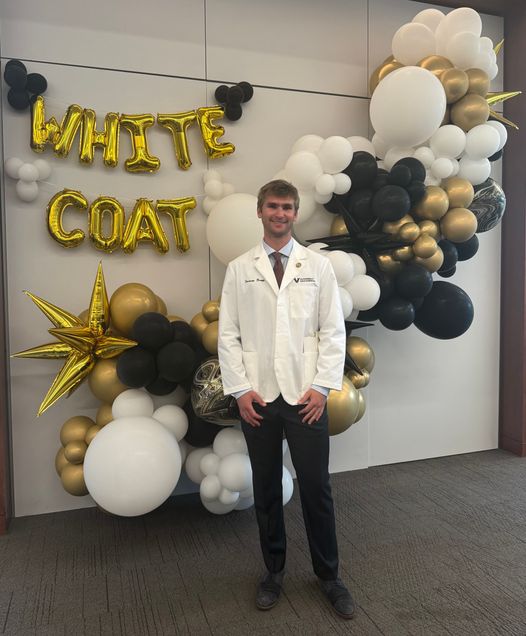
BU Major & Graduation Date:
BS Health Science, Minor Human Physiology, May 2025
Current School and Year:
Preferred Pronouns:
he/him
Hometown:
What school are you attending and what you are studying?
I am currently in the MD program at Vanderbilt University School of Medicine. I applied because of their program’s structure allowing dedicated research time with a guaranteed mentor and funding. The hospital’s reach across much of the southeast also meant access to lots of patients, and the small class size meant students would have exposure to many more cases than other locations may. After being here a few months, what really makes Vanderbilt unique is the school’s true commitment to building a strong community and pushing students while still encouraging them to enjoy life outside the classroom. We have an amazing community of both students and faculty, and even though many schools say this about themselves, I really felt it was true when visiting Vanderbilt. The faculty really know the students and care about our wellbeing, and the students are all so welcoming and work together to make sure we all succeed.
Is there a specialization and/or specific population you are interested in?
I am currently interested in clinical neurology but am keeping an open mind while I learn about different systems and go through clinical rotations next year. I spent 3 years doing research with stroke and dementia patients, mainly focusing on language impairments in these populations, and this is an area I would like to stay involved in through my career. However I also know my preferences may change after experiencing new specialties, so right now I’m just trying to focus on learning foundational skills to be a great physician.
What are one or two of your favorite experiences/activities and why?
Before starting medical school, I worked as an EMT as well as in clinical neuroimaging research. These were both amazing experiences, with EMT teaching me how to interact with patients and providers and navigate the healthcare system independently, and research teaching me how to apply scientific concepts to new ideas which could improve patient care. These activities were both very important for informing who I want to be as a physician and the roles I hope to pursue over medical school. In medical school, I have also started working as a lab tech at our free student-run clinic, performing blood draws and other point-of-care tests for uninsured patients who otherwise wouldn’t be able to receive care. This both gives me the ability to practice clinical skills in my first few months of medical training, but also provide an invaluable service to local patients and make a difference in their care.
Did you take gap years?
I took one gap year, where I continued working at my research assistant position at the BU Center for Brain Recovery. My role focused on coordinating our MRI acquisition/data processing across multiple studies. I loved this position as I was able to learn lots of neuroanatomy and clinical skills in neurology/radiology, and work directly with people who were dedicated to improving outcomes for future stroke/dementia patients. This was very influential in shaping the field I hope to pursue in my career and I hope to continue with similar research through Vanderbilt’s dedicated research curriculum.
What was your favorite BU course and why?
I really loved Advanced Regional Anatomy, the upper level seminar where we were able to perform full cadaveric dissections for the Gross Human Anatomy course and perform an autopsy report at the end of the semester. While I learned a lot more specific anatomical information in Gross Anatomy, ARA taught me hands-on skills in dissection that have been super valuable so far in my gross anatomy lab at Vanderbilt. It was just a great low-stress course for learning useful skills and honing my medical knowledge in a friendly environment. It was also extremely meaningful to have the opportunity to perform full cadaveric dissections as an undergraduate student, and gave me a great appreciation for the people who donate their bodies to help educate the future generation.
Have you always known you wanted to be a doctor?
I have known I wanted to be a doctor since high school. My anatomy/physiology and neuroscience teachers in high school were very influential in shaping my interest in this field and showing me how fascinating medicine is. My parents also always encouraged my curiosity and gave me the freedom to explore what I was interested in, and I wouldn’t be where I am today without their support.
What resources at BU did you find most helpful or want to spotlight that others might not know about?
I worked as a peer tutor in the ERC for multiple years–this wasn’t something I knew about when going through lower-level chemistry/biology courses, but most of my students found our sessions super beneficial for their learning. I would definitely encourage students, especially in general and organic chemistry, to try meeting with a peer tutor at least once. Even if you don’t think you need it, learning from other students who have completed the course and understand the bigger picture about how to approach certain topics can be very helpful for understanding complicated material and feeling more confident in the class.
What are your hobbies/What do you like to do for fun outside of the classroom?
I love exercising and the outdoors: I like to weightlift, run, bike, do yoga, hike/camp, and play sports like pickleball, tennis, and volleyball with friends. I am also super into coffee, and like to try different coffees and brewing methods as well as roast my own beans at home to try different origins and roast styles. I also love cooking and am always down to go try new/fun restaurants around town.
Are there any tips/advice you would like to share with current pre-health students?
One piece of advice an older med student gave me was to remember to celebrate the small things in life. The medical journey is long, and it’s easy to fall into a mindset of “I just need to get through this next exam/class,” but there’s always another step after that. If you wait to feel satisfied until you’re done, you’ll never actually enjoy any of it. Pre-med is hard not only because you need to do well academically, but there’s also constant pressure to be doing extracurricular, clinical, and research work on top of that. Take the time to acknowledge everything you’re accomplishing along the way and remember you’re not alone in finding it difficult.
Something that surprised me is that medical school in some ways feels lighter than pre-med. Once you’re in you can focus on learning the material and becoming a good doctor, rather than constantly trying to stack your resume. Obviously it’s a big hill to climb to get there and there’s a lot to learn, but it’s nice to be able to focus on actually becoming a good doctor rather than someone who’s good at taking exams.
My last piece of advice is to keep an open mind about where you end up, and choose based on where you’ll actually be happiest, not based on what looks best on paper or what other people expect. Vanderbilt wasn’t my first choice at first, and people in my life questioned the decision, but it was the place I felt most supported and where I knew I’d genuinely enjoy my life during school. Being happy while I study will ultimately set me up better for STEP/match and make me a better physician in the end.