Law, Movements, and the Fragility of Hope
A conversation with Boston University School of Law associate professor, Dr. Ayodeji Kamau, Perrin.
Law, Movements, and the Fragility of Hope
A conversation with Associate Professor Dr. Ayodeji Kamau Perrin about global human rights and legal mobilization.
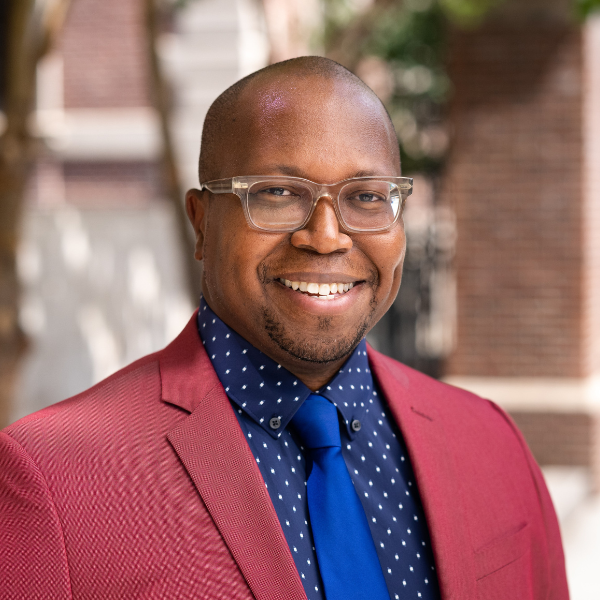
Dr. Ayodeji Kamau Perrin is an interdisciplinary scholar of human rights, social movements, and legal mobilization. His work examines litigation as a vehicle for social change, from the strategic choices of aggrieved communities to judicial decision-making, compliance, backlash, and countermobilization. With particular attention to transnational dynamics, he explores the development of transnational litigation networks, comparative constitutional interpretation, norm diffusion and contestation, and the dialogue between domestic and international legal orders. Professor Perrin is currently teaching courses on Corporations and Professional Responsibility.
He spoke with The Record on legal mobilization, global human rights, and whether catastrophe is history’s engine of change.
Q&A
The Record: You’ve described yourself as a legal realist. What does that mean for how you see the law?
I’m a legal realist in the sense that I don’t believe law is neutral or self-executing. I think law bends to the will of those who know how to manipulate it toward particular ends. That doesn’t mean doctrine doesn’t matter. It does. But it operates within a larger ecosystem of power.
That’s why I’m interested in why social movements choose to use courts at all. Movements have many tools at their disposal. If enough people are aggrieved, they can vote. They can organize. They can boycott. They can protest. In some cases, historically, they’ve even turned to armed resistance.
Litigation is only one strategy among many. My question has always been: when and why does a movement decide to enter the courts?
A cursory observation of your academic career indicates a person intellectually located within both law and political science. Can you speak a little bit about how those disciplines intersect in your work?
My formal training is in political science, but much of what informs my thinking comes from sociology. Legal scholars often focus on doctrinal reasoning, what judges say in their opinions, and whether it aligns with precedent. But social science asks a different question. It looks at actors. Judges, yes, but also lawyers, law clerks, advocacy organizations, amicus briefs, and the broader political and cultural context. Judges are not immune from those pressures.
Political science offers frameworks for understanding judicial behavior. Some judges adhere closely to precedent. Others worry about institutional legitimacy. Others pursue ideological goals and select supporting precedents. Those frameworks help explain outcomes.
But I ultimately situate myself as a human rights and social movement scholar because my primary concern is not doctrinal purity. It’s mobilization.
You use the term “mobilization.” What does legal mobilization mean in your work?
For me, legal mobilization refers specifically to litigation. Other scholars include lobbying or administrative advocacy. I don’t, because social movement theory already accounts for those strategies.
Instead, I’m interested in moments when organized movements—not lone actors—choose courts as a primary vehicle. During the civil rights era, Thurgood Marshall and the NAACP focused on litigation. Martin Luther King Jr. emphasized mass nonviolent protest. Others, including Malcolm X and the Black Panthers, argued for armed resistance. Litigation is rarely uncontested inside movements. My work examines the factors that make it more or less likely.
Was there a formative experience that led you to this focus?
Yes. In 2003, I encountered the case of a woman in northern Nigeria sentenced to death by stoning under a Sharia law that forbids sex outside of marriage. There was a global online petition campaign to pressure Nigeria’s federal government to intervene. But the woman and her legal team didn’t want political intervention. They wanted her sentence to overturn within Sharia law itself. They feared that external pressure—especially from Western actors—would delegitimize the result and provoke backlash.
Ultimately, her sentence was overturned on appeal through arguments grounded in Islamic jurisprudence. That case introduced me to tensions that have stayed with me: the friction between transnational human rights advocacy and local legitimacy. It made me question whether external pressure always helps or whether it sometimes undermines.
So, there are many shifting powers of legitimizing human rights. Is there a definitive role of law in international courts, domestic courts, and advocacy networks?
When I began my doctoral work, I thought law would be central. I planned to study how African regional courts were adopting human rights reasoning by referencing European and inter-American jurisprudence.
Over time though, I shifted my focus.
Instead of asking how judges reason, I began asking: where do these cases come from in the first place?
Law becomes one factor among many. Social movements consider legal precedent, but they also weigh network strength, repeat-player advocacy organizations, judicial composition, and political climate.
And then there’s compliance. After a favorable ruling, will the state comply? Often what you see is procedural compliance—cosmetic reforms rather than substantive change.
Doctrine explains only part of what happens.
Given the need for movements right now, how should ordinary people understand judicial power?
Judicial power is malleable. It expands and contracts depending on other actors.
Executives can comply with or ignore rulings. Legislatures can restrict jurisdiction. Civil society can empower courts by bringing cases or weaken them by withdrawing legitimacy. We’re seeing contemporary examples of this tension. Courts issue rulings; administrations may resist. That struggle reveals that judicial authority ultimately depends on broader political conditions.
Essentially, courts are powerful, but not omnipotent.
Can you offer examples of court decisions you feel were truly transformative?
In the United States, the classic example is Brown v. Board of Education. There’s a long-standing debate about whether Brown directly caused school desegregation or whether meaningful change required the Civil Rights Act of 1964.
I tend to think Brown mattered symbolically. It cracked the wall of Jim Crow. It signaled that segregation was not immutable.
Internationally, I find the decriminalization of same-sex conduct especially powerful. India’s 2018 decision striking down Section 377 [a penal code for same-sex relations] was transformative. Unlike Lawrence v. Texas, which relied heavily on privacy, the Indian Court emphasized dignity and transformative constitutionalism: the idea that a constitution can actively reshape society. These decisions had immediate effects: conduct that was criminal one day became lawful the next. On the other hand, cases like Kiobel v. Royal Dutch Petroleum Co. restricted access to US courts for foreign plaintiffs under the Alien Tort Statute. That closed doors for many human rights claimants.
So, transformation cuts both ways.
You cover so much ground in your scholarly writing. It begs asking if there’s a question you still can’t answer?
Two.
First: What do we do about democratic backsliding and threats to the rule of law? If courts are ideologically divided and executives disregard rulings, institutional solutions seem fragile.
Second: does transformative progress require catastrophe? The abolition of slavery followed civil war. The modern human rights regime emerged from the devastation of World War II. Major expansions of rights often follow profound ruptures.
I don’t want that to be the pattern. But history makes it difficult to ignore.
That’s fascinating. Has this changed your understanding of hope?
Yes. I have less hope than I used to. I wish I could say otherwise. The pressures on democratic institutions, the climate crisis, the pace of technological disruption—all of it feels destabilizing.
But perhaps part of scholarship is sitting honestly with uncertainty.
