#RaceClass with Steven Dean

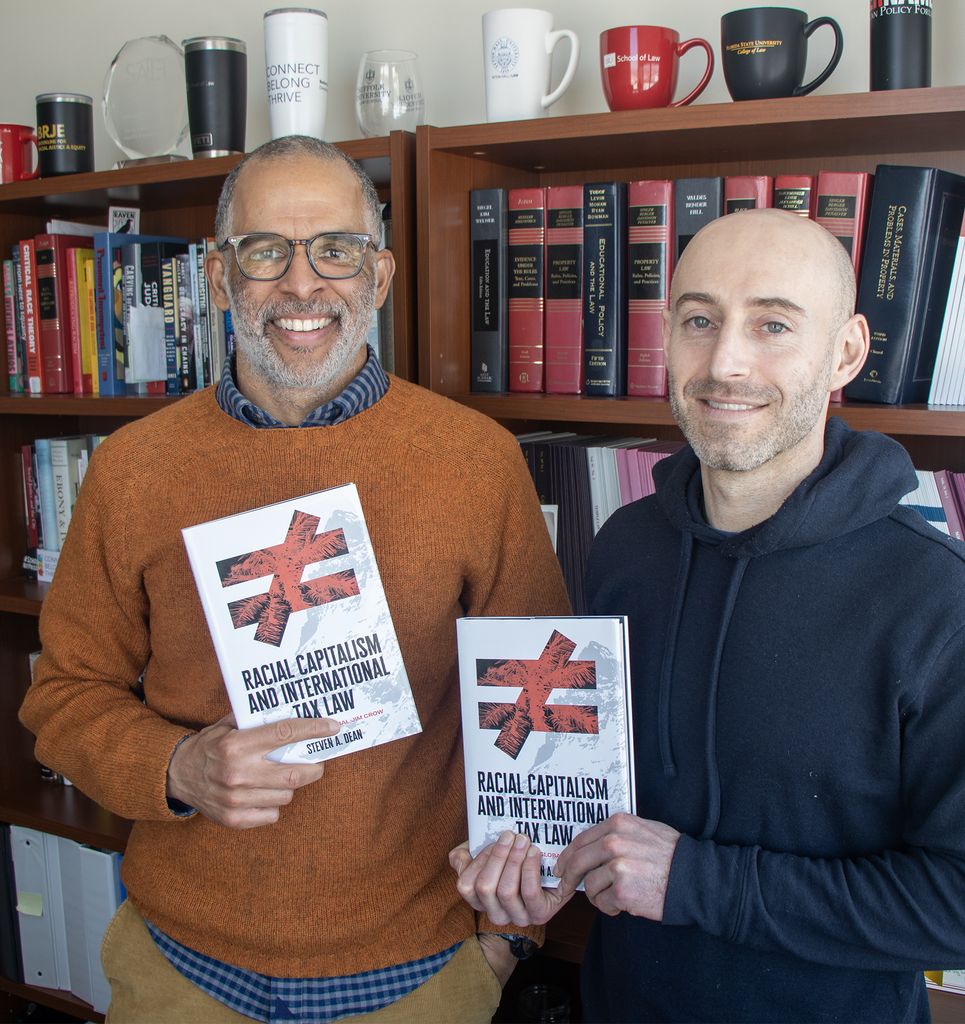
Professors Steven Dean and Jonathan Feingold.
#RaceClass with Steven Dean
A discussion on how international tax law silently sabotaged Black nations.
In December, BU Law Professor Jonathan Feingold invited fellow BU Law Professor Steven Dean to talk about Dean’s recently published book, Racial Capitalism and International Tax Law: the Story of Global Jim Crow, on Feingold’s podcast, #RaceClass.
Their conversation explores the ways in which tax law was designed to serve white populations and harm Black people and communities in the United States and around the world. Dean also reflects on his experiences as a Black man in academia and the ways the life paths of his family were determined by racist systems.
The following article has been edited for The Record. Listen to the full podcast interview in the below link.
Q&A
Jonathan Feingold: Where was your racial education? How was it that you started thinking about these things we call race and racism?
Steven Dean: I had a series of experiences at an academic institution that had a reputation for being very progressive, that were decidedly not progressive in my view. I’m very comfortable in white spaces. Being the only Black person in a room has never bothered me.
My dad is Black, my mom is white. My dad is from the Bahamas. My mom grew up in Fargo. Tax is a very white space. Despite that, I found it very easy to build connections.
When I joined that institution, I thought I was going to continue to do what I had always done. I would go to this rarefied space of tax law in academia and offer the perspective of somebody who had a different set of experiences than a lot of the people there. I assumed people would be quite open to my insights. It turns out they were not.
Before that experience, I was not very strident about race. I understand that I’ve had a lot of privilege in my life, gone to a lot of fancy schools and never had any trouble in the way that I’m sure a lot of other people of color do.
But the years I spent at that supposedly progressive institution made me realize that if I wanted to make changes, I might have to be a little more strident.
Jonathan Feingold: How did you get to a place of writing a book about racism and tax?
Steven Dean: There is a standard narrative that the global tax system was set up in the 20s, designed by experts with an organization called the League of Nations, which then became the United Nations. That invites the assumption that all our problems today are simply a result of the passage of time: “how could these well-intentioned folks a century ago prepare themselves for all the machinations of Google? They couldn’t possibly foresee the tax planning strategies Google would use a century later.”
The narrative insisted that nothing changed for the next one hundred years. In my research, I learned this wasn’t true. There was, in fact, a transformation in the late 1950s and in 1960. A new governing body for global tax policy was created called the OECD, the Organization for Economic Cooperation Development. Today, it is often referred to as “a club of rich countries.” What mattered then was that all the members of the OECD happened to be white.
I realized that in 1960—which is also known as the Year of Africa, because so many African colonies achieved independence—suddenly, those rich (and white) countries decided that they needed a new a new way of managing global tax policy.
It is no coincidence that this was also a moment when historians like Vanessa Ogle at Yale identified the racial panic that accompanied the decolonization of Africa. Europeans and Americans were convinced that Africans could not manage economic their own economic lives.
For decades, at the behest of multinational corporations—including the ones that we now know as Citibank and General Motors—experts had been trying to bring the League’s global tax system online, but their efforts had fallen flat. They tried to do it in Latin America during World War Two. Latin Americans quite reasonably rejected that approach, noting it would have prevented them from taxing US multinational corporations.
The multinationals kept trying and trying. At this moment in 1960, they realized they were pushing on an open door. Using its power over international economic law, the Global North shut down discussions at the UN and created a new body they controlled.
When I saw what had really happened over the past century, what I saw was the Global North saying, “Well, we’ve enjoyed taxing multinationals for decades. It’s been great for us. It helped Europe rebuild after two world wars; it even helped some of the other former colonies develop the states that helped help them flourish. But with Africa decolonizing, we’re going to not do it anymore. We’re not going to tax multinationals.”
Jonathan Feingold: So many interesting pieces to what you just said. Does OECD still exist?
Steven Dean: Not only does it still exist, but it still never has had an African member.
Jonathan Feingold: I’m wondering if you could boil down the book’s driving thesis or observation.
Steven Dean: To put it very succinctly: global tax policy was effectively sabotaged in the 1950s and 1960s to prevent the world from taxing multinationals, and that process was facilitated by a race panic triggered by Africa’s decolonization.
Jonathan Feingold: You use the term “global Jim Crow” to describe this international tax law system. Could you walk us through some of the comparisons between US Jim Crow and global Jim Crow? And how tax law is a key driver of racial hierarchy?
Steven Dean: It’s true. In Dorothy Brown’s incredible book, The Whiteness of Wealth, she shows the ways the US tax laws work to disadvantage Black Americans that are profound and over time are really impactful.
There’s another scholar, Camille Walsh, a historian who studies tax and education in Jim Crow America. She shows that at that time, there were mechanisms in place that defunded Black schools and redirected taxes paid by Black Americans towards white schools. Walsh shows that while there were successful legal challenges to the mechanisms, officials usually succeeded in blocking change. It sounds incredible, but that’s what happened.
What’s so powerful about the story was how state and local officials quietly created a structure that put control of school funding in friendly hands, making those successful legal challenges irrelevant. That puts the entire burden of creating change on those who don’t have the necessary resources or control.
Even when the courts acknowledged that a funding structure was unconstitutional, nothing changed, because the people who are in charge, are still in charge. There’s a certain degree of complacency that leaves those systems in place over decades.
At the end of Reconstruction in the US, it was believed by many that the reason that the effort to include Black Americans into American civic life failed was simply “because Blacks were bad at governing.” Not because of white violence and fraud, but because of some native incapacity.
And when Blacks would complain they weren’t getting any benefit from their tax dollars, sometimes people would respond, “Well, you get benefits from educating your white neighbors, because then they’ll take care of you. Because you certainly couldn’t do it yourself, and you need this help.”
The same logic applies to decolonized nations. When they complain about not having the resources to create a functioning state, they are told that if they had a functioning state they’d be able to collect the necessary revenues. If you don’t have a functioning state, how can you make your state function without the revenues to make it function?
In 1960—this is before the end of Jim Crow—racism was entirely legal in the United States. When I use the term global Jim Crow, I’m not using an American framing to explain a universal phenomenon; I’m pointing out that the US imposed one of its own worst failings, and that’s a kind word, onto the world by way of a global tax system that allows multinationals to avoid paying taxes.
What’s so powerful about the story was how state and local officials quietly created a structure that put control of school funding in friendly hands, making those successful legal challenges irrelevant. That puts the entire burden of creating change on those who don’t have the necessary resources or control.
Jonathan Feingold: In education right now, due to a number of Supreme Court precedents over the past five years, it is increasingly likely that state tax dollars are being paid by everyone into systems that then pay for schools. And those schools are teaching that many of the folks paying for those schools through their tax dollars are less human. There are all sorts of ways in which this history is still with us.
With that, transitioning to the format of the book, it is inviting anyone who’s trying to better understand this moment in different sorts of ways. Some would not think to look to international tax law, or would wonder, “what does that have to do with me?”
In your book, you start every chapter with a personal narrative. It helps the reader see something that you can’t see otherwise. How did you decide on this format? I’d love for you to share some of those examples that connect it to the lesson in international tax law.
Steven Dean: This is, I think, what Nazi Germany probably learned from Jim Crow.
And part of the story that I tell in the book is that I grew up in a tax haven, the Bahamas. Part of the reason the concept of a tax haven has become such a racially charged notion is that people don’t think that places like the Bahamas are real places with real people.
What I hoped to achieve by telling that story was to make the country real, to make the issues that flow from an intentionally flawed global tax system real. Explaining that these far away countries and complicated issues relate to people you might know makes it harder to blame all the problems of our global tax system on countries like the Bahamas.
Most people don’t really understand that there weren’t high schools in the Bahamas when it was a colony. My dad only went to high school because his dad had helped build a monastery run by Benedictine monks who started a high school. They arranged for his son, my dad, to attend. It was only on the eve of decolonization of the Bahamas in 1973, when the white minority was put out of power by the Black majority that the country was able to build high schools. My mom went on to be a guidance counselor in one of those high schools for decades.
The global tax system was sabotaged in 1960 because they didn’t want to pay the salaries of people like my mom. Mom had been a nurse in America, but she never managed to work as a nurse in the Bahamas.
If the Global North had allowed these newly independent states to do what they themselves had done, taxing multinational corporations in order to pay for schools and hospitals, the stories of those former colonies might have been very different. But that would have been expensive for the multinationals.
This can all be a little abstract, so I like to use a true story to capture what happened at decolonization. My mom told me about Prince Charles, now King Charles, approaching her at the Bahamas independence celebration. She had taken four helium balloons to bring home to her four kids. And he basically said, “Hey what are you doing with those balloons?”
I imagine Prince Charles feeling vulnerable already because he’s losing this colony, and now, to add insult to injury, he’s losing these four balloons. The colonies helped make him rich and now he’s losing those resources, and even his balloons aren’t safe. Decolonization was a fight over resources, over who could spend what.
Jim Crow steered resources away from Black Americans. And that’s what global Jim Crow did for the world. The Global South doesn’t have the schools and hospitals that it could have had if the Global North hadn’t sabotaged the global tax system in a moment of racial panic. And—unbelievably—we still have that same incredibly inequitable system.
Jonathan Feingold: Thank you for sharing all that in the book and now. One thing that I’m constantly thinking about is how this cycle of disinvestment and defunding and extraction has the predictable consequence of communities being underresourced and struggling. And that dynamic then being leveraged to reinforce racist tropes about the community, as to suggest that this is a group-based deficiency.
Do you mind providing a quick explainer on your book’s cover art?
Steven Dean: The cover is dominated by this inequality sign. And within it is the silhouette of a palm tree. In the discourse about the dysfunction of the global tax system and corporate tax abuse, palm trees have come to serve as a trope.
The OECD actually published a brochure that tried to explain visually what was wrong with the global tax system. It used a palm tree on a tropical island to explain, in effect, why we can’t have nice things.
That’s how we scapegoat the Bahamas and other small island nations for a problem that’s systemic and global.
Embedded in that inequality sign, you can see some of the palm fronds of an authentic tree that one of my childhood friends painted. But looming in the background is the Matterhorn mountain in Switzerland. Which is another key part of the story.
In the early 1960s the John F. Kennedy administration focused on Switzerland as the key tax haven. In my perfect world, when we think about the problems of the global tax system, we would think not about palm trees, but about the Matterhorn. That would be a much better way to encapsulate what’s wrong with the global tax system.
Jonathan Feingold: Folks will have to read the book to understand why JFK thought the solution to racism in the United States was to take planes instead of cars.
Thank you so much, Steve. It’s a joy to share a suite with you at BU Law and to be in conversation with you today.
Steven Dean: I’m very grateful, Jonathan. You’re welcome. Take care.