Criminal Law Clinical Program

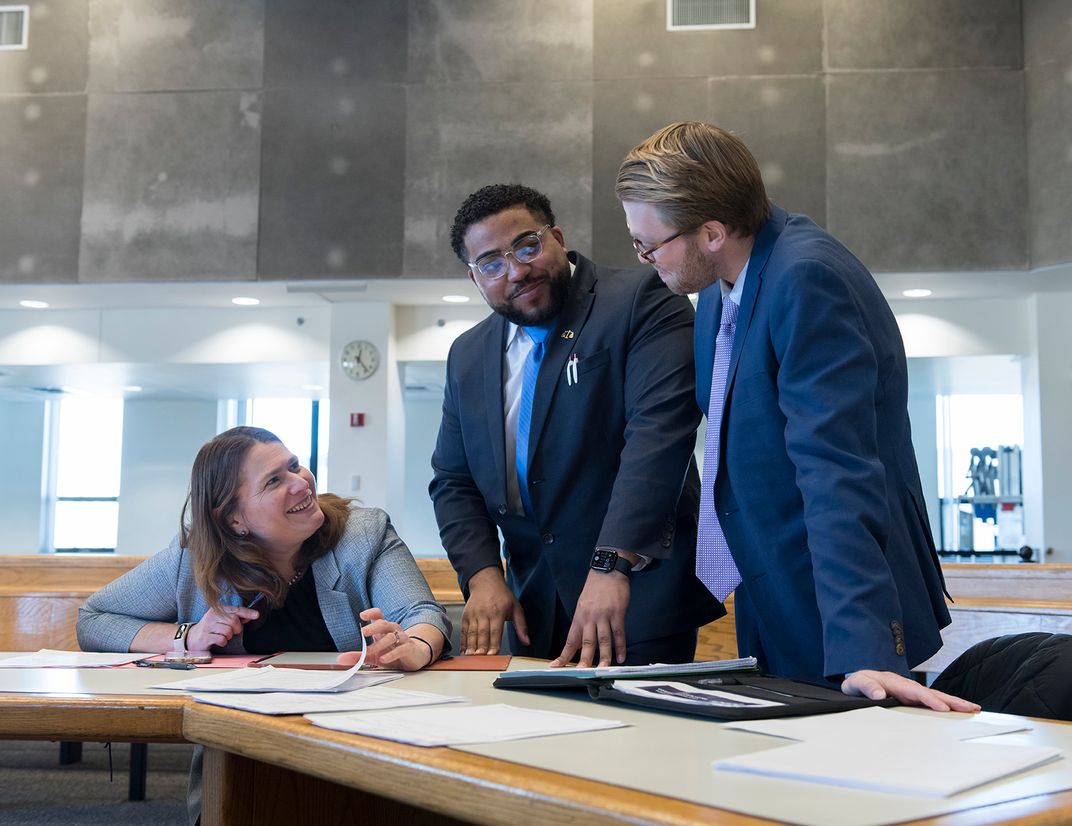
Students enrolled in the Criminal Law Clinical Program learn first-hand what it means to be a criminal law attorney. They formulate case strategies, engage in client counseling, draft legal pleadings, and litigate trials, evidentiary motion hearings, bail hearings, sentencing hearings, and other matters in court. Their investigative fieldwork includes interviewing witnesses and visiting crime scenes. Students follow their cases from beginning to end; in some years clinic students have even taken their cases to the Massachusetts Supreme Judicial Court.

The Criminal Law Clinical Program is composed of two separate year-long clinics: a Defender Clinic and a Prosecutor Clinic.

Clinic students work as 3:03 student-attorneys and carry full responsibility for their own cases. Defenders represent indigent clients in the Boston Municipal Court, Roxbury Division, in a variety of misdemeanor and felony cases. In addition to their case-related work, Defenders also work on criminal law related projects. Prosecutors handle felonies and misdemeanors on behalf of the Norfolk District Attorney’s Office in the Quincy District Court.

Students may enroll in either clinic as a 2L or 3L, with priority going to 3Ls.  All students participating in the Criminal Law Clinical Program are eligible for the Concentration in Litigation and Dispute Resolution.

Pre-/co-requisites: Please see below for each semester.

Faculty


Listen to Shira Diner discuss her work with clinic students:

Listen to Angelo Petrigh discuss his background, movement lawyering, and teaching in the clinic:


Professor Karen Pita Loor gives a lecture in a classroom.

Defender Clinic

Defender Clinic

THIS CLASS IS RESTRICTED to students who have formally applied to and been accepted to the Defender Clinic. In the Defender Clinic, students represent clients charged with criminal offenses in the Boston Municipal Court, handling felony and misdemeanor cases under the supervision of a clinical faculty member. Students gain exposure in lawyering experiences such as investigation, interviewing, counseling, and trial advocacy. Students must be available to be in court selected court day(s) each week. Students will receive more information about which days they must have available for court before they must register for all courses. Students complement their casework with work on criminal law related projects. PRE/COREQS: Criminal Trial Advocacy (except where student has previously completed another trial advocacy course); Evidence (strongly recommended) or Criminal Procedure (Comprehensive (AB) or Investigation (A)). NOTE: The Criminal Law Clinical Program counts towards the 6 credit Experiential Learning requirement. GRADING NOTICE: This course does not offer the CR/NC/H option.

Defender Clinic – Advanced

THIS CLASS IS RESTRICTED to students who have formally applied to and been accepted to the Defender Clinic. Students who advance to the Defender Clinic – Advanced continue the fieldwork and coursework from the prior semester. Students further develop their lawyering skills as they work on cases and criminal law related projects with increasing independence. Students must be available to be in court selected court day(s) each week. PRE/COREQS: Evidence and Criminal Procedure (Comprehensive (AB) or Investigation (A)). NOTE: The Criminal Law Clinical Program counts towards the 6 credit Experiential Learning requirement. GRADING NOTICE: This course does not offer the CR/NC/H option.

Clinic students exit a courtroom in Roxbury.

Criminal Prosecution Clinic

Criminal Prosecution Clinic

THIS CLASS IS RESTRICTED to students who have formally applied to and been accepted to the Criminal Prosecution Clinic. In the Criminal Prosecution Clinic, students serve as prosecutors in the Quincy District Court on behalf of the Norfolk County District Attorney's office, handling felony and misdemeanor cases of increasing complexity under the direct supervision of a clinical faculty member. Students are exposed to a wide variety of experiences, including investigation, interviewing and trial advocacy. Students litigate evidentiary hearings and conduct every phase of jury and bench trials. Students serve as the lead prosecutors on their own cases. Students must be available to be in court selected court day(s) each week. Students will receive more information about which days they must have available for court before they must register for all courses. PRE/COREQS: Criminal Trial Advocacy (except where student has previously completed another trial advocacy course); Evidence (strongly recommended) or Criminal Procedure (Comprehensive (AB) or Investigation (A)). NOTE: The Criminal Law Clinical Program counts towards the 6 credit Experiential Learning requirement. GRADING NOTICE: This course does not offer the CR/NC/H option.

Criminal Prosecution Clinic – Advanced

THIS CLASS IS RESTRICTED to students who have formally applied to and been accepted to the Criminal Prosecution Clinic. Students who advance to the Criminal Prosecution Clinic – Advanced continue the fieldwork and coursework from the prior semester. Students further develop their lawyering skills as they work on cases with increasing independence. Students must be available to be in court selected court day(s) each week. PRE/COREQS: Evidence and Criminal Procedure (Comprehensive (AB) or Investigation (A)). NOTE: The Criminal Law Clinical Program counts towards the 6 credit Experiential Learning requirement. GRADING NOTICE: This course does not offer the CR/NC/H option.

Student Testimonials