Conversation with Mariah Gruner, PhD Candidate, American & New England Studies
Interview with Mariah Gruner
Dissertation Project: “‘…Has Ever Been the Appropriate Occupation of Woman’: Crafting Femininity in American Women’s Decorative Needlework, 1820 to 1920”
At what stage was your dissertation in March 2020? What were your plans at that time?
When the pandemic struck, I had already completed a substantial amount of my background research and written almost three of my chapters. I had done a fair bit of travelling—to the UK, Virginia, and here in Massachusetts. In all three places, I was lucky to be able to closely examine the textiles my dissertation engages with—stitched depictions of architecture, abolitionist samplers and other antislavery textiles, and forms of suffrage needlework stitched by women over the course of the 19th and early 20th centuries. By March 2020, my big plan was to spend a month at the Winterthur Museum, Garden & Library in Delaware where I had the good fortune of having been awarded a month-long residential fellowship. I knew I planned to defend in the spring of 2021 and that I needed to adapt my plans to make that happen.
How have you adapted your plans to life under lockdown?
I have spent much of the last year in conversation with archives about how I might feasibly access the materials I need, given the constraints of our current world. I am full of admiration and gratitude for the kindness and consideration that librarians, archivists, and curators have shown me—and many other scholars out there—in this process.
I had planned to visit Winterthur in April 2020 to give a talk and then begin my month-long residency, bookended by trips to archives and museums in Philadelphia and New York. But by May, I was pretty certain I would need to complete my dissertation without that travel and so adapted my plans. I was surprised to discover, in January, that Winterthur was figuring out abbreviated, safe ways for scholars to complete portions of their residential fellowships. I was able to visit for two weeks, staying alone in their scholar’s residences and planning careful visits to specific objects I hoped to observe. It felt surreal to sit singly in the reading room, with materials I had been looking forward to interacting with for so long. But I am so grateful to the librarians and curators who made it possible.
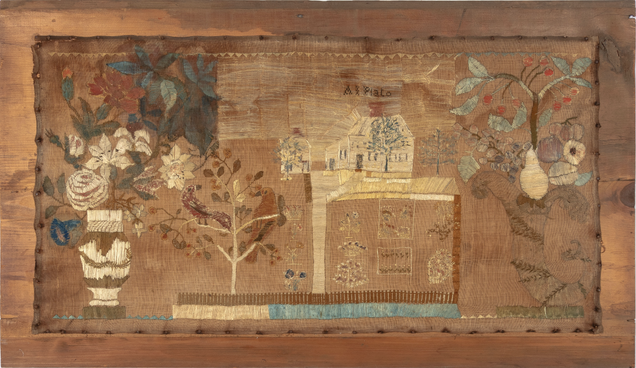
After my safely-distanced visit, Winterthur has continued to help and support me in getting access to sources. I’ve been amazed at the generosity and collegiality of folks willing to share their work. For example, I’d been able to briefly examine a needlework picture stitched by Ann Plato, a path-breaking Black poet, educator, and essayist working in the first half of the nineteenth century. A student in textile conservation at Winterthur generously sent me high-quality photographs of the house and garden that Plato stitched and their detailed conservation report. Ann Plato’s needlework picture was not part of the trip that I’d initially planned, but her work has now become central to my second chapter. Winterthur is also allowing me to do the second half of my fellowship with them remotel
The Library of Congress has been equally helpful. By chance, using the “Ask a Librarian” function on their website, I inquired about holdings of Nannie Burroughs, the fierce suffragist, educator, and civil rights leader who ran the Woman’s Convention of the National Baptist Convention and started the National Training School for Women and Girls. Amazingly, they responded by sending me a scanned version of a ledger book for a needlework exhibit that Burroughs organized in 1907.
Do you have any take-aways about research in the time of a pandemic?
This past year has not been one that I would have wished for. I wish I had been able to spend time closely examining objects and having the kind of fortuitous happenstance that sometimes occurs in the archive. But I feel lucky to have work that I can largely do remotely and that I find renewing and sustaining. I have the greatest respect for librarians, who have gone beyond the call of duty to connect researchers like me with materials, considering the exigent circumstances. I felt hesitant to reach out to people at first, given the overlapping crises we’ve all been living through. I did not want to adapt, nor to expect others to. But, as time has gone on, I’ve sought comfort and purpose in my work and have been pleasantly surprised that librarians and archivists have been so willing to support newly remote researchers. I hope that some of these forms of accessibility persist beyond this moment of crisis. I also hope that we continue to understand that the dissertation process never actually happens in isolation—it’s informed by our access to material resources and systems of support and by the circumstances around us. That’s always been true, but is perhaps more visible and more acute in the last year. There’s no “productivity hack” that can (or should) substitute for funding and social support.
My recently submitted dissertation is not what I would have written in a world without the pandemic— especially the final chapter on suffrage needlework, written over the last year. Yet not having full access to real objects and relying on facsimiles has enabled me to draw upon a wider variety of women activists. The realities of lockdown have caused me to tell a different but nevertheless still complicated and interesting story of the many amazing women from many backgrounds who stitched themselves into selfhood. For example, I had not planned any travel to the west coast, but working remotely meant that I was no longer limited by geography. I ended up spending quite a bit of time virtually digging through the archives of Abigail Scott Duniway—a suffragist, writer, and newspaper publisher in Oregon who donated a quilt to the first National Suffrage Bazaar—and Nettie Asberry—a suffragist and civil rights leader who was the founder of the first chapter of the NAACP west of the Rockies, a president of the Washington State Federation of Colored Women, and who donated her prize-winning lace opera coat to the Washington State Historical Society. Thanks to the Oregon Historical Society and the University of Washington, these women’s stories and textiles have become central to my project and to considering the ways that Black and white suffragists navigated the political landscape in the American West.
My thinking has also been different; my attention to repetitive labor and durational work has very much been informed by my own craft practice during pandemic and by my new relationship with the (for me) now utterly overlapping categories of “home” and “work.” That sensibility has informed my writing and brought out new ideas about the felt meanings of textile work. It’s also helped me rethink what I understand as “work” on my dissertation, recognizing that I need to allow ideas to rest and percolate and that sometimes the best thing for my writing is to pick up knitting needles, ride my bicycle, or work on a quilt and let my mind wander.
Some things are irreplaceable. My dissertation would have benefited immensely from the several conferences I had planned to attend over the last year, all of which have been postponed or canceled. I know that my ideas are sharper and fuller when honed in conversation. The pandemic has meant that I was not able to have the kinds of generative conversations that happen between conference sessions, or even the kinds of unplanned discussions with fellow students here at BU that enrich and enliven scholarship. It is hard to know that my defense will happen—as much of my life has been happening—on a screen. Finishing a dissertation is always hard and finishing during a pandemic is especially challenging. But I love my work; I think it matters and, thankfully, the dissertation is but one stage in a process. I hope to benefit from closer proximity to materials as well as fellow scholars, colleagues and friends in the next iteration of my project.
Mariah was interviewed by Arthur George Kamya, March 2021.