[Pedestrian space] was related to the idea of wanting to get off the pedestal, get off the canvas. And I think it was coined with an awe of other cultures where art seemed to fit in the middle of things rather than on the periphery…. I wanted to be in the middle of it, whatever “it” was. Whether it was culture, or life, whatever…. Pedestrian space had a different intonation but it certainly was related to the literal space that Don Judd wanted to occupy.
Our BUCH Forum’s title “Pedestrian space” is inspired in part by the writings of the artist Fred Sandback, who used the term (with Dan Edge) in 1968 in order to establish a new way of thinking about artistic production. In the symposium “Pedestrian Space”, we begin with the artwork and its environs, but then we move into philosophy, mathematics, architectural theory, and politics. Considering the long philosophical history of reflection on the importance of walking, everyday life and diurnal experiences of orienting ourselves in “street philosophy” (as Emerson called it) we will examine how the many possible inflections of pedestrian space project into the university commons and beyond, taking into account processes of reparation, immigration, separation, politics, philosophy, community engagement, and conversation in everyday life. In a fractured world, our embodied experiences of everyday space are deeply connected with the nature of the university, civil disobedience, re- and de-location, and democratic forms of life that take into account the ethics of care and vulnerability.
The pervasive influence of algorithms on our entertainment and educational consumption is undeniable, serving at times to increasingly blur and draw novel lines between them. “Beyond the Binge” will grapple with complex questions regarding futures of education and entertainment that will inevitably be shaped by AI. Fostering a critical dialogue among computer scientists, media theorists, philosophers, humanists and historians, the aim of this two-day conference is to generate actionable recommendations for a more ethical and equitable future. The first day of the conference will focus on entertainment and algorithms, the second will focus on the future of humanistic education and research. Visit the Beyond the Binge webpage.
Mathematics with a Human Face, 2024
Mathematicians and philosophers gathered in BU’s law building on April 22, 2024, for the inaugural “Mathematics with a Human Face” conference, sponsored by the Center in collaboration with the University of Bergen’s Department of Philosophy and the Norwegian Research Council. The event drew seven speakers from around the world to discuss the role of creativity and the human element in mathematics and the age of AI.Center Director Juliet Floyd, known for her work in the philosophy of logic and mathematics, welcomed attendees, who enjoyed a day full of conversation. Watch the recording.
Fora Archive
Forum 2019, Can We Talk ? Dialogue and Debate in the Contemporary Academy
Kilachand Honors College director Carrie Preston speaking at 2019 Round Table
Dialogue and Debate in the Contemporary Academy, explored one of the biggest challenges facing universities today: the question of how to promote honest intellectual exchange. In fall 2020, we plan to continue the work begun in Forum 2019 through three working groups of undergraduates, graduate students, and faculty and staff. Visit the Can We Talk webpage.
Forum 2018, Humanities Approaches to the Opioid Crisis
2018 Speaker Samuel Kelton Roberts with an attendee
Partnering with area schools ofpublic health and medicine, andrepresentatives of city, state, and federal government, this forum demonstrated how humanities disciplines provide languages that address social and health problems. The goal was to initiate local, national, and global conversations with experts at both academic and non-academic institutions on the opioid crisis. Visit the Humanities Approaches to the Opioid Crisis webpage.
Forum 2017, Recording Lives: Libraries and Archives in the Digital Age
In this forum, the Center reached beyond its academic borders to highlight what humanities fields have to offer a broader public.
Partnering with theBoston Public Libraryand theBoston Athenæum, the forum featured panelists from the Athenæum, the Congressional Library & Archives, the Handel and Haydn Society, Historic Newton, Mount Auburn Cemetery, and the Mellon Sawyer Seminars at BU, to discuss how local cultural and academic organizations are deploying digital technologies to provide or expand access to their collections and engage more diverse audiences. The Center published abook collectionof essays from the 2017 forum, edited by former Director Susan Mizruchi, in 2020.Visit the Recording Lives webpage.

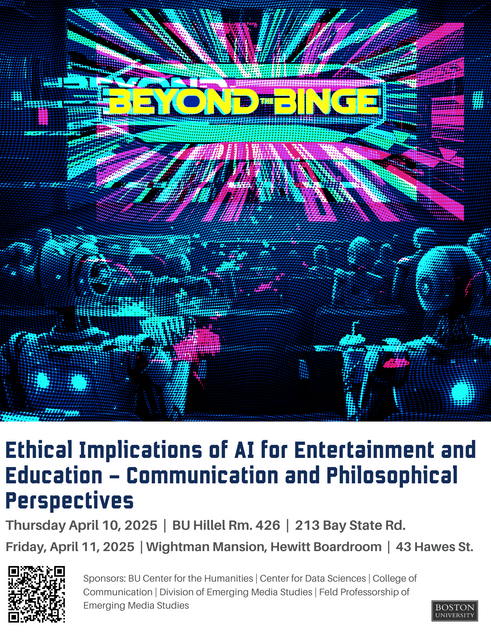 The pervasive influence of algorithms on our entertainment and educational consumption is undeniable, serving at times to increasingly blur and draw novel lines between them. “Beyond the Binge” will grapple with complex questions regarding futures of education and entertainment that will inevitably be shaped by AI. Fostering a critical dialogue among computer scientists, media theorists, philosophers, humanists and historians, the aim of this two-day conference is to generate actionable recommendations for a more ethical and equitable future. The first day of the conference will focus on entertainment and algorithms, the second will focus on the future of humanistic education and research.
  Mathematicians and philosophers gathered in BU’s law building on April 22, 2024, for the inaugural “Mathematics with a Human Face” conference, sponsored by the Center in collaboration with the University of Bergen’s Department of Philosophy and the Norwegian Research Council. The event drew seven speakers from around the world to discuss the role of creativity and the human element in mathematics and the age of AI.