News
Commencement Speaker Rep. John Lewis Champions Civil Rights
Georgia congressman has devoted his life to making #goodtrouble
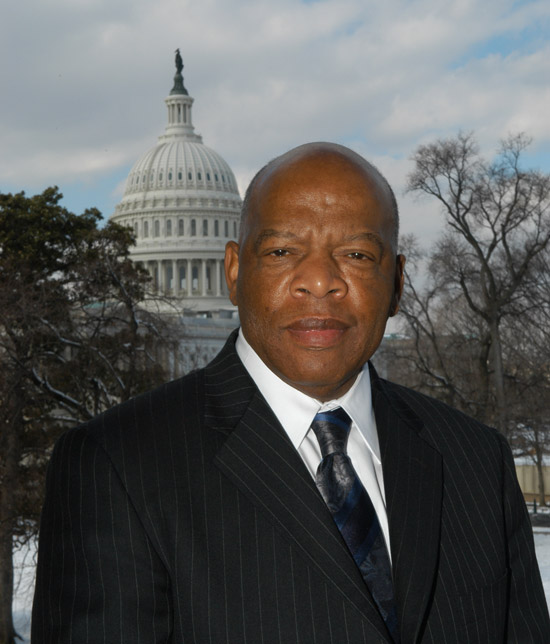
Congressman John Lewis (D.-Ga.) will receive a Doctor of Laws at BU’s 145th Commencement Sunday. Photo courtesy of US House of Representatives.
If you had to choose one life to represent the best of America over the last century, John Lewis’ would be a good choice.
Lewis went from childhood poverty in the Jim Crow South to heroism on the frontlines of the Civil Rights Movement and on to the halls of Congress, where as the representative of Georgia’s fifth district since 1987, he’s more than willing to raise a ruckus even today, at age 78, if the cause is just.
As @repjohnlewis on Twitter, his favorite hashtag is #goodtrouble, usually accompanying a black-and-white picture of him at a civil rights protest, once even with a mug shot of his friend and mentor, Rev. Martin Luther King, Jr. (GRS’55, Hon.’59). But Lewis also applies the hashtag to issues, like net neutrality, that didn’t exist in the days of civil rights marches.
“Sometimes you have to get in trouble—good trouble, necessary trouble—to make a way out of no way,” Lewis tweeted back in March.
As Boston University’s 145th Commencement speaker, Lewis should provide plenty for graduates to contemplate on Sunday, May 20, when he will speak and receive an honorary Doctor of Laws.
Born the son of Alabama sharecroppers in 1940, Lewis grew up picking someone else’s cotton in the segregated South. He says he hardly knew a white person. As a teenager in the 1950s, he was inspired by King, who he heard preaching about equal rights on the radio. He hoped to attend Morehouse College, as King had done, but couldn’t afford the tuition, so he attended American Baptist Theological Seminary in Tennessee, where he could pay for his education by working on campus. After graduating, Lewis earned a bachelor’s degree in religion and philosophy from Fisk University, joined protests at whites-only Nashville lunch counters, and formed a lifelong commitment to nonviolence.

John Lewis (foreground) was among demonstrators beaten by Alabama state troopers during a civil rights march in Selma, Ala., on March 7, 1965. Lewis’ skull was fractured with a billy club. Photo by AP.
Lewis was one of the original 13 Freedom Riders, black and white civil rights protestors who traveled through the South, putting themselves in harm’s way to fight segregation in interstate bus travel. He befriended King and became a leader of the Civil Rights Movement as head of the Student Nonviolent Coordinating Committee. He was beaten and jailed many times.
“Since the people invested government with its authority, we understood that we had to obey the law,” Lewis later wrote. “But when law became suppressive and tyrannical, when human law violated divine principles, we felt it was not only our right, but our duty to disobey.”
Lewis helped organize, and spoke at, the 1963 March on Washington, addressing the huge crowd from the same podium King made his “I Have a Dream” speech from that day. And a cop wielding a billy club fractured his skull on “Bloody Sunday” in Selma, Ala.—March 7, 1965—part of a horrific scene of police attacking marchers as they crossed the Edmund Pettus Bridge. That scene was broadcast on national television and became a turning point for the Civil Rights Movement.
In the 1970s and ’80s, Lewis turned to electoral politics, first as an Atlanta city councilor, then as the congressman from Georgia’s fifth district. He continues to fight for freedom and dignity for all, for a just government and society, and to protect voting rights.
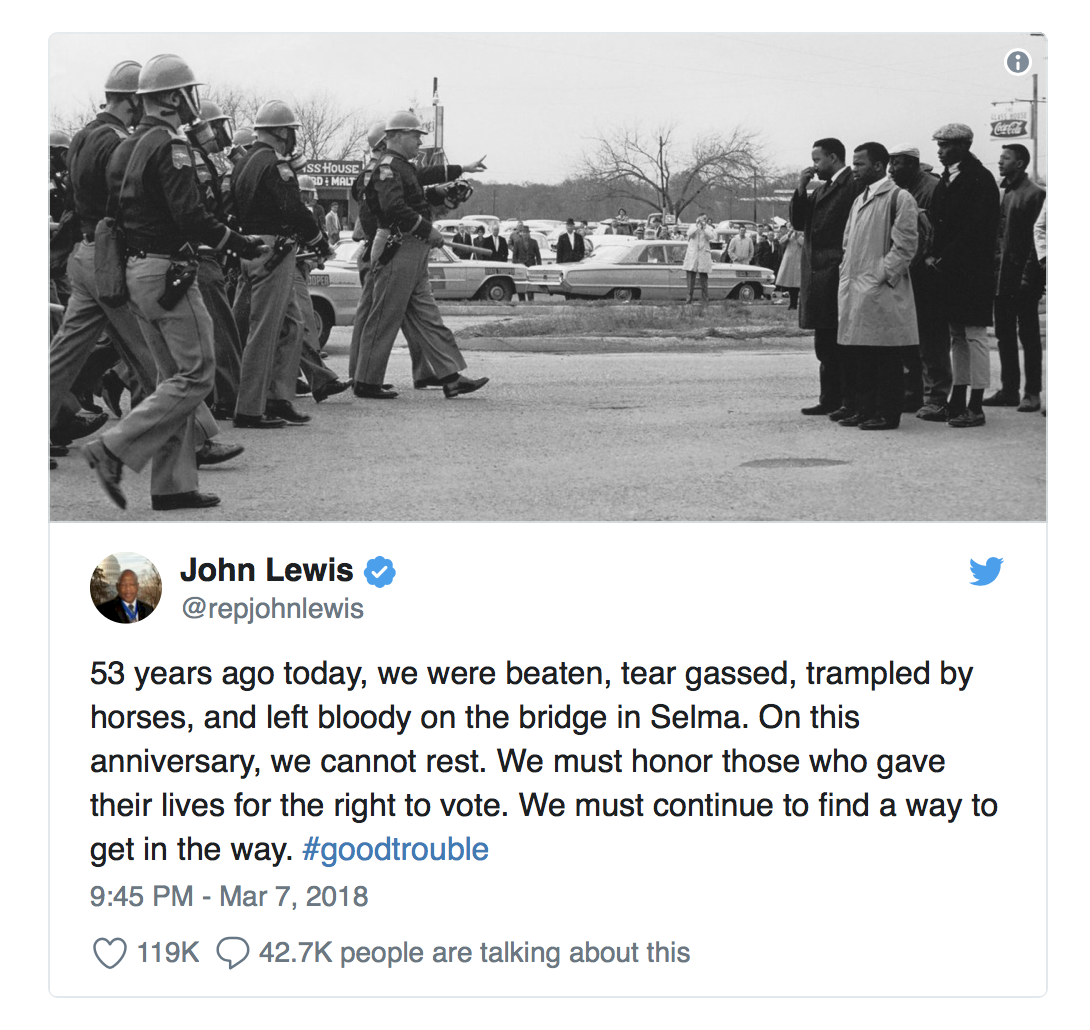
On the 50th anniversary of Bloody Sunday, he walked over the Edmund Pettus Bridge again, hand in hand with the nation’s first black president. Barack Obama awarded Lewis the nation’s highest civilian honor, the Presidential Medal of Freedom in 2011. In 2001 Lewis received the only John F. Kennedy Profile in Courage Award for Lifetime Achievement ever granted by the John F. Kennedy Library Foundation.
In 2016, he won the National Book Award for Young People’s Literature for the third of his best-selling graphic novels, March: Book Three, intended to teach young people about the Civil Rights Movement.
“Every generation leaves behind a legacy,” Lewis wrote in Across That Bridge: A Vision for Change and the Future of America (Hachette Books, 2012). “What that legacy will be is determined by the people of that generation. What legacy do you want to leave behind?”
This year’s other BU honorary degree recipients are Chinese filmmaker Zhang Yimou, Doctor of Humane Letters; San Juan, P.R., mayor and activist Carmen Yulín Cruz Soto (CAS’84), who will be the Baccalaureate speaker, Doctor of Laws; National Institute of Allergy and Infectious Diseases director Anthony S. Fauci, Doctor of Science; and filmmaker and journalist Vibha Bakshi (COM’93,’96), Doctor of Humane Letters.
Find more information about Commencement here.
Author, Joel Brown can be reached at jbnbpt@bu.edu.
President Robert A. Brown Extends Contract
Accepts trustees’ unanimous request to sign on until 2025

BU President Robert A. Brown has agreed to extend his contract. Photo (left) by Scott Nobles.
President Robert A. Brown, whose 13 years of leadership have transformed the campus and elevated the profile, ranking, and endowment of Boston University, has agreed with the Board of Trustees to extend his contract for five additional years. Brown’s contract, previously scheduled to conclude on July 31, 2020, now runs through July 31, 2025.
Kenneth Feld (Questrom’70), chair of the Board of Trustees, says the board’s decision was unanimous and enthusiastic. “We all thought if Bob Brown were interested in staying on, it would be the best thing for the University,” says Feld. “Bob has been president for 13 years, and when you look at how far Boston University has come in that time, it’s amazing. The Moody’s ranking is higher than it’s ever been; there are 64,000 applicants for the freshman class; U.S. News & World Report has ranked BU number 37 among top national universities; the success of the Campaign for Boston University is well ahead of what anyone projected; and just look at the major research that’s being done. The executive team and the academic team that he put together are all part of this success.
“The list is too long to mention,” Feld continues. “The board sees all this, and they want Bob to continue to lead the way. We’re fortunate that he said yes, because there is still a lot of work to do, and his energy is better than ever. He’s committed to taking Boston University to a new level of excellence.”
“I am honored that the Board of Trustees supports the direction and momentum of Boston University and that they have the confidence in me to continue to lead this great institution,” says Brown. “I can think of no better way to conclude my academic career than to help this University continue to grow in quality, impact, and recognition. Beverly and I feel very good about the enormous progress of the University, driven by our faculty and staff, and we are excited about being part of the future of Boston University.”
Author, Art Jahnke can be reached at jahnke@bu.edu.
AIDS Researcher and Champion Anthony Fauci a 2018 Honorary Degree Recipient
Long-serving NIAID director, known for science and communication skills
 BU will confer on Anthony Fauci, the director of the National Institute of Allergy and Infectious Diseases, a Doctor of Science—his 44th honorary degree. Photo courtesy of National Institute of Allergy and Infectious Diseases.
Anthony S. Fauci, director of the National Institute of Allergy and Infectious Diseases (NIAID) at the National Institutes of Health since 1984, is one of the world’s most admired scientist-physicians. He has served under six presidents and led the country through the darkest days of the AIDS pandemic. Fauci was one of the principal architects of the President’s Emergency Plan for AIDS Relief, a program that has saved millions of lives in the developing world.
On May 20, at BU’s 145th Commencement, the University will confer a Doctor of Science on Fauci.
Even in Washington, D.C., a city of workaholics, Fauci is famous for his 16-hour workdays. In 2008, when President George W. Bush awarded him the Presidential Medal of Freedom, he noted that Fauci “sometimes forgets to stop working.” Bush joked about the notes on Fauci’s windshield from coworkers: “Go home, you’re making me feel guilty.”
And in an age when tweets and angry talk show rants pass for dialogue, Fauci stands out for his communication skills. Whether it involves testifying before Congress about the need for research funding or talking about Ebola on national television, he can make complicated science comprehensible. The goal, he says, is not to appear smart. It is to be understood.
In 1984, when a mysterious plague called AIDS was devastating the gay community and Anthony Fauci was the new NIAID director, he did something that was viewed by the scientific establishment as radical and ill-conceived: he met with AIDS activists.
Confronted with a deadly disease that at the time had no treatment, the activists wanted input into the regulatory process around drugs and clinical trials. “Most scientists were afraid of them,” Fauci says. “They wouldn’t listen to them.” Desperate to be heard, the activists stepped up their demonstrations across the country. They shut down Wall Street, set off smoke bombs on the NIH campus in Bethesda, Md., and hanged Fauci and other health officials in effigy.
“The activists were in great pain” Fauci says. “They had a disease that was associated with a disenfranchised population—gay men, injection drug users, commercial sex workers. They were saying, ‘Wait a minute, you’ve got it wrong. We’re going to live an additional few months to a year and a half and you’re talking about a process that’s going to take years. You’ve got to reexamine the paradigm.’”
He invited a group of AIDS leaders to meet with him in his office. “No one had ever spoken to them—forget about inviting them to their office,” he recalls. “That’s where the dialogue began. It continues to this day.
“They were misinformed on some things,” Fauci says. “They were also quite correct on some things that we were misinformed on. Once you sat down and talked to them, it didn’t change the fact that we disagreed on a lot of things, but it transformed hostility into mutual respect. That opened the door to gradually getting our differences ironed out.”
It was “one of the best things I’ve ever done,” he says.
Fauci, whose parents were the children of immigrants, grew up in Brooklyn’s Bensonhurst section, in an apartment above his pharmacist father’s drugstore. As a boy, he delivered prescriptions on his bike. He credits his parents—and his Jesuit education, at Regis High School, in New York City and at the College of the Holy Cross, where he earned a bachelor’s degree—with his lifelong interest in public service.

Fauci drapes his honorary degree robes on a coatrack in his office. Photo courtesy of Fauci.
His parents believed in making a contribution to society and “were never, ever interested in worldly things,” he recalls. “They were never concerned at all with money. When I was a kid, it used to get me a little annoyed.”
Fauci speaks passionately of the debt he owes his Jesuit teachers. “People say, ‘Well, so you spent four years in Greek in high school and three years in college and you spent four years in Latin in high school and three years in college—what the hell has that got you?’” he says. “‘You can’t speak Latin, you can’t speak Greek.’
“That’s not what it’s all about,” he says. “It’s about understanding civilizations. It’s understanding people. It’s understanding the thoughts and philosophy of scholars hundreds, if not thousands, of years ago. That’s the thing that is to me the most valuable thing—understanding humanity.”
As NIAID director, Fauci oversees research to diagnose, prevent, and treat HIV/AIDS and other infectious diseases, such as malaria, tuberculosis, and Ebola. He is also chief of the NIAID Laboratory of Immunoregulation—a field he helped pioneer—where he has made numerous important discoveries related to immune-mediated and infectious diseases. He is a key advisor to the White House and the Department of Health and Human Services on global infectious disease issues. His awards include the National Medal of Science, and the Mary Woodard Lasker Award for Public Service, and he serves on the editorial boards of numerous scientific journals, delivers major lectures around the world, and is the author, coauthor, or editor of more than 1,300 scientific publications. A 2017 analysis of Google Search citations ranked him as the 24th most cited researcher of all time.
At 77, Fauci no longer runs marathons, but he says he still logs three or four miles a day. And he carves out time to see patients two days a week.
He continues to meet with AIDS activists. Just recently he invited two longtime activists, Peter Staley and David Barr, to his home for dinner, where they talked about the lack of availability of a drug that helps to prevent HIV infection—and their concerns that AIDS is no longer receiving sufficient attention.
“I cooked them a sausage and rigatoni meal,” Fauci says. “We sat down and had a bottle of wine and spoke until the wee hours of the mornings. It was just like in the 1980s.”
This year’s other BU honorary degree recipients are Commencement speaker and civil rights icon Congressman John Lewis (D-Ga.), Doctor of Laws; Chinese filmmaker Zhang Yimou, Doctor of Humane Letters; San Juan, P.R., mayor and activist Carmen Yulín Cruz Soto (CAS’84), who will be the Baccalaureate speaker, Doctor of Laws; and filmmaker and journalist Vibha Bakshi (COM’93,’96), Doctor of Humane Letters.
Find more information about Commencement here.
Author, Sara Rimer can be reached at srimer@bu.edu.
Carmen Yulín Cruz Soto (CAS’84) Honored with a Doctor of Laws
San Juan mayor who battled a hurricane and a president is Baccalaureate speaker

Less than eight months after sparring with President Trump over the federal government’s aid to Puerto Rico following Hurricane Maria, San Juan Mayor Carmen Yulín Cruz Soto (CAS’84) will give BU’s Baccalaureate address and receive an honorary degree. Photo courtesy of Cruz.
If past is indeed prologue, you could have spied Carmen Yulín Cruz Soto’s political horizon when she was in the eighth grade. Back then, the future mayor of San Juan, P.R., began a five-year run as president of her class at Puerto Rico’s University High School.
Metaphorically, you also could have glimpsed what was to come by watching Cruz’s career as a top sprinter, breaking records in her high school league. Racing against time and the opposition has become the 55-year-old mayor’s MO since two forces of nature—Hurricane Maria and President Trump—slammed Puerto Rico, and her, last fall.
On Sunday, May 20, when Cruz (CAS’84) gives this year’s Baccalaureate address at 11 am at Marsh Chapel and receives an honorary Doctor of Laws at BU’s 145th Commencement, she’ll mark almost eight months since the hurricane, which has left at least 150,000 Puerto Ricans still lacking electricity and awaiting insurance payments for leveled homes and property. In the days after Maria, she scrambled frenetically, both personally (helping residents of an assisted living facility evacuate) and politically (desperately seeking to hasten aid from the US government while telling a news conference, “We are dying here. Mayday.”).
Then Hurricane Trump hit. Stung by criticism that his administration dragged its feet in helping the island, the president made Cruz one of the globe’s most famous municipal executives, tweeting about the “poor leadership ability by the Mayor of San Juan” and complaining that Cruz, “who was very complimentary only a few days ago, has now been told by the Democrats that you must be nasty to Trump.”
Cruz tweet-fired back, “The goal is one: saving lives. This is the time to show our ‘true colors.’ We cannot be distracted by anything else.”
She won the argument, according to Elaine Duke, then acting Homeland Security secretary, who visited Puerto Rico in October and pronounced the federal response “not satisfactory.”
By standing her ground, Cruz “got the crisis the attention it desperately needs, just as if it were happening in Florida or Texas,” actor and fellow Puerto Rican Benicio Del Toro wrote for Time last month, when the magazine named Cruz to its annual list of the world’s 100 most influential people.
“Cruz’s legacy,” he added, “will be marked by her uncompromising refusal to let anyone ignore the lives of those affected by the hurricane. For this we are forever grateful.”
Born in San Juan, Cruz majored in political science at BU and also earned a master’s degree in public policy from Carnegie Mellon University. She worked for the US Treasury Department before returning to Puerto Rico in 1992, where she held corporate jobs at Colgate-Palmolive, Banco Popular de Puerto Rico, AT&T, and Scotiabank.
She became an advisor to San Juan’s mayor and served in the island’s House of Representatives before winning the mayoralty in 2012. In that election, five years before the launch of the #MeToo movement, the incumbent, entrenched for a dozen years, put down the challenger he dubbed “esa señora” (that woman) as a socialist.
Cruz countered by calling herself a “pitirre,” a type of bird that attacks larger avians. She rallied students and LGBTQ voters, among others, to win office. As mayor, she has supported unionization of municipal health workers and an anti-austerity strike by university students, while opposing Puerto Rican statehood, a hot-button topic on the island, saying, “You don’t fight injustice by asking to become part of the system that committed the injustice against you in in the first place. That’s like a freed slave striving to become a slave owner.” She has also been an active advocate for immigrants, the LGBTQ community, and those who have struggled with gender-based violence.
In November 2016, as Trump was elected president, the future target of his ire was re-elected, resoundingly, to a second term as mayor.
This year’s other BU honorary degree recipients are Commencement speaker and civil rights icon Congressman John Lewis (D-Ga.); Chinese filmmaker Zhang Yimou, Doctor of Humane Letters; National Institute of Allergy and Infectious Diseases director Anthony S. Fauci, Doctor of Science; and filmmaker and journalist Vibha Bakshi (COM’93,’96), Doctor of Humane Letters.
Find more information about Commencement here.
Author, Rich Barlow can be reached at barlowr@bu.edu.
NSF and Air Force Announce Partnership
BU IN DC
Michael Dennehy of the School of Education attended the national Junior Science and Humanities Symposium, a Department of Defense-sponsored program to engage youth in science, technology, engineering, and math, between May 2 and 5. BU Academy student Divya Bachina competed in the event.
Sondra Crosby of the School of Medicine spoke at a Congressional briefing sponsored by the Center for Victims of Torture and Human Rights First regarding the Central Intelligence Agency's interrogation program on May 7.
NSF AND AIR FORCE ANNOUNCE PARTNERSHIP
On Wednesday, National Science Foundation (NSF) Director France Córdova and U.S. Air Force Secretary Heather Wilson signed a letter of intent committing the two agencies to collaborate on research. The agreement will strengthen ties between the NSF and the Air Force in four research areas: space operations and geosciences, advanced material sciences, information and data sciences, and workforce and processes. Wilson stated that the Air Force would like to learn from the NSF how to work with universities, while Cordova said the NSF will benefit from understanding how the Air Force transitions research to the marketplace.
BUZZ BITS...
- National Endowment for the Arts Chair Jane Chu announced she will step down at the conclusion of her four-year term on June 4. President Donald Trump has yet to nominate a replacement.
- On Monday, the National Academies of Sciences, Engineering, and Medicine released a report urging universities to integrate science, technology, engineering, mathematics, and medicine with the arts and humanities.
- The National Endowment for the Humanities announced Tuesday it would open up a second round of competition for its new humanities Infrastructure and Capacity Building Challenge Grants, responding to significant demand for the funds. The new program was first announced in January, and the inaugural awards will be announced in August. The second competition application deadline is August 1.
GRANTS NEWS YOU CAN USE
The Department of Defense (DOD) Congressionally Directed Medical Research Program (CDMRP) released its fiscal year 2018 Peer Reviewed Medical Research Program solicitations. The DOD intends to make $330 million available across 52 topic areas, including antimicrobial resistance, emerging infectious diseases, non-opioid pain management, and tissue regeneration. CDMRP utilizes a two-tiered review process that includes both scientific and programmatic review, so investigators are urged to carefully review the submission requirements.
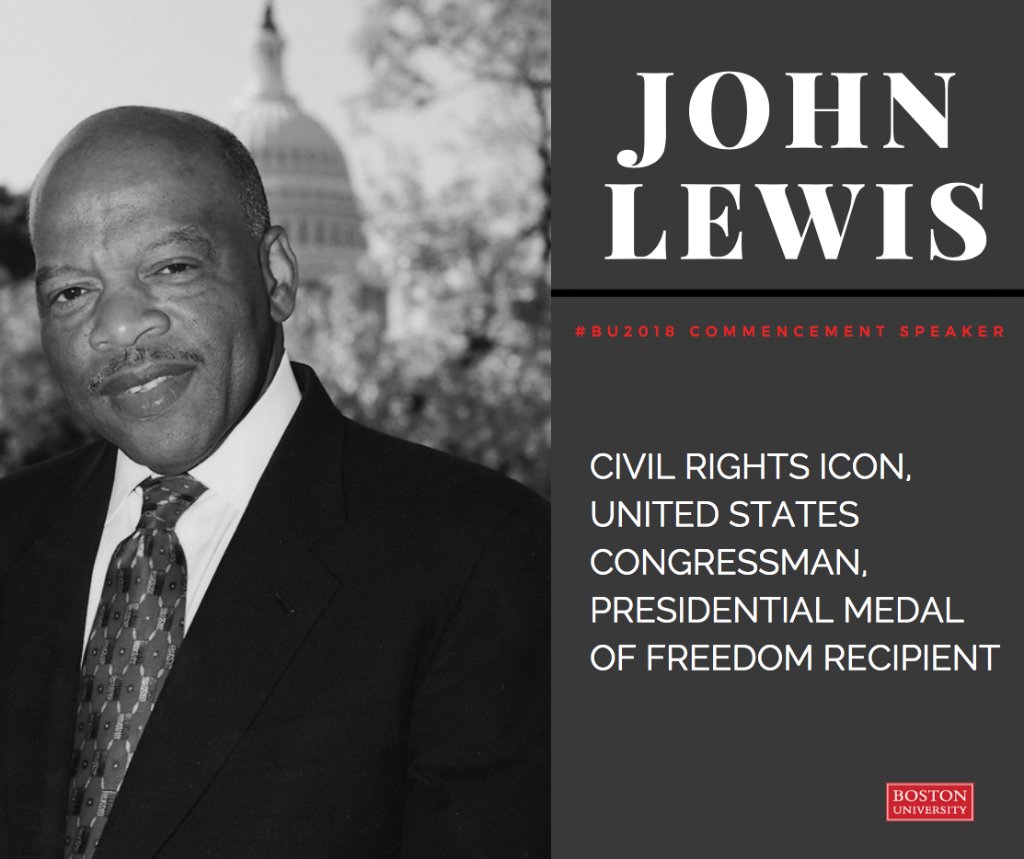
Rep. John Lewis to Deliver BU Commencement Address
 ON THE CHARLES RIVER
Rep. John Lewis to Deliver BU Commencement Address
National Institute of Allergy and Infectious Disease Director Anthony Fauci and San Juan, P.R. Mayor and BU alumna Carmen Yulín Cruz will also be honored.
Find out more
 COMMUNITY RESOURCE
Getting to Graduation
The BU School of Education-based Center for Promise studies what it'll take for more kids to complete high school on time.
Read about their work
 RESEARCH HIGHLIGHT
Where I'm Coming From
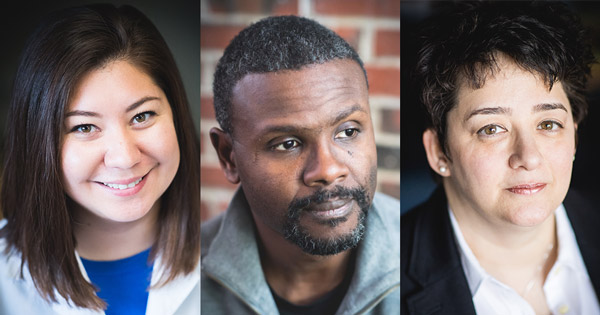
The world of science is missing something: representation. Hear from three BU faculty members about what it's like being an underrepresented voice in the field they love. Listen to their stories
IN CASE YOU MISSED IT...
Stephen Davidson of the BU Questrom School of Business writes in his letter to the editor that retail clinics are not the solution to healthcare in The New York Times... David Felson of the BU School of Medicine explains why many people are prone to arthritis in middle age to The Wall Street Journal... Nina Silber of the BU College of Arts & Science discusses the importance of the new national lynching monument in The Washington Post... Robert Murowchick of the BU Pardee School of Global Studies weighs in on Hobby Lobby's role in smuggling ancient Iraqi artifacts with The Associated Press... The Boston Herald looks at a new initiative at the BU School of Medicine and other medical schools to incorporate end-of-life care into their curriculum.
DOD Research Chief Lays Out Priorities
BU IN DC
Anthony Janetos, director of the Pardee Center for the Study of the Longer-Range Future, attended a meeting of the Space Studies Board, of which he is a member, at the National Academies of Sciences, Engineering and Medicine from May 1 through 3.
DOD RESEARCH CHIEF LAYS OUT PRIORITIES
At a House Armed Services Committee hearing on promoting innovation at the Department of Defense (DOD), Under Secretary of Defense for Research and Engineering Mike Griffin discussed his top technology and research priorities:
- Hypersonics: DOD is developing a hypersonics roadmap to be delivered in July that will consolidate current prototyping and research efforts.
- Directed Energy Laser Weapons: In particular, developing megawatt-class directed energy weapons in space for space defense.
- Artificial Intelligence (AI): Under Secretary Griffin is overseeing the creation of a Joint Artificial Intelligence Center, to be launched within the next six month, to coordinate AI efforts within the DOD and potentially across federal agencies.
Other focus areas the Under Secretary touched upon include trusted microelectronics, sensing and communications assets in space, and quantum science.
BUZZ BITS:
- The U.S. Senate confirmed Jon Parrish Peede as the chair of the National Endowment for the Humanities. Mr. Peede has been serving as the Endowment's acting chair since May 2017.
- James "Lynn" Woodworth started work as the latest commissioner of the National Center for Education Statistics at the U.S. Department of Education. He was appointed to the position earlier this year.
GRANTS NEWS YOU CAN USE
The Department of Energy (DOE) Building Technologies Office released a $19.5 million funding opportunity announcement through its Buildings Energy Efficiency Frontiers & Innovation Technologies (BENEFIT) program. This annual solicitation seeks to advance a range of technology areas related to building efficiency. This year, DOE is emphasizing early-stage research across six topical areas: advanced separation technologies for building energy efficiency, advanced building materials, high-performance windows, novel approaches for cyber-physical systems in buildings, integration research of advanced commercial energy efficiency packages, and advancements in natural gas and other fuel-driven equipment. A webinar for BENEFIT will be held May 8, and concept papers are due June 8.
Civil Rights Icon John Lewis Will Speak at 145th BU Commencement
Longtime US congressman will receive Doctor of Laws degree

Members of the Class of 2018 reacted enthusiastically to the announcement that longtime civil rights activist US Representative John Lewis (D-Ga.) will speak at BU's 145th Commencement on May 20. Photo by Cydney Scott.
- Announced at Senior Class Breakfast: civil rights icon John Lewis will deliver the 2018 Commencement address May 20
- Other honorary degree recipients: Anthony S. Fauci, Carmen Yulín Cruz Soto (CAS’84), Vibha Bakshi (COM’93,’96), and Zhang Yimou
- Metcalf teaching award winners revealed and Senior Class Gift update delivered
Civil rights icon John Lewis, a member of the US House of Representatives since 1987, will deliver the 145th Commencement address on Sunday, May 20, on Nickerson Field.
BU President Robert A. Brown announced Lewis as the Commencement speaker at Thursday’s Class of 2018 Senior Breakfast at the George Sherman Union Metcalf Ballroom, where more than 2,500 soon-to-be graduates noshed on tarts, sausages, scones, muffins, and fruit. Songs like Pharrell’s “Happy,” Katy Perry’s “Dark Horse,” and Ariana Grande’s “Break Free,” and a slideshow of pictures of the seniors from the last four years brought some nostalgia.
Lewis (D-Ga.) will receive an honorary Doctor of Laws. Brown also named this year’s other honorary degree recipients: National Institute of Allergy and Infectious Diseases director Anthony S. Fauci, Doctor of Science; San Juan, P.R., mayor and activist Carmen Yulín Cruz Soto (CAS’84), Doctor of Laws; filmmaker and journalist Vibha Bakshi (COM’93,’96), Doctor of Humane Letters; and award-winning filmmaker Zhang Yimou, Doctor of Humane Letters. Cruz will deliver this year’s Baccalaureate speech on Commencement morning at Marsh Chapel. Yasmin Younis (COM’18) was announced as this year’s student speaker.
Brown also revealed the winners of the University’s highest teaching honors. This year the top honor, the Metcalf Cup and Prize, goes to Brooke Blower, a College of Arts & Sciences associate professor of history. Elizabeth Co, a CAS senior lecturer in biology, and James A. Wolff, a School of Public Health associate professor of global health, are the recipients of the Metcalf Awards for Excellence in Teaching. The three faculty members will be honored at the Commencement ceremony.
Born the son of sharecroppers in Jim Crow Alabama, the 78-year-old Lewis was a major leader in the Civil Rights Movement. He organized sit-ins at segregated lunch counters, participated in Freedom Rides, organized voter registration drives, was chairman of the Student Nonviolent Coordinating Committee (SNCC), and gave a keynote address at the 1963 March on Washington. He headed up the 1965 “Bloody Sunday” march across the Edmund Pettus Bridge in Selma, Ala. The march ended with peaceful protesters brutally attacked by police officers, leaving Lewis with a fractured skull. The incident garnered headlines worldwide and helped lead to passage of the Voting Rights Act of 1965.
Despite more than 40 arrests, physical attacks, and serious injuries, Lewis has remained an advocate of nonviolence. After leaving SNCC in 1966, he was active in the Field Foundation, the Southern Regional Council, and the Voter Education Project and was appointed by President Jimmy Carter to direct the ACTION federal volunteer agency.
He has received numerous awards, including the Presidential Medal of Freedom, the highest civilian award in the United States. Lewis was elected to the Atlanta City Council in 1981 and was elected to the US House of Representatives in 1986.

At Senior Breakfast May 3, 2018, at Metcalf Ballroom, President Robert A. Brown announces that civil rights icon John Lewis will speak at the 145th BU Commencement. Projected above Brown is a photo of Lewis just prior to the Civil Rights March on Washington. Photo by Cydney Scott.
Fauci is one of the world’s most influential and accomplished scientist-physicians and has greatly contributed to the understanding of HIV and AIDS throughout the world.
He has directed the National Institute of Allergy and Infectious Diseases (NIAID) at the National Institutes of Health since 1984, where he oversees extensive research on infectious diseases and diseases of the immune system. He is also chief of the NIAID Laboratory of Immunoregulation—a field he helped pioneer—where he has made countless important discoveries related to immune-mediated and infectious diseases. Fauci has advised five US presidents on HIV/AIDS as well as several other domestic and global health issues. He is a recipient of the National Medal of Science and the Presidential Medal of Freedom, among other honors.
Cruz first gained international attention last September in the wake of Hurricane Maria, the worst natural disaster to hit Puerto Rico and the Commonwealth of Dominica. While mobilizing the island’s scant remaining resources, she advocated relentlessly on behalf of the Puerto Rican people, facing down government bureaucracies that were often inefficient and seemed at times uncaring. Her repeated insistence that “This is not about politics; this is about saving lives,” resulted in many nongovernmental organizations and private companies supporting the recovery effort.
The BU alum is a former member of the Puerto Rico House of Representatives and is an active advocate for immigrants, the LGBTQ community, the deaf community, children with functional diversity, and those who have struggled with gender-based violence. She was recently named to Time magazine’s “100 Most Influential People of 2018” list. For her humanitarian work, Cruz has been recognized with the Martin Luther King, Jr., Center’s Humanitarian Leadership Award and the AIDS Healthcare Foundation Humanitarian Award.
In Bakshi’s 2015 film Daughters of Mother India, the filmmaker and journalist shone a light on gender violence in India. In 2017 the Global Creative Index named the documentary the Most Awarded Social Campaign in the World. It also won the President’s Award for Best Film on Social Issues at the National Film Awards, India’s highest film honor, as well as earning two Cannes Lion nominations.
Two earlier socially conscious films by Bakshi—Too Hot Not to Handle, an HBO documentary about climate change, and Terror at Home, part of the Emmy-winning Stop the Violence Against Women campaign—have also met with wide acclaim. Her latest film is SON RISE, which is inspired by the HeforShe mandate, which stresses that gender equality can only be achieved if men and boys are part of the struggle. Bakshi founded Responsible Films, where she produces and directs socially conscious films and campaigns.
Zhang is a leading Chinese filmmaker who has earned international kudos and commercial success. After beginning his career as a cinematographer and actor, he made his directorial debut in 1987 with Red Sorghum, followed by Ju Dou in 1990—the first Chinese film nominated for an Academy Award for Foreign Language Film—and Raise the Red Lantern in 1991. He has also directed two operas, Turandot and The First Emperor, and a ballet adaptation of Raise the Red Lantern. Six of his films have been nominated for Oscars in various categories and five have been nominated for Golden Globe Awards for Best Motion Picture–Foreign Language. Zhang has also received several lifetime achievement awards.
His most famous productions were the dramatic opening and closing ceremonies of the 2008 Summer Olympics in Beijing. He directed the Beijing portion of the handover ceremony at the close of the 2018 Winter Olympics in PyeongChang, and he will helm the closing ceremony for the 2022 Winter Olympics in Beijing.
At the breakfast, event emcee Kenneth Elmore (SED’87), associate provost and dean of students, welcomed the 2018 Class Gift cochairs, Nebe Betre (COM’18) and Kaitlin Geraghty (CAS’18), who thanked the graduating seniors for their generosity. More than 2,200 students from the Class of 2018 have supported over 100 different funds so far, and these seniors are scrambling to break the record for the most philanthropic graduating class in BU history (the Class of 2017 currently holds the record, with more than 2,850 donors).
Brown reminded the seniors of some of the milestones they experienced, like their first year on campus, when Boston had a wild winter and multiple snow days. “BU today is different than the BU people went to 25 years ago, and you’ve seen some significant physical changes to the institution,” Brown said, citing the record-breaking $115 million gift from Rajen Kilachand (Questrom’74, Hon.’14) and the new Rajen Kilachand Center for Integrated Life Sciences & Engineering and the opening of the Joan & Edgar Booth Theatre.
“I do hope you come back. The Castle will not be wrapped in red by the fall, and we will have the first alumni center on campus,” Brown said. “Stay connected with us—we’re all on a journey. You’re launching your journey in two weeks, and this institution, too, is on a journey.”
One of the last speakers was Joanne Lee (SED’17, CAS’17, MET’19), who now works for the Boston chapter of the College Advising Corps, a nonprofit that strives to increase the rates of college enrollment and completion among low-income, first-generation, and underrepresented high school students. She welcomed the Class of 2018 as new members of the BU Alumni Association and offered tips on what she has learned as a newly minted college grad: “Don’t forget to take time for yourself…invest in worthwhile relationships…find people that challenge you and make you see things from another perspective…stay involved in BU in the years ahead…and don’t sweat the small stuff.”
Find more information about Commencement on the Commencement website.
Authors, BU Today staff.
Todd Klipp Calls It a Career, After 34 Years at BU
Board of Trustees secretary will be replaced by Erika Geetter

Todd Klipp is retiring after 34 years at BU. Erika Geetter, who replaced him as BU’s top lawyer in 2013, will assume his duties as Board of Trustees secretary. Klipp photo courtesy of the Office of the General Counsel. Geeter photo by Kalman Zabarsky.
Love for a pair of young grandchildren who live far away is hastening the end of Todd Klipp’s decades-long career at BU. Klipp—senior vice president, senior counsel, and Board of Trustees secretary—is retiring after 34 years.
Erika Geetter, who succeeded Klipp five years ago as vice president and general counsel, the University’s top legal officer, will become the board’s secretary with its September 13 meeting. In that role, she will coordinate meetings of the board and its committees, act as liaison between the trustees and the University community, and manage the Trustees office.
“My wife, Anne, and I have decided to move to West Michigan this summer to be closer to our grandchildren,” Klipp says. “They are now three and five—and growing up very fast—and we want to be a bigger part of their lives as they do.”
Klipp will continue to be a special advisor to Robert A. Brown, University president, and will assist both Geetter as she takes on the board secretary’s role and Drew Marrochello, BU athletics director, who will report directly to Brown beginning July 1.
“If I have any time or energy left,” Klipp says, “I have lots of books I’d like to read, places I’d like to visit, and things I’d like to do. It has been an honor to work for four different presidents, including, most recently, Bob Brown, whose leadership has been both inspiring and transformative.”
Brown says Klipp has had a “brilliant career of service to the University.…His wise counsel has helped guide our Board of Trustees and University leadership to where we are today. He will be missed.”
With Geetter adding to her duties, Crystal Talley, an associate general counsel since 2004, has been promoted to deputy general counsel as of July 1. She will oversee day-to-day administration of the general counsel’s office. In 2015, Talley was named BU’s inaugural associate vice president for compliance, serving in the position until November 2016.
Klipp has been trustees secretary under three chairmen, the latest current chair Kenneth Feld (Questrom’70), who calls him “the go-to person for advice and counsel because of his vast institutional knowledge of Boston University. His impeccable ethics and experiences in higher education have made Todd a valuable resource to the Board of Trustees. I wish Todd well and congratulate him on an extraordinary career at Boston University and his willingness in sharing his wisdom and reason with the trustees.
“Erika Getter is well suited to become the next secretary of the board after being mentored by Todd,” Feld says. “She has earned her stripes as vice president and general counsel. Most recently she was instrumental in leading the teams working on the successful Wheelock College merger with Boston University.”
Brown says Geetter “has the confidence of all of the senior leadership in this important role in the governance of the University.”
As chief legal officer, Geetter has practiced law in the areas of compliance; academic and faculty affairs; employment, benefits, and labor relations; student affairs; and governance and trustee matters.
“The array of legal issues confronting large private research universities in recent years has become increasingly complex,” Geetter says, including issues of “sexual misconduct, free speech, and myriad forms of regulatory compliance.”
Ronald Reagan was president when Klipp came to BU in 1984. He became general counsel three years later and was named a vice president in 1997, secretary of the Board of Trustees in 2005, and a senior vice president in 2011.
He helped navigate the tumultuous years of 2002 to 2005, a period of instability in the presidency that ended with the inauguration of Brown and the adoption of measures to improve board governance.
A graduate of Hamilton College and the Fordham University School of Law, Klipp has also been an adjunct professor at the School of Law, where he has taught a seminar on nonprofits. Before coming to BU, he was an associate at New York and Boston law firms.
Geetter joined the office of general counsel in 1996 and rose to deputy general counsel in 2011, helping in administration and representing Klipp periodically. She worked for the city of Nashville’s legal department and for Legal Services before coming to BU.
She graduated from Yale University in 1985 and earned a JD from the University of Chicago Law School in 1989. She has served as a member and cochair of the steering committee for the Boston Bar Association’s College and University Law Section.
Author, Rich Barlow can be reached at barlowr@bu.edu.
CAS Computer Scientist Honored for Cryptography Innovation
Ran Canetti’s invention allows secure internet communications

Ran Canetti, a CAS professor of computer science, has won one of the top awards in cryptography. Photo by Cydney Scott.
BU’s Ran Canetti has been awarded one of the top honors in his field of computer science—the 2018 RSA Conference Award. The College of Arts & Sciences professor of computer science won the award for his pioneering work in cryptography. Canetti’s many contributions include a mechanism that enables people to communicate and interact securely over the internet.
“Ran developed a building block that allows people day in and day out to authenticate themselves on the internet,” says Azer Bestavros, a William Fairfield Warren Distinguished Professor and a CAS computer science professor. The founding director of the Hariri Institute for Computing and Computational Science & Engineering, Bestavros refers to the authentication protocol called HMAC, which Canetti coinvented in 1996. “Anytime you access BU accounts, or visit a secure website—like Amazon or Google or Netflix—you’re using Ran’s building block. Billions of people use it every day. That building block is embedded in the fabric of the internet.”
Noting Canetti’s other work on internet security, and his efforts to connect computing to law and public policy, Bestavros credits the computer scientist with helping to establish BU’s presence in the fields of cryptography and cybersecurity.
Canetti, who is also the director of the Hariri Institute’s Center for Reliable Information Systems & Cyber Security, accepted the lifetime achievement award at this month’s RSA Conference meeting in San Francisco.
Canetti and Rafail Ostrovsky, a University of California, Los Angeles, professor of computer science and mathematics, both received the RSA Conference Award for Excellence in the Field of Mathematics. “Their combined experience developing novel problems, models and fundamental notions opened the door for multiple new directions in cryptography,” according to the award citation. In addition to the HMAC protocol, the award also honored, among Canetti’s other contributions, his work on universally composable security, which enables the building of secure systems, component by component.
“I’m really honored,” says Canetti, who grew up in Israel and earned a PhD from the Weizmann Institute of Science. “I’m standing on the shoulders of my teachers and a lot of other people.”
The annual awards, which were established in 1998, have in the past honored excellence in three fields—mathematics, information security, and public policy.
“People working on the mathematical foundations of computer science are usually seen as working in ivory towers,” says Bestavros. “Nothing could be further from the truth for Ran. Even though his work is highly theoretical, its impact on society is immeasurable. Without it, the internet wouldn’t be secure.”
“This award is a very big deal,” says frequent collaborator Leonid Reyzin, a CAS professor of computer science, who also works in cryptography. “It’s for lifetime achievement, but Ran is not nearly done yet as far as I can tell. I have very high hopes for things he is working on now. “
Canetti says he is particularly honored to have received the award this year, when a fourth category—humanitarian service—was added. The winner of that award, Tim Jenkin, is a former political prisoner and communications officer for the African National Congress. Jenkin and his team created a communication system that allowed them to smuggle messages to Nelson Mandela during his almost three decades in prison in South Africa, speeding the dismantling of apartheid in that country.
“I’m very happy they chose to do this,” Canetti says of Jenkin’s award. “It makes me more proud to be part of this award when it’s not just about mathematics, but specifically about using cryptography for social good.”
Canetti, known among his colleagues for his modesty, acknowledges that he has also been working in cryptography for “social good.” However, he says, “I’m on the mathematical side. It’s harder to see.”
Author, Sara Rimer can be reached at srimer@bu.edu.