AI Didn’t Kill the Computing Degree
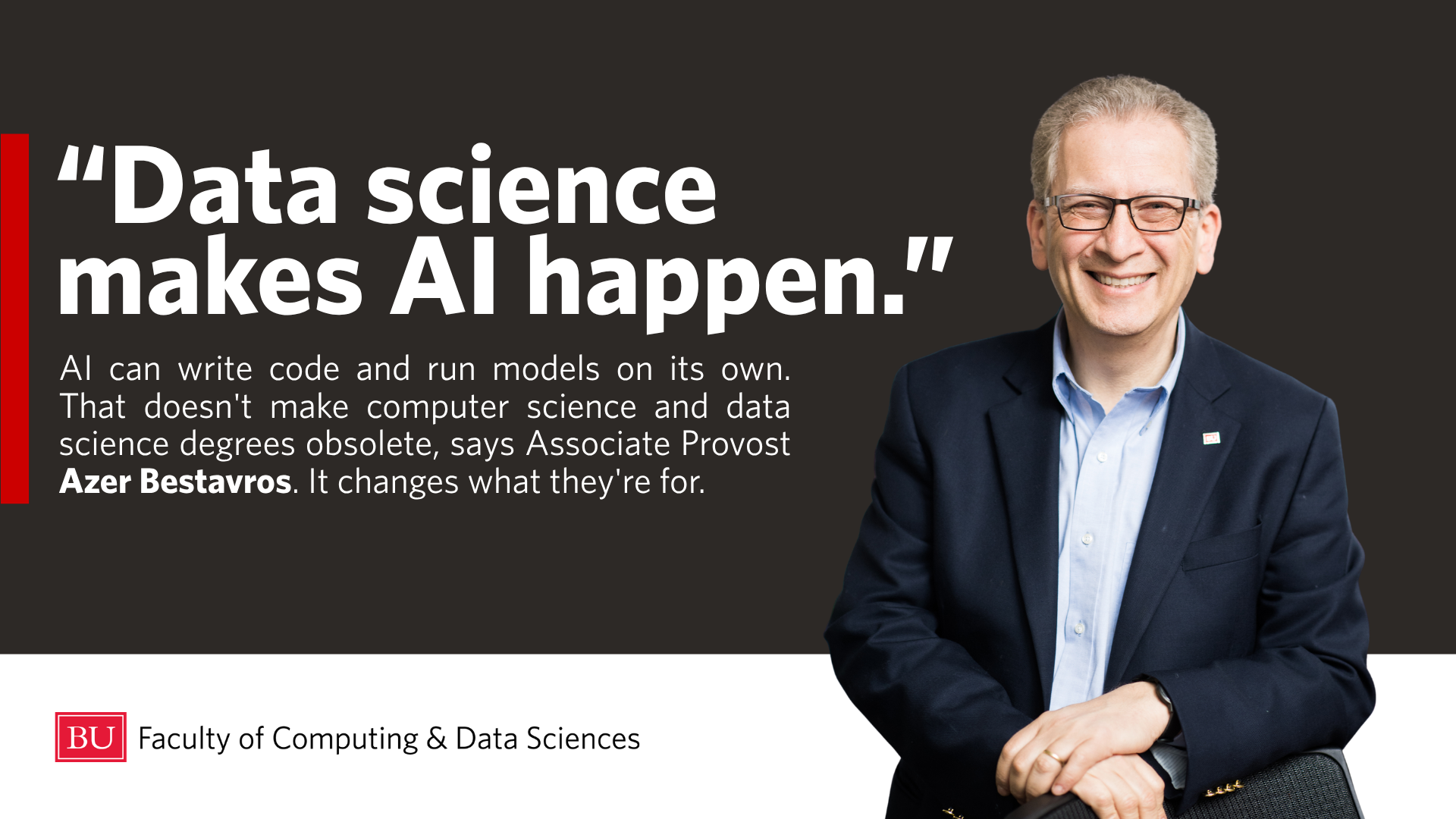
A familiar argument has taken hold: AI can generate working code and run statistical models without supervision, so the degrees that once taught those skills are on their way out. Azer Bestavros, Associate Provost for Computing & Data Sciences at Boston University and the William Fairfield Warren Distinguished Professor of Computer Science, thinks the argument fails on its own terms.
"Writing code was never the reason why we taught programming languages," he said on a recent episode of the BU Virtual Connects podcast. The point, he added, was critical thinking, and the ability to check someone else's work.
That last clause matters more now than it did five years ago. Bestavros describes the core of computer science as computational thinking, systems architecture, and abstraction. He describes data science the same way: not a set of calculations, but a discipline of reasoning about data, staying critical about results, and knowing which questions to ask. None of that is what AI automates. What AI automates is the mechanical layer on top: the syntax, the boilerplate, the routine implementation.
He draws the parallel to statistics. Spreadsheet software didn't make statistical literacy unnecessary. It made the absence of it more expensive, because it let people produce confident-looking output from methods they didn't understand. The same dynamic now runs through every field with access to a model. A model, however many billions of parameters it has, is a mathematical system running on data, and flawed data produces flawed results regardless. Someone has to be able to catch that. It's the argument Bestavros compresses into a phrase he returns to often: data science makes AI happen.
The clearest example comes from his own teaching. Algorithms is his favorite course, the part of the discipline he finds beautiful and the part students respond to. But getting there took time. Undergraduates couldn't work on algorithms until they could implement them, which meant two or three semesters of programming instruction first. Three terms of syntax before the interesting material. That prerequisite chain is what's collapsing. Bestavros describes a version where a single course covers programming with AI assistance and students reach algorithmic reasoning much earlier, because the model handles the implementation while the student handles the thinking.
What replaces the mechanical work is judgment. If a model produces an implementation, someone still has to determine whether it's correct, whether it holds at scale, and what happens when the inputs shift. Those are foundational questions, not syntactic ones, which is why Bestavros argues AI has reinforced the importance of these disciplines even as it changes how they must be taught.
That same logic shapes how he thinks universities should respond to industry's pace. Trying to match it is a losing proposition.
"We are going to lose that race every single time," he said. The alternative is to teach what doesn't change. Products and platforms turn over quickly; the foundations underneath them don't. He's clear this isn't a case for moving slowly. The Faculty of Computing & Data Sciences was built to be agile. The speed is meant to go toward changing how the foundations are taught, not toward chasing whatever industry shipped last quarter.
Listen to the full episode of BU Virtual Connects.