Modeling the Mind: Understanding Human Behavior Through Autonomous Agents
When second year Faculty of Computing & Data Sciences PhD student Yan (Stella) Si describes her work, there’s a clear theme: she builds systems that try to understand people. Under the mentorship of Professor Joshua Peterson, she works at the intersection of cognitive science and AI, using large models on behavioral data to test cognitive theories and experimenting with language models as “automated theorists” that can propose and refine explanations for human behavior.
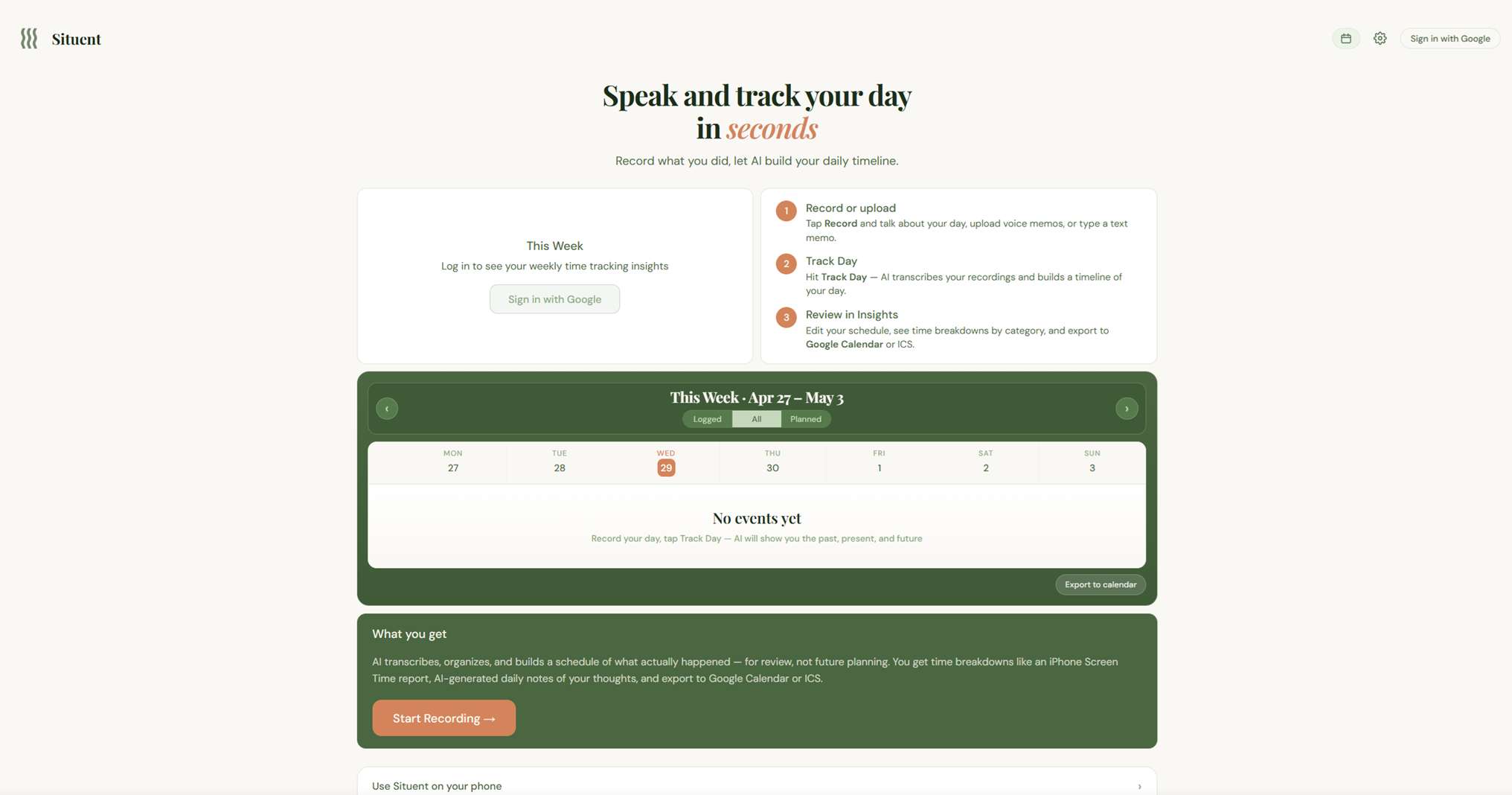
Outside the lab, that same curiosity has turned into a side project: Situent, an AI powered calendar assistant designed to help people actually see and shape how they spend their time. Situent began over winter break as a personal experiment. Stella realized she often didn’t have a clear, honest sense of where her time was going: how much was really going to research, writing, teaching, side projects, or rest. She’d already been thinking about agentic AI and workflow automation, and Situent became the place to apply those ideas to her own life.
The name “Situent” comes from situating a person in context. In literature and journalism, you often start with the “who, what, when, where, why, and how” to understand someone’s life. Situent’s first take is on when. By tracking how your time is spent, it gradually builds a sharper picture of your routines, constraints, and priorities.
The long-term vision is a context aware personal AI: less of a one-off chatbot, more a companion that knows your patterns well enough to become a proactive strategy partner. Today, Situent is an AI calendar assistant that effortlessly helps you understand your time. In practice, it behaves like a calendar companion that turns what you say as insights and into future actions.
Stella built Situent first for herself as “user zero,” pushing new features through her own schedule before sharing them with others. Her own shorthand for it is an “executive strategist” that moves along with you, making it easier to see where your time is going and where to redirect it. Only recently has she started to open it up and think more deeply about broader user types. It’s grown to have a group of test users, including people outside Stella’s immediate circle, and has been showcased at BU Spark’s Code & Tell, where it won the audience choice award. Stella credits BU Spark! and the CDS community as key spaces for testing ideas and collecting honest feedback.
Agentic AI, Beyond Situent
Agentic AI, which is a system that can execute tasks autonomously, in multi step actions rather than answer a single prompt, has taken off most clearly in coding, where models can iterate on code with relatively little help. Outside of that, the space is noisier. There are lots of demos, but fewer tools that people can rely on daily, with OpenClaw being the most recent of this emergent agentic tech. It can independently solve issues with minimal input, is proactive in taking actions even when the user is away, and dynamically adapts and codes based on user needs.
Building on research from the Data Science of the Mind Lab led by CDS Professor Joshua Peterson, Stella explores automated research agents in cognitive science. Her work, Autopsych, uses LLMs to automate psychological theory discovery, applying skills in computational modeling and decision making theory to accelerate and scale how new insights are generated in the cognitive science field. “When you think about DeepMind and other companies, they’re all approaching agentic AI in different ways. In psychology, it has the potential to bring us a better understanding of humans. It allows us to do things we couldn’t before,” Stella says.
Situent is an attempt to bring that agentic behavior to calendars and time. It’s challenging to design a good agent. You can either create better agent models and deployment methods, or improve one area of expertise. Stella is focusing on the latter, with a goal of driving forward the understanding of humans via the development of agentic AI, allowing her to do so better, faster, and at a larger scale.
There's something so fitting about a CDS PhD student – someone who spends her days studying how AI can model human behavior – turning those same tools inward. At its core, CDS was built on the belief that data science should serve people. Situent is Stella's own answer to that: a reminder that the most rigorous place to test a theory is sometimes your own life.
-- Shriya Jonnalagadda (CDS'28), Data Science Research Communications Intern