In His New Book, The Dark Frontier, BU Biologist Explores the Deep Sea—and Provides a Warning on Its Future
Jeffrey Marlow combines journalism, historical narrative, and policy work to illuminate the ocean’s depths before they are changed forever
Video via iStock/Jezperklauzen
In His New Book, The Dark Frontier, BU Biologist Explores the Deep Sea—and Provides a Warning on Its Future
Jeffrey Marlow combines journalism, historical narrative, and policy work to illuminate the ocean’s depths before they are changed forever
A few hundred meters beneath the surface of the Pacific, just off Malibu’s crowded coastline, Jeffrey Marlow watched an almost extraterrestrial landscape emerge.

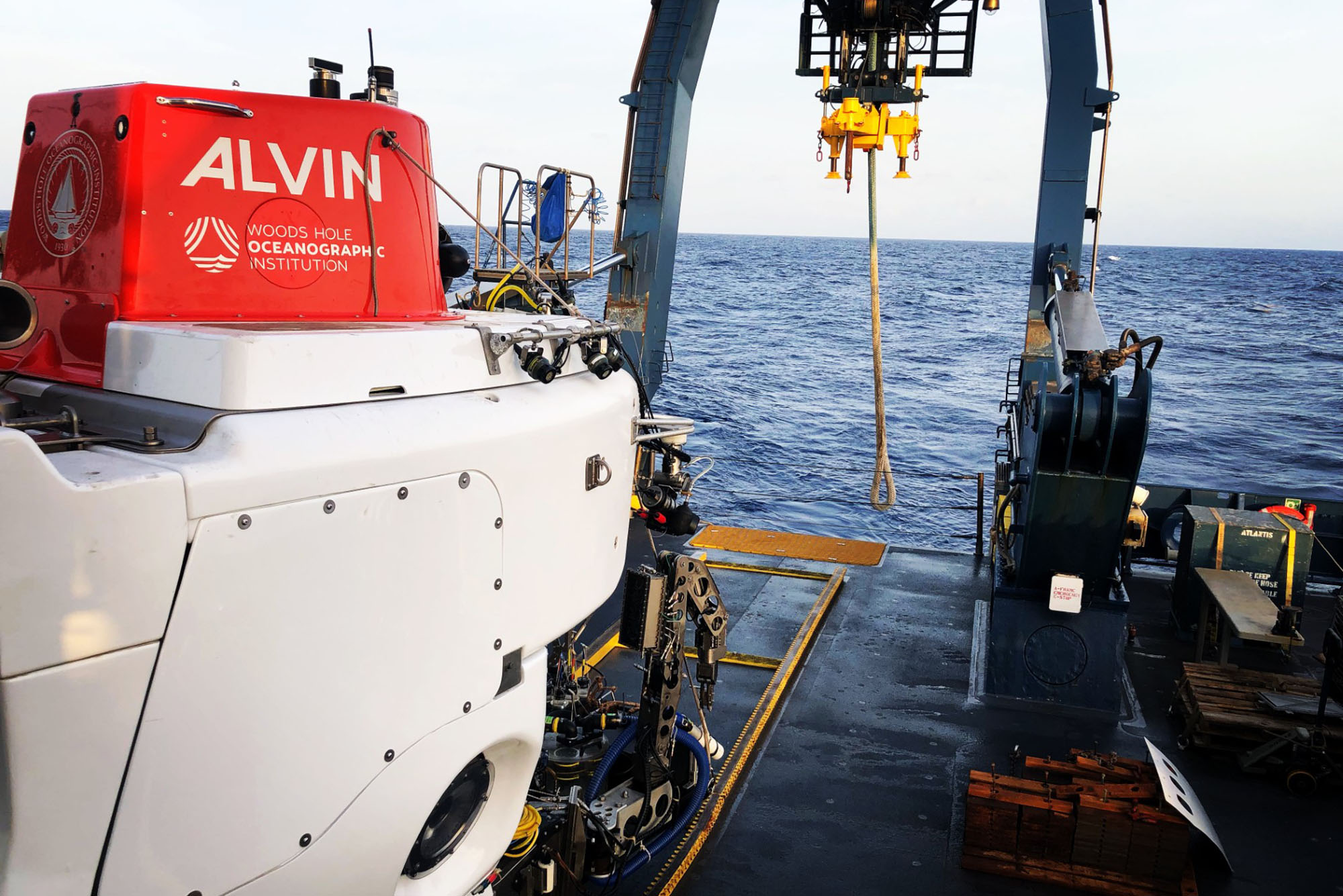
Marlow, a Boston University College of Arts & Sciences assistant professor of biology, was part of a team using an uncrewed submersible to explore the Point Dume methane seep, where potent gases leak through cracks in the seafloor. The vehicle’s cameras revealed chimneylike rock structures coated in thick microbial mats, while fish drifted through what Marlow describes as a “Seussian” landscape. Hidden just off one of America’s most popular stretches of coastline was an ecosystem few humans had ever seen.
“We ultimately learned that the microbes in the rocks at this site are able to eat methane faster than [microbes] at any other methane seep we’ve found,” Marlow says. “The experience really hit home to me the fact that the ocean is an entirely distinct realm that is so far almost entirely unexplored, that something so close to this place where millions of people live, has never been seen.”
For Marlow, who studies microbes that thrive in some of Earth’s harshest environments, moments like this capture the enduring mystery of the deep ocean—an area that makes up most of our planet, but remains almost entirely unseen.
That mystery drives his new book, The Dark Frontier: Unlocking the Secrets of the Deep Sea (Penguin Random House, 2026). Blending memoir, scientific exploration, journalism, history, and policy, the book traces humanity’s attempts to understand the ocean’s depths before they are changed beyond repair. Alongside Marlow’s groundbreaking research on microbes (the microscopic organisms that regulate the Earth’s chemistry) are tales of fallen whale carcasses and deep-sea mining expeditions, interviews with field experts, and tense scenes from international negotiations over the ocean’s future.

A Childhood Spent Exploring
Growing up in Colorado, Marlow was drawn early to the natural world. “I really trace it to family road trips,” he says. “We would drive up into the mountains, or to Yellowstone, and I think the exploratory aspect was always the most exciting part to me, of just climbing around, following whatever seemed most interesting.”
As a graduate student at the California Institute of Technology, Marlow initially hoped to work on Mars missions. But while training in geology, he had a bit of an intellectual crisis and found himself pulled toward biology instead.
“There’s just something about biology and how life works that I totally fell in love with and couldn’t escape from,” he says. “The fact that [life] is self-sustaining, and we don’t really know how it began, and it changes and adapts. And as much as I love rocks, they don’t do that. Even though they’re impossible to see without a microscope, the microbes won me over in the end.”
Marlow writes in his book that these microscopic organisms “can eat anything from oil to fool’s gold and breathe compounds like sulfate or nitrate, opening up for them niches that are unavailable to animals.”
In his BU lab, Marlow investigates how microbial life survives and thrives in extreme environments, including active volcanoes and hypersaline lakes. His work could shed light on how Earth’s climate is regulated, how life first emerged on our planet, and whether life may exist elsewhere in the universe.
In this video, BU student Natalie Lett explains Marlow’s research on microbes and other organisms that make their homes in extreme environments. Background image courtesy of Marlow
Despite their tiny size, microbes play an outsized role in shaping the planet. “In every drop of seawater, there are hundreds of thousands of microbes; in every pinch of soil, there’s about a billion microbes,” Marlow says. “They are incomprehensibly abundant. And so, if each one of them is doing just a tiny piece of the puzzle, it becomes a pretty enormous and intricate puzzle.”
In recognition of his work, Marlow was this year selected to join the National Academies’ New Voices in Sciences, Engineering, and Medicine cohort, which aims to build “a network of emerging US leaders to address national and global challenges,” according to the organization. He was also recently named—along with fellow BU biologist Meg Younger—a National Academy of Sciences 2026 Frontiers of Science Fellow.
A Love of Writing
Before The Dark Frontier, Marlow wrote several science-centered articles for general audiences, including a series of reports for the New Yorker. He began to work on his book in 2019, motivated by a desire to bring deep-sea science to a wider audience.

Early reviews of the book have been strong. Book review site Kirkus called Marlow a “gifted writer,” praising his “cinematic descriptions” of everything from polymetallic nodules being suctioned from the seafloor to the “goopy, smelly rot” of submerged whale carcasses. “In his telling, even the most staid, diplomatic meetings are riveting,” Kirkus said. The Dark Frontier has also been named to the New Yorker’s Best Books of 2026 So Far list.
But the book is also a warning. Marlow argues that humanity is rapidly damaging ecosystems it barely understands. Humans have visually documented only about 1,470 square miles (roughly 0.001 percent) of the deep seafloor, according to a 2025 study in Science Advances. Scientists have found chemicals and pollutants even in animals living in the Mariana Trench, the deepest part of the ocean, as governments and industries increasingly eye the seafloor for mining, drilling, and aquaculture.
“Almost any drop of water you get from anywhere in the ocean will have some chemical signature of human influence,” Marlow says. “The window for understanding the unaltered deep sea has probably already passed. There are still relatively pristine wildernesses on the seafloor, but that may not always be the case given the diffuse threats of pollution and climate change, or the acute threats of mining and oil drilling. We need to understand what’s actually there before it changes or disappears.”
The urgency is difficult to overstate and extends into global policy. Marlow worked on the Agreement on Marine Biological Diversity of Areas Beyond National Jurisdiction, commonly known as the High Seas Treaty, which took force this year and is the first global accord to regulate the ocean beyond national boundaries.
Before this agreement, Marlow says, there was no comprehensive set of rules to govern much of the ocean. But after about six years of “really detailed and agonizing negotiations,” this treaty came together. “Essentially, it sets up a way for any financial gains that come from biodiversity—such as new pharmaceuticals or industrial enzymes—to be distributed equally around the world,” he says.
The agreement also creates pathways for marine protected areas, much like national parks.
“As we continue to explore and understand the open ocean, people in countries who have not typically been involved with these efforts can build capacity and start to ask their own questions,” Marlow says. “It’s really about leveling the playing field and making sure we use this global commons in a well-thought-out and ideally sustainable way. Before this treaty, it was really kind of a free-for-all. It’s really profound and important.”
Still, Marlow believes that because the deep sea is hidden from view, it is easy to imagine it as irrelevant. But many planetary-wide functions—from carbon storage to nutrient regeneration—depend on the deep sea. “If these ecosystems are overlooked, we will continue to degrade them at an alarming rate, and the significance may not be obvious for a while,” he says.
For all the warnings embedded in The Dark Frontier, Marlow remains hopeful. The same curiosity that once made him think he wanted to command Mars robots now keeps him focused on the unexplored frontiers here on Earth.
“There’s no shortage of stories to keep telling about the deep sea,” Marlow says. “As expansive as I tried to be in writing this book—going back centuries into the past and working with communities around the world—it’s still just a tiny fraction of the inspiring, transformational work that people are doing.”