How Augmented Reality Could Help Engineers Better Insulate Older Homes
A Boston University–based manufacturing innovation center is developing an AR-guided insulation system to reduce energy loss
How Augmented Reality Could Help Engineers Better Insulate Older Homes
How Augmented Reality Could Help Engineers Better Insulate Older Homes
Behind the historic charm of many New England homes is an often-overlooked problem: their walls contain little to no insulation. That can make houses hotter in summer and chillier in winter. In some older homes, as much as 25 percent of heating energy is lost through the walls.
“If the US is going to meet its 2050 energy reduction and carbon emission reduction commitments, some 50 million homes are going to need a deep energy retrofit,” says Andre Sharon, a Boston University College of Engineering professor of mechanical engineering. “It turns out that actually insulating the walls in a cost-effective and nondisruptive manner to the residents is very challenging.”
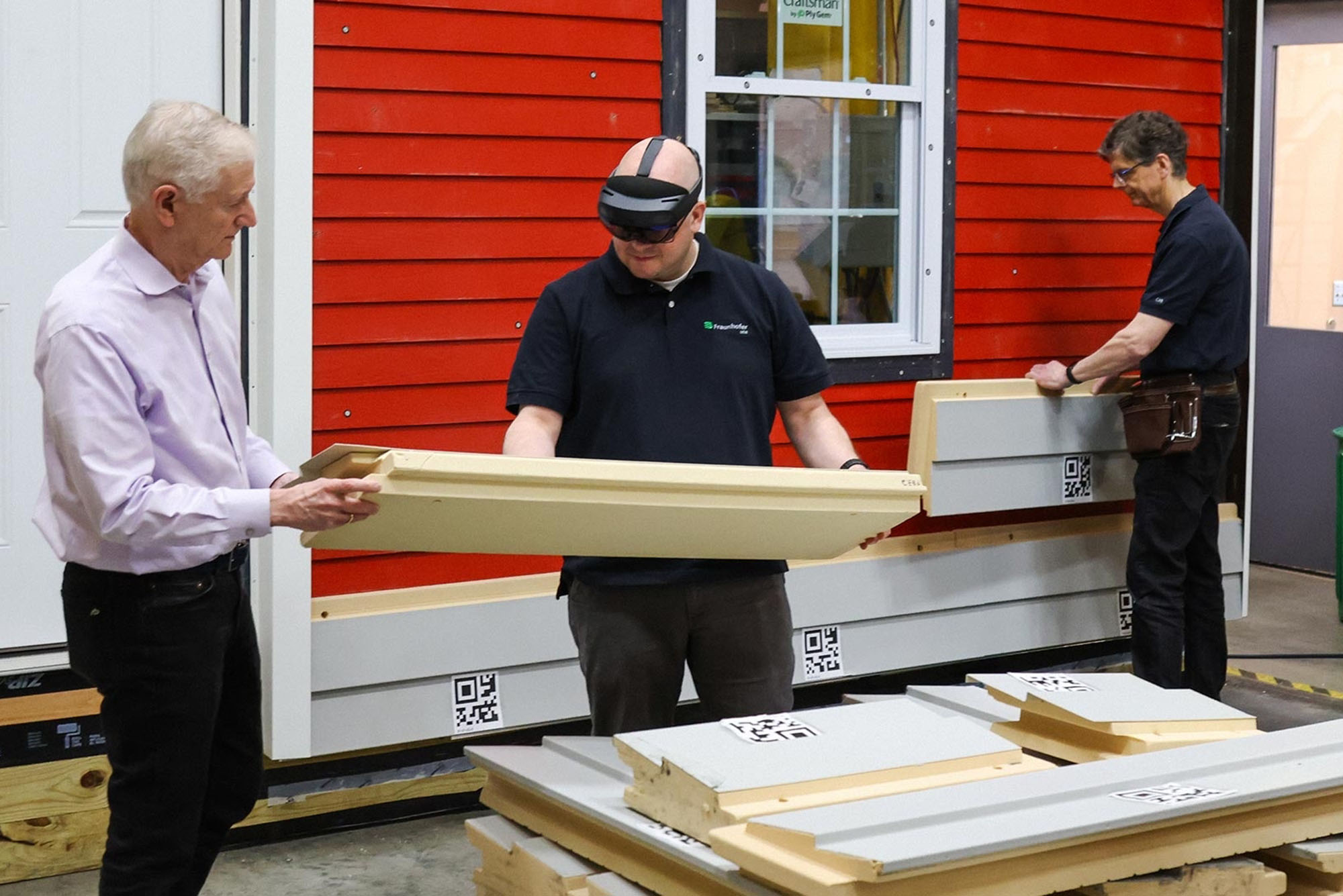
He and his team are testing a potential solution: customized, highly insulated panels that can be added to existing walls with the help of augmented reality. The insulation system can quickly be installed by a team of two, potentially cutting a building’s heating and cooling energy lost through walls by up to 85 percent.
Sharon is the director of the Fraunhofer USA Center for Manufacturing Innovation (Fraunhofer CMI), a BU-based applied research hub that brings together students, faculty, and professional engineers to help American companies “solve their most difficult engineering and manufacturing problems,” according to its website. The center is part of an international network established by Germany-based research and development nonprofit Fraunhofer-Gesellschaft, which partners with universities across the world to bridge the gap between academia and industry. Fraunhofer CMI, which has been located at BU since its founding in 1994, specializes in pursuing innovation in sustainable energy, industrial automation, and biomedical systems.
The team’s augmented reality (AR) approach to insulating homes combines both a software and mechanical solution. Using the system, engineers first laser scan a building, then analyze that scanning data to design and fabricate custom insulated paneling. At the job site, workers wear a virtual reality headset that uses AR to guide them through the installation process, showing exactly where each panel needs to go, reducing the need for time-consuming adjustments and on-site cutting. The project is funded by the Department of Energy.
“The biggest innovation here is on the AI and software part, from starting with laser scanning a house and being able to process the data into a model that a computer could understand, to developing all sorts of algorithms in order to very accurately get the dimensions of every feature in the house,” says Sharon, who also has an appointment in ENG’s division of materials science and engineering. “We applied digital manufacturing technologies to the construction industry, which is long overdue.”
According to the team, the system could help homeowners stay comfortable—and bring financial benefits.
“By combining our building technologies expertise with our vast manufacturing automation experience at the center, we were able to develop a cost-effective solution that makes financial sense for the homeowner,” says Kurt Roth, Fraunhofer CMI’s head of building energy systems and the project’s coprincipal investigator.
The next step is to bring the system to homes. Partnering with the Boston Housing Authority, Sharon and the Fraunhofer CMI team plan to retrofit at least two houses in the Boston area (and, separately, one in Pittsburgh, Pa.), to showcase the system in real-world settings. They are also in conversations with partners in New York.
As the team looks forward to broader adoption, Aaron Sharpe, Fraunhofer CMI’s software and controls manager, says the project reflects just how important the collaborative effort between Fraunhofer and BU has become. He first started working at the center while an ENG undergraduate and says its campus location gives students frequent opportunities to join live projects and work with full-time engineering staff.
“I was immediately immersed in real engineering, contributing to a wide variety of active projects,” says Sharpe (ENG’03,’07) of his student experience. “It was incredibly rewarding and ultimately shaped my entire career path.”
He’s currently leading the software side of the project to retrofit older buildings—and mentoring the next generation of engineers.
“The AR-guided insulation project is a perfect example of the Fraunhofer-BU partnership,” says Sharpe. “We are taking cutting-edge technology and applying it to a very physical, manual process to make it safer and more efficient. It’s exactly the kind of real-world innovation I hoped to be doing when I first started here 25 years ago.”
In the video above, watch as Sharon and the Fraunhofer CMI team demonstrate the AR-based technology used to help retrofit homes with better insulation.