Skip to Main Content
Boston University
  • Bostonia
  • BU Today
  • The Brink
  • University Publications

    • Bostonia
    • BU Today
    • The Brink
  • School & College Publications

    • The Record
Other Publications
The Brink
  • Sections
Pioneering Research from Boston University

Farouk El-Baz Tapped by Egypt President

Advisory council will have role in efforts to improve roads, education, other national projects
October 6, 2014
Twitter Facebook
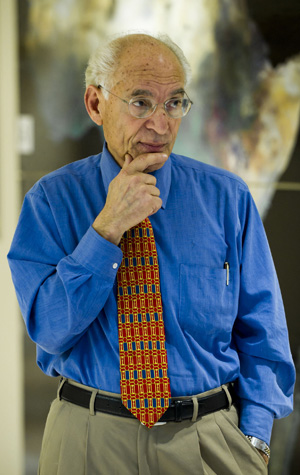
Farouk El-Baz has worked alongside the Egyptian government once before: from 1978 to 1981, he was science adviser to the late President Anwar Sadat. Photo by Kalman Zabarsky

Egyptian President Abdel-Fattah El-Sisi has established an advisory council that will include Boston University’s Farouk El-Baz and 15 other renowned academics and experts.

El-Baz is a College of Arts & Sciences research professor of archaeology and a College of Engineering research professor of electrical and computer engineering and director of Boston University’s Center for Remote Sensing. He is also part of the associated faculty at the CAS Department of Earth & Environment.

Members of the council, which El-Sisi formally announced in a presidential decree on September 6, will have a vital role in national projects, including the creation of a channel that runs parallel to the Suez Canal and the Egyptian government’s efforts to improve roads. Council members also will help El-Sisi in his fight to improve education in Egypt, as well as help diminish religious turmoil within the country’s borders and improve discourse within the media.

“I am very proud to have been selected to join President El-Sisi’s advisory council,” says El-Baz. “To have been chosen alongside so many distinguished individuals is a true honor, and I look forward to working with the other members and the president on a wide range of issues that the Egyptian government and its people face today.”

This is not El-Baz’s first time working alongside the Egyptian government. From 1978 to 1981, he was science adviser to the late President Anwar Sadat. Due to increases in population and other factors, Sadat believed Egyptians should spread out from the Nile Valley and utilize more of the surrounding desert’s land. El-Baz was given the task of choosing and developing several desert tracts without harming their respective environments.

Among the 15 other council members is 2011 Boston University honorary degree recipient Ahmed Zewail (Hon.’11), who won the 1999 Nobel Prize in Chemistry. Other notable members include Sir Magdi Yacoub, an Egyptian-born British cardiothoracic surgeon who was knighted by Queen Elizabeth in 1991, and Ali Faramawy, president of Microsoft Middle East and Africa.

El-Baz, who was born in the Nile Delta town of Zagazig, Egypt, in 1938, is educated in both chemistry and geology. He received a BS in chemistry and geology from Ain Shams University and an MS in geology from the Missouri School of Mines and Metallurgy in Rolla, Mo. Later, he earned a PhD in geology from the University of Missouri-Columbia after doing research from 1962 to 1963 at the Massachusetts Institute of Technology in Cambridge.

Over the course of his career, El-Baz, a veteran of NASA’s Apollo program of lunar exploration, has become well known for his role in the selection of landing sites for the Apollo missions and the training of the astronauts in visual observations and photography. He is a pioneer in applying space images in the fields of geology, geography, and archaeology.

The Center for Remote Sensing was formed in 1986 as a facility for scientific research in archaeology, geography, and geology and is used to study the Earth and its resources—particularly groundwater—using satellite images and data from both airborne and ground sensors. Under El-Baz’s direction, it was selected by NASA as a Center of Excellence in Remote Sensing in 1997.

Explore Related Topics:

  • Africa
  • Archaeology
  • Share this story

Share

Farouk El-Baz Tapped by Egypt President

Share

  • Twitter
  • Facebook
  • Reddit
  • LinkedIn
  • Email

Latest from The Brink

  • Football and Health

    NFL Players Four Times More Likely to Die of Diseases Like ALS, Dementia, and Parkinson’s, BU Study Finds

  • Antibiotic Resistance

    Boston University-Led Biopharmaceutical Accelerator Boosts New Drugs’ Chances of Success, Study Finds

  • Research News

    Brink Bites: A Boston Climate Leader and New Oral Cancer Targets

  • Home Energy

    How Augmented Reality Could Help Engineers Better Insulate Older Homes

  • Noise Prevention

    Fast Company Names Boston University–Designed Sound Shield a “World Changing Idea”

  • Sports Medicine

    Would Better Hip Care for Young Female Athletes Prevent Pain and Surgery Later in Life?

  • Marine science

    In His New Book, The Dark Frontier, BU Biologist Explores the Deep Sea—and Provides a Warning on Its Future

  • Radicalization

    How Do Social Movements Emerge—and Why Do Some Radicalize?

  • Accolades

    Squid-Inspired Lab Technology Wins Student Team a Boston University Climate Award

  • Physics and AI

    Boston University Joins National Science Foundation Institute Pushing Frontiers of Physics and AI

  • Space Weather

    We Can Predict Space Weather. What If We Could Also Stop It?

  • Clean Energy

    Boston University Researchers Team Up with Massachusetts to Launch New Clean Energy Tools

  • Hiking Safety

    Chances Are You’re Not Carrying the Right Safety Gear When You Hike

  • Ebola

    How Worried Should We Be About the Bundibugyo Ebola Outbreak?

  • Urban Geography

    Boston University’s Loretta Lees honored by UK’s Royal Geographical Society

  • Infectious Diseases

    Measles, Cholera, and Mpox: BU-Based Outbreak Tracker Monitors World’s Most Dangerous Infectious Diseases

  • Baseball

    Does Spending Big in Major League Baseball Equal On-Field Success?

  • Internet Cookies

    Should You Accept Internet Cookies? BU Researchers Say the Open Web Could Suffer Without Them

  • Bio-Inspired Engineering

    Could This King-Size Citrus Fruit Inspire a Better Mobile Phone Case?

  • Excess Deaths

    Why Does the US Have Higher Death Rates than Other Wealthy Nations?

Section navigation

  • Sections
  • Notable
  • Videos
  • About Us
  • Topics
  • Archive
Subscribe to Newsletter

Explore Our Publications

Bostonia

Boston University’s Alumni Magazine

BU Today

News, Research, Community

The Brink

Pioneering Research from Boston University

  • Twitter
  • Facebook
  • YouTube
  • LinkedIn
  • Instagram
  • Weibo
  • Medium
© Boston University. All rights reserved. www.bu.edu
© 2026 Trustees of Boston UniversityPrivacy StatementAccessibility
Boston University
Notice of Non-Discrimination: Boston University prohibits discrimination and harassment on the basis of race, color, natural or protective hairstyle, religion, sex or gender, age, national origin, ethnicity, shared ancestry and ethnic characteristics, physical or mental disability, sexual orientation, gender identity and/or expression, genetic information, pregnancy or pregnancy-related condition, military service, marital, parental, veteran status, or any other legally protected status in any and all educational programs or activities operated by Boston University. Retaliation is also prohibited. Please refer questions or concerns about Title IX, discrimination based on any other status protected by law or BU policy, or retaliation to Boston University’s Executive Director of Equal Opportunity/Title IX Coordinator, at titleix@bu.edu or (617) 358-1796. Read Boston University’s full Notice of Nondiscrimination.
Search
Boston University Masterplate
loading Cancel
Post was not sent - check your email addresses!
Email check failed, please try again
Sorry, your blog cannot share posts by email.
Farouk El-Baz Tapped by Egypt President
0
share this