Street Medicine
Proud and contrary tradition of protester and street medic
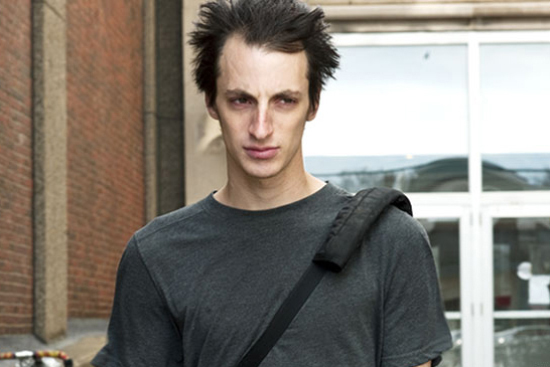
Jeff Stein’s bad luck began when he arrived at the 2008 Republican National Convention in St. Paul, Minn., to help set up a free medical clinic and join a heaving street demonstration—all in front of the local police station.
The location all but guaranteed that Stein and his colleagues, who had come from across the country to dispense first aid to anyone injured in the planned mass protests, would end up in jail.
And they did.
“We were aiming to disrupt and take an intersection,” says Stein (CAS’11), who in addition to performing his medical services sometimes joins a protest. “We knew there was a good chance we would get arrested. We were going to try to avoid it, but none of us were terribly surprised.”
Stein was held for three days, largely because he refused to give his name to police. “It’s a deliberate tactic,” he says. “It’s called jailhouse solidarity, and it means they couldn’t book us. And if they can’t book you, they can’t kick you out of jail. The point of that is to clog up their system. Then they said, ‘Give us your name or face contempt—30 days.’” Stein complied and was charged with misdemeanors, including disorderly conduct and disturbing the peace. He was released on the evening of the third day.
Stein faces the possibility of arrest every time he heads out to a public demonstration to administer first aid. In his three years at BU, he has taken his makeshift medical kit to some half-dozen large demonstrations, from Seattle, Wash., to Pittsburgh, Pa. Stein is a street medic, a member of the latest generation of a loose network of activists who first tended to marchers injured in civil rights–era actions in the 1960s and now appear at political protests and natural disasters all over the world. Stein, for example, flew to Haiti in the aftermath of last winter’s deadly earthquake. Other street medics offered their services in New Orleans after the city was wrecked by Hurricane Katrina in 2005.
Street medics are prepared to treat a wide range of problems, from blisters to gunshot wounds. Some are doctors, some are nurses, and some have no medical training save for a 20-hour basic first-aid course. Many street medics, like Stein, are also emergency medical technicians.
No one keeps an official tally, but Stein and others say the ranks of street medics peaked during the Vietnam War.
“There was a need for an alternative to hospitals,” recalls Tom Hayden, a founder of the 1960s student activist movement Students for a Democratic Society, who trained as a medic. “The police would go to hospitals looking for fugitives to arrest.”
Hayden, a former California state senator and current director of the Peace and Justice Resource Center in California, says the first street medics were medical professionals or medical students who wanted to treat victims of police brutality. Emergency care was needed, he says, to treat abrasions, bruises, broken bones, and pepper spray irritation.
“I remember cleaning a head wound and applying a butterfly bandage to the head of a minister who was clubbed by the police seeking to arrest him,” Hayden says. “There were thousands of such cases. The need has continued ever since.”

The black sheep of the bunch
Street medics reappeared in relatively large numbers when protesters mobilized at the World Trade Organization meeting in Seattle in 1999, according to Stein. They have established collectives that train and work together in the United States and abroad—they were among the activists in the ill-fated flotilla carrying humanitarian aid to Gaza last May—as well as at community health clinics, such as the Common Ground Health Clinic in New Orleans.
Stein, who started as a street medic in high school, has worked at demonstrations large (meetings of the International Monetary Fund and the World Bank in Washington, D.C.) and small (a tree-sit in southern Indiana). Pale and wiry, with a shock of brown hair darting every which way, Stein has an activist’s intensity. And he speaks like a scholar, which he is. He is among 20 Martin Luther King, Jr., scholars at BU, an academically gifted group committed to social justice and community service who receive scholarships in honor of one of the University’s most illustrious alums, Martin Luther King, Jr. (GRS’55, Hon.’59). In high school, they earned average GPAs of 3.8 and graduated in the top 5 percent of their classes. They have mentored at-risk youth, raised money for girls’ schools in Afghanistan, and created and led cultural, race relations, and advocacy groups.
“The black sheep of the bunch,” Stein says with a self-deprecating smile.
Katherine Kennedy, advisor to the King scholars, recalls that she suspected Stein was a little bit different when, as a freshman, he asked if he would lose his four-year full-tuition scholarship if he were arrested.
“It took me a little off guard,” says Kennedy, director of the Howard Thurman Center, BU’s multicultural center. “I thought a moment and said, ‘Well, Jeff, Martin Luther King was arrested, so I guess my direct answer is no. But I will also say that it would deeply depend on what you were arrested for.’”
Kennedy soon came to see Stein’s activism as “a well-thought-out, humanitarian” commitment. “He’s a very mature young man,” she says. “He knows the dangers, the risks. He is not reckless. But he’s determined to have these experiences and determined to have an experience that is uniquely his.” As she learned more about Stein, she says, “he didn’t seem like your average 21st-century young person. He reminded me of a young man from the days when I was in college, in the ’60s.”
Struck by the simplicity of it
Stein grew up in Seattle, the son of a research technician and a Boeing project manager. He was an early reader, who showed signs of his future activism when, after reading a magazine article about animals raised for slaughter, he announced to his parents that he planned to become a vegetarian. He was eight.
As a teenager, Stein joined the Seattle Young People’s Project, whose members, ages 13 to 18, form a young but tenacious voice for social change. “Probably the most well-known thing they did, before I got involved, was forcing the Seattle school district to use Howard Zinn’s A People’s History of the United States as a history text for all seniors,” he says. “We were also doing a lot of campaigning against standardized testing in Washington. I haven’t kept up with it, but it probably is still racist and biased against lower-income kids who don’t have the same cultural background as the kids in private schools.”

When George W. Bush was reelected in 2004, Stein was moved, he says, to look “beyond established political theories and means for change.” Anarchist theory seemed to offer a sane alternative. “I remember just being struck by the simplicity of it,” he recalls, “and saying, why can’t we just take care of each other and practice mutual aid and take care of our communities ourselves?” He adopted what he considers a moderate stance. “I don’t think most anarchists would say they can live their lives free of capitalist society. For me, it’s about using the tools I have, and the tools I have access to, to fight. I’m lucky enough to have this scholarship, and I hope to use it to further my goals, even if it means getting a higher paying job and giving all that money back to projects I care about.”
Kennedy remembers asking Stein about his political leanings. Ultimately, she says, “he shows respect for Boston University, he shows the utmost respect for, and appreciation of, being a Martin Luther King scholar, and he shows me the utmost respect as the advisor and mentor to his program. That has endeared him to me immensely.”
When you’re being shot at
Soon after he arrived in Boston as a freshman in 2007, Stein grabbed his textbooks (“I had a test the next week,” he says) and jumped on a bus bound for Washington, D.C., and an IMF-World Bank protest. There, he loaded up his first-aid pack with gauze, Band-Aids, latex gloves, salves, and a selection of herbs.
The job of a street medic can be as simple as handing out bottles of water on a hot afternoon, or as Stein found that day in Washington, treating minor cuts and bruises. But when demonstrations turn violent, his biggest job may be helping pepper spray victims, flushing the chemical irritant out of eyes with saline or applying a mixture of Maalox and water to the skin to relieve the burning.
The next summer, he headed to southern Indiana for a campaign against the construction of an interstate highway and later to the Republican National Convention. After his arrest, Stein chose to take a few months off from study. “I did not lose my scholarship,” he notes. He spent the semester working at a pizza shop in Allston. “It wasn’t so much missing the classes,” he says. “It was more just, like, getting out of jail and the shock and needing some time to comprehend the whole experience before I plunged back into college.”
The international relations major resumed classes in spring 2009, and he and other medics began training a new crop of street medics across the Northeast. The 20-hour sessions cover first aid, a brief history of the street medic movement, and, he says, “street tactics—how to run and do things when you’re being shot at.” Later that spring and summer, he traveled to Washington, D.C., for another IMF-World Bank action, to West Virginia for a campaign against mountaintop removal mining, and to Pittsburgh, Pa., for the 2009 G-20 summit of world leaders.
Last winter, Stein dropped everything once again to provide medical care to earthquake victims in Haiti. Two weeks after the temblor, he and another emergency medical technician, two wilderness EMTs, and a clinical herbalist boarded a flight bound for Port-au-Prince. They camped out by an orphanage near the airport, sleeping under tents and tarps. They woke at 5:30 a.m., packed up their medical supplies, and set out for areas that needed help. Stein says they treated patients with open fractures, infections, crush wounds, head injuries, and preexisting medical conditions. When they’d done what they could in one area, they would scout another location or requisition more supplies from aid groups like the World Health Organization.
Stein says his professors had no problem with his two-week absence, allowing him to make up the class work he’d missed. He says he enjoys similar support from his parents—to a point. “Some of the things I do make them uneasy for multiple reasons,” he says, “not the least of which is my safety.”
“He definitely adds some stress to our lives sometimes,” says his mother, Carrie, who works at a cancer research center in Seattle. “When he goes to a protest, with a lot of arrests and tear gas, it makes us nervous.”
But the family is close, she says, and Stein always lets them know where he’s going and what he’ll be doing. “It’s definitely a passion for him,” she says. “He has always cared about people who are less fortunate than he is.”
Their son’s work has inspired both parents to become more involved in issues they care about. His father, Dick, who works for Boeing, volunteered as a legal observer for the National Lawyers Guild at the 2008 Republican National Convention. “I was on the streets the whole week,” the senior Stein says. “We would joke about that afterwards, that Jeff’s dad saw more action than he did.” The experience was an eye-opener. “I got to meet his friends and people he associated with. I found they were pretty passionate, bright, and committed.”
This past spring, Stein opted not to attend the G-20 talks in Toronto. As an activist with a record, he says, he wasn’t confident he’d make it across the border. Instead, he took summer classes, then traveled to Chile to help a friend doing research on the effects of mining runoff on indigenous populations.
Come winter, he’ll likely be back on the streets, missing a few classes and risking arrest.
“Every day you can open the paper and see some horrible injustice that’s being perpetrated by corporations or governments of First World countries,” says Stein, who has been thinking about nursing school since returning from Haiti. “And these kinds of things need to be fought, and they need to be actively resisted. Is my everyday life affected by the decisions of the G-20? Yes, but does it make my life horrible? Not in directly observable ways. But the people who are getting screwed over in Third World countries aren’t able to fight these people. We have the privilege of being in the places where they meet and of being able to fight them. If we can do that as an act of solidarity with people who can’t, then we need to do that.
“Where do I fit in? To resist these people, at the very least we need to be healthy, and at the very least, we need to know that if someone gets shot with something or has chemicals all over their bodies, we will be able to take care of them. We can fight harder when we’re taking care of ourselves.”
Cynthia K. Buccini can be reached at cbuccini@bu.edu.
This article was originally published in the Fall 2010 issue of Bostonia.
Comments & Discussion
Boston University moderates comments to facilitate an informed, substantive, civil conversation. Abusive, profane, self-promotional, misleading, incoherent or off-topic comments will be rejected. Moderators are staffed during regular business hours (EST) and can only accept comments written in English. Statistics or facts must include a citation or a link to the citation.