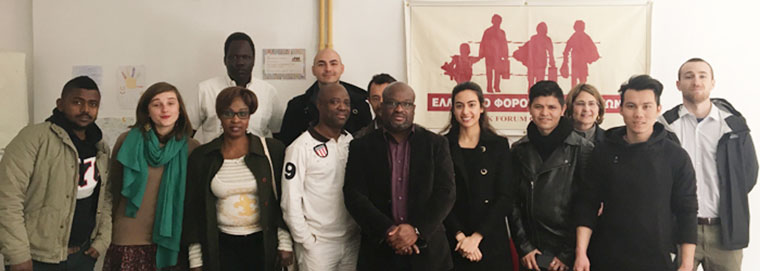
IHRC students Brendan Sweeney’18 (first from the right) and Arwa Al Ali’18 (fifth from the left) with members of the Greek Refugee Council in Athens in March 2017.
Advocate for Human Rights around the World.
Work for global and regional human rights while representing non-governmental organizations and group clients from all parts of the world. Learn about treaties, policies, and other legal mechanisms for implementing and enforcing international human rights and humanitarian law.
In the International Human Rights Clinic, students:
represent international NGO’s, through research and advocacy, and drafting submissions to the UN Human Rights Council, the treaty bodies, and the regional human rights organs (in the American, African, and European human rights systems);
file briefs and amicus briefs on international human rights law issues in US domestic courts;
handle appeals in refugee and international human rights cases;
participate in universal jurisdiction claims in the US and other courts;
partner with various organizations in working on humanitarian cases.
Credits
The International Human Rights Clinic is a two-semester commitment. Students earn 6 graded credits for the clinic fieldwork that spans two semesters. Clinic students also take 2 seminar courses: International Human Rights (fall; 3 graded credits); and Int’l Human Rights Advocacy (spring; 3 graded credits).
Fall Classes
Spring Classes
Course Prerequisites
If you have not already done so, you must take International Human Rights (S): Law JD 991 during the first semester of clinic participation.
Faculty
The clinic fieldwork is supervised by Professor Susan Akram. Professor Akram also teaches the two required seminar classes.
Advocacy in the Inter-American Human Rights System
The IHRC, along with a number of other human rights clinics and centers filed an amicus curiae brief to support the Request for an Advisory Opinion on Democracy and Human Rights at the Inter-American Court of Human Rights. The brief covers a wide range of issues illustrating how democratic institutions and core pillars of democracy are eroding in the United States, and asks the Court to consider a robust form of democracy as guaranteed under the Inter-American instruments.
Statement by Academics, Researchers and Experts for the Global Compact on Refugees Participating in the Conference on Responsibility-Sharing for Refugees in the Euro-Mediterranean Space At The American University in Cairo 10 October 2017
Submission to the UN Committee on Economic, Social, and Cultural Rights (CESCR) for Consideration on the Report on China Concerning the Rights of the Uyghur and other Turkic and Muslim Peoples
Confronting the Problem of Statelessness BU Law International Human Rights Clinic students are documenting the laws and policies that deal with citizenship and nationality in Middle Eastern and North African countries.
The Campaign to End Statelessness in Egypt: English, Arabic
The Campaign to End Statelessness in Iraq: English, Arabic
The Campaign to End Statelessness in Jordan: English, Arabic
International Human Rights Clinic students have worked with civil society organizations on issues spanning the globe. Watch videos of past Clinic projects in Cambodia, the Dominican Republic, and Haiti.
Support our work!
Supporting the International Human Rights Clinic has an immediate impact on our students and on the vulnerable communities they represent. Even a small gift can make an enormous difference.
To support the program, click here and write “International Human Rights Clinic” in the additional details field. For more information about giving, please contact lawalum@bu.edu.