There is a certain comfort that is brought only by the stillness of the hours between dusk and dawn. Nightfall has long held a fascination for artists and, especially since the nineteenth century, has had rich treatment in the United States and Europe as our contributors to the Spring 2022 issue of SEQUITUR show. In his 1881 poem, “A Clear Midnight,” American poet and journalist Walt Whitman (1819–1892) muses on the night as a time of great solitude, an occasion for the temporary transcendence of mundane pursuits:
This is thy hour O Soul, thy free flight into the wordless, Away from books, away from art, the day erased, the lesson done, Thee fully forth emerging, silent, gazing, pondering the themes thou lovest best, Night, sleep, death and the stars.
In night Whitman found a source of solace and reverie, and his poem provides a late Romantic response to the subject which emphasizes spiritual, psychological interiority. In contrast, other artists featured in this issue move beyond the self, rendering the nocturne in terms of its connections to secular, earthly exteriority.
[image permissions expired]
Figure 1. Andreas Gursky, Connect I (2018). Copyright: Andreas Gursky / ARS, 2022. Courtesy: Sprüth Magers. Andreas Gursky, VG BILD-KUNST, Bonn.
Picturing individuals seeking nighttime diversion, the 2018 photograph Connect I by German photographer Andreas Gurksy (b. 1955) shows, for example, how night can invigorate bustling after-hours entertainment (fig. 1). Many of Gursky’s works capture global mass phenomena, and Connect I is no exception. This full-bleed C-print, which extends to the edges of the picture plane, depicts a vast crowd in a large, darkened space. Their bodies, lit only by flashing red and white lights, sway to the grandiose sounds of DJ Solomun performing at the Connect Festival on the West Stage of Messe Düsseldorf, Germany, in the early morning hours of October 13, 2018.1 More than 20,000 people, including locals and “techno tourists” from around the world, attended this and many other overnight performances during the fourteen-hour event.
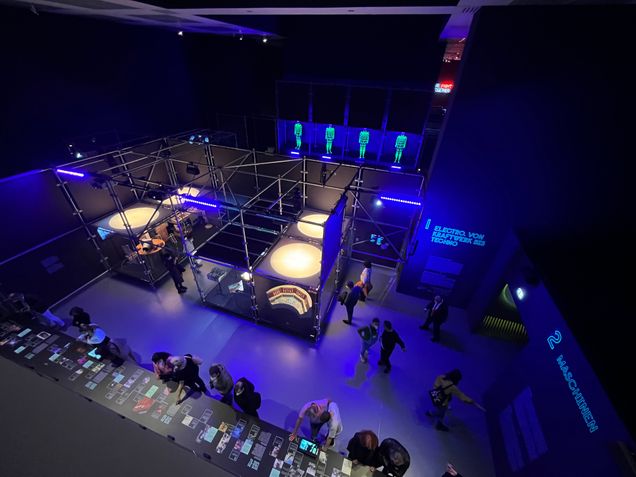
Gursky’s photograph, a preliminary version of which is the cover art for Solomun’s second studio album Nobody Is Not Loved (2021), is now on view at the Kunstpalast Düsseldorf for the first time. An entire gallery of the current exhibition Electro. Von Kraftwerk bis Techno (Electro. From Kraftwerk to Techno) (December 9, 2021–May 15, 2022)—tracing the 100-year history of international electronic music—features a selection of Gursky’s famed images of nighttime rave, club, and festival culture (fig. 2).2 A long-time enthusiast of the techno music scene in Germany, Gursky has taken awe-inspiring photographs of the annual Mayday electronic music festival in Dortmund and the legendary techno club Cocoon in Frankfurt since the 1990s.
For this issue of SEQUITUR, we invited current and recent graduate students to submit further instances of how artists and makers have responded to the theme of “Nightfall.” The six selected authors explore the diverse ways in which night has been experienced, imagined, celebrated, and critiqued in art, architecture, and material culture in the United States and Europe from the early nineteenth century to the contemporary period.
In the history of art and architecture, nightfall has often been a catalyst for creative inspiration of various forms. Artists past and present have employed light or its absence as both subject and medium. Some have used darkness to harness tonal contrasts, highlight points of emphasis, or accentuate emotional tension in their compositions. Others have responded to the unique challenges of making things visible at night, experimenting with photography, film noir, and nocturnes. Following the industrial revolution and introduction of electricity, architects conceived of architecture of the night, using artificial illumination to redefine the nocturnal presence of buildings, monuments, and urban spaces. In recent years, scholars such as Hélène Valance have delved deeper into the darker contexts of nocturnal imagery, examining the genre not simply as a stylistic response to nighttime fascination and evolving technologies but also as an aesthetic that is often wrapped up in racial and imperial discourses.4
Elizabeth Mangone’s feature essay, for example, shows how French artist Adolphe Yvon’s (1817–1893) use of striking contrasts between day and night; light and dark; and white, Black, and Indigenous figures is reflective of racial anxieties and biases in the post-Civil War era. In her close examination of Yvon’s allegorical painting, Genius of America (ca. 1868), Mangone demonstrates how this work, which was meant to celebrate the abolition of slavery and reunification of the American Republic, actually registers the artist’s paternalistic attitudes toward people of color and reflects the sensibilities of his time.
Jin Wang’s research spotlight, which focuses on the lesser known Belgian Symbolist painter and graphic artist Léon Spilliaert (1881–1946), similarly explores the sociopolitical implications of nightfall’s representation in art. While existing scholarship on Spilliaert has emphasized his position as a insomniac loner who wandered his hometown of Ostend at night, Wang seeks to place the focus on Ostend’s rapid urbanization in the late nineteenth century and Spilliaert’s relation to early twentieth century empathy theories. Spilliaert’s city- and seascapes, Wang argues, should be read in terms of the “darkness” out of which they emerged; much of the infrastructure that the artist recorded was a direct result of Belgian imperialism and colonialism.
Three authors examine nightfall or darkness by forging connections between fine art and the written word. In her feature essay, Xiaoli Pan offers a preliminary reading of Odilon Redon's illustrations for La Maison hantée, the 1896 French translation of British author Edward Bulwer-Lytton's 1859 novella The Haunted and the Haunters; Or, The House and the Brain. Pan emphasizes the material characteristics and macabre undertones of Redon's lithographs, as well as their divergences from Bulwer-Lytton's ghost story. Her focused analysis of Redon's imagery sparks further investigation into themes such as mesmerism and the subconscious prevalent in Victorian gothic literature.
Amy DeLaBruere finds striking parallels between the artistic methodologies and oeuvres of nineteenth-century British painter J.M.W. Turner (1775–1851) and twentieth-century American poet Wallace Stevens (1879–1955). In her close examination of two of Turner’s paintings and two of Stevens’s poems, DeLaBruere shows us that both creators progressively abstracted and obscured their images and texts—which often illustrate terrestrial or celestial nighttime skies and darkened bedroom scenes—through their visual and verbal application of essential color.
Renée Brown’s discussion of the German photographer Anneliese Hager’s (1904–1997) 1964 book of poems and photograms—images made by placing objects directly onto photographic paper and then exposing them to light—continues the compelling relation between visual art and language. In her review of the exhibition White Shadows: Anneliese Hager and the Camera-less Photograph at the Harvard Art Museums, Brown contends that Hager’s juxtaposition of complexly layered text and image should be seen as indicative of her larger interest in distortions of perception and legibility. Harvard’s revisionist exhibition brings the artist’s innovative achievements out of the shadows, even if her works appear alongside other photographs by nineteenth- and twentieth-century scientists and artists.
Hager’s knowledge and fascination with science is shared by Argentina-born, Berlin-based artist Tomás Saraceno (b. 1973). In their review of the exhibition, Tomás Saraceno: Particular Matter(s), at The Shed, New York, Sarah-Rose Hansen describes the visitor’s ocular experience of moving through Saraceno’s interactive installations which employ sensory perception as a means of inviting environmental awareness of our shared planet. These works, which contain references to solar eclipses and sun orbs, feature dramatic shifts in lighting that animate human physiological processes scientifically referred to as light and dark adaptations.
Our issue concludes with a summary of Under(Water), this year’s Mary L. Cornille (GRS ’87) 38th Annual Graduate Symposium in the History of Art & Architecture, co-organized by Katherine Mitchell and Francesca Soriano. Eight graduate students, presenting on a broad range of topics spanning cultures, geographies, and centuries, engaged with the theme in two panels titled “Water as Resource” and “Water as Connector,” while keynote speaker Dr. Stacy L. Kamehiro’s examined water as a vital space of transit in Oceanic art and visual culture. While at first it may seem like the themes of “Nightfall” and “Under(Water)” have little in common, deeper consideration of these paired topics reveals intriguing parallels. One such correlation between bodies of water and the period between dusk and dawn is that both often have particular connotations of mystery, mythology, and peril. In her research spotlight, SEQUITUR author Jin Wang shows us artist Léon Spilliaert's images of lone figures in bleak coastal environments while symposium speaker Marina Wells analyzes the dangers posed by the whaling industry as reflected in nineteenth-century representations of the subject. The congruences between water and night’s immersive qualities is suggested by speaker Krista Mileva-Frank’s discussion of simulated underwater submersion at the Expositions Universelles and SEQUITUR contributor Sarah-Rose Hansen’s analysis of Saraceno’s large-scale installations.
The editors would like to thank the authors for illuminating the hidden nuances of nightfall, showing us that the possible subjects related to this topic are far more myriad and expansive than we thought when we released our call for content in February 2022. At this challenging moment in world history, marked by the ongoing COVID-19 pandemic, Russian aggression in Ukraine, and attacks on civil liberties as well as gun violence in the United States, we may struggle to see through the veil of darkness in order to find a path forward. We must choose community and solidarity with others in a time of social distance, suffering, and the denial of human rights. Despite an uncertain future, nightfall offers just one occasion for different groups of people to come together, and may it bring the kind of acceptance, connection, and freedom like that written in Whitman’s poems or pictured in Gurksy’s images of urban nightlife.
____________________
Althea Ruoppo is a PhD candidate in history of art and architecture at Boston University. Her dissertation focuses on three German artists who have gradually developed their own specific approaches to transnational sculpture through the medium and strategy of assemblage: Isa Genzken (b. 1948), Reinhard Mucha (b. 1950), and Rosemarie Trockel (b. 1952).
2. The exhibition Electro: De Kraftwerk à Daft Punk originated in Paris in 2019 at the Musée de la Musique-Philharmonie de Paris, where it was curated by Jean-Yves Leloup. In 2020, an expanded version of the show traveled to London’s Design Museum under the title Electronic: From Kraftwerk to The Chemical Brothers.
3. Wall label, “The Dancefloor,” Electro. Von Kraftwerk bis Techno, Kunstpalast Düsseldorf, December 9, 2021–May 15, 2022.
4. See Hélène Valance, “PART II: Heart of Darkness: The Nocturne as Metaphor for Racial Difference,” in Nocturne: Night in American Art, 1890–1917 (New Haven: Yale University Press, 2018), 87–146.
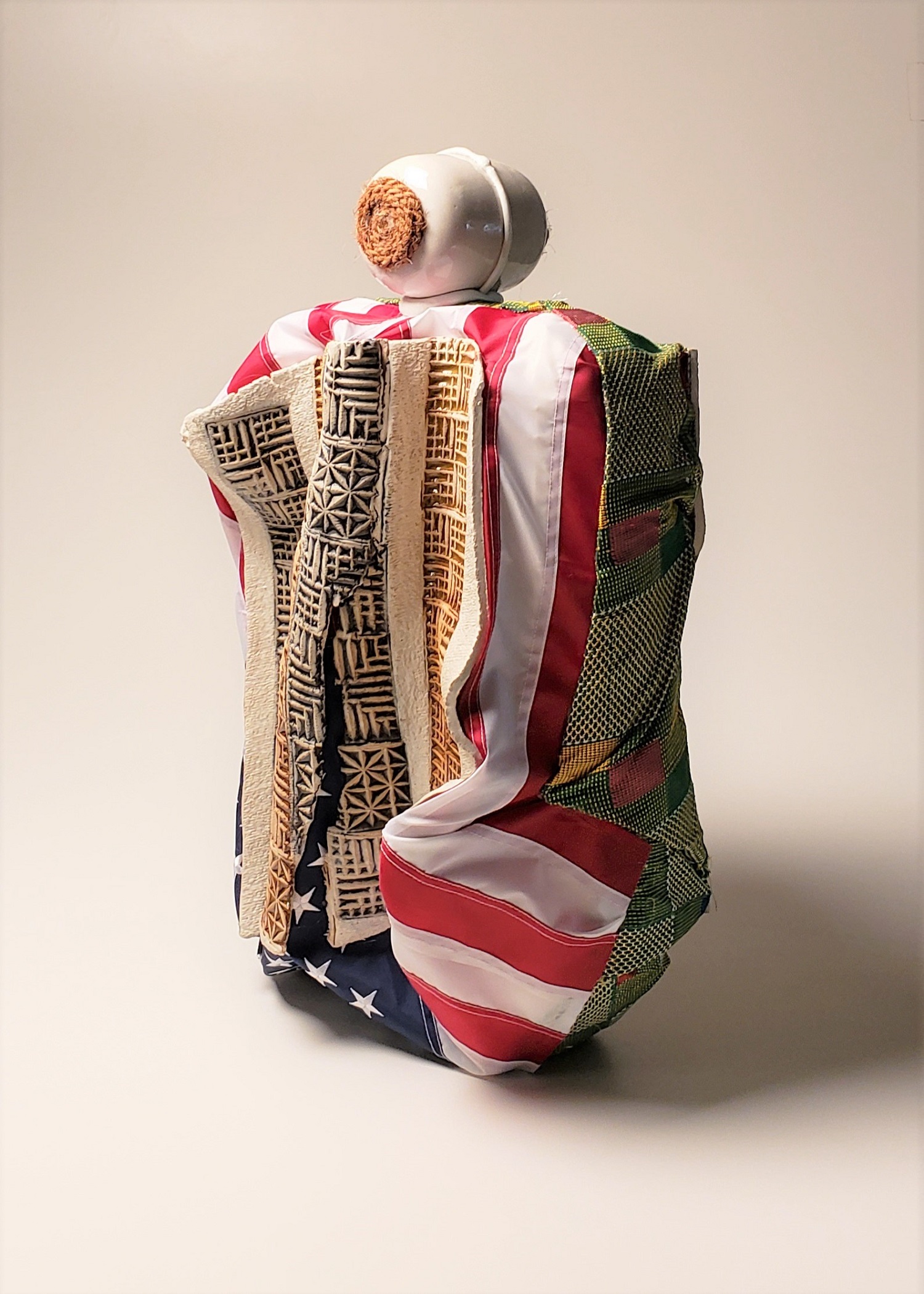
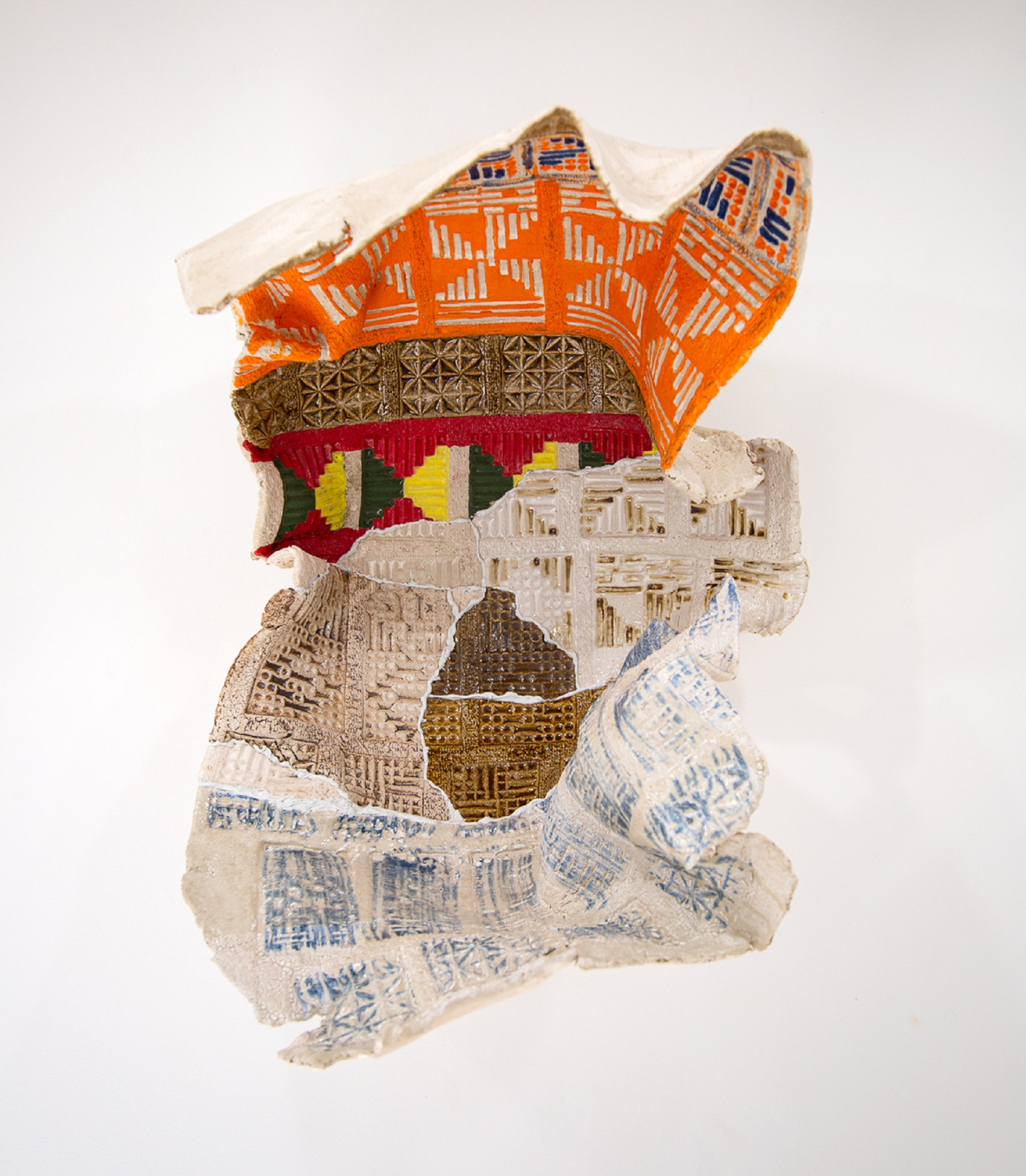
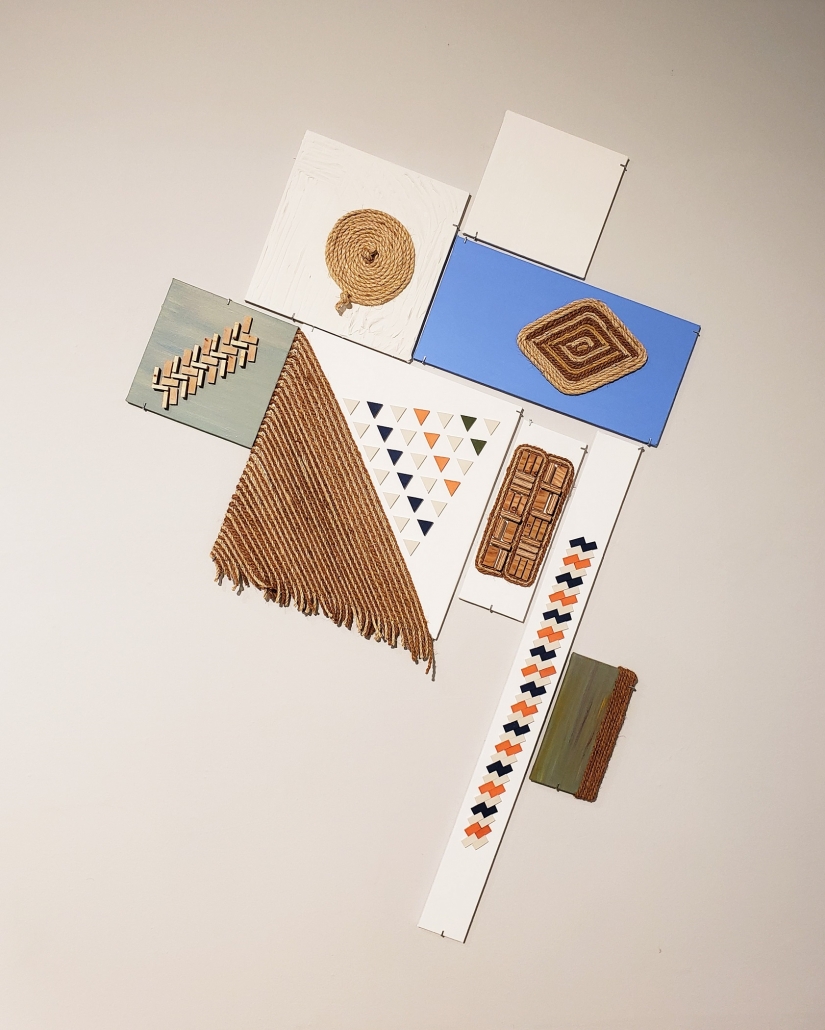
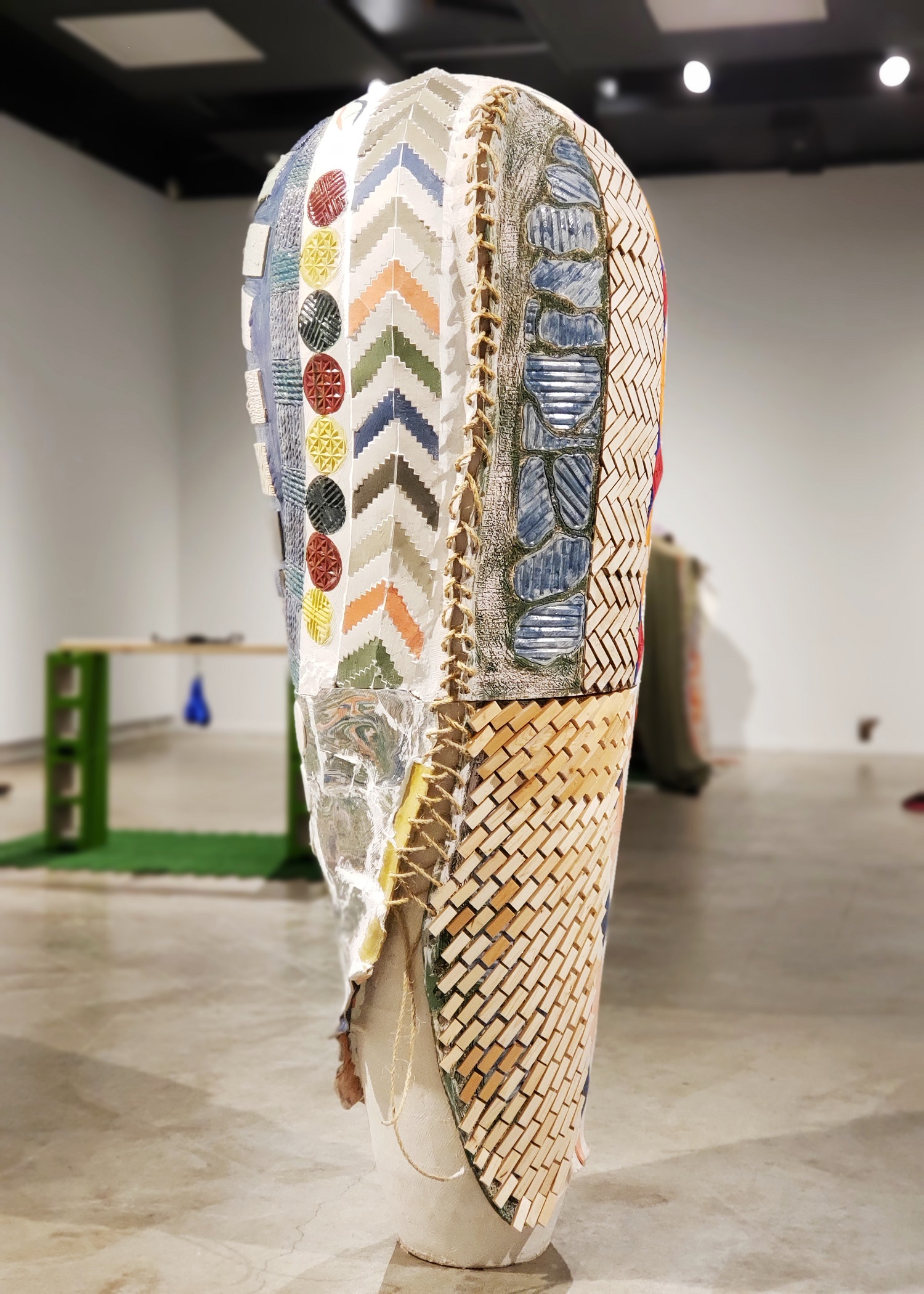
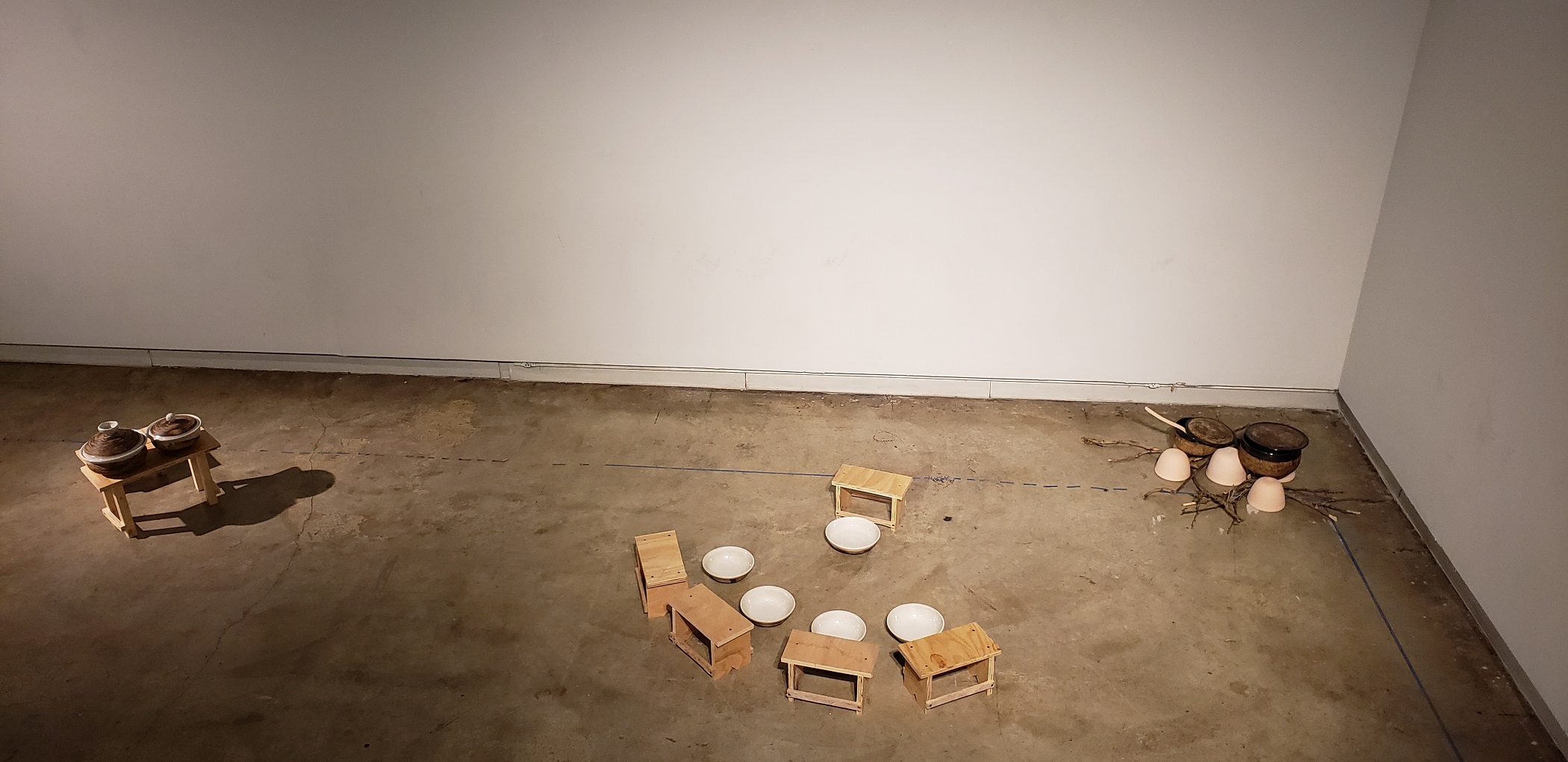
Figure 1. Japheth Asiedu-Kwarteng. I Miss You Dada (2021). Ceramic, Kente, American flag, jute rope, epoxy. 28 x 18 x 13.5 in. Image courtesy of the artist; Figure 2. Japheth Asiedu-Kwarteng. Picking the Pieces Together (2020). Ceramic, epoxy. 28 x 18 x 15 in. Image courtesy of Anthony Kascak; Figure 3. Japheth Asiedu-Kwarteng. Ruffled Feathers (2020). Ceramic, mixed media. 84 x 48 x 3 in. Image courtesy of the artist; Figure 4. Japheth Asiedu-Kwarteng. Everything and Nothing: The Diary of One Who Leaves (2020). Ceramic, mixed media. 74 x 30 x 30 in. Image courtesy of the artist; Figure 5. Japheth Asiedu-Kwarteng. As a Result of My Responsibilities (2020). Ceramic, wood. 17 x 134 x 60 in. Image courtesy of the artist.
Inspired by Kente cloth traditionally woven by the Asante men of Ghana and the Ewe men of Ghana and Togo, my mixed-media works explore the potential of textiles to communicate the complexities of the diaspora: separation, fear, rejection, love, nostalgia, racism, and appropriation. These sculptures are my visual vocabulary for discussing the experience of entering and leaving the diaspora during the COVID-19 pandemic. Thoughts of my family, conversations with them, and their pain due to my absence influence the names of my works.
As a Result of My Responsibilities (2020) borrows from the traditional Akan dinner setting in which the patriarch is served at a table in a space separate from the matriarch and children of the family to demonstrate my, as well as my father’s, separation and displacement from our family. Hung on the wall, Picking the Pieces Together (2020) envisions Kente cloth made from clay. It appears to defy gravity to symbolize my recovery from quarantine and self-isolation. I Miss You Dada (2021) speaks to my return to the United States after visiting my family in Ghana; everything once again felt strange like during my first arrival. Through the repetitive processes of molding, weaving, and assembling, I reconstruct fragile Kente in ceramic to preserve its potent revered symbolism, while reflecting on my twenty months as a separated father and husband.
____________________
Japheth Asiedu-Kwarteng
Japheth Asiedu-Kwarteng is an MFA candidate at Illinois State University. Japheth is a member of NCECA and has been featured in several prestigious exhibitions including the 2021 NCECA Annual exhibition. He was a presenter at the 2021 NCECA Conference. Japheth holds the NCECA Multicultural, Baber, and Lela Winegarner fellowships.
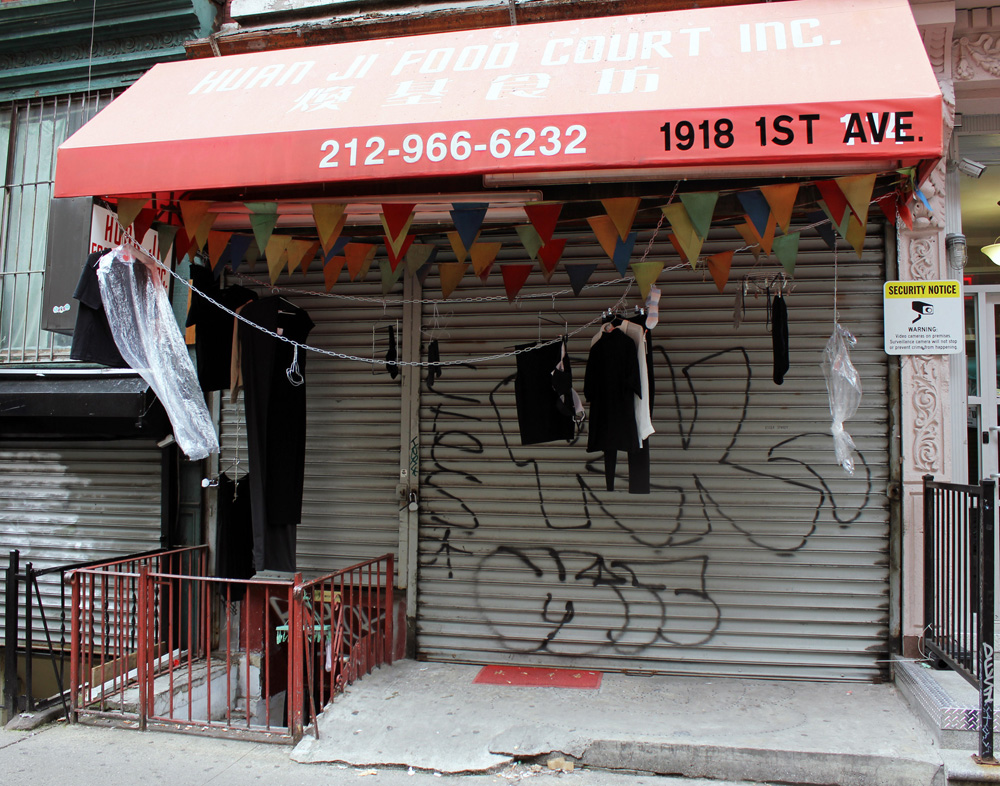
Figure 1. Installation view of During the Month of August Essex Street will be Closed (2013). Essex Street, New York. Courtesy of the artist and Essex Street/ Maxwell Graham.
From Sunday, July 28 to Sunday, August 11, 2013, the exterior of Essex Street, an art gallery in New York City, was closed to visitors (fig. 1). A sun-faded red awning hung above the entrance, signaling not to the space behind the graffitied metal shutters, but instead to the text above: “HUAN JI FOOD COURT INC.” in white capital letters. The phone number of the advertised Chinese restaurant and the street address of the gallery remained on the fabric cover in a plain, white text, but the latter was obscured by a second superimposed address in black—“1918 1st Ave.” Affixed beneath the awning, heavy-duty chains and multi-colored pennants drew the eye to a shaded space where various articles of black and white clothing, in addition to some remnants of dry cleaner’s plastic, were hung to dry in front of the metal window covers.1
Staged by artist Park McArthur, the temporary installation, entitled During the Month of August Essex Street will be Closed, at first resists any clear categorization. Seemingly incongruous components of the work display visual signs of obsolescence, such as the repurposed signage for a then-nonexistent restaurant. Likewise, these components also signal to less obvious evidence of neglect and decay, such as the infinitely drying clothes, forgotten or abandoned by a hypothetical and unseen tenant of the space. Importantly, however, the exhibition does not initially look out of place; while residents of the neighborhood or frequent gallery visitors may notice the minor changes to the gallery’s exterior, including the painted-over address and wet clothes, the installation, both in its individual elements and culminating effect, is incredibly ordinary. The only thing that suggests it fits elsewhere is the second superimposed address on the awning, which belongs to Draper Hall, a former nurses’ dormitory next to Metropolitan Hospital in East Harlem that remained vacant after flooding from Hurricane Sandy in 2012 and began new development as senior housing in 2015. Prior to this, the dormitory building housed nursing students and, on occasion, elderly patients in need of affordable housing near the hospital facilities. These details of neglect in public view, things in need of continual maintenance alongside that which requires a complete overhaul to function, point to how During the Month of August participates in an ongoing discourse around institutional care, to which disability scholars and activists have called attention since the 1960s when the disability rights movement began to take shape and foregrounds the devastating consequences of the COVID-19 pandemic on these institutions and subsequent responses.2
By incorporating concrete examples of these systemic issues, McArthur emphasizes the connection to this discourse with the inclusion of a 112-page document accompanying the installation written by Clarence J. Sundram, Governor Andrew Cuomo’s Special Advisor on Vulnerable Persons, that visitors can access via the gallery’s website. Released in April 2012, the report, titled The Measure of a Society: Protection of Vulnerable Persons in Residential Facilities Against Abuse & Neglect, details the findings of a year-long investigation in response to the concerns of Governor Cuomo and others over failures to report and respond to instances of abuse and neglect in state-certified or funded residential facilities.3 Paired with the visual and contextual components of the installation, the report insinuates how little is known about what happens behind closed doors, especially because egregious acts of abuse or neglect only become newsworthy as “deviations from the norm.”4
Writing about McArthur’s work for Art in America in 2018, Ariel Goldberg describes Sundram’s text as “a conceptual framework for the suspended clothing, alluding to histories of buildings where practices of care have either been erased or distorted into dehumanization at the hands of the state.”5 Human traces have been all but erased from the installation, remaining only in the physical evidence of previous unseen actions. In bringing together the various elements of the exhibition—the installation site, the then-defunct building, and the government report—McArthur emphasizes the tension between private and public spaces and the fraught separation between the two.
Blurred spheres of private and public life have become more apparent amidst the COVID-19 pandemic, in which personal choices and behavior have the potential to impact society on a broad scale. The Center for Disease Control (CDC) and World Health Organization (WHO) have recommended safeguards against contracting the virus, most notably social distancing. These safety measures have impacted the ways in which everyone has learned to navigate the world, such as working from home and avoiding physical interaction with people from outside of one’s own household. Though intended as equitable, these kinds of protective measures favor those privileged enough to undertake such large changes to their daily lives at the expense of those living in high-density areas, multigenerational homes, and with public-facing jobs. The essential workers whose labor sustains society, including grocery store clerks, warehouse workers, and delivery drivers, not only continued their risky jobs, placing themselves at increased risk of infection, but also often faced more stressful working environments without adequate compensation.6 Additionally, the pandemic has exacerbated the strain on residential care facilities and the longstanding, systemic issues they already faced. Ironically, New York State’s policies regarding residential care facilities and nursing homes have faced some of the most scrutiny, prompted by the state’s requirements for retaking recovered COVID patients and severe underreporting of COVID-related deaths in nursing homes by several thousand cases.7
Moreover, these suggested safety measures, in addition to more general consequences of COVID like supply-chain and employment disruptions, place an extra burden on the lives of disabled people, especially those who require home healthcare or other personal assistance to complete daily tasks. Staffing shortages and emergency funding restrictions, including the failure of some states to designate home healthcare workers as essential, have resulted in fewer resources for agencies, and thus have reduced the availability of services.8 Conflict arises, then, when disabled people are made to choose between their own safety, by staying home without guaranteed access to basic services, and potential exposure by entering medical facilities or other public spaces.9Together these factors bring into question the ways in which institutions of care have been historically structured and how they might be reimagined in a post-COVID world. How do we provide and access better care, especially in the wake of increased physical and social isolation? Disabled people, alongside LGBTQIA2S+ and BIPOC communities, were acutely aware of these problems long before the pandemic. Consequently, they have envisioned and organized alternative means of support to meet their own needs. One compelling approach to both accessing care and fostering community has emerged in the form of care collectives, or care webs.
Loree Erickson, a Queer-Crip theorist, writes about a vision of collective care on her blog, describing it as, “the work performed by informal collectives within and between marginalized communities committed to meeting the interdependent care needs of community members.”10 With disability justice as a central organizing principle, care collectives operate within a mutual aid framework to provide support for community members and fill in the gaps left by institutional shortcomings. Since 1999, Erickson has met her own daily care needs, including tasks such as getting out of bed and using the bathroom, through this model after facing a variety of issues surrounding inadequate funding and discrimination from home health aides. In sharing her experience within activist spaces, she has noted a pattern of people turning towards collective care after encountering similar barriers to accessing adequate and respectful care.11
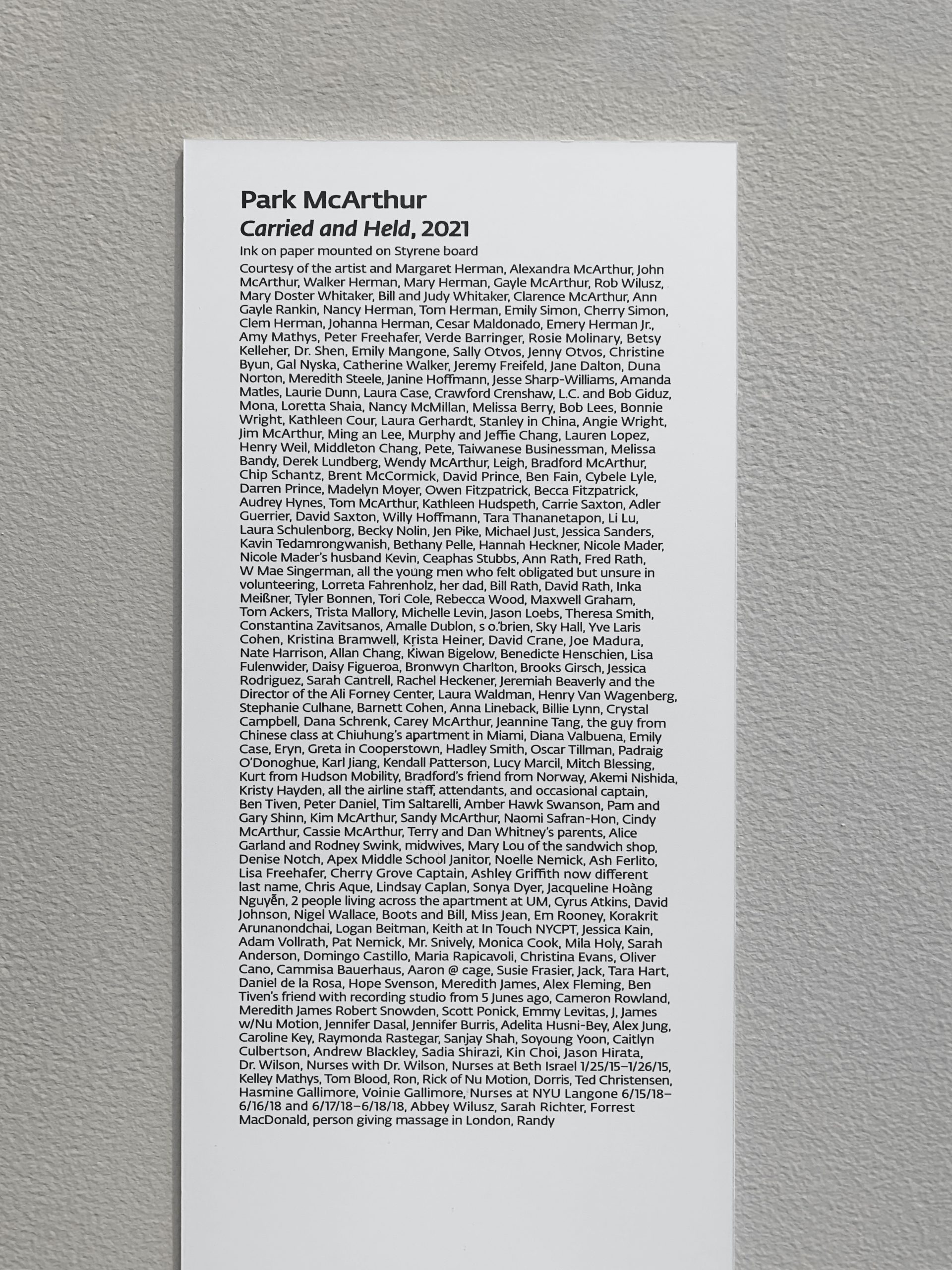
Figure 2. Installation view of Climate Changing: On Artists, Institutions, and the Social Environment (2021). Wexner Center for the Arts, Columbus, Ohio. Courtesy of Essex Street/Maxwell Graham.
Park McArthur cited her initial encounter with collective care at the 2010 US Social Forum in Detroit, Michigan, where the newly formed Creating Collective Access (CCA) collective group founded by “three disabled Asian femmes,” organized to meet the needs of fellow sick, disabled, queer, and POC.12 At this conference, CCA crowdsourced care through peer engagement with individual attendees helping to meet each other’s supportive care needs in an unfamiliar and inaccessible environment whilefostering a sense of camaraderie. McArthur engages with the lived experiences of care in her art, working from her perspective as a disabled adult who requires a significant amount of physical support. She often does this through collaborative works, such as Carried and Held, an ongoing project with iterations as recent as 2021 (fig. 2). Taking the form of a vertical museum label, the work conforms to the visual standards of the institution in which it is displayed. Whether placed on the wall ofan exhibition space or gallery, the work always looks like typical museum signageand contains the same general content. However, the specific formatting of the label depends on the specifications established by the displaying institution.
In the 2021 version cited above at the Wexner Center for the Arts in Columbus, Ohio, the artist’s name is at the top of the panel, followed by the artwork title on the line directly underneath. Below, the material, specific to this version of the work, is listed as ink on paper mounted on styrene board. The most significant element of the work, however, is the list of over 250 names following the courtesy line, which begins, “Courtesy of the artist and Margaret Herman, Alexandra McArthur, John McArthur...” and so on. This grouping sequentially records the individuals who have provided assistive care to the artist through the literal acts of carrying and holding, simplified descriptions of the physical support that McArthur requires. McArthur, furthermore, adds names to the work upon each new iteration of the label. Carried and Held not only documents the care that McArthur has received, but it also frames the people providing care as part of a collaborative and ongoing effort. Grouping friends and family alongside anonymous individuals, as in “2 people living across the apartment at UM,” McArthur’s work demonstrates the ways in which affection operates to facilitate care between both strangers and loved ones.13 In this way, care work extends beyond the scope of community organizing as an active project and instead implicates everyone who performs a task in the service of another person.
These concepts of care work and collective care are only beginning steps to solving the historical injustices of government-supported institutions which have failed to supply adequate services to vulnerable populations. In During the Month of August, McArthur calls attention to the often-overt systemic deficiencies that remain normalized and, thus, overlooked in daily life. However, the fundamental ideas of mutual aid and community-based support provide opportunities to consider how we might better assist one another in the aftermath of the COVID pandemic. This kind of supportive care is already happening on a small scale for many such as ‘pods’ of friends or family who gather in-person and help each other with basic needs such as grocery shopping or childcare. McArthur demonstrates the significance of both personal support and aid from the broader community in Carried and Held, emphasizing the impact of even small actions. Moreover, she calls attention to the failures of institutional care to protect vulnerable members of society, highlighting the normalization of neglect. In reframing intimate personal support and social reform alike as different means of collective care, McArthur helps us recognize how care work fosters social connection and social justice. By engaging with her work, we might be able to start thinking about how we can better support ourselves and one another.
____________________
Madison Whitaker received a Master of Arts in art history from Southern Methodist University in Dallas, Texas in 2021. Madison’s research interests include care practices in contemporary art, especially through the lens of Crip theory, and concepts of queer kinship.
____________________
Footnotes
1. Prior to the gallery’s move in 2017 from Eldridge Street to another space on Hester Street in Lower Manhattan, the flags and red awning were part of its everyday exterior. Photos of the gallery’s exterior from pre-2017 are difficult to locate, but these details are sometimes visible in interior installation views. The primary difference, then, between the exterior on a normal basis and during the span of this exhibition is the metal gate covering the windows during the day and the wet clothing hung outside.
2. Leah Lakshmi Piepzna-Samarasinha, Care Work: Dreaming Disability Justice (Vancouver: Arsenal Pulp Press, 2018), 43.
3. Clarence J. Sundram, The Measure of a Society: Protection of Vulnerable Persons in Residential Facilities Against Abuse & Neglect: Report Submitted to Governor Andrew M. Cuomo (New York State Commission on Quality of Care and Advocacy for Persons with Disabilities, 2012), 11.
6. Some companies did offer “COVID Pay” to their employees as a means of compensating their labor during the peak of the pandemic, but it is difficult to assign a monetary value to risking one’s own life.
11. Erickson, “Welcome to Cultivating Collective Care Website!”
12. Leah Lakshmi Piepzna-Samarasinha, Care Work: Dreaming Disability Justice (Arsenal Pulp Press, 2018), 21; Park McArthur, “What Is Collectivity, Conviviality, and Care?,” in Question the Wall Itself, ed. Fionn Meade and Jordan Carter (Minneapolis: Walker Art Center, 2017), 248.
13. Eva Feder Kittay, “The Ethics of Care, Dependence, and Disability,” Ratio Juris 24, no. 1 (March 2011): 53. In this instance, affection does not necessarily mean a platonic or romantic concern for one another but could describe feelings of empathy and moral obligation.
MASS MoCA
April 4, 2021–September 5, 2022
by Max Gruber
Installation view of Glenn Kaino: In the Light of a Shadow (2021) at MASS MoCA. Photo by Tony Luong.
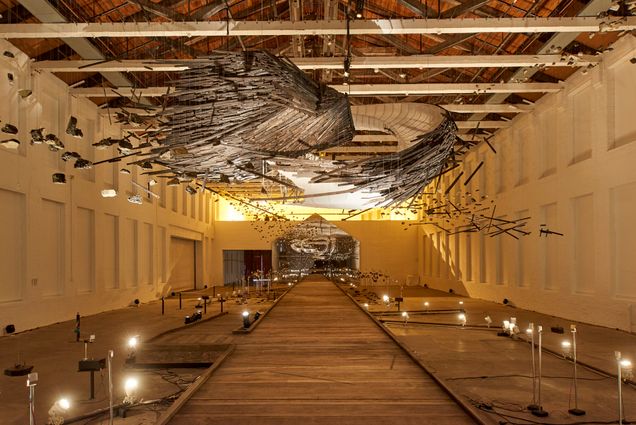
Viewers were led by gallery attendants into a vast hall shrouded in darkness. A grave silence coated the space, broken only by anticipatory coughing, shuffling, and the knowledge that the resonant sound of Glenn Kaino’s installation was about to begin. Short, brilliant infusions of light emanated from above, each flash punctuated by jolting percussion. The pulsating light gradually revealed an imposing form, fragmented yet lithe, lying just out of reach. And then, suddenly, it was gone. Small objects lined a wooden walkway, their forms impossible to discern in the darkness. Light projected outwards from both sides of the path, unveiling the shapes and materials of the forms. Sculpted shards of wood and stone cast shadows on the walls, eliciting the feeling of a primordial stasis, of a calm before the storm.
Los Angeles-based conceptual artist Glenn Kaino’s In the Light of a Shadow addresses social justice movements and their protests across time and space. The wooden shards and stones that make up Kaino’s shadow-play reference various protests from around the world. Some of these sculptures are even 3D-printed replicas of specific events. In this installation for MASS MoCA, on view through September 2022, the artist takes aim at two “Bloody Sundays,” one in Selma, Alabama, in 1965 and the other in Derry, Northern Ireland, in 1972, drawing on the legacy of these violently repressive episodes to explore broader themes of protest, exploitation, and resilience. Kaino draws on the solidarity and community present in these movements as beacons of hope for humankind. By using abstract forms in combination with iconography from specific historical movements, Kaino is able to center episodes of resilience and joy that emerge from episodes of oppression in a way that transcends their original contexts, placing them in dialogue with a pantheon of social justice and civil rights movements across history.
Installation view of Glenn Kaino: In the Light of a Shadow (2021) at MASS MoCA. Photo by Tony Luong.
The light projection moved further down the walkway, its shift heralded by a sonic wave of heavy, industrial noise and new shapes on the wall. These shapes were figurative, depicting human forms in myriad scenarios: fighting, watching in horror as a figure falls backwards off a precipice, or marching in a large group alongside a military/battle tank. Others were triumphant, even iconic, as some figures holding a flag and musical instruments struck a defiant pose, while two others raised their fists in solidarity in a gesture that recalled the Black Power salute at the 1968 Olympics. Just as the drama of the visual material waxed, so too did the music, as a bombastic horn section began to swell, filling the hall with a palpable charge, as if the audience’s own energy was being invoked in the scenes playing out in front of them. As viewers’ silhouettes joined those projected on the wall, their movements became enmeshed in the work, their forms both subsumed and implicated in the piece’s investigation of humanity’s capacity to incite violence and to liberate the oppressed.
The piece’s universalizing imagery—wooden shards with recurring slogans of social justice such as “si se puede,” “climate action now,” and “end detention now”—is contrasted by moments with pointed historical associations, as the horns are succeeded by a children’s chorus singing “We Shall Overcome.” This song is repeated by a group of Irish voices, reminding viewers of the evolving role it has played in social justice and labor movements across the globe, not just in the United States.1 That two movements as different as these might be united through song speaks to the transnational nature of Kaino’s project and the importance of sound in conveying these emotions.2 Here, the artist successfully toes the fine line between the indictment of past injustices and the eulogization of liberation movements throughout time.
Installation view of Glenn Kaino: In the Light of a Shadow (2021) at MASS MoCA. Photo by Tony Luong.
Further down the hall, projections of ships that look like Spanish galleons, an ominous nod to the colonization of the new world, implicate viewers in their imperial mission as their shadows dance alongside the rigid masts of the ships. Just as viewers found themselves walking alongside civil rights activists and protestors at the beginning, so too would they embark on ill-fated conquests in the name of empire. Finally, light fills the hall, and viewers encounter a warped mirror at the end of the walkway riddled with bullet holes, prompting an eerie moment of contemplation. The mass above the center of the walkway is bathed in light, finally visible as a ship in the shape of an ouroboros, a snake eating its own tail. In fact, it was modelled after Lord Mountbatten’s Shadow V, the fishing boat on which the infamous member of the British royal family was assassinated by the Irish Republican Army in 1979. The warped hull and self-destructive imagery of the ouroboros is a statement both on the unsustainable condition of imperialism and humanity’s suicidal march toward climate annihilation. Withering yet defiant, the snake which eats itself symbolizes our monstrous appetite for control and the palpable symptoms of environmental and social disease that follow. And yet, Kaino’s piece draws its power from the warmth of community. The small forms which hang from the ceiling and surround the ouroboros, though activated individually by light projections, appear as a murmuration of starlings, each taking wing and in dialogue with the other, careening towards a utopic future that centers hope, life, and the resilience of the human spirit.
____________________
Max Gruber
Max Gruber is a Master of Arts candidate at the Williams College / Clark Institute Graduate Art Program. His research and criticism have dealt with Latin American and global contemporary art, photography, visual culture, and socially-engaged art.
____________________
Footnotes
1. Originally a gospel song which was adopted by the American Civil Rights movement, “We Shall Overcome” was also adopted during The Troubles in Northern Ireland and has been present in a number of social movements across the world. Freya McClements “Derry and ‘We Shall Overcome’: ‘We plagiarized and entire movement.’” The Irish Times. Accessed December 17, 2021.
2. The artist collaborated with David Sitek of the band TV on the Radio to produce the sound for the piece.
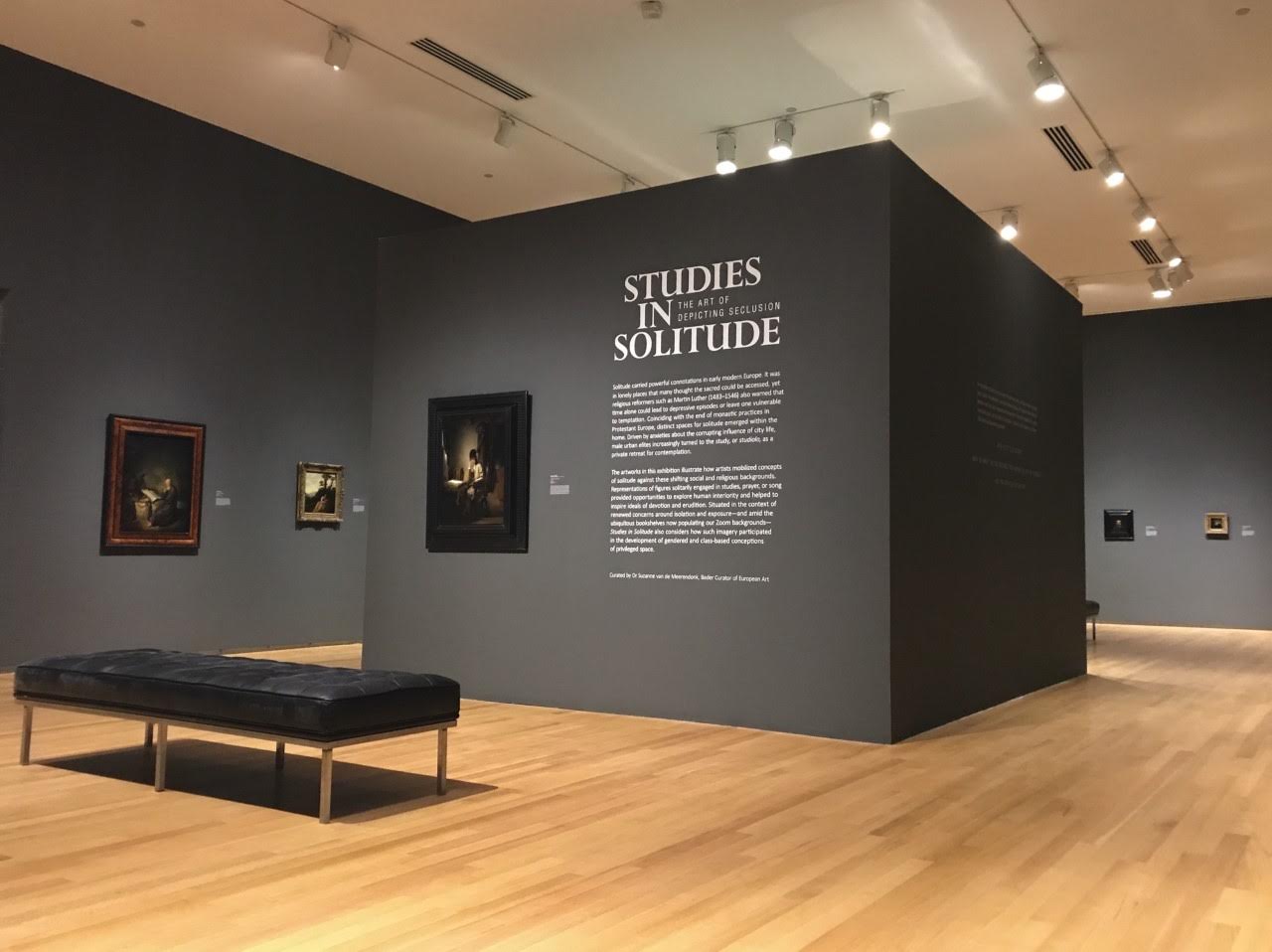
Figure 1. Installation view of Studies in Solitude: The Art of Depicting Seclusion at Agnes Etherington Art Centre. Photo: Mark Birksted.
In March 2020, the COVID-19 virus spread like wildfire. We retreated into our homes for what was promised to be a few weeks of lockdown; it was our duty to stay home in order to protect ourselves and others. More than a year and a half later, we are emerging from isolation into a different world than the one we left. Now, as we re-enter museum spaces, The Agnes Etherington Art Centre in Kingston, Ontario (Canada), presents an exhibition as a meditation on the universal isolating impacts of the pandemic.
Studies in Solitude: The Art of Depicting Seclusion is an exhibition of the Centre’s collection of seventeenth-century Dutch paintings curated by the Bader Curator of European Art, Dr. Suzanne van de Meerendonk, who contextualizes the experience of pandemic isolation within historic representations of solitude. The exhibition illustrates that the Early Modern relationship with solitude, much like our own, was a complex navigation of benefits and challenges. Throughout the exhibit, viewers confront their contemporary relationships with solitude to consider what the curator calls the “social and moral implications” of this experience.1
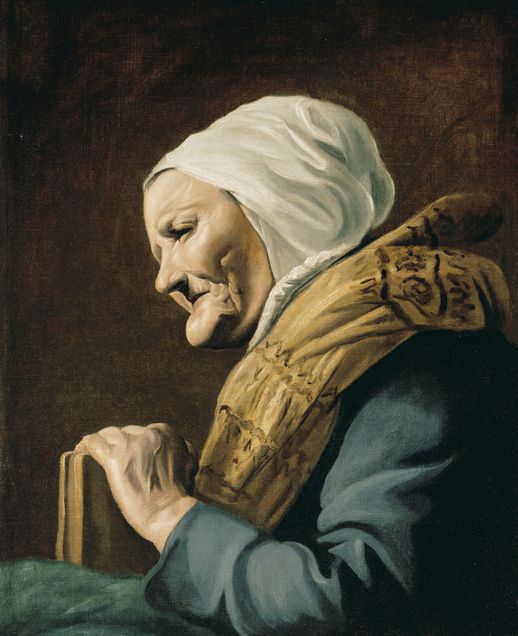
Figure 2. Jacob van Campen, Old Woman with a Book (1625–1630), oil on canvas. Agnes Etherington Art Centre. Gift of Alfred and Isabel Bader, 2013.
Van de Meerendonk’s exhibition illustrates how the museum can encourage contemplation in the aftershock of COVID-19; it provides a space and a visual language for considering our own mortality. Many of the subjects in the exhibition’s paintings have a complex relationship with solitude as they are nearing death and coming to terms with the impermanence of their existence. Jacob van Campen’s Old Woman with a Book (1625–1630, fig. 2) depicts the increased piety that comes with advanced age and the awareness of human frailty. As many of us sat in our homes addicted to the news of the pandemic’s spread, helplessly following case counts and infection rates, we contemplated our own mortality. The last year has marked a shift in both the acceptability and the necessity of solitude. Perhaps in viewing Old Woman with a Book, viewers see themselves.
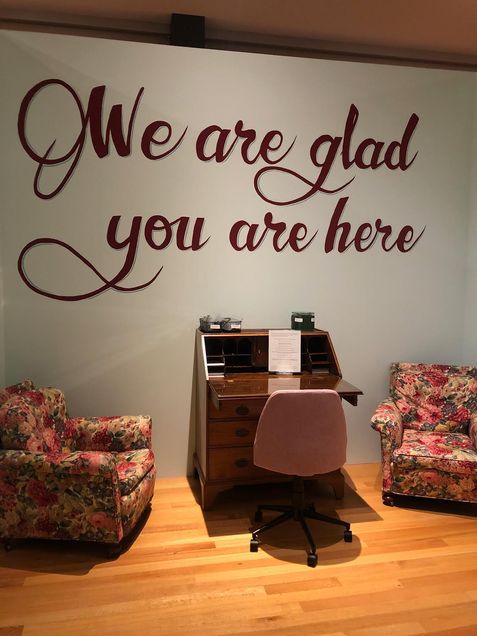
As visitors explore the exhibition, they can enter a studiolo-esque room, which bears similarities to those depicted in many of the surrounding paintings (fig. 3).2 Van de Meerendonk presents this area as a space for reflecting on the effects of solitude; seating and writing materials are available for the visitor to aid in this practice. It is a solitary space, but also a place for engagement, much like our homes. Visitors can write a postcard that the gallery will mail, or they can leave a note or response to another visitor in the space. Intimate notes to visitors’ past or future selves, their loved ones, and those lost to the pandemic fill a display wall built for these meditations. The organization of the gallery helps the visitor contemplate their own experiences of isolation.
Figure 3. Installation view of Studies in Solitude: The Art of Depicting Seclusion at Agnes Etherington Art Centre, Kingston, Ontario. Courtesy Agnes Etherington Art Centre. Photo by the author, 2021.
Studies in Solitude poses the question: who gets to be alone? The subjects depicted in these paintings are either primarily older, wealthy men shown in their private studioli, or religious and biblical figures in devotional scenes. In contrast, complexities accompany depictions of women in solitude, an experience traditionally reserved for men.3 Works with female subjects must have a religious connotation, and either directly depict a religious moment like the annunciation or carry a message of Christian morality through warning of the sexual agency associated with female privacy.4 Women were not allowed to experience solitude because of its associations with male spaces of knowledge and consequently could not be depicted in such a masculine fashion. Solitude continues to be a privileged experience as it was in the seventeenth-century. During the pandemic, many people did not have a safe place to isolate because they were experiencing homelessness, living in overcrowded housing, or working essential jobs that often put them at risk. Considering solitude as a privileged experience can reframe negative contemporary associations between the impacts of isolation and our mental health.
The isolation of figures presented in Studies in Solitude reminds us that seclusion can also provide new opportunities. Throughout the exhibit, these figures are all in the pursuit of either knowledge or religious commune. Solitude has also served another purpose in the context of the pandemic. Perhaps the increased activism and involvement in the Black Lives Matter movement and other social movements precipitated from this pause in our lives and contemplation in a solitary space. Would we have stopped to pay attention if we had not been forced into isolation?
Studies in Solitude reminds us that, like others before us, we are not alone in our struggle to define the consequence of solitude in our lives. Our experience of COVID-19 amplifies our ability to identify with the subjects of this exhibition. In this way, viewers experience a renewed appreciation for these works and for the connection Dr. van de Meerendonk makes between Early Modern depictions of solitude and our newly-defined relationship with isolation. This exhibition draws attention to our need for connection and how our shared experience of the last eighteen months has been universal in its isolating effects. Ultimately, the experience of solitude during the pandemic has revealed systemic social inequities that deserve our focus. Solitude has given us pause to re-evaluate and make changes in our own lives, and serves, as it did in the seventeenth century, as a place of reflection rather than simply a state of being.
____________________
Hailey Chomos
Hailey Chomos is a Master of Arts candidate in art history at Queen's University. Her research focuses on the reception and collection of European art in North America in the early twentieth century. She holds an Honours Bachelor of Arts in history and art history from the University of Toronto.
____________________
Footnotes
1. Studies in Solitude: The Art of Depicting Seclusion, Agnes Etherington Art Centre, Kingston, Ontario, 2021. Unless otherwise noted, quotations in this review come from exhibition label text.
2. Van de Meerendonk created the installation and reflective exercise in collaboration with Emma Tow, art history student at Queen’s University, and Sebastian De Line, Associate Curator of Indigenous Care and Relations at the Agnes Etherington Art Centre.
3. Wall text, Old Woman with a Book (1625–1630), in Studies in Solitude: The Art of Depicting Seclusion, Agnes Etherington Art Centre, Kingston, Ontario.
4. Wall text, Woman with a Pear (1651), in Studies in Solitude: The Art of Depicting Seclusion, Agnes Etherington Art Centre, Kingston, Ontario.
Japheth Asiedu-Kwarteng is an MFA candidate at Illinois State University. Japheth is a member of NCECA and has been featured in several prestigious exhibitions including the 2021 NCECA Annual exhibition. He was a presenter at the 2021 NCECA Conference. Japheth holds the NCECA Multicultural, Baber, and Lela Winegarner fellowships.
Heather Burich is an emerging art historian and administrator with interests in collections and exhibition design. She holds a Bachelor of Arts in history with minors in art history and museum studies from Miami University in Oxford, Ohio and is currently pursuing a Dual Master’s in arts administration and art history at the School of the Art Institute of Chicago. Her research involves the social, political, and environmental implications of collections management and cultural heritage protection.
Hailey Chomos is a Master of Arts candidate in art history at Queen's University. Her research focuses on the reception and collection of European art in North America in the early twentieth century. She holds an Honours Bachelor of Arts in history and art history from the University of Toronto.
Colleen Foran is a PhD student studying African art at Boston University. Her research focuses on contemporary West African art, particularly on public and participatory art in Ghana’s capital of Accra. Prior to coming to BU, Colleen worked at the Smithsonian National Museum of African Art in the curatorial, editorial, and advancement departments. She completed her MA in May 2020, as well as a Graduate Certificate in African Studies from BU’s African Studies Center
Max Gruber is a Master of Arts candidate at the Williams College / Clark Institute Graduate Art Program. His research and criticism have dealt with Latin American and global contemporary art, photography, visual culture, and socially-engaged art.
Jake Matthews is a recent graduate of the School of the Art Institute of Chicago. At a broad level, his research is focused on the politics of visuality and medium-specificity. His recent work has considered Indigenous uses of video and new media as responses to environmental degradation and state violence.
Madison Whitaker received a Master of Arts in art history from Southern Methodist University in Dallas, Texas in 2021. Madison’s research interests include care practices in contemporary art, especially through the lens of Crip theory, and concepts of queer kinship.
ICA Watershed, Institute of Contemporary Art / Boston
July 3—September 6, 2021
by Colleen Foran
Figure 1. Installation view, Firelei Báez. ICA Watershed, East Boston, 2021. Photo by the author, 2021.
Since 2018, the Institute of Contemporary Art / Boston (ICA) has annually commissioned a site-specific installation for the Watershed, its outpost in East Boston.1 This year’s exhibition highlighted the work of Dominican-American artist Firelei Báez (b. 1981). Báez’s family had roots in both the Dominican Republic and Haiti, and her childhood was inflected by growing up near the Haitian border. She was acutely aware of shared histories and ethnicity-based tensions between the two nations—and of the power of visual representation to either reinforce or break down such barriers.2 This early understanding of cultural identity as in flux inspired the work that made Báez an art-world star: lush, detailed depictions of bodies in transformation and hybrid folkloric creatures, often painted or drawn over reproduced historical maps.
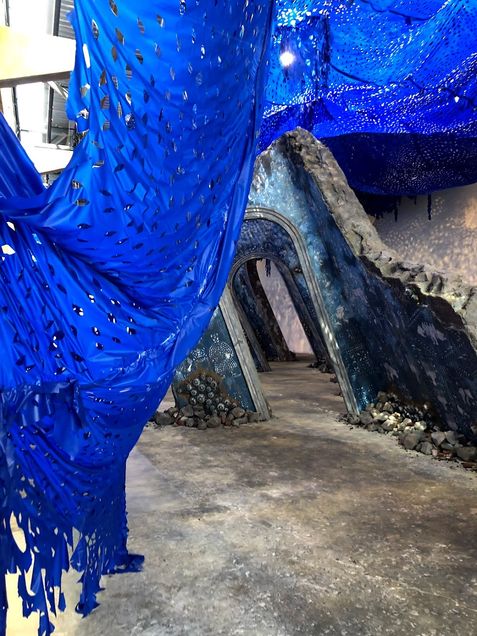
The exhibition centerpiece, however, was Báez’s vision of the ruins of Haitian palace Sans-Souci, titled To breathe full and free: a declaration, a re-visioning, a correction (19º36’16.9”N 72º13’07.0’’W, 42º21’48.762’’N 71º1’59.628’’W) (2021) (fig. 1).3 The architectural fragment included five arches, angled precariously to suggest that it was slipping into the seabed as a blue tarp undulated overhead to mimic waves. Sans-Souci was a complex space to resurrect; the luxurious nineteenth-century palace was built by Henri Christophe (1767–1820), a leader of the Haitian Revolution who would controversially rule as king of northern Haiti from 1811 until he died by suicide in 1820. His political rivals would go on to unite the fractious nascent nation, while Christophe’s royal residence was left to decay after a destructive 1842 earthquake.4 The Haitian Revolution is the most successful rebellion of enslaved people in history. From 1789 to 1804, African-descended residents of the colony Saint-Domingue liberated themselves from French rule and built the first Black republic in the world.5 Yet the legacy of colonialism and white supremacy has continued to hamper Haiti. As natural disasters and political violence rocked the Caribbean nation throughout the summer of 2021, these resonances weighed heavy for the exhibition visitor.6
The recreation of Sans-Souci struggled to bear this density of reference. Its scale, while enormous, still failed to fill the massive industrial warehouse, making the installation feel less immersive than overwhelmed. This issue was shared by the audio component, which, according to didactics, featured recordings of migration stories from residents of East Boston.7 The testimonies were intended to emphasize the exhibition’s site-specificity and reinforce the goals of the artist and curator to embed it within a specific neighborhood.8 However, they were played at such a low volume that the soundscape was reduced to an occasional burble. An opportunity to root the exhibition in its surrounding community—long the home of recent immigrants, including its current majority-Hispanic population—was lost in the cavernous space.
Figure 2. Firelei Báez (b. Dominican Republic, 1981). Detail, To breathe full and free: a declaration, a re-visioning, a correction (19º36’16.9”N 72º13’07.0’’W, 42º21’48.762’’N 71º1’59.628’’W) (2021). Installation view, Firelei Báez. ICA Watershed, East Boston, 2021. Photo by the author, 2021; Figure 3. Firelei Báez (b. Dominican Republic, 1981). Detail, To breathe full and free: a declaration, a re-visioning, a correction (19º36’16.9”N 72º13’07.0’’W, 42º21’48.762’’N 71º1’59.628’’W) (2021). Installation view, Firelei Báez. ICA Watershed, East Boston, 2021. Photo by the author, 2021; Figure 4. Firelei Báez (b. Dominican Republic, 1981). Detail, To breathe full and free: a declaration, a re-visioning, a correction (19º36’16.9”N 72º13’07.0’’W, 42º21’48.762’’N 71º1’59.628’’W) (2021). Installation view, Firelei Báez. ICA Watershed, East Boston, 2021. Photo by the author, 2021; Figure 5. Firelei Báez (b. Dominican Republic, 1981). Detail, To breathe full and free: a declaration, a re-visioning, a correction (19º36’16.9”N 72º13’07.0’’W, 42º21’48.762’’N 71º1’59.628’’W) (2021). Installation view, Firelei Báez. ICA Watershed, East Boston, 2021. Photo by the author, 2021; Figure 6. Firelei Báez (b. Dominican Republic, 1981). Detail, To breathe full and free: a declaration, a re-visioning, a correction (19º36’16.9”N 72º13’07.0’’W, 42º21’48.762’’N 71º1’59.628’’W) (2021). Installation view, Firelei Báez. ICA Watershed, East Boston, 2021. Photo by the author, 2021.
This was an installation intended to be seen (or, perhaps, photographed) from a distance. The sensation of being plunged underwater was potent—and important—in a city threatened by rising sea levels.9 Closer inspection dispelled the illusion. The sinking arches were anchored by blocks (textured to look like stone but without convincing heft) and what was clearly shredded rubber (fig. 2). The tarp’s distressed appearance was disproved by its regular, repeated holes, which only partly screened the harsh industrial lighting that punctured the watery impression (fig. 3, see also fig. 1). These aspects destabilized some of the less-convincing connections being drawn between Sans-Souci and the Watershed—the real palace, after all, was not submerged by a flood, but damaged by an earthquake. They accentuated that these ruins occurred artificially, outside of historical processes, and lent the installation an appealingly aesthetic sense of fantasy.
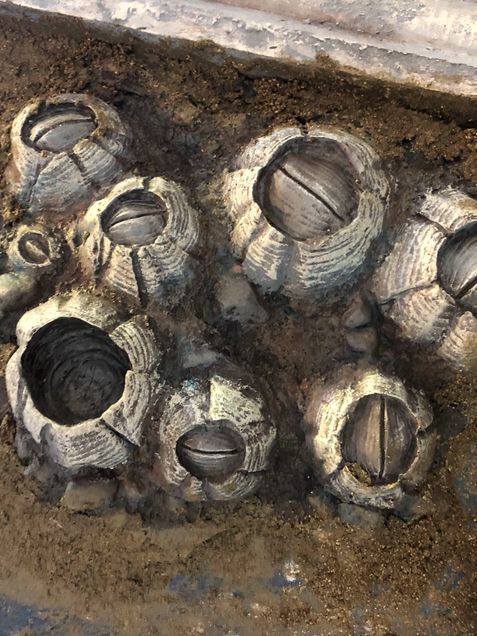
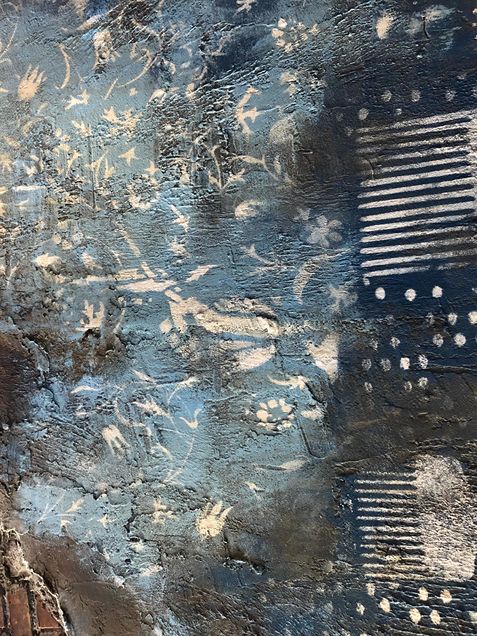
Age and decay were further connoted through fabricated barnacles. There was evident care and attention here, with sand carefully applied to blur the edges of each cluster (fig. 4). But the barnacles did not withstand scrutiny, especially when compared with the real-life creatures abundantly visible on nearby harbor structures. Viewers were encouraged to look closely at these additions because of what they partially obscured: repeating patterns stenciled across the monument’s blue-painted surface that alluded to African diasporic identities and lineages of Black resistance (figs. 5, 6). The color and symbols referenced indigo textile techniques that enslaved Africans brought with them from West Africa to the Americas and that became a staple good of the transatlantic slave trade—of which Boston’s harbor was a crucial node.10
Figure 7. Stephen Hamilton (b. United States, 1982). Owners of the Earth (2020). From The River and The Forest series. Acrylic on indigo-dyed adire oniko. Installation view, Stephen Hamilton: Indigo. ICA Watershed, East Boston, 2021. Photo by the author, 2021.Figure 8. Installation view, Stephen Hamilton: Indigo. ICA Watershed, East Boston (2021). Photo by the author, 2021.
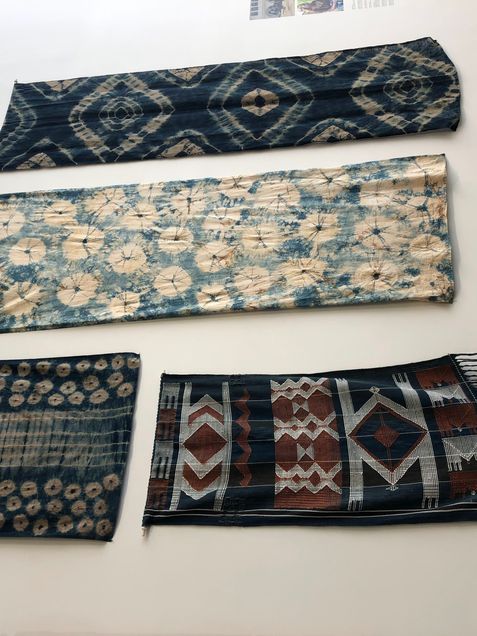
The sense that Baez’s version of Sans-Souci was a theater set, rather than a real place, was thrown into sharp relief by the paired exhibition Indigo featuring Boston-based artist Stephen Hamilton (b. 1982). The small exhibition punched above its weight and grounded Báez’s smart exposure of cross-continental histories. Without it, the allusions to indigo as a connection point for the African diaspora would have been far more abstracted, only semi-visible on the intentionally deteriorated palace surface (see fig. 6). The show featured five textiles by Hamilton in the educational area at the rear of the building. These works displayed the techniques he had studied in southwestern Nigeria, including the making of natural dyes and loom-weaving (figs. 7, 8). Accompanying wall labels included photographs taken in Nigeria that illustrated these methods for the visitor. The showstopper was Owners of the Earth (2020), a mixed-media wall hanging that depicted three reposed women surrounded by emblems of classical Yoruba art against the backdrop of resist-dyed indigo fabric (adire) (fig. 7). As a Black American, Hamilton understands his process-oriented practice and research into historical African art as a restorative recovery of stolen knowledge.11
It was tactility that distinguished the artworks; Hamilton’s pieces rewarded long, careful looking, with evidence of the hand-at-work in every layered detail. Showing the exhibitions in the same venue was an inspired choice to drive home the material legacies of the transatlantic slave trade. The worldwide dispersal of indigo fabric and its production trailed that of millions of kidnapped and enslaved Africans to the Americas and the Caribbean. That exchange underwrote Boston’s growing wealth as a colonial port, just as it foreshadowed Haiti’s eventual liberation and struggles to succeed in the face of colonial underdevelopment.
From the shores of Boston, Haiti might seem distant, as do the cultures and traditions of West Africa. Yet these locations are intimately linked, historically and presently, through the forces of migration, global trade, and a changing climate. Báez and Hamilton are artists both extremely adept at revealing these connections. This presentation of Báez’s work, however, emphasized aesthetic over substance, the imaginary over the tangible, surface over depth. Its details called to mind the constructed nature of the space more than the passage of time. The set dressing contrasted with Hamilton’s textiles, which he created as a labor of time-intensive love informed by deep research into West African traditions of making. Seen together, these two bodies of work marked the distance between fantasy and reality—in all its painful, messy, intertwined layers.
____________________
Colleen Foran
Colleen Foran is a PhD student studying African art at Boston University. Her research focuses on contemporary West African art, particularly on public and participatory art in Ghana’s capital of Accra. Prior to coming to BU, Colleen worked at the Smithsonian National Museum of African Art in the curatorial, editorial, and advancement departments. She completed her MA in May 2020, as well as a Graduate Certificate in African Studies from BU’s African Studies Center
____________________
Footnotes
1. With the exception of the summer of 2020, when the initiative was suspended due to COVID-19 and the Watershed pivoted to become a food distribution center for hard-hit East Boston communities.
3. The parenthetical of this lengthy title references the geographic coordinates for Sans-Souci in Haiti, followed by those of the Watershed in Boston, thus explicitly indicating distant physical locations were entangled within the space of the installation.
4. Wall text, Firelei Báez, ICA Watershed, East Boston.
5. Elizabeth Maddock Dillon and Michael J. Drexler, “Introduction: Haiti and the Early United States, Entwined,” in The Haitian Revolution and the Early United States: Histories, Textualities, Geographies, edited by Elizabeth Maddock Dillon and Michael Drexler (Philadelphia, PA: University of Pennsylvania Press, 2016), 1–2.
6. The first half of 2021 saw continuous protests in Haiti’s capital against President Jovenel Moïse after he controversially retained power beyond expected term limits. Then, on July 7, 2021, Moïse was assassinated in a shocking attack on his Port-au-Prince home. The political situation in Haiti remains uncertain, as various groups vie for political and on-the-ground power. This instability was compounded when a 7.2 magnitude earthquake struck the island nation on August 14, 2021, causing widespread damage and killing thousands. Shortly after, recovery efforts were hampered by a severe tropical storm. Early autumn brought news of thousands of Haitian migrants gathering on the southern United States border seeking asylum—a further reminder of the interconnectedness of Haitian and American histories and futures.
7. Wall text, Firelei Báez, ICA Watershed, East Boston.
8. Báez previously created a smaller fragment of Sans-Souci for an exhibition on New York City’s High Line, on view from May 2019 to May 2020. This version shared the Watershed example’s patterning and appearance but was titled solely with the palace’s geographic coordinates: 19.604692°N 72.218596°W (2019); Mitter, “In Boston, Art That Rises From the Deep.”
9. Not far from the ICA’s Seaport location, the corner of an almost entirely submerged luxury condo building surfaced from the waters of Fort Point Channel—a reminder of what the area could look like in just a few years. This portent, a work of art titled Polarity (2021) by Boston artist Zy Baer (b. 1993), was on view in the harbor throughout the summer, like the Watershed’s installation. It was not, however, sponsored by the ICA, but by the local group Fort Point Arts Community.
10. Wall text, Firelei Báez, ICA Watershed, East Boston.
11. Wall text, Stephen Hamilton: Indigo, ICA Watershed, East Boston.
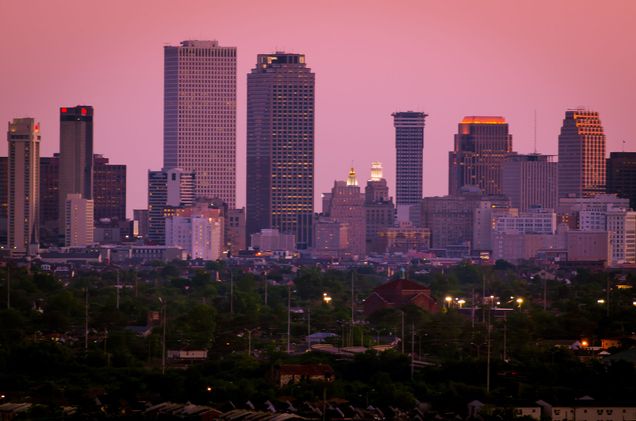
Figure 1. Billy Metcalf. New Orleans Skyline (April 24, 2012). Courtesy of Billy Metcalf Photography.
United States art museums located in geographically hazardous zones should be well-informed about the considerable risks posed to their collections at any given time. As the impact of climate change intensifies, public institutions need to review their collection management policies in response to the growing frequency of natural disasters. After the devastation of Hurricanes Katrina and Ida over the past two decades, the city of New Orleans (Louisiana) has become an example for how to develop and rework protocols for emergency preparedness. These museums' efforts in protecting cultural heritage have ensured the survival and longevity of their museum collections for both local and tourist communities to learn from, identify with, and celebrate.
My master’s thesis investigates cultural heritage protection for art museums that are threatened by climate change and natural catastrophes. Focusing on three case studies—the New Orleans Museum of Art, the Ogden Museum of Southern Art, and the New Orleans African American Museum—I want to learn from their experiences with disaster preparedness, mitigation, response, and recovery of art objects. By interviewing museum staff and professionals in the field of disaster preparedness, and assessing each organization’s collection management policy, I will analyze how these museums implemented precautions that could be transferable to future catastrophes at other institutions in the United States, and possibly how to establish collaborative initiatives for endangered institutions.
My main research questions revolve around the locus of cultural heritage management and resiliency in New Orleans (NOLA). What are the issues of cultural heritage protection in a city facing climate change or one located in natural disaster hazardous zones? What have these institutions learned from catastrophic experiences, and what does learning mean here? I am curious as to what organizations in New Orleans have learned from their experiences enduring Hurricanes Katrina and Ida, and if this learning has translated into a collaborative process to create specialized initiatives for art object longevity. If this is the case, the communication, planning, assessment, and comparison of goals and missions add layers of depth to the formulation of effective disaster preparedness protocols nationwide. What other agencies have been involved in emergency planning, mitigation, response, and recovery of cultural heritage, and what benefit do they contribute to the museums in question. Most importantly, the outcome I hope to achieve in this thesis is to evaluate how the lessons learned and precautions implemented by NOLA art museums are transferable to other projects in the United States. I believe that my chosen case studies serve as prime examples for others located in geographically hazardous zones, or more urgently, for places where climate change will have a future impact.
My research methodology has closely engaged with contextual reading and conceptual mapping. Using Joseph A. Maxwell’s Qualitative Research Design: An Interactive Approach, and engaging in collaborative activities, myself and student colleagues have developed our personal research designs to undertake our summative master’s theses. In early October, I remotely attended the Smithsonian’s annual National Conference of Cultural Property Protection. Over two days, various organizations and professionals across the country spoke about current initiatives in cultural property protection both within and outside of institutions. These discussions highlighted the resilience of staff and consultants even in the face of natural disaster. I have also reached out to staff at select museums nationwide with a brief questionnaire about the evolutions of their collections management policies and how these policies might have changed due to natural disasters that may have impacted their respective cities and to gauge interest in participating in a more formal interview process. The responses to this survey have been promising, and I have been awarded a grant to travel to New Orleans this winter to visit my case study institutions and complete interviews with staff and specialists in the field. Another interview I will conduct will be with Samantha Forsko, the current Director of Collections at the Art Institute of Chicago, who also wrote her master’s thesis on emergency preparedness in cultural heritage organizations and cooperative disaster networks. In 2022, gathering and interpreting primary source information will be my main focus as I finalize my thesis and complete my dual degree master’s in arts administration and art history. With this research, my hope is that these methods of inquiry on art museums’ current collection management policies and protocols will continue to be applied to institutions with similar situations that may find themselves in need of disaster preparedness in years to come.
____________________
Heather Burich
Heather Burich is a third year dual-degree graduate student at the School of the Art Institute of Chicago finishing her Master’s in Modern & Contemporary Art History, Theory, and Criticism and Arts Administration & Policy ('22). Her research involves the social, political, and personal implications of collections management, archives, and cultural property protection.
The world is not only what you make it but how, why, and for whom you make it. For the Karrabing Film Collective, seeing is a generative act in itself. The group was founded in 2013 in the Belyuen community of Australia’s Northern Territory in the wake of heightened policing and incarceration, reduced social welfare, and increased mining activity. The group is a grassroots Indigenous media group that utilizes an “improvisational realism” to expose issues including, but not limited to, state bureaucracy, settler-colonial violence, and environmental degradation.1 Their genre, which is neither strictly fiction nor non-fiction, enables them to counter hegemonic visual histories and propose alternate methodologies through which to imagine the physical environment.
This visualization incorporates ideas of place, ancestry, and temporality. Critical theorist and filmmaker Elizabeth A. Povinelli, who is a cofounder of the group, proposes that the Collective engages with questions of geontology, or, “what difference the difference between Life and Nonlife make[s].”2 This essay will examine how the group addresses both ontological and temporal incongruities not only through their choice of fractured narratives but in their selected medium of iPhone videography. It will consider the group’s 2016 film Wutharr, Saltwater Dreams, their first work to be filmed entirely using an iPhone. More specifically, it will examine the extent to which this format intrinsically lends itself to visual and auditory montage, or synesthesia. Finally, this essay argues that these formal techniques are harnessed to explicate the ubiquitous effects of settler-colonial violence, on one hand, and the utopian potential of fragmentation, on the other.
Wutharr is a 29-minute film centered around a simple question: what caused a boat motor to break down on a journey to Karrabing’s remote country? Several members of the Belyuen community, including Trevor and Rex, had taken the boat, owned by Linda Yarrowin, on voyages to collect water and to fish in previous days. Three alternate perspectives are presented by Rex, Trevor, and Linda, although these often exist in the same frame.3 The fractured nature of these positions and their ontological origins are explicated through superimposed images of contemporary subjects, land, and historical events. In Rex’s account, the reason for the breakdown is simply that the boat’s wiring needs changing: “I don’t know about Lord but I know about wiring.” Trevor, meanwhile, maintains that their ancestors are punishing them. Thirdly, Linda believes that the situation is a test of her Christian faith: “If you have faith in the Lord [the motor] will start.”4 Outside of these three oral accounts, structural forces are at play. As a group of characters passes time in a front yard, a state official approaches and hands Linda a set of forms that must be completed for not satisfying the safety requirements of lighting a safety flare. The documents require firm “yes” or “no” responses, although the group does not agree that such definitive answers can be provided. At another point, Trevor and his boat crew encounter a white character, Jack, who contradicts their rights to land ownership: “I’m not on your f*cking country, I’m on the saltwater.”
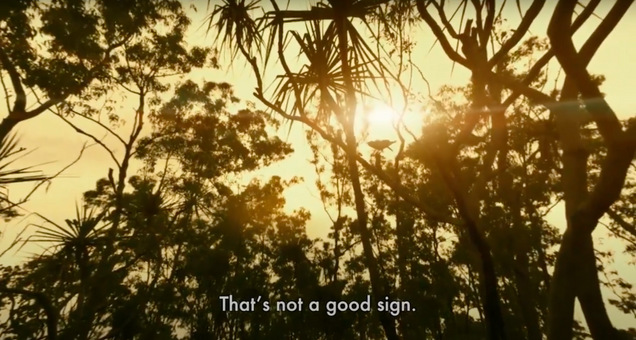
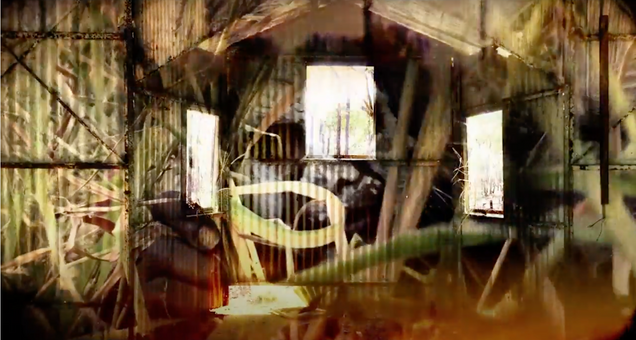
The multiple narratives within Wutharr suggest that in order to make any ontological determination, one must consider the living, non-living, human, and non-human across multiple temporalities. In its visual language, the film establishes connections between these seemingly distinct entities. In Trevor’s account of the story, as the group walks to collect drinking water, he warns of a bad omen: “That crow is singing out. That’s not a good sign.” Subsequently, nyudj (ancestral spirits) demand that the group be punished (figs. 1, 2): “They never visit us. Let’s go make trouble for them.” Superimposed on the faces of the nyudj are fragments of plant life and reflective streams of light. These moments exist within the same frame, where the bodies of the film’s protagonists become entangled with non-human forms, ancestral figures, and other, often unidentifiable visual material. Different registers of time—historic, ancestral, and geologic—materialize, overlap, and recede.
Figure 1. Karrabing Film Collective. Wutharr, Saltwater Dreams (2016). Video still. Courtesy of Karrabing Film Collective.Figure 2. Karrabing Film Collective. Wutharr, Saltwater Dreams (2016). Video still. Courtesy of Karrabing Film Collective.
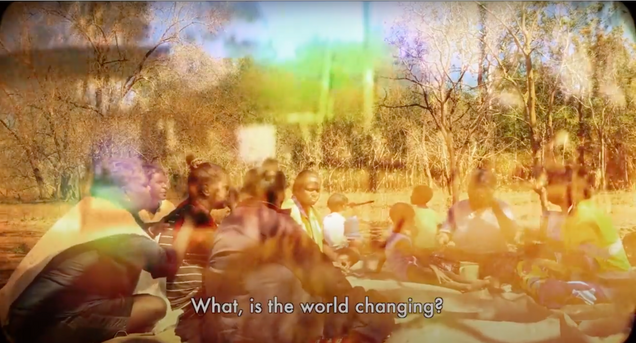
If, on a narrative level, Wutharr proposes an alternative means of comprehending one’s ontological capacity, what does this approach look like? Cultural theorist Nicholas Mirzoeff describes countervisuality as having three constituent aspects: “a claim to move out of the ‘place’ allocated to one by birth, a claim to democracy, … and a means of sustaining these claims beyond the spontaneous moment of uprising.”5 The Karrabing Film Collective’s use of multiple narratives and layered imagery underscores a connection between ontology, epistemology, and visuality. The Collective refuses any singular source of knowledge and being, and also rejects the production of a singular visual field. In Linda’s account, the group sits outdoors and discusses its relationship to both their ancestors and Christianity. Images of a scorched, de-solidified ground at times overlay the faces of the group members. Archival footage from Christian missions, which orchestrated the removal of Indigenous children from communities between approximately 1905 and 1967, is entangled in the flames and dried earth. “What year is this? 1952?” someone asks. “No! It’s 2015” responds another. “What? Is the world changing?” (fig. 3). In Wutharr, the juxtaposed images and dialogue establish the temporal interdependence of these threats. The destruction of the environment is a threat to existence as is the legacy of child removal policies and missionary Christianity. Here, the Collective’s countervisual strategy demonstrates that it is impossible to segregate issues of anthropogenic climate change from the legacy of colonial violence and from the everyday, comparatively mundane experience of existing in one’s environment.
Figure 3. Karrabing Film Collective. Wutharr, Saltwater Dreams (2016). Video still. Courtesy of Karrabing Film Collective.
Wutharr is the first of the Karrabing Film Collective’s works to have utilized the iPhone as their primary filming technology. In 2016, the Collective’s members began completing their own cinematography and adopted a more organic schedule closer to the pace of home movies. The utilization of the iPhone achieves two things. Firstly, it narrows the spatial and temporal distance between the filmmaker and the world, facilitating improvisation. Secondly, and perhaps most critically, it enables the filmmakers’ environment to be fragmented even further. The small, tactile camera allows the filmmakers to get closer to the ground, to capture details more intimately, and to edit and splice material rapidly.
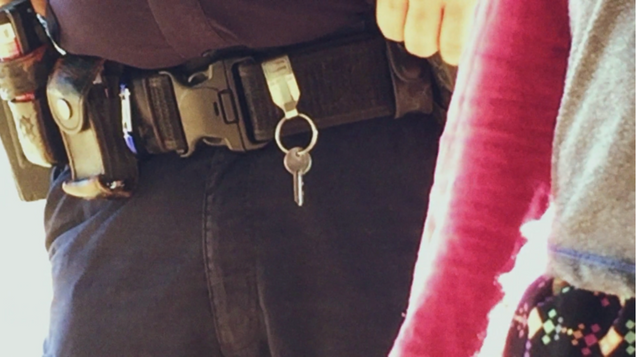
Figure 4. Karrabing Film Collective. Wutharr, Saltwater Dreams (2016). Video still. Courtesy of Karrabing Film Collective.
In other ways, the Karrabing Film Collective makes use of the iPhone for the aesthetic qualities that it facilitates. Wutharr is not necessarily a rebuke to the linear narratives of mainstream cinema, but it signifies the development of an alternate realism that utilizes the language of fragmentation. With the ability to rapidly shoot and review content, get closer to their subjects and environments, and quickly transfer video files, the Collective is better able to layer and splice seemingly disparate images to produce a continuous narrative. Formally, this approach incorporates aspects of rhythmic montage, or the editing of shots based on their visual content. There is a scene in Wutharr, for example, in which shots of the group are juxtaposed with another shot depicting fragments of the state official’s uniform (fig. 4). Yet more crucially, one can think of the Collective adopting montage on a theoretical level. In “A Dialectic Approach to Film Form,” film director and theorist Sergei Eisenstein stipulates that montage is “the idea which arises from the collision of independent shots.”6 He conceptualizes a form of vertical montage, concerned with single moments rather than their relation in a sequence, that cannot be traced in the static frame nor the musical score, but only “in the dynamics of the musical or cinematic process.”7 It is this kind of synesthesia, or play between visual and non-visual phenomena, that also characterizes the Karrabing Film Collective’s experimentation with the iPhone camera.
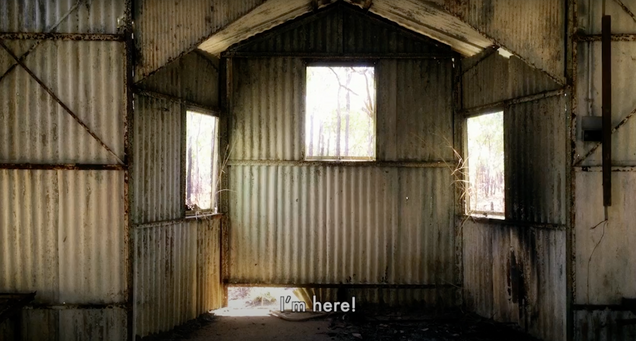
This sort of formalized synesthesia is evident in the final scenes of Wutharr. Visually, a later scene is produced, as a shot of an eroding metal structure, perhaps a shed, responds to the closeup shot of the ancestor amongst the grass (fig. 5). This site and those encountered by the film’s protagonists are forever entwined with the living and the non-living, the organic and the inorganic, the now and the then. The soundtrack of this short scene is a continuation of the dialogue, song, church bells, and instruments that accompanied Linda’s account of the story. In this way, the Collective produces a synesthesia that enmeshes the sonic qualities of the previous scene with different visual fragments, altering the framing of the narrative. In the last second of the scene, the shot of the ancestor disappears, leaving only the image of the metal structure and the sound of the group from the earlier scene. A voice shouts “I’m here!” as the scene fades to black.
Figure 5. Karrabing Film Collective. Wutharr, Saltwater Dreams (2016). Video still. Courtesy of Karrabing Film Collective.Figure 6. Karrabing Film Collective. Wutharr, Saltwater Dreams (2016). Video still. Courtesy of Karrabing Film Collective.
The adoption of vertical montage or synesthesia, facilitated by the tactility and adaptiveness of the iPhone camera, presents the environment as a network of connections. Landscapes and matter are transformed and exist within an entangled world. Film theorist May Adadol Ingawanij notes a dialectical aspect to this approach, too, as state bureaucracy, environmental crisis, and social inequality all shape the lives of the film’s Indigenous characters:
There is no outside of the everyday time of settler late liberal violence, yet that time of routinized administrative denial of life beyond the bare survival of Indigenous subjects intersects with and rubs against multiple other temporal scales, the deep time of partially connected and at times rivaling versions of ancestral dreaming with the deep time of geological change and the accelerated time of capitalist extraction.8
Thus, the process of seeing is inherently bound to both external forces, contemporary and historic, and specifically Indigenous ontologies. Wutharr, Saltwater Dreams is utopian in its presentation of recalibrated ecological and social exchanges. To return to Mirzoeff’s idea of countervisuality, the Collective’s filmmaking facilitates a movement away from the structural forces that constrain Indigenous ways of seeing, acts as a claim to democracy, and will exist beyond the moment of unrest that resulted in the group’s formation. The film is dystopian, however, in its insistence that Indigenous bodies can never be detangled from the persistent legacy of settler-colonialism and environmental destruction. Rather than visualizing an entirely new future, the Karrabing Film Collective presents a heterogeneous means of seeing. This presents a new method of visualizing temporal incongruities of a historical, ancestral, and geological nature as well as the environment, encompassing the living and the non-living, both away from and within view of the settler state. There is both pain and power in perceiving all of this at once.
____________________
Jake Matthews
Jake Matthews is a recent graduate of the School of the Art Institute of Chicago. At a broad level, his research is focused on the politics of visuality and medium-specificity. His recent work has considered Indigenous issues of video and new media as responses to environmental degradation and state violence.
2. Elizabeth A. Povinelli, “Geontologies: The Concept and Its Territories,” e-Flux no. 81, (April 2017): 3.
3. In an interview with Vdrome, the Collective state that “Wutharr begins and insists throughout that Indigenous families are not homogenous cultural machines but are composed of complex points of view… All three points of view exist in the same frame.” See Vivian Ziherl, “Karrabing Film Collective: ‘Wutharr, Saltwater Dreams,’” Vdrome, 2016. https://www.vdrome.org/karrabing-film-collective-wutharr-saltwater-dreams.
4. Before 1975, the recognized Indigenous community of Belyuen was known as Delissaville. Beginning in 1825, the Church Mission Society, among others, arrived to establish Christian missions that targeted Indigenous communities.
5. Nicholas Mirzoeff, “Visualizing the Anthropocene,” Public Culture 26, no. 2 (2014): 213–32.
6. Sergei Eisenstein, “A Dialectic Approach to Film Form,” Film Form (1949): 4.
Figure 1. Alfredo Greñas. Un penitente (1892). El Barbero n° 5 (April 24, 1892): 1. Biblioteca Nacional de Colombia. Photo by the author, 2021.
In 1892, the Colombian political cartoonist Alfredo Greñas (1852–1949) published the back of an engraving plate as a sign of protest for the government censorship of his work (fig. 1).2 Un penitente (A penitent), a monochrome print with Catholic undertones in its title, is a testimony of how images not only represent the external world but function as active agents that allow us to understand our experience of reality. The image marks the immediate aftershock of a traumatic experience by representing a distressing act of censorship that vividly describes daily life in Colombia under the conservative dictatorship of the last decade of the nineteenth century. In this case, the author explains in the image caption that the print he prepared for the fifth issue of his newspaper, El Barbero, could not be published as the editorial board was forced to directly impose the government’s prohibition on the distribution of satirical images.3 Even though at that moment no laws were censoring the free press, the police directly threatened Greñas with severe penalties. In response to this illegal official repression, the cartoonist denounced this silencing by depicting an eloquent image of the censoring act.4
Greñas’s absent image of a penitent comes to mind when thinking about trauma and the role of art in actively constructing an aftershock of this censoring event. Only through representations of traumatic experiences can memories of such occurrences be articulated in the present. By visualizing the official suppression via a public image, Greñas made the space to have a critical distance from the violent act through its narration.5 Only through this suggestive depiction of the official silencing do we know about this event today, as we are able to imagine the violenceof the Latin-American strongmen governing the different countries of the hemisphere in the second half of the nineteenth century. My republishing of Greñas’s eloquent silence is a small homage to the harsh experiences we have collectively felt since the start of the COVID-19 pandemic: an ongoing series of events that seems so overwhelming that it eludes any satisfactory form of representation. Consequently, as we seek to engage with the convoluted and complex events of our recent past, looking back at earlier examples from different parts of the world can be a way for us to learn to confront the remains of a complicated and painful experience.
The past two years have been difficult not only because of an ongoing pandemic but because we have been dealing with several other unfolding calamities, including climate change; the consequences of the withdrawal of the twenty-year military occupation of Afghanistan; the United States Capitol takeover during the transition of presidential power; and worldwide social and political unrest that locally has taken the form of the Black Lives Matter movement and other social justice movements. For many, these events have been painful experiences, while for others they may have fostered reevaluations of the importance of the social bonds that compose one’s life. What is clear is that together we have experienced history in the making. Surely, it is not an understatement that the events related to a worldwide health crisis have affected us on a personal and a collective level. Consequently, many of us are asking: how will the experience of the past two years be remembered?
As art historians, we need to think about the importance of images in these scenarios as the visual arts have a privileged position in the discussion of memory. Memory is not considered as providing authentic and verifiable access to the lived experience of the event, but it is a narration made in the present to engage with what previously happened. To form a memory is to build a representation of the event: a window that separates the lived experience from the present.6 Art as a form of representation has the potential to engage with trauma; it provides a means of reinvesting in new beginnings.7
For this issue of SEQUITUR, we invited perspectives on an urgent issue: the aftershock. As we try to process the experiences of the past two years, the question now centers around the impact of these events. How can we know when the COVID-19 pandemic will be a thing of the past? How can we re-engage with daily life as new variants of the virus continue to emerge? And, how do we learn to live with its effects? What have we absorbed from the social movements that surfaced in response to political unrest? How are we and generations to come going to remember the lessons learned and the lives lost? What teachings from the past can we look back on to confront the remains of a painful experience? And from the perspective of our journal: what knowledge can we find in the discipline of art history to think through these questions?
Back in September, when we sent out the call for papers, it seemed that we finally had a handle on the pandemic while we were processing the social and political unrest parallel to this crisis. This issue was intended to reflect on the aftershock of the health crisis. However, the emergence and spread of the Omicron variant has proved that this is an ongoing matter with which we are still learning to live. The contributions of the seven authors selected for this issue attest that the issues related to the general notion of the aftershock are far more encompassing. Three of these authors directly address the experience of living through a pandemic, whether through the lens of disability studies, the personal experiences of family separation amidst international border closures, or a historical comparison with depictions of isolation in the seventeenth century. Another considers questions of heritage preservation in response to climate change catastrophes. Other contributions focus on colonial legacies and their consequences around the world as they relate to contemporary indigenous communities, the transatlantic slave trade, and violent repressive events related to imperial power, racial and ethno-nationalist conflicts.
Jake Matthews opens our issue with a feature essay that explores the Karrabing Film Collective’s Wutharr, Saltwater Dreams (2016). Matthews examines the film’s ontological distinctions between the binaries of things living and non-living, as well as human and non-human. Matthews studies how the Indigenous collective engages with this distinction not only through their choice of narrative but in their selected medium. The author discusses how the present-day Indigenous communities of Australia navigate the long legacy of settler colonialism.
The second feature essay is by Madison Whitaker and focuses on the work of the contemporary artist Park McArthur, particularly her 2013 installation During the Month of August Essex Street will be Closed. The author engages in a discussion with disability scholars and activists to recognize how care work fosters social connection and social justice. It offers a reflection on how to start thinking about ways to better support ourselves and one another in the aftermath of the COVID-19 pandemic.
The artistic work of Illinois-based Ghanaian artist Japheth Asiedu-Kwarteng is presented in a visual essay. Inspired by Kente cloth of the Asante and Ewe weavers, the artist’s mixed-media sculptures function as a personal visual vocabulary through which to communicate Asiedu-Kwarteng’s experience of living in the United States during the COVID-19 pandemic. Asiedu-Kwarteng sees his three-dimensional works as a means to process his family’s pain due to his absence from Ghana.
Heather Burich’s research spotlight focuses on the author’s thesis project about cultural heritage protection for art museums that are threatened by climate change and natural catastrophes. Taking three case studies from New Orleans—the New Orleans Museum of Art, the Ogden Museum of Southern Art, and the New Orleans African American Museum—Burich argues that museums need to review their approach to collections management in the light of increasingly frequent natural disasters. The author asks how and what these organizations have learned from their experiences of disaster preparedness, mitigation, response, and recovery of cultural heritage.
The issue features three exhibition reviews that relate to our theme of aftershock, as well. Firstly, Colleen Foran discusses the works presented by Firelei Báez and Stephen Hamilton at the ICA Watershed in Boston. The author explores the dialogue between these exhibitions through the color indigo and reflects on the material legacies of the transatlantic slave trade. As Foran argues, the worldwide dispersal of indigo fabric and its production connects millions of kidnapped and enslaved Africans to the Americas and the Caribbean.
Secondly, Hailey Chomos reviews the exhibition Studies in Solitude at the Agnes Etherington Art Centre in Ontario (Canada). Curated by Dr. Suzanne van de Meerendonk, the show contextualizes the experience of pandemic isolation within historic representations of solitude in seventeenth-century Dutch paintings. As Chomos explains, the exhibition invites us to renew our appreciation for these paintings by connecting Early Modern depictions of solitude with our newly-defined relationship with isolation.
Finally, Max Gruber reviews Glenn Kaino’s In the Light of a Shadow, on view at MASS MoCA, discussing the installation’s engagement with our contemporary experience in relation to the self-destructive tendencies of British imperial power and climate change. The installation connects international protest movements and the legacy of violently repressive episodes to explore broader themes of protest, exploitation, and resilience.
As we think through the questions associated with the aftershock of experiencing these histories in the making, and what the future may hold in store, we would like to thank the authors who contributed to this issue of SEQUITUR. Their contributions provide a range of different approaches to the question of aftershock and speak to the complexities of building (and preserving) a unified image of what we have collectively experienced in the recent past. Although we may wish we had grappled more effectively with various incidents in the moment of their occurrence, by commemorating the aftershock we can learn from Alfredo Greñas and process traumatic events through artistic means and regenerative acts.
____________________
Julián Serna is a PhD Candidate studying Latin American Art of the 19th and 20th centuries. He is currently working on the relation between the private Arts Academies of Paris and the emergence of the official Art Academies Latin American between 1870 and 1900. Before joining Boston University, he was working as a curator on several projects in his home country, Colombia. He has worked as the chief curator of the Art Collection of the National Museum of Colombia, the exhibition coordinator of Bogota’s contemporary art Kunsthalle, the Galeria Santa Fe, and as advisor of the Visual Arts Office of the Bogota Institute of Arts (IDARTES).
____________________
Footnotes
1. I want to take this opportunity to thank Professor Melanie Hall and my fellow editors at SEQUITUR for their comments and contributions to this editorial note.
2. Born in Colombia in 1853, Alfredo Greñas was an engraver and a political cartoonist who died in exile in Costa Rica in 1949. He was the founder and editor of several liberal newspapers critical to the Colombian government which was famous for his militant illustrations. After experiencing the forced closure of his publications, and shortly after the publishing of this image, he was condemned to exile in 1892. During the period of his relocation in Costa Rica, he acquired a printing press in the city of San Juan while he worked for the diary La Presa Libre.
3. Alfredo Greñas, Un penitente (1892). El Barbero n° 5 (April 24, 1892): 1.
4. Beatriz Gonzalez Aranda, “Grafica Critica entre 1886 y 1900,” in Miguel Antonio Caro y la cultura de su época, ed. Rubén Sierra Mejía (Bogotá: Universidad Nacional de Colombia, 2002), 279-317.
5. Dominick LaCapra, Writing History, Writing Trauma (Baltimore, London: John Hopkins University Press, 2001).
6. Aleida Assmann, Cultural Memory and Western Civilization (Cambridge: Cambridge University Press, 2011).
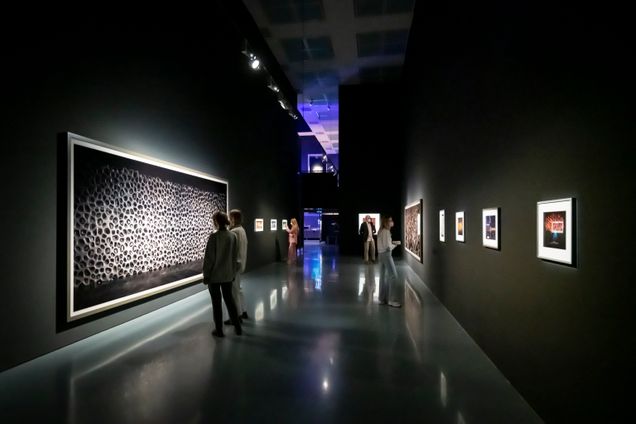 Figure 2. View of the work Untitled XV (2008), Andreas Gursky, © Andreas Gursky / VG Bild-Kunst, Bonn, 2021. Courtesy Sprüth Magers, exhibition Electro. From Kraftwerk to Techno, photo: Kunstpalast/ Katja Illner.