news
Notes about Contributors
Isabella Dobson is a PhD student in the History of Art & Architecture at Boston University interested in the ways that eroticism, desire, and sensuality operate in paintings and prints of the female body from the Early Modern period.
Theodora Bocanegra Lang is an MA candidate in Modern and Contemporary Art History at Columbia University. She received her BA from Oberlin College in Art History. She was most recently curatorial assistant at Dia Art Foundation, where she worked on exhibitions with Jo Baer, Joan Jonas, and Maren Hassinger.
Sybil F. Joslyn is a PhD candidate in the History of Art & Architecture at Boston University. She studies American art and material culture in the long nineteenth century, and her research explores the intersection between material and visual culture, the expression of individual and national identities, and intercultural exchange in the Atlantic World. Previously, Sybil has held internships and fellowships at The Metropolitan Museum of Art, the Museum of Fine Arts, Boston, Bard Graduate Center, Hirschl & Adler Galleries, Inc., and the Winter Show. Her dissertation examines maritime salvage as object, material, and process to interrogate perceptions of identity, property, and value during America’s Age of Sail.
Rachel Kline is a third-year PhD student in the History of Art & Architecture at Boston University specializing in the Italian Renaissance. With a background in anthropology, she hopes to use this perspective to explore the cultural meanings acquired by art objects and their materials circulating in the Renaissance. Rachel is especially interested in the artistic exchange between Italy and Northern Europe during the fifteenth century.
Emma Lazerson received her BA from Emory University in 2022 and is currently a first-year MA candidate in Art History at Case Western Reserve University. Her research focuses on early modern Italian female artists, contextualizing their practices in social, religious, and global theories.
Samuel Love is a PhD candidate in History of Art at the University of York. His thesis explores the carnivalesque visual culture of interwar British High Society, tracing how its engagements with baroque and Dionysian iconographies constituted a transgressive rejection of sociopolitical norms.
Michaela Peine received her BA in English and Studio Art from Hillsdale College, specializing in oil painting and portraiture. She is pursuing an MA at the University of St. Thomas studying Art History with a certificate in Museum Studies. She is currently researching contemporary artistic responses to Northern Renaissance and Baroque art, as well as decolonial educational practices in museums.
Ateret Sultan-Reisler is the John Wilmerding Intern in American Art at National Gallery of Art, Washington D.C. She is working on a major retrospective of Elizabeth Catlett (2024–25). Ateret holds an MA in History of Art & Architecture from Boston University and a BA in Art History and Psychology from University of Maryland.
SIREN (some poetics)
Amant, Brooklyn, NY
September 15, 2022–March 5, 2023
by Farren Fei Yuan
The exhibition SIREN (some poetics) that was unveiled this fall at Amant in East Williamsburg, Brooklyn offers an evocative experience that dissolves the boundaries in sensory perception and artistic media. As such, it posits an alternative to the proliferation of Instagram-ready exhibitions that are focused on creating spectacles and repackaging works of art into reified commodity forms.
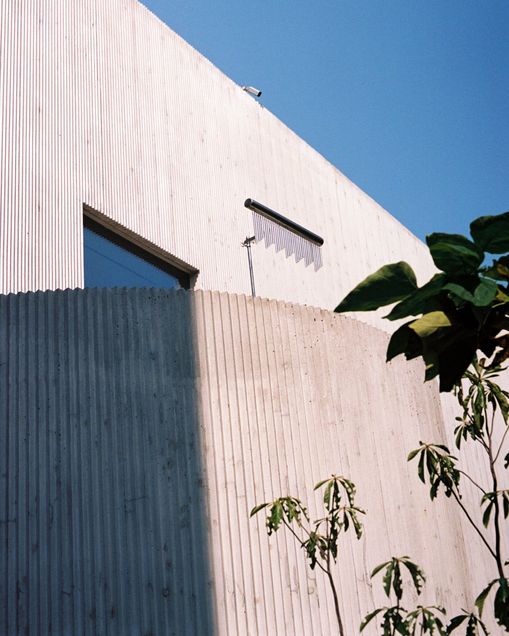
Founded in 2019 as a non-profit arts organization, Amant acts at once as a studio space for young artists and an exhibition space, aiming, most importantly, “to slow down the art-making process.”1 SIREN, for example, takes place in the multiple spaces of the gallery that spans across Maujer Street and envelops a courtyard garden. In contrast to exhibitions that simply present information to be received, visitors to Amant are led to make their own discoveries: inadvertently walking into the uncanny installation of a tire, an umbrella, and a school desk, or catching the sounds of bell chimes in the distance (figs. 1 and 2). These outdoor works embed poetics in the everyday.
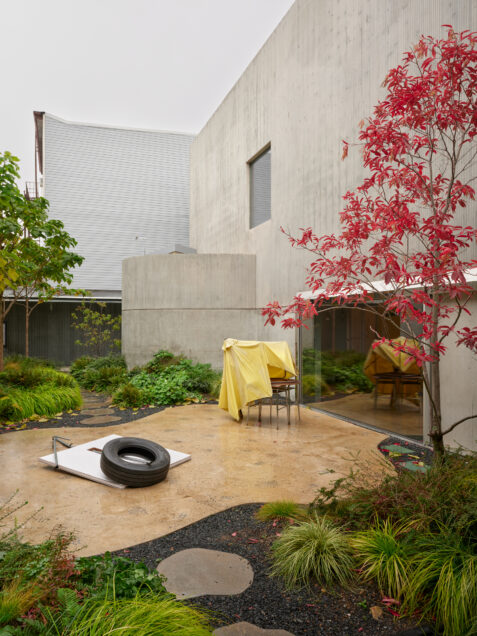
SIREN is accompanied by a series of performances, poetry readings, “learnshops,” and creative writing workshops that take place during the exhibition period, in various spaces across the buildings. The ideas generated from these multi-disciplinary and open-ended activities become incorporated into one’s understanding of the artworks. SIREN takes place within a larger stream of everyday activities, meaning that the exhibition is “read,” “written,” and “narrated” even if it is also “seen.” SIREN encounters its audience on an individual level, through a private, slow, and multi-sensory experience. Visuality as the privileged mode of engaging with art is challenged by a range of activities that interpenetrate the gallery space.2
The dismantling of hierarchical categories of perception and knowledge has strong thematic resonance with SIREN. As Quinn Latimer writes, the siren which sounds “over land [and] across water” stands for both an emittance that establishes perceptual, linguistic, social, and territorial borders and as an expansive call that stretches across uneven terrains.3 This double-sided notion of drawing and erasing boundaries, at once disciplining and liberating, underpins the concerns of the works featured in the exhibition. The seventeen participating artists work freely in watercolor, drawings, textiles, sculptural installations, videos, and the written word, to interrogate the idea of the siren across domains and temporalities: as a figure of myths, songs, and poetry as well as of technology.
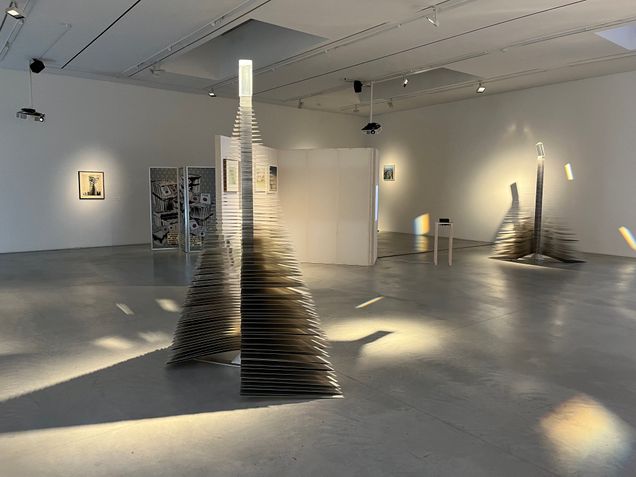
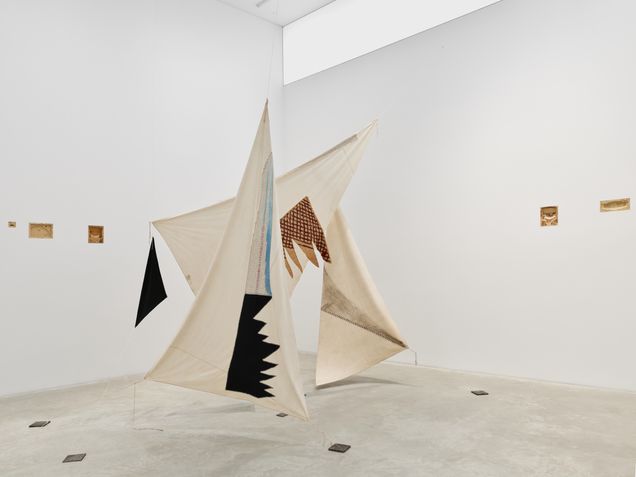
Lilian Lijn’s Queen of Hearts, Queen of Diamonds (1980), a pair of optical glass prisms whose three facets extend out through a tower of aluminum plates, are set apart, each emitting light that cuts across the space and interacts with the gallery lighting. Fetishized figures of patriarchal female archetypes and goddesses from Ancient Greek, Hindu, and Indigenous mythologies are dissipated into an assemblage of visual forms, texts, sound, volumes, and light that refuses to unify into an intelligible form. Their elusive bodies take the form of metallic pyramids under ample light (fig. 3) to flickering conical silhouettes in darkness (fig. 4), resisting capture by the objectifying gaze.
If Lijn works towards the dissolution of reified forms (both actual and figurative), other artists in the exhibition affront the visitor with sensoralities of the abject, thereby frustrating any attempt to spectacularize, reducing the exhibition into a pleasing yet inconsequential image. The most subtle example is a work by Patricia L. Boyd who has collected grease from restaurant leftovers, then used these materials to create negative casts of office items bought at a liquidation auction (fig. 5). The casts constitute a lexicon of rejects, the material evidence of the failures and excesses of contemporary society. However, these casts are embedded in the gallery walls, well above eye-level, such that their texture and form cannot be discerned. Boyd often works with “boundaries and thresholds”: the Borrowed Times series here introduces the abject (literally) into the institutional structure of the gallery and challenges the threshold of the visitor’s comfort.4
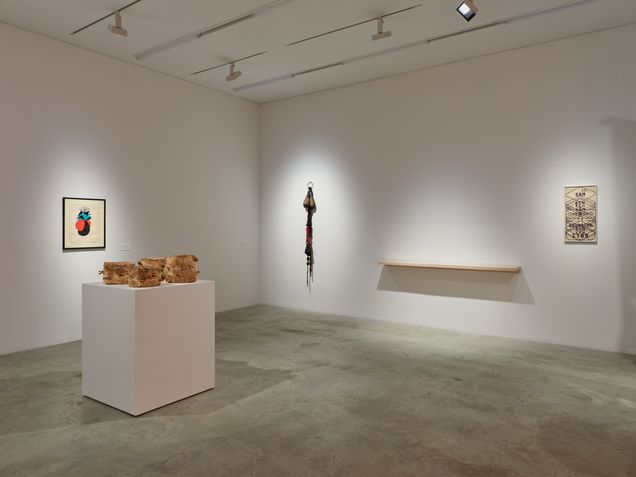
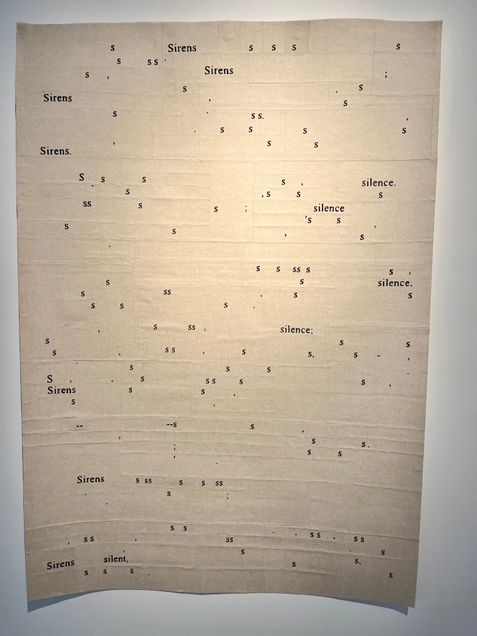
Such materiality of degeneration and decay is also palpable in Senga Nengudi’s R.S.V.P: Reverie-Combat Fatigue (1977/2011) in which hanging nylon stockings capture the material experience of the female body in its most deject, subversive state; or Nour Mobarak’s Fugue I and Fugue II (2019) where cultivated fungi cover two speakers whose multi-layered poetic recordings reflect upon history and memory (fig. 6). Addressing other dimensions of society, other artists in the exhibition turn moments of system failure into poetic allegories. Rivane Neuenschwander visualizes a possible glitch in communication in her textile piece, The Silence of the Sirens (2013) (fig. 7), a poetic constellation that emerges over a geometric grid, drifting between registers of sound and language: “silence,” “siren,” “SS,” “ssss(h).” The muted emptiness of the woven ground, and the refusal of the letters to give in to intelligible language, posit the mythical power of silence: as in Kafka’s parable referred to in the title, perhaps Odysseus survives because the sirens did not sing.
Making system failures visible exposes the problems and contradictions that would otherwise be simply smoothed over to produce an impression of successful operation. The artist collective Shanzhai Lyric, for example, composes poems out of counterfeit goods, consumer detritus, and theft practices (fig. 8). In Iris Touliatou’s HAPPINESS, 2018-2022 (to Laurie) (2022), a small display screen is held in place on a wall by the frame of an egg carton (fig. 9). Captions pop up at intervals, synchronized via a custom-made software to the speed of incoming notifications from the artist’s unread Gmail inbox. The continuous generation of signs that overflow in an incoherent narrative dramatically plays out the fracturing of today’s user-consumer’s sense of self. These are further played out on a phallic formal structure that is made uncanny by empty carton slots, the shadow cast on the wall, and the reflection of the viewer on the dark screen. The comfortably distant and secure position of the viewer that the spectacle relies on for its ideological functioning is disturbed.


SIREN posits the un-form, the abject, and the glitch as ways to practice contemporary poetics. The subversive power of the works is subtly embedded in their poetic beauty, like the deceptive charm of sirens, confronting the visitors and thereby resuscitating their experience. In a society of hyper-mediation, we need more exhibitions like SIREN which provoke us to reexamine and rethink common perceptions.
____________________
Farren Fei Yuan is an aspiring art researcher and critic. She graduated with a first class in BA in History of Art from The University of Oxford and is currently pursuing an MA in Modern and Contemporary Art: Critical and Curatorial Studies at Columbia University. Yuan has a special interest in image-text relations and post-war visual culture in the global context.
____________________
Footnotes
1. “About,” Amant, accessed December 10, 2022, https://www.amant.org/about.
2. This challenge to the assumptions underlying our conceptions of different activities is a strategy Rancière puts forth as an alternative to the rigidified practice of mixed media and interdisciplinarity. See Jacques Rancière, “The Emancipated Spectator,” in The Emancipated Spectator (London: Verso, 2021), 22.
3. Quinn Latimer, “SIREN (some poetics) [exh. guide],” Brooklyn, New York: Amant, 2022.
4. Patricia L. Boyd, “Contact Barrier: Patricia L. Boyd,” by Dora Budor, Mousse Magazine, July 5 2021, https://www.moussemagazine.it/magazine/patricia-l-boyd-dora-budor-2021/.
Following Institutional Critique Inside the Library
by Levi Sherman
When artists in the 1960s began challenging systemic authority, it seemed any cultural heritage institution—library, archive, or museum—could be a target of what would become known as Institutional Critique.1 The same period heard the first rumblings of today’s “digital convergence,”2 or the collapse of libraries, archives, and museums into repositories of information, accessed by users with little interest in the distinctions between these types of institutions.3 Yet even as librarians, archivists, and museum registrars blurred into “information professionals” in the 1960s, artists would develop a very different relationship with libraries than with archives and museums. My current research triangulates this unique artist-library relationship through the art historical framework of Institutional Critique, the cultural history of libraries, and the discourse of information science.
I hope to complicate the art historiography of Institutional Critique and glimpse what has been lost when the distinct purposes and practices of libraries, archives, and museums blur into information or institutionality writ large. These blurred boundaries haunt Institutional Critique from its inception in the journal October, which drew heavily from Foucault’s rather abstract understanding of the archive.4 It seems no coincidence that Henry Pisciotta writes from the perspective of a working librarian when he posits an alternative timeline of Institutional Critique, which peaks with the archival turn of the 1990s.5 Where art historians like Blake Stimson distinguish between a generation who tries to hold public institutions accountable and one who tries to redirect private institutions, Pisciotta shows that artists never stop trying to hold libraries to their mission.6
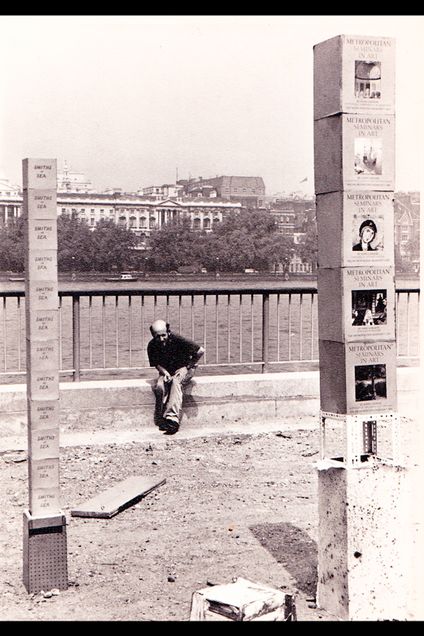
John Latham naturally figures into Pisciotta’s study of the Institutional Critique of libraries. Latham staged his spectacular book-burnings, Skoob Tower Ceremonies (1964–1968), at several institutional sites, like the British Library.7 Figure 1 illustrates another Skoob Tower Ceremony staged in London’s South Bank, with a similar civic architectural backdrop. But few later artists adopt Latham’s approach. Where Latham treats the library—like the museum and the courthouse—as a shallow signifier of culture and authority, later artists perform their critique from inside the institution, often with its permission and support.8 These artists understand the library as an exercise of authority but also democracy. They engage in a nuanced immanent critique that addresses how libraries operate rather than what they represent symbolically.
Beneath its stereotypically neoclassical façade, the modern public library has never been a centralized authority like the archive or museum, which share its spectacular architecture of power. Indeed, library history reveals continued frustration with this decentralized governance within national organizations like the American Library Association.9 Public libraries are accountable to taxpayers, serve amateur researchers, and prioritize information dissemination over preservation or connoisseurship. In other words, the anti-institutional pressure that Stimson associates with “new technologically enabled forms of peer-to-peer social organization” shaped the public library long before digital convergence began.10
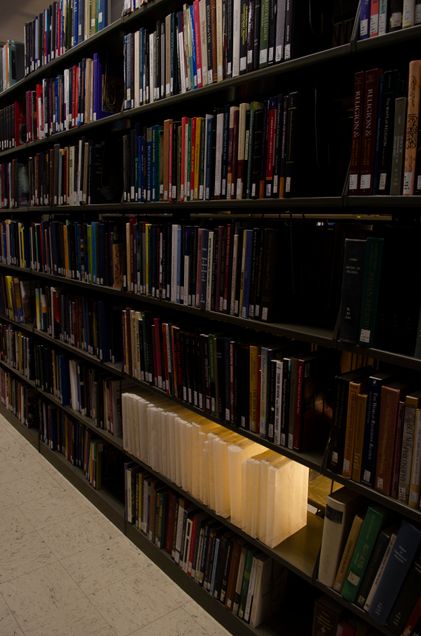
Artists need not intervene in the library’s spectacular trappings—its outward signifiers of culture and authority—because members of the community remain agonistically engaged with the institution’s inner workings. Indeed, the everyday interactions between the library and its patrons are generative points of departure for many artists. One example is India Johnson’s Negative Theology (2019–2020), which converses with a specific library as a site and set of practices (fig. 2).11 Johnson checked out a university library’s complete selection of books on the subject of negative theology and filled their spots on the shelves with fabric casts during the check-out period.12 Thus, the location, scale, and duration of Johnson’s installation are determined by the library’s classification scheme, acquisition plan, and checkout policy. Whereas Institutional Critique artists tended to approach art museums from the position of artists rather than patrons, Johnson's visit mirrors that of a typical user; anyone can remove books from a library shelf and keep them, thus altering the space within the constraints of the site.
Art history has been better at theorizing generalized modes of site specificity than addressing the operations of a specific site like a public library. My research seeks to understand how artists engage with libraries and their communities of readers by using the tools of library historians like Wayne Wiegand, a people's historian of libraries: the public and mundane evidence of policies, annual reports, meeting minutes, and letters to the editor.13 Reading Johnson’s immanent critique in the context of library history reveals the decentralized yet highly institutionalized terrain where people continue to encounter actual democracy, not just architectural and artistic spectacle of democracy found outside of the library.
____________________
Levi Sherman is a PhD student in Art History at the University of Wisconsin-Madison. With a background in design and interdisciplinary art, he maintains a studio practice and co-operates a small press. Levi’s research interests include walking art, artists’ books, and the broader intersection of contemporary art, books, and libraries.
____________________
Footnotes
1. According to art historian Blake Stimson, “institutions were understood to be the means by which authority exercised itself” and so represented the system of “illegitimate authority” and control, which artists previously located in authoritarian figures like heads of state. Blake Stimson, “What Was Institutional Critique?” in Institutional Critique: An Anthology of Artists' Writings (Cambridge, MA: MIT Press, 2011), 22.
2. Wayne A. Wiegand, Part of Our Lives: A People’s History of the American Public Library (United Kingdom: Oxford University Press, 2015), 193–194.
3. Cecilia Salvatore, “Libraries, Archives, and Museums in the Twenty-First Century,” in Libraries, Archives, and Museums: An Introduction to Cultural Heritage Institutions Through the Ages (Maryland: Rowman & Littlefield Publishers, 2021), 251–260.
4. In framing Institutional Critique, Benjamin H.D. Buchloh and Hal Foster tend to address the idea of the institution rather than its operation. Foster’s 1996 essay “The Archive without Museums” exemplifies this approach, which invokes the library as a Borgesian, Alexandrian thought experiment. Foster does so by blurring Foucault’s respective treatments of the library and the archive, which themselves tend toward the abstract. See Hal Foster, “The Archive without Museums,” October 77 (1996): 97–119.
5. Henry Pisciotta, “The Library in Art’s Crosshairs,” Art Documentation: Journal of the Art Libraries Society of North America 35, no. 1 (2016): 2–26.
6. Stimson,“What Was Institutional Critique?,” 37.
7. Elisa Kay, “John Latham,” Flash Art International 44, no. 280 (October 2011): 64–67.
8. Pisciotta discusses examples by Mel Chin, George LeGrady, Clegg & Guttman, and others which reveal different strategies for maintaining a critical edge while collaborating with the institution.
9. One telling example was the ALA “Library Bill of Rights,” which emerged during the Second World War to combat censorship and promote free inquiry. Library historian Wayne Wiegand notes that actually implementing the LBR was “almost always messy, often impossible, and professional consensus… was hard to discern.” Wayne A. Wiegand, Part of Our Lives: A People’s History of the American Public Library (Oxford: Oxford University Press, 2015), 166.
10. Stimson, “What Was Institutional Critique?,” 32.
11. India Johnson, “Negative Theology,” India Johnson, accessed October 18, 2022, https://indiajohnson.hotglue.me/?sitespecific/
12. Negative theology, or the study of the divine through what it is not, is no doubt a pun, but the subject also relates to Johnson’s research into the intersection of religion, language, and book art.
13. As municipally funded institutions with public boards, library records are generally more available than those at museums and other private institutions.
Curses as Crowd Control: Tourist Folklore at Pompeii
by Rowan Murry
In 1922, news of Howard Carter’s rediscovery of King Tutankhamun’s tomb took the world by storm. In February 1923, excavators reburied and secured the tomb while archaeologists catalogued their findings and made plans for the next excavation season. It was around this time that the excavation’s financier, who had been present at the opening of the tomb, died mysteriously.1 In actuality, Lord George Herbert, the fifth Earl of Carnarvon (1866–1923), had contracted blood poisoning from an open wound caused by a mosquito bite.2 The press, seizing on the story of the Earl’s “mysterious” death, developed a sensationalized narrative of the so-called “mummy curse,” a legend that has pervaded the field of Egyptology ever since.3
The Egyptian mummy curse is an example of what I will refer to as “tourist folklore.” The term describes the perceived phenomenon of misfortune brought upon tourists who steal from or vandalize cultural heritage sites and the perpetuation of these myths by local inhabitants or stewards of these sites.4 Often, tourist folklore myths are bolstered, or sometimes even invented, by heritage site stewards to discourage theft or vandalism.5 This essay examines one example of how custodians of heritage sites manipulate public superstition to protect their sites from thievery and vandalism associated with tourism, especially in cases where funding and implementing physical security measures is impossible.
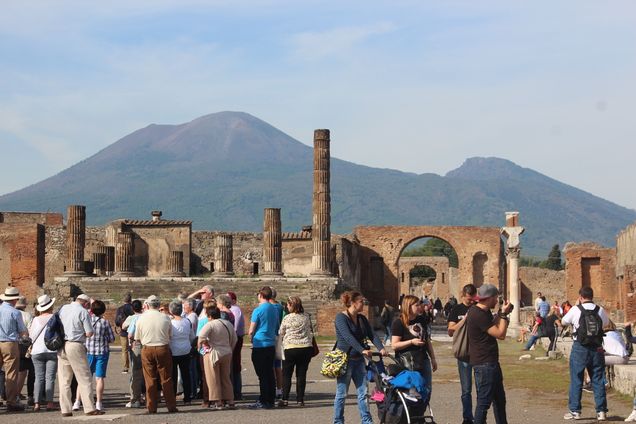
A valuable example of contemporary tourist folklore operates at the ruined city of Pompeii, an archaeological park near Naples, Italy (fig. 1). Pompeii is an important example not only because of its notoriety as a "dark tourist site"—a site associated with death and trauma—but also because it is one of the most visited UNESCO sites in the world, with approximately three million visitors per year.6 Using frameworks offered by Marcel Mauss and Michel Foucault, this essay utilizes the cultural heritage site of Pompeii as a means to explore the tourist folklore phenomenon. While the example of tourist folklore at Pompeii is not representative of all types of heritage sites and folklore, it provides an example through which to discuss themes of magic, dark tourism, and spectacle.
A discussion of the origins and function of tourist folklore requires an introduction to “contagion magic,” a dominant force fueling superstition and mysticism at Pompeii. The concept of magical contagion is best summarized by French sociologist Marcel Mauss in his book A General Theory of Magic:
The idea of magical continuity, realized through the relationship between parts and the whole or through accidental contact, involves the idea of contagion. Personal characteristics, illness, life, luck, every type of magical influx are all conceived as being transmitted along a sympathetic chain….However, magical contagion is not only an ideal which is limited to the invisible world. It may be concrete, material and in every way similar to physical contagion.7
In other words, once a person comes into physical or spiritual contact with an object, person, or entity, its essence, properties, or spiritual links are transmitted to the person. Contagion curses imply that the physical act of touching and subsequently removing an object from its home initiates spiritual contagion. The physical act of theft provokes bad luck caused by the object, the land, or a deity, which afflicts the offender and sometimes even their family and friends.
Pompeii shares similarities with the tourist folklore and mummy curses associated with the excavations of ancient Egyptian tombs. Anthropologist Anna Wieczorkiewicz dissects this societal fascination with ancient bodies and death, and concludes that “mummies, skulls, and skeletons become our fetishes in seeking meaning” about our own mortality.8 At Pompeii, visitors are immersed in a past world of paganism, debauchery, and destruction, where they play the roles of archaeologist, discoverer, adventurer, ancient Roman, and tourist.9 As a result, Pompeii becomes a dark tourist site where death and destruction are commodified and fetishized. This “quasi-religious mystique” of Pompeii is a crucial factor in a tourist’s decision to steal from the site.10 Visitors to dark tourist sites “seek tangible symbols of the place, the memory, meanings and experiences,” where material objects offer a medium through which they can reflect and channel complicated feelings or difficult memories.11 In addition to these motivations, I propose that the act of stealing artifacts from dark tourist sites like Pompeii is an act of defiance against mortality. It is a direct challenge to the destruction and death one must face at Pompeii—it gives the thief an illusion of control, both literal and metaphorical, over natural forces.
In October 2020, the media amplified the sensationalized story of a “cursed” Canadian woman who had visited Pompeii in 2005.12 She stole “two white mosaic tiles, two pieces of [amphorae], and a piece of ceramic wall” as souvenirs from her visit.13 In 2020, the woman returned the artifacts along with a letter, which stated that she “wanted to have a piece of history that couldn’t be bought,” and which she claims plagued her with bad luck and “negative energy” for 15 years.14 In the letter, she cites examples of her misfortune, including a breast cancer diagnosis and financial loss.15 She implies that the bad luck associated with the artifacts was the direct result of desecrating such a powerful site of trauma, loss, and destruction; it was a disrespectful act which activated Pompeii's magical contagion.
Luana Toniolo, Archaeological Officer of Pompeii, has estimated about 200 returns of stolen material to Pompeii over the past ten years, both resulting from and in anticipation of the potential curse.16 Toniolo suggested that artifacts which have been removed from their findspot lose their “strength as historical objects,” a quality which is crucial for the park’s mission of preservation and education.17 The park’s desire to deter tourists stealing and displacing artifacts led to a fascinating exhibition on the site’s tourist folklore. In response to the 2020 letter regarding the curse, curators at the Antiquarium of Pompeii compiled a temporary exhibition of letters and returned “cursed” objects. According to CNN, the purpose of the exhibition was anthropological, as a documentation of tourist interactions at Pompeii, but the underlying message is clear: do not steal from the site or else.18 News and media coverage of the alleged curses and subsequent exhibition further sensationalized the tourist folklore narrative maintained by the park’s staff.
The curse of Pompeii further perpetuates this air of mystique offered by dark tourism, and the stewards of Pompeii are using it to their advantage. By displaying returned cursed objects in the Antiquarium and in the media, the custodians of Pompeii are simultaneously creating further interest in the site while protecting it from future damage. The curse brings more visitors to the park, but the threat of magical contagion keeps them in line. At a place like Pompeii, which spans 170 acres, it is impossible to always surveil guests. This is where the curse plays a crucial role. In Foucault’s panopticon, a prisoner surveillance system which functions as a metaphor for modern society’s structure, the threat of constant visibility provokes self-regulation.19 At Pompeii, the threat of the curse plays the singular authoritative role which influences the behavior and social norms of the masses. Fear of this authority creates a system of self-discipline and social control—it is a means of surveillance without a physical entity.
At Pompeii, tourists’ desires to steal from the site stem from uncomfortable encounters with death, destruction, and dark tourism. The curse relies on its mystical associations with paganism and death at the site to both enrapture visitors and the media and ensure the site’s future protection from vandalism and theft. The media spectacle created by the curse serves Pompeii in various ways by preventing destruction and theft, serving as cost-effective security measures, and bringing more attention, visitors, and money to the site. In the face of mass tourism, curses can help communities and custodians regain some semblance of authority over their own heritage and history. However, in some cases, tourist folklore further perpetuates stereotypes and misrepresentations of ancient culture and beliefs. This is true for Pompeii, which is often portrayed in the media as debaucherous and esoteric. It is vital to consider the ways tourist folklore operates in different contexts and how this can positively or negatively impact our collective understanding of history and cultures.
____________________
Rowan Murry received her BA in Art History from the University of Mississippi and is currently pursuing an MA in Museum Studies at New York University. She is particularly interested in Ancient Roman art and archaeology, ethical collecting, and interactive technologies for physical and virtual exhibitions.
____________________
Footnotes
1. Mark R. Nelson, “The Mummy’s Curse: Historical Cohort Study,” British Medical Journal 325, no. 7378 (December 21–28, 2002): 1482.
2. Roger Luckhurst, The Mummy’s Curse: The True History of Dark Fantasy (Oxford: Oxford University Press, 2012), 8.
3. Luckhurst, The Mummy’s Curse, 9; “George Herbert, 5th Earl of Carnarvon,” The British Museum, accessed December 12, 2022, https://www.britishmuseum.org/collection/term/BIOG53843.
4. Joyce D. Hammond, “The Tourist Folklore of Pele: Encounters with the Other” in Out of the Ordinary: Folklore and the Supernatural (Logan, Utah: Utah State University Press, 1995), 159.
5. Other examples of sites that have a history of tourist folklore in order to discourage theft and vandalism include The Petrified Forest in Arizona and Hawai’i Volcanoes National Park.
6. The Palgrave Handbook of Dark Tourism Studies (London: Palgrave Macmillan UK, 2018); “Visitor Data,” Pompeii Archaeological Park. This number does not account for any COVID-19 pandemic closures during 2020–2022. The most recent data comes from 2018.
7. Marcel Mauss, A General Theory of Magic (London: Routledge, 2001), 81–82.
8. Anna Wieczorkiewicz, “Unwrapping Mummies and Telling Their Stories” in Science, Magic, and Religion: The Ritual Processes of Museum Magic (New York: Berghahn Books, 2004), 68.
9. Wieczorkiewicz, “Unwrapping Mummies and Telling Their Stories,” 66.
10. Dorina Buda and Jenny Cave, “Souvenirs in Dark Tourism: Emotions and Symbols,” in The Palgrave Handbook of Dark Tourism Studies (London: Palgrave Macmillan, 2018), 719.
11. Buda and Cave, “Souvenirs in Dark Tourism: Emotions and Symbols,” 719–720.
12. Jack Guy and Nicola Ruotolo, “Tourist returns stolen artifacts to Pompeii after suffering ‘curse’ for 15 years,” CNN, October 13, 2020, https://www.cnn.com/travel/article/pompeii-artifacts-returned-scli-intl/index.html.
13. Guy and Ruotolo, “Tourist returns stolen artifacts.”
14. Guy and Ruotolo, “Tourist returns stolen artifacts.”
15. Guy and Ruotolo, “Tourist returns stolen artifacts.”
16. James Gabriel Martin, “Curious tales of why tourists have been returning ‘cursed’ items to Pompeii,” Lonely Planet, October 26, 2020, https://www.lonelyplanet.com/news/pompeii-cursed-objects-tourists.
17. “About Us,” Archeological Park of Pompeii, accessed December 12, 2022, http://pompeiisites.org/en/archaeological-park-of-pompeii/about-us/.
18. Guy and Ruotolo, “Tourist returns stolen artifacts.”
19. Michel Foucault, Discipline and Punish: The Birth of the Prison (New York: Vintage Books, 1979).
Paved Paradise: The Concrete and the Stuplime at Parc des Butte-Chaumont
by Madeline Porsella
“The modernization process is complete, and nature is gone for good.”
– Fredric Jameson, Postmodernism, or, the Cultural Logic of Late Capitalism (1991)
When the Parc des Buttes-Chaumont (Buttes-Chaumont Park) opened in conjunction with the Exposition Universelle on April 1, 1867, the city of Paris was in the midst of a legendary makeover undertaken in 1853 by Napoleon III, leader of the French Second Empire (1851–1870), and headed by Georges-Eugene Haussmann (1809–1891), prefect of the Seine. Medieval Paris’s narrow, winding streets, deemed unhealthy and unhygienic by nineteenth-century standards, were razed and replaced by wide boulevards, green spaces, and fountains. These changes, known as Haussmannization, created a new culture of display in Parisian public life, a “spectacularization” that reconfigured the relationship between citizens and the urban landscape. A rapidly developing technology, concrete, helped remake the city at every level beginning with the sewers that allowed wastewater to flow unseen under city streets. Haussmann and Jean-Charles Adolphe Alphand (1817–1891), who designed the Parc des Buttes Chaumont, used the site to experiment with concrete’s aesthetic possibilities. Decimating the existing landscape, they transformed an old refuse dump into a green space punctuated with picturesque vignettes (fig.1). Concrete allowed them to simultaneously subordinate and reproduce the environment, creating an artificial landscape that Ulf Strohmayer has called a “second nature.”1 The park’s overall effect was a simulacrum of nature “made naturally wild,” a controlled experience of pristine nature achieved via a total artificiality.2

Today, we live with the legacy of the resulting shift in our relationship to the landscape: romantic awe at nature’s unfathomable scale, the Kantian sublime, gave way to the fantasy of human domination, remaking the natural world as a containable and reproducible cultural product. Updating the sublime for the twenty-first century, Sianne Ngai coined the term stuplimity: the sublime meets tedium and repetition to the point of boredom and stupefaction.3 Nature writer Robert Macfarlane uses the term to describe the daily barrage of information regarding climate change, “the aesthetic experience in which astonishment is united with boredom, such that we overload on anxiety to the point of outrage-outage.”4 Due in large part to concrete fantasy-scapes in the legacy of the Parc des Buttes-Chaumont, we are confronted daily with statistics on humanity’s detrimental impact on the environment.5 Calamitous destruction is reduced to a data set.
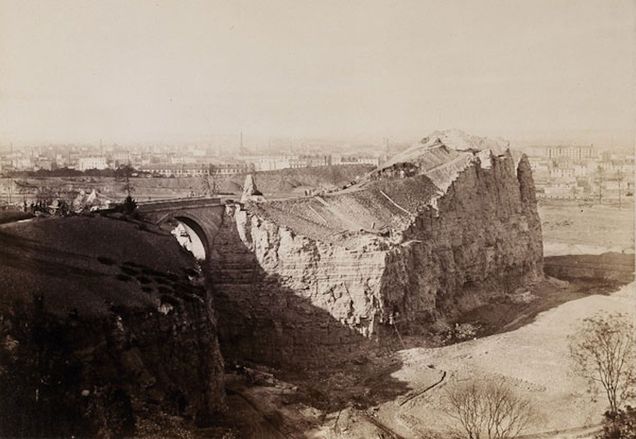
The Parc des Buttes-Chaumont was a new kind of spectacularized public works project. Breaking from the conventions of previous world’s fairs and exhibitions, installations at the 1867 Exposition Universelle were not limited to the Palais de l’Exposition; they bled out into the streets, putting renovated Paris on display.6 The concurrent debut of the Parc des Buttes-Chaumont demonstrates how sprawling the exhibition truly was. Named for the bleak topography that had previously occupied the site, Chauve-mont or bald hill, the park had an equally bleak history: for nearly 600 years it had housed the gallows where the French king not only hung criminals, but left them on display as a warning to any would-be delinquents. After the 1789 Revolution, it was used as a quarry and refuse dump (fig. 2). The seedy location was likely chosen for the contrast it provided with Alphand’s romantic vision, demonstrating the state’s modernity and power by paving over the site’s undesirable past.7 To any of the fair’s eleven million visitors, the awe-inspiring views and romantic features were only enhanced by knowledge of the gory wasteland that had preceded them.8
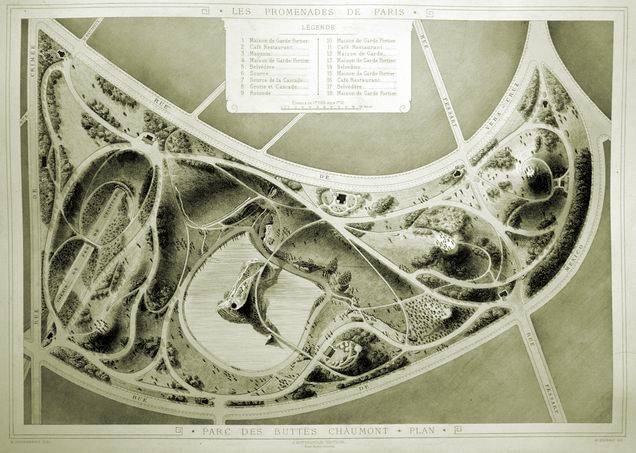
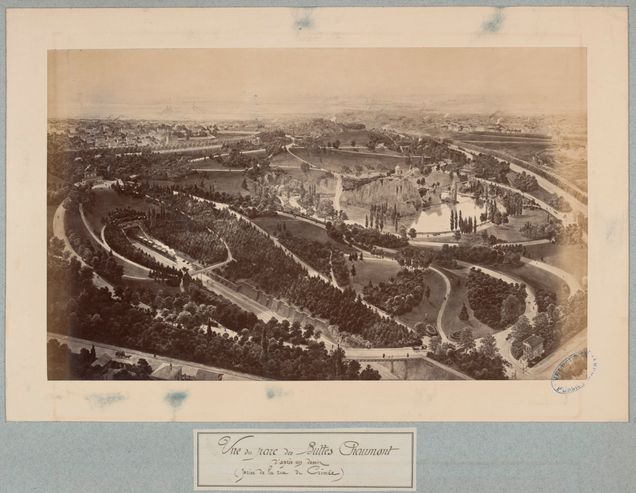
Ironically, the romantic natural feeling of the park was created with innovative artifice. Alphand envisioned a wild landscape punctuated with moments of the “engineered picturesque.”9 In order to evoke untouched nature, engineers employed technologies that eradicated the existing environment: concrete, landscaping, and water pumps. While Alphand’s functional concrete constructions, such as an artificial lake bed, were invisible to visitors, he also deployed the material as a surface treatment for innovative decorative features—cast faux bois (imitation wood) fences, rock faces, and stalactites were all made using concrete.10 Carefully designed vistas were visible from the elliptical paved paths snaking through the park (figs. 3 and 4).
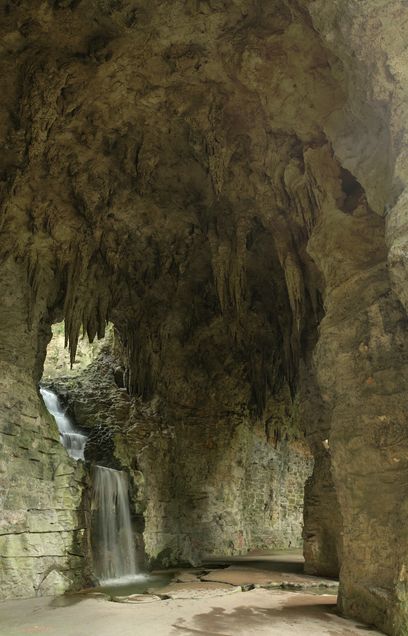
In one striking example, Alphand transformed a pre-existing lacuna in the granite, a result of quarrying, into a grotto complete with faux stalagmites and stalactites and a cascading waterfall (fig. 5). A space that had previously been nothing but cut stone now presented itself as a natural marvel. Ulf Strohmayer argues that this reconciliation of technology and landscape is “not so much an act of concealment but of acceleration….”11 In the period eye, the park’s design, a “landscape full of simulacra…modeled on repetitions,” was a triumph of humankind’s capabilities.12 To be able to reproduce the grandeur of the natural world was to play god. This power was put on full display in the park, creating a spectacle of technology and labor, the twin engines of modernization, masquerading as untouched nature. Concrete is not disguised; “it is resolved… into its products—which can thus celebrate both nature and human ingenuity.”13 A new landscape was formed, one that recast nature and culture as oppositional forces while demonstrating that, in truth, they produce one another.
The Parc des Buttes-Chaumont anticipates the end-product of this accelerating cycle of growth and modernization—modern, and even postmodern, Paris. Peter Collins, author of Concrete (1959), locates a shift from aristocratic favor for carving and masonry to a taste for democratic modes of building—casting and molding—in the late eighteenth century.14 Broadly, this reflects the changing values of the time, an acceleration towards a mass-consumer society. The widespread adoption and use of concrete aligned with a shifting social structure fomented by urban environments; cities industrialized, grew, and modernized to meet demand as people flooded in to provide labor. These new denizens became consumers of the goods produced under industrial conditions. By the mid-nineteenth century, concrete technology was ready to rise to society’s needs, supporting the new infrastructure of both mass production and mass consumption.
In the intervening century and a half, we have poured concrete at a monstrous pace. Concrete continues to lay the foundations for high-rises, highways, suburbs, subways, and urban sprawl, the infrastructure of modern life. It is second only to water in rankings of the world’s most used building materials.15 Due to a carbon-intensive production process, concrete is responsible for about eight percent of global carbon emissions.16 China is by far its largest consumer on earth, releasing 858.23 million tons of CO2 in 2020.17 This is largely the result of amped-up development projects designed to demonstrate state authority by dominating nature. In this way, China builds upon the Parc des Buttes-Chaumont’s legacy.
The Three Gorges Dam, one such infrastructure project, exemplifies how concrete use has developed globally from the nineteenth century to the present day (fig. 6). The concrete hydroelectric gravity dam in Hubei Province was ironically conceived in an effort to limit greenhouse gas emissions from coal. It has had an immeasurable impact on the surrounding environment—increasing risk of landslides, accelerating extinction of indigenous wildlife, displacing over a million Chinese residents, and flooding archaeological sites that once sat on the river’s banks. It is so massive that its weight is estimated to have increased the length of earth’s day by .06 seconds.18
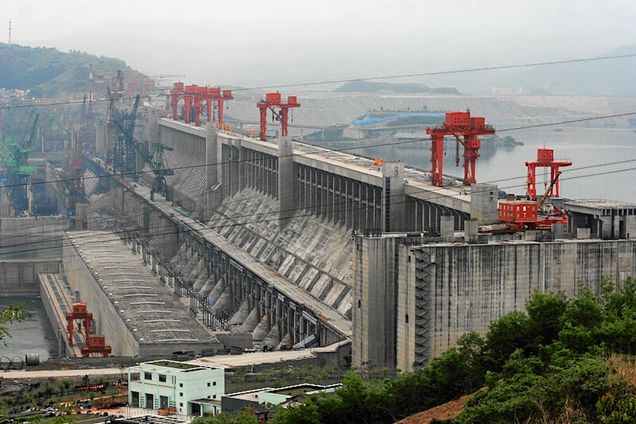
Archeologist Christopher Witmore uses the Three Gorges Dam, as imaged in Edward Burtynsky’s photographs, to describe the “Hypanthropos,” his neologism for our current epoch, defined by calamity and the often monstrous and unanticipated consequences of human projects.19 Witmore’s term is offered to replace the more commonly used “Anthropocene,” our current geological period defined by human impact on the stratigraphic record. In a 2018 paper on concrete and ice, anthropologists Tim Ingold and Cristián Simonetti identify concrete as “the most obvious candidate for marking the origin of the Anthropocene.”20 In their argument, concrete is the material that afforded humans enough power over the landscape to impact the geological record.
The term Hypanthropos is playfully constructed to remind us that, though the Anthropocene is marked by human activity, we are not in control. It is a double-entendre: the prefix hyp- recalls both the Greek prefix hyper-, meaning “excess, overwhelming being,” and hypo-, meaning “a sense of being under, beneath, [or] below something.” Humans, Witmore explains, are “suspended above and below”; they both overwhelm their environments and are contained within or overwhelmed by them.21 Hypanthropos’s multiple meanings displace the anthropos, the human, in their larger ecological context. The Parc des Buttes-Chaumont and the Three Gorges Dam are unique to the Anthropocene, human-made objects with massive environmental impacts. They reinvent nature “as contrast—with culture, with symmetry,” when, in reality, no such opposition exists.22 Nature is paradoxically both produced by and a container of culture, both hypo and hyper, above and below.
Witmore uses Burtynsky’s images of the colossal concrete dam as a medium for illustrating our suspension. If the Parc des Buttes-Chaumont modeled concrete’s usefulness in creating controlled landscapes, then contemporary concrete infrastructure projects, which have caused immeasurable and unpredictable ecological destruction, show the fallacy in that promise. Witmore reminds us that though the scale and impact of the Three Gorges Dam are astonishing, "Over the last two decades more than half of the concrete ever produced was mixed, poured, and set—4.3 billion tons were produced in 2014 alone. As for ‘water control and utilization’ projects, more than one large dam has been built every year for at least the last 60.”23 This is the legacy of Alphand’s experiments in concrete.
When the Parc des Buttes-Chaumont opened, it solidified the illusion that culture could dominate and tame nature, turning it into a reproducible commodity. Concrete was the critical technology in establishing the park’s “second nature,” an environment of artificiality.24 However, our current state of climate catastrophe has proved that illusion, or rather delusion, to be dangerously false. No matter how convincingly we cast imitation stalactites, they will never be more than cheap reproductions. Projects like the Three Gorges Dam remind us that our technological know-how does not elevate us above the natural world. No amount of concrete will remove us from the planet’s delicate ecosystem.
____________________
Madeline Porsella is an interdisciplinary historian and artist based in New York, NY. She studied studio art at Bard College and is currently pursuing her MA in Decorative Arts, Design History, and Material Culture at the Bard Graduate Center. Her research is focused on the late nineteenth and early twentieth centuries where her areas of interest include the incorporation of new technologies into art and design, new media, the relationship between science and the occult, and cultural constructions ranging from memory to the gendered body.
____________________
Footnotes
1. Ulf Strohmayer, “Urban Design and Civic Spaces: Nature at the Parc Des Buttes-Chaumont in Paris,” Cultural Geographies 13, no. 4 (October 2006): 570.
2. Strohmayer, “Urban Design and Civic Spaces,” 565.
3. Sianne Ngai, "Stuplimity: Shock and Boredom in Twentieth-Century Aesthetics," Postmodern Culture 10, no. 2 (2000). doi:10.1353/pmc.2000.0013.
4. Robert Macfarlane, “Generation Anthropocene: How humans have altered the planet forever,” The Guardian, April 1, 2016, https://www.theguardian.com/books/2016/apr/01/generation-anthropocene-altered-planet-for-ever.
5. Christopher Witmore, “Hypanthropos: On Apprehending and Approaching That Which Is in Excess of Monstrosity, With Special Consideration Given to the Photography of Edward Burtynsky,” Journal of Contemporary Archaeology 6, no. 1 (2019): 144.
6. Anne O’Neil-Henry, “Introduction,” Dix-Neuf 24, no. 2–3 (2020): 115–122.
7. Abigail Susik, “Aragon’s ‘Le Paysan de Paris’ and the Buried History of Buttes-Chaumont Park,” Thresholds, no. 36 (2009): 68.
8. Ann E. Komara, “Measure and Map: Alphand’s Contours of Construction at the Parc des Buttes Chaumont, Paris 1867,” Landscape Journal 28, no. 1 (2009): 35–36.
9. Ann E. Komara, “Concrete and the Engineered Picturesque the Parc des Buttes Chaumont (Paris, 1867),” Journal of Architectural Education 58, no. 1 (2004): 5.
10. Komara, “Concrete and the Engineered Picturesque,” 6–9.
11. Strohmayer, “Urban Design and Civic Spaces,” 565.
12. Strohmayer, “Urban Design and Civic Spaces,” 569.
13. Strohmeyer, “Urban Design and Civic Spaces,” 566.
14. Peter Collins, Concrete: The Vision of a New Architecture: A Study of Auguste Perret and His Precursors (New York: Horizon Press, 1959), 19.
15. Man-Shi Low, “Material Flow Analysis of Concrete in the United States,” (MS thesis, Massachusetts Institute of Technology, 2005), 11.
16. Justin Davidson, “Concrete Doesn’t Have to Be an Ecological Nightmare,” New York Magazine, December 3, 2021.
17. Hannah Ritchie and Max Roser, "CO₂ and Greenhouse Gas Emissions," OurWorldInData.org, accessed December 17, 2021.
18. Witmore, “Hypanthropos,” 139.
19. Witmore, “Hypanthropos,” 143.
20. Simonetti Cristián and Tim Ingold, "Ice and concrete: solid fluids of environmental change," Journal of Contemporary Archaeology 5, no. 1 (2018): 27.
21. Witmore, “Hypanthropos,” 143.
22. Strohmeyer, “Urban Design and Civic Spaces,” 565.
23. Witmore, “Hypanthropos,” 139.
24. Strohmeyer, “Urban Design and Civic Spaces,” 570.
Notes about Contributors
Colleen Foran is a PhD candidate studying African art at Boston University. Her research focuses on contemporary West African art, particularly on public and participatory art in Ghana’s capital of Accra. Prior to coming to BU, Colleen worked at the Smithsonian National Museum of African Art.
Katherine Gregory is an Art History PhD candidate at the University of Texas at Austin. A scholar of American art history, she is writing her dissertation on Robert S. Duncanson’s landscape paintings. She is the recipient of a 2022–2023 Luce/ACLS Dissertation Fellowship.
Sarah Horowitz is a PhD candidate in the history of art and architecture at Boston University. Her dissertation research focuses on the intertwined art, architectural, and urban histories of postwar American performing arts centers. Prior to pursuing her doctoral studies, she was the curatorial assistant at the Picker Art Gallery and the Longyear Museum of Anthropology at Colgate University. She received her MA in Art History from the University of Massachusetts–Amherst and BA in Art History and Museum Studies from Marlboro College.
Rowan Murry received her BA in Art History from the University of Mississippi and is currently pursuing an MA in Museum Studies at New York University. She is particularly interested in Ancient Roman art and archaeology, ethical collecting, and interactive technologies for physical and virtual exhibitions.
Darcy Olmstead is an MA candidate in Modern and Contemporary Art History (MODA) at Columbia University. Her current thesis seeks to explore artists’ publications in digital time by examining four recent projects by artists who utilize the form of the book to reflect on a world of chaos and hyper-culture brought about by digitization. She is originally from Fayetteville, Arkansas, and holds a Bachelor of Arts from Washington and Lee University.
Madeline Porsella is an interdisciplinary historian and artist based in New York, NY. She studied studio art at Bard College and is currently pursuing her MA in Decorative Arts, Design History, and Material Culture at the Bard Graduate Center. Her research is focused on the late nineteenth and early twentieth centuries where her areas of interest include the incorporation of new technologies into art and design, new media, the relationship between science and the occult, and cultural constructions ranging from memory to the gendered body.
Levi Sherman is a PhD student in Art History at UW—Madison. With a background in design and interdisciplinary art, he maintains a studio practice and co-operates a small press. Levi’s research interests include walking art, artists’ books, and the broader intersection of contemporary art, books, and libraries.
Farren Fei Yuan is an aspiring art researcher and critic. She graduated with a first class in BA in History of Art from The University of Oxford and is currently pursuing a MA in Modern and Contemporary Art: Critical and Curatorial Studies at Columbia University. Yuan has a special interest in image-text relations and post-war visual culture in the global context.
Meret Oppenheim: My Exhibition
Museum of Modern Art, New York
October 30, 2022–March 4, 2023
by Katherine Gregory

Upon hearing the name Meret Oppenheim (1913–1985, Germany), any person who has taken an introductory art history course will picture her fur-covered cup Le Déjuner en Fourrure (1936) (fig. 1). This sculpture has come to stand for Oppenheim’s entire oeuvre and, as such, has retroactively established her in the public consciousness as the feminist leader of the Surrealists. Oppenheim herself, however, resisted such gendered categorization of her fifty-year career that produced hundreds of works, ranging from paper collages to hard-edged abstractions to figurative painting and experimental photography. Oppenheim did not want to be thought of as just a woman artist or just a Surrealist, and thus she declined to be interviewed for or have any works reproduced in the definitive survey Women Artists and the Surrealist Movement (1985). The recent traveling exhibition Meret Oppenheim: My Exhibition, currently at MoMA, aims to transform that popular understanding of the artist, showcase the breadth of her output, and let her diverse artworks speak for themselves (fig. 2).
Organized chronologically, the exhibition opens with Oppenheim’s precocious debut with the Surrealists in Paris at age eighteen. Her early assemblages like Fur Gloves with Wooden Fingers (1936) are both feminine (with polished red nails) and outrageously grotesque (disembodied and eerily lifelike). These works invite her viewer to imagine touching and tasting these uncanny objects that simultaneously repel any possibility of sexual pleasure. In terms of the idea of “spectacle,” few artists seem more relevant than Oppenheim, whose titanic output has played with viewers’ ideas of the absurd, the horrific, the titillating, and the beautiful. The early Surrealist works (in the first rooms of the exhibition) exemplify the movement’s fascination with dreams, the subconscious, and the power of both to transform the world through enthusiastic creative expression.
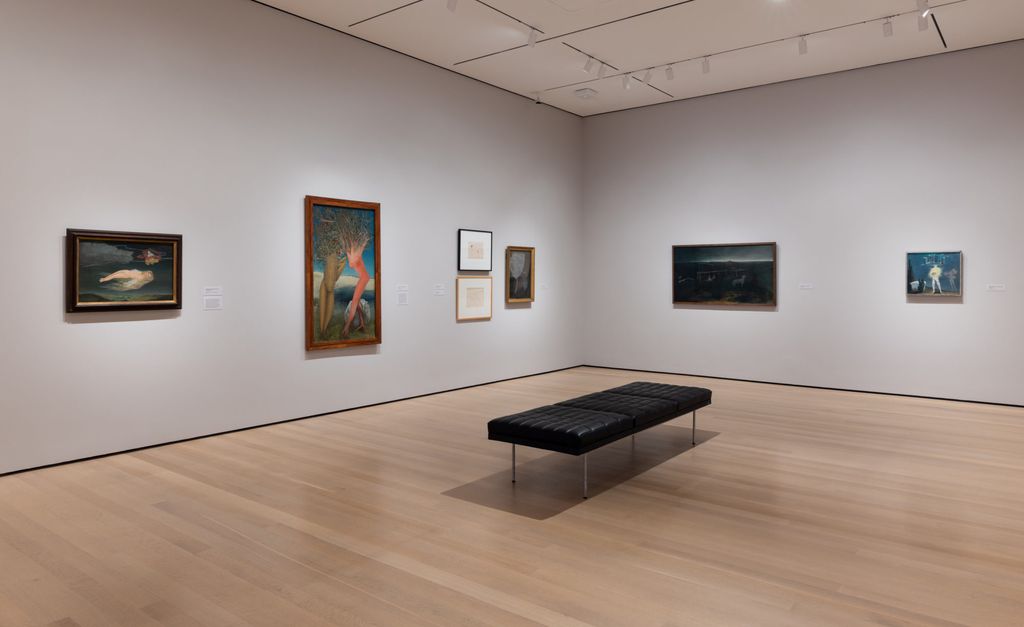
The exhibition then discusses Oppenheim’s prewar figurative painting, paying close attention to the artist’s engagement with fairy tales and legends. In 1937, Oppenheim left Paris because of the growing political tension in Europe. After fleeing Paris for rural Basel in the lead-up to World War II, she painted The Suffering of Genevieve (1939) (fig. 2), based on a fable about a banished young woman. The artist painted a nude, armless woman, circled by her golden hair, floating through the black night. The helpless yet beautiful woman (defined by Anglo-European standards of female perfection) embodies the spectacular disempowerment of female artists, celebrated for their feminine grace yet disarmed and thus unable to make unpleasant artistic or political statements. The curators suggest Oppenheim felt kinship with this character as an exile far from her creative home in Paris.
Although Oppenheim experimented with different media and expressive painting styles throughout her life, she often returned to familiar themes or stories. In 1954, Oppenheim began renting a new studio space in Bern and producing work that engaged with the Pop and Nouveau Realisme movements. Genevieve and Four Echoes retells the myth from her 1939 work in biomorphic abstraction, with curving, clover-shaped planes of color standing in for the fable’s titular character. Several galleries pay substantial attention to Oppenheim’s abstract paintings, collages, and sculptures, encouraging us to consider her non-figurative works with equal reverence as her well-known Surrealist assemblages. Oppenheim’s abstract works stun the viewer with their simple magnitude: she evokes natural shapes, pairs of lovers, or her own body with a language of forms that is both subtle and unambiguous. There She Flies, the Beloved (1975) is a painting depicting a hermaphroditic shape – both phallic and triangular – rocketing across the picture plane. Oppenheim believed in a “dual-sex spirit” present in herself, and that delineating a hard line between “male” and “female” forms or themes belittled the creative impulse that powered her work. Here, we might consider the spectacular power of deconstructing the gender binary in such an unambiguous, powerful visual language, playing on and breaking up “gendered” shapes with vivid turquoise paint, richly textured tortoiseshell, and molded plastic shapes.
The title of the Museum of Modern Art’s exhibition originates from a series of drawings Oppenheim produced in the final years of her life (fig. 3). Titled My Exhibition, the artist designed her own retrospective with a suite of drawings chronologically organized that depict miniaturized and scaled colored sketches of 200 works. Placed as a mid-exhibition pause, MoMA presents the entire suite of drawings in their own gallery, so that the viewer might see how Oppenheim conceived of her own career as an elder artist. MoMA’s exhibition celebrates Oppenheim by prioritizing the artist’s vision of her own career, encouraging the viewer to reconsider how they have previously considered Oppenheim’s work and how they might expand their understanding of her. One might, as Oppenheim herself wanted, to centralize the spectacular, not just the surreal, in her work.

____________________
Katherine Gregory is an Art History PhD candidate at the University of Texas at Austin. A scholar of American art history, she is writing her dissertation on Robert S. Duncanson’s landscape paintings. She is the recipient of a 2022–2023 Luce/ ACLS Dissertation Fellowship.
____________________
Editors’ Introduction
by Sarah Horowitz
The term “spectacle” encompasses an array of meanings across disciplines. As early as the seventeenth century, “spectacle” was associated with the theatrical displays of early English drama. Furthermore, the rise of a new middle class particularly in France during the nineteenth century gave way to new interpretations of the expression.1 “Spectacle” in this historical context became linked to socio-economic ideas of capitalism. More recently, the word has taken on more abstract, conceptual definitions, particularly in scholarly understandings of postmodern society. For instance, cultural and political theorist Guy Debord’s idea of a “society of the spectacle” in the late 1960s offers a useful explanation and critique of capitalist culture, one in which excess imagery mediates human interpersonal relationships.2 “Spectacle” often connotes performativity in our contemporary world as the ubiquity of new media—film, multimedia installation, and other immersive spaces—transforms and sometimes disrupts our perceived realities.
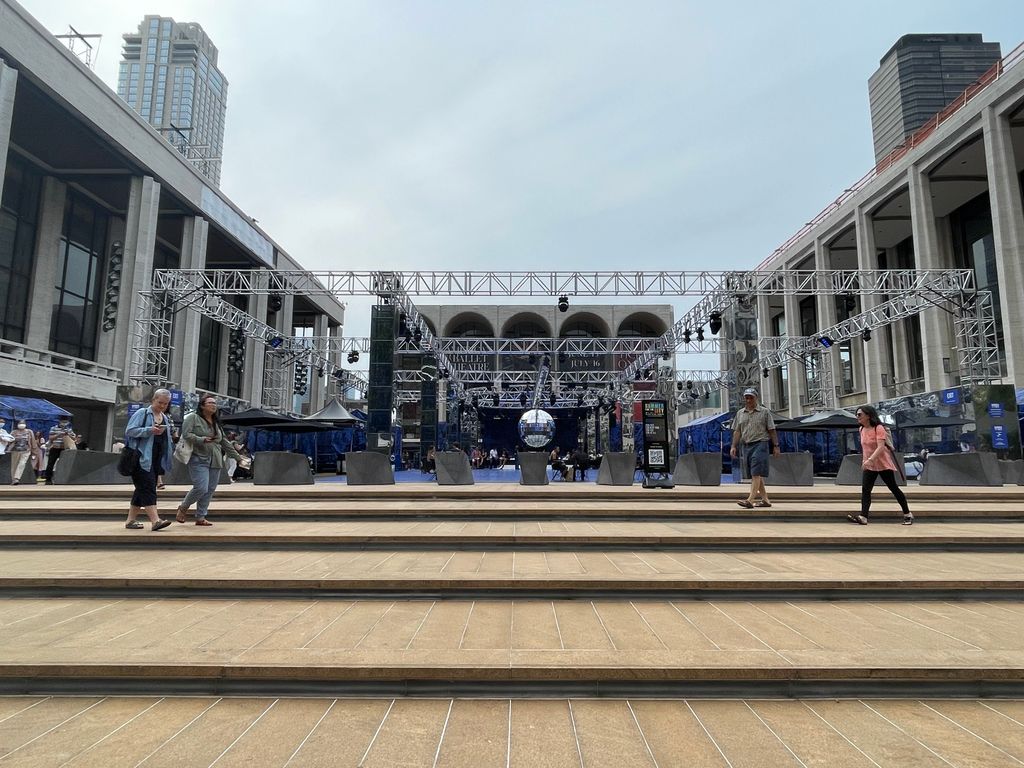
Debord’s notion of “spectacle” is valuable for interpreting art and architecture. While his seminal text The Society of the Spectacle was published in 1967, Debord’s theories about consumerist tendencies can be applied to different situations across artistic media, time periods, and geographic boundaries. As an architectural historian, I want to call attention to how Debord’s philosophies of the spectacle aid in an understanding of postwar American architecture, specifically the example of performative spaces such as Lincoln Center for the Performing Arts in New York City. The building project was a collaborative effort in which American architect Wallace K. Harrison led a team of prominent modern designers in drawing up a plan for the premier performing arts complex in the United States. The centerpiece for the Lincoln Center campus is a large rectangular plaza—modeled after a Renaissance-era piazza—framed by the travertine-clad arcaded facades of the New York State Theater (now David H. Koch Theater), Metropolitan Opera House, and Philharmonic Hall (now David Geffen Hall) (fig. 1). As a public outdoor space, the plaza contrasts with the exclusive indoor environments of the surrounding performance venues where in order to enter, one must be a paying customer. These tensions of who is privy to these exterior and interior spaces at Lincoln Center evoke Debordian ideas of the spectator and passive consumer. According to Debord, the experience of these outside and inside realms at Lincoln Center would be solely mediated by capitalism and consumer relationships. We, as a result, become enveloped by this spectacle of confrontation with multiple sensory environments—architectural, performative, and visual. However, I would argue that people traversing the plaza or attending a performance at Lincoln Center assume more agency than Debord implies in their engagement with these spaces. By actively moving through and participating in the various landscapes and buildings making up Lincoln Center, people become a fundamental part of the spectacle.
In this issue of SEQUITUR, notions, expressions, and experiences of “spectacle” are thoughtfully considered by the selected contributors. In her feature essay “Paved Paradise: The Concrete and the Stuplime at Parc des Butte-Chaumont,” Madeline Porsella explores tensions between nature and culture in the use of concrete to create the Parc des Butte-Chaumont, a man-made landscaped park that opened in Paris in conjunction with the Exposition Universelle of 1867. Porsella draws a striking comparison between the park’s spectacular display of new materials and technology in the late nineteenth century with the detrimental impacts of concrete on the present-day Anthropocene.
Rowan Murry also discusses spectacle in the context of the built environment and historic preservation. Focusing on the archeological site of Pompeii as an example of what she defines as “tourist folklore,” Murray examines how this ancient ruined city—one of the most visited UNESCO world heritage sites—is remarkable for its associations with magic and a fabled curse where visitors stealing material objects from the site bear the consequences of their actions. The essay presents an intriguing interpretation of Pompeii as a place haunted by this “dark tourism” where historic preservationists must balance their responsibility as custodians of a historic site with the lucrative possibilities of promoting ahistoric and potentially harmful tourist folklore.
The third feature essay in this issue conjures up one of the major debates concerning the spectacle and its definition and representation in art, architecture, and other forms of visual culture: where do the boundaries of the spectacle lie? In “Ruining the Spectacle: Nikita Gale’s END OF SUBJECT,” Darcy Olmstead probes the possible limits of the spectacle embodied in the work of contemporary installation artist Nikita Gale. Referencing the past theories of the spectacle and visuality put forth by Debord and art historian Jonathan Crary, Olmstead argues that Gale’s multimedia work offers a disjointed view of the spectacle where viewers are constantly pulled in competing directions by different visual and auditory elements. The spectacle in this case implodes.
These fluid parameters of what defines—or even obliterates—the spectacle are further questioned in this issue’s research spotlights and exhibition reviews. Levi Sherman investigates how the concept of institutional critique can be applied not only to museums and archives, but also libraries. Sherman asks readers to reconceive the public institution of the library as a space where artists can intervene to reveal power dynamics between these institutions and the patrons they serve. In contrast, ambiguous relationships between performance artists and (paying) spectators at the Chale Wote Street Art Festival in Ga Mashie, Accra, explored by Colleen Foran, expose the haziness of the spectacle and its precise definition.
In some instances, the spectacle transforms into the uncanny. Exhibitions such as The Amant Foundation’s SIREN (some poetics), reviewed by Farren Fei Yuan, problematize the viewer’s engagement with and experience of the everyday as it is visually expressed in contemporary art installations inside and outside the gallery spaces. Like Olmstead and many of the other authors included in this issue, Yuan suggests that there is an inevitable dissolution of the spectacle that takes place in the tug of war between perception and so-called reality. Spectacle and its connection to the uncanny are clearly discerned in Katherine Gregory’s critique of Meret Oppenheim: My Exhibition, on view at the Museum of Modern Art, New York. Gregory contends that by representing the breadth of Oppenheim’s work beyond the artist’s most famous surrealist sculptures, the exhibition sheds light on other aspects of Oppenheim’s artistic career, including the spectacular. For example, the artist’s dissolve of gender binaries in her work, Gregory suggests, becomes a means by which Oppenheim engages with spectacle.
While it may be a futile effort to pinpoint the boundaries of the spectacle, the authors in this fall’s issue of SEQUITUR uncover the possibilities of the term for articulating intangible bonds and disjunctures between spectators and the visual and built environment. Systems of control and power may exist in the capitalist society portrayed by Debord, but we have the authority to shape the spectacular into something of our own making.
____________________
Sarah Horowitz is a PhD candidate in the history of art and architecture at Boston University. Her dissertation research focuses on the intertwined art, architectural, and urban histories of postwar American performing arts centers. Prior to pursuing her doctoral studies, she was the curatorial assistant at the Picker Art Gallery and the Longyear Museum of Anthropology at Colgate University. She received her MA in Art History from the University of Massachusetts–Amherst and BA in Art History and Museum Studies from Marlboro College.
____________________
Footnotes
1. French cultural theorists Jean Baudrillard and Walter Benjamin as well as British art historian T.J. Clark have previously written about the emergence of capitalism and middle class society in nineteenth-century France.
2. Guy Debord, The Society of the Spectacle (1967), trans. Donald Nicholson-Smith (New York: Zone Books, 1994).
Ruining the Spectacle: Nikita Gale’s END OF SUBJECT
by Darcy Olmstead
Nikita Gale’s 2022 installation, entitled END OF SUBJECT, at David Zwirner’s 52 Walker gallery is a wreck. It features a set of enormous bleachers, some bent and smashed, strewn haphazardly across the gallery (fig. 1). Visitors are invited to sit wherever they can, but any position on the cold metal is uncomfortable, making it impossible to observe the work with ease. What people then look upon is a confusing ruin: dangling cords, flashing spotlights pointing out at odd directions from the walls and the floor, and scratched metallic surfaces. It is as if one has entered a school gymnasium after it had been bombed.
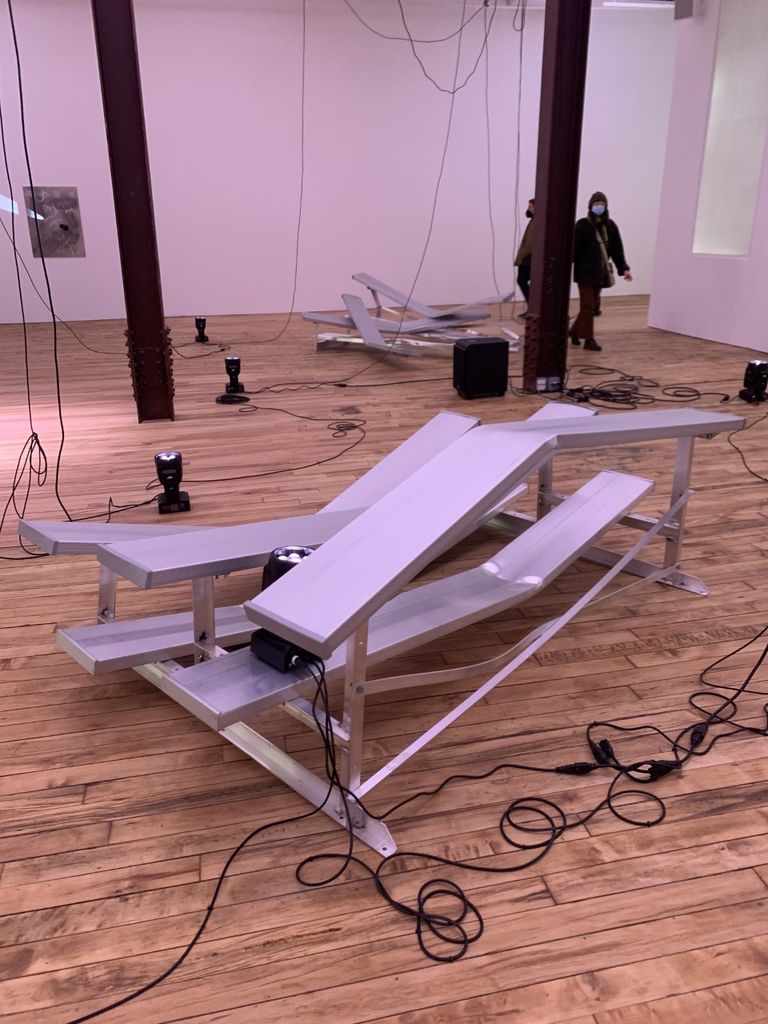
In the aftermath of the explosion, a strange soundtrack bounces off the walls and flickering lights fill the room. Nikita Gale’s immersive installation includes an engineered soundscape: Toni Morrison reading Sula, an original audio track by composer Tashi Wada, beating rain, claps of thunder, laughing and crying, a dog barking, and the artist whistling.1 The soundtrack reverberates through a series of metallic prints on the walls of the gallery. Gale explains that “the sounds are from widely disparate contexts so there’s a sense of kind of sonically rummaging through ruins—tidbits and vignettes from widely varying environments and contexts.”2 Gale provides a stream of content in the soundtrack for the installation, but each sound is presented in fragments. Audience members are presented with a sonic archive full of holes and a gallery space in ruins. On the walls are Gale’s “Body Prints,” composed of burnished and painted aluminum panels incised with bodily words such as “finger,” “penis,” “mother,” etc. In an interview for the New York Times, Gale explained that she is “interested in using language to examine different systems that render a body legible as human, gendered, racialized, and so on.”3
In her installation practice, Gale is dismantling the spatial systems that anchor the observer to their own body, thus engaging with longstanding art historical inquiries into spectatorship. She presents a phenomenologically rich space, one that brings the ruins of an amphitheater or stadium into the gallery—all areas where power is negotiated and attention is controlled and directed. Amid bleachers and spotlights, the individual body of the viewer is dismantled into unrecognizable, uncategorizable parts.
Gale says that her initial proposal for the installation came from “thinking through how the activities and ‘tasks’ of the human sensory system… can activate or deactivate structures that inform how subjects… are rendered or alienated/made invisible.”4 Gale therefore acknowledges a long history of theoretical models discussing the observer. This history is famously explored in art historian Jonathan Crary’s 1992 Techniques of the Observer, in which the author examines how capitalism developed a visual model of consumption for the modern subject in the nineteenth century.5 Building upon the work of Michel Foucault, Crary produces a history of visuality that is based in modern systems of control:
[In the 1820s and 1830s] emerges a plurality of means to re-code the activity of the eye, to regiment it, to heighten its productivity and to prevent its distraction. Thus the imperatives of capitalist modernization, while demolishing the field of classical vision, generated techniques for imposing visual attentiveness, rationalizing sensation, and managing perception. They were disciplinary techniques.6
Crary discusses nineteenth-century optical devices—from the panorama, to the stereoscope, the camera, and eventually the moving picture—to examine how the human eye was “re-coded” for control.
Gale uses materials and structures within such a tradition critical of the materials and devices used to direct the modern observer. This is most evident in her discussion of the sporadic lighting installation for END OF SUBJECT, in which Gale positions spotlights on various metal prints and upon the columns of the gallery pointing in random directions:
I often use spotlights in my work because… they’re objects that tell you where to look and direct attention in a way that I find really seductive… So the spotlight is a useful metaphor for thinking about power in the context of the public arena: the stage, or wherever we focus our attention, represents where power is concentrated.7
The structures implemented for crowd control and dominant modes of visuality are concepts crucial throughout the installation. Gale takes sites of power like arenas and stages where observers are directed and restrained, and instead allows room for movement and distraction without purpose. The visitor is rarely comfortable, never allowed to be fully immersed in the work. Every auditory and visual disruption made throughout the performance is a means to break the spectacle.
The spectacle, as theorized by Guy Debord in Society of the Spectacle (1967), describes how the visual culture of modern society is used to regulate the spectator. Gale’s work rebuts the spectacle described by Debord: “the spectacle’s estrangement from the acting subject is expressed by the fact that the individual’s gestures are no longer his own; they are the gestures of someone else who represents them to him” on a screen or in an image.8 Gale seeks to counteract the spectacle through appeals to the individual’s corporeality. For one, visitors are forced to step over a series of wires and constantly move over and around sets of bleachers in END OF SUBJECT. Lights flicker on and off at random intervals, forcing viewers to use their sense of touch among other senses outside the visual. Debord, in one famous passage, writes that “when the real world is transformed into mere images, mere images become real beings—figments that provide the direct motivations for a hypnotic behavior.”9 Gale’s installation refuses to rely upon such methods. Any time a viewer begins to be immersed in one aspect of her work, the soundtrack or lighting pulls them from near hypnosis. The spectacle loses its hold.
Yet END TO SUBJECT does not merely seek to dismantle systems of power and visual control, but to bring the body back to the viewer through a form of what curator Eric Booker calls “reverse archaeology.”10 Gale’s implication of the spectator in her work comes from an anthropological understanding of architecture and technology informed by her degrees in archaeology and sociology. Describing her practice in the 2018 Studio Museum exhibition catalogue Fictions, Booker continues, “Initially drawn to an object for its aesthetic or physical qualities, the artist works her way back through each facet of its form—carefully researching its history and use, as well as evaluating the physical and personal experiences she has had with it.”11 She studies the way power is embedded in the gallery, the auditorium, or the arena, and then she disrupts it. Viewers thus step through the ruins of the spectacle itself.
Gale, rather than looking directly to a specific archive, investigates the archaeology of the present and proposes a space for the viewer to imagine bodily alternatives. In an interview with art21, Gale said that “It’s almost like I think of each of my works and each installation as a portal or an invitation to a conversation… [my installations] are creating a permanent record of a gestural, almost fugitive movement between structures or armatures associated with control.”12 Not only are her works future ruins, but future archives—she is attempting to force her spectators to act as archaeologists of their own lives. Debord wrote that “the real values of culture can be maintained only by actually negating culture. But this negation can no longer be a cultural negation. It may in a sense take place within culture, but points beyond it.”13 Gale’s spotlights never point directly upon objects in the room, but beyond them. In Gale’s work, the spectacle has been destroyed, but a space for conversation—a space to fabulate a new future where bodies cannot be so easily racialized, gendered, and coded for control—lies in the wreckage.
____________________
Darcy Olmstead is an MA candidate in Modern and Contemporary Art History (MODA) at Columbia University. Her current thesis seeks to explore artists’ publications in digital time by examining four recent projects by artists who utilize the form of the book to reflect on a world of chaos and hyper-culture brought about by digitization. She is originally from Fayetteville, Arkansas, and holds a BA from Washington and Lee University.
____________________
Footnotes
1. Madeline Schulz, “Nikita Gale ‘END OF SUBJECT’ at 52 Walker,” Flaunt Magazine, February 14, 2022, https://archive.flaunt.com/content/nikita-gale.
2. Nikita Gale quoted in Shulz, “Nikita Gale, ‘END OF SUBJECT’ at 52 Walker.”
3. Nikita Gale interviewed by Janelle Zara, “From Nikita Gale, A Panel Etched with ‘Blood,’ ‘Nerves’ and ‘Knee,’” New York Times, February 18, 2022.
4. Madeleine Seidel, “Nikita Gale: ‘END OF SUBJECT,’ 52 Walker, New York,” BURNAWAY, April 7, 2022, https://burnaway.org/magazine/gale-zwirner/.
5. Jonathan Crary, Techniques of the Observer : On Vision and Modernity in the Nineteenth Century (Cambridge: MIT Press, 1992).
6. Crary, Techniques of the Observer, 24.
7. Janelle Zara, “From Nikita Gale, A Panel Etched with ‘Blood,’ ‘Nerves’ and ‘Knee,’” New York Times, February 2022.
8. Guy Debord, Society of the Spectacle (1967), trans. Ken Knabb (London: Rebel Press, 2014), 10.
9. Debord, Society of the Spectacle, 5.
10. Eric Booker, “Object Complex,” in Fictions (New York: Studio Museum, 2018), 48.
11. Booker, “Object Complex,” 49.
12. Essence Harden, “In The Studio: Nikita Gale,” Art21, accessed March 21, 2022, https://art21.org/read/in-the-studio-nikita-gale/.
13. Debord, Society of the Spectacle, 114.
Reconsidering Performance Art: History, Tradition, and Contemporaneity at Chale Wote in Ga Mashie, Accra
by Colleen Foran
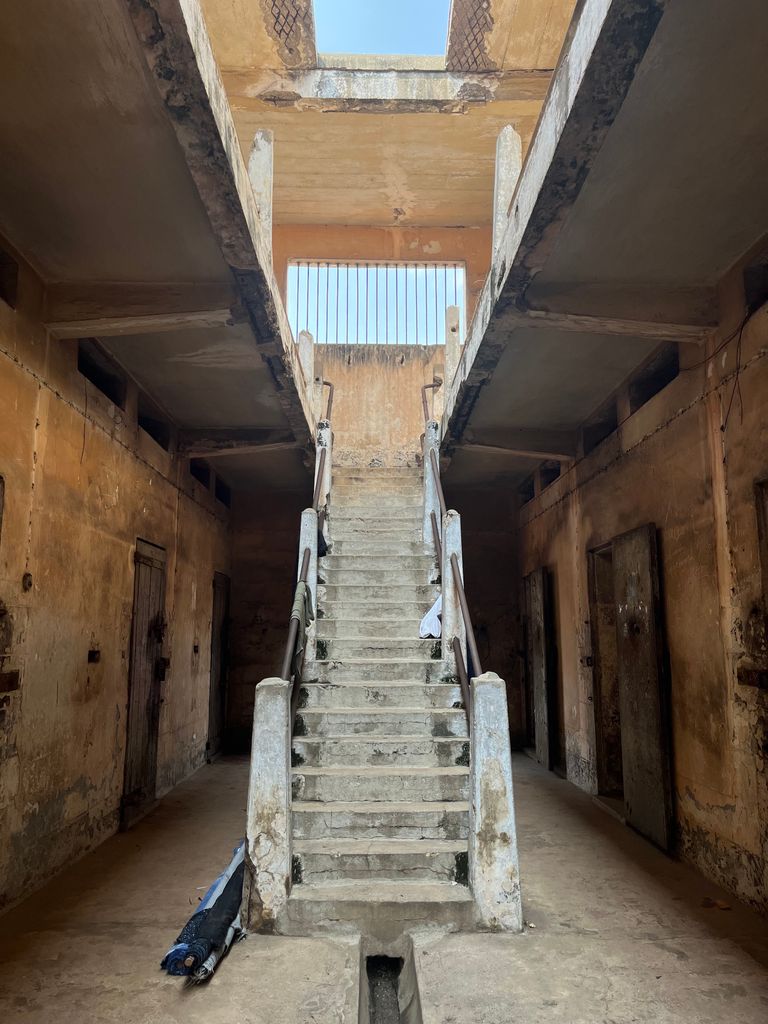
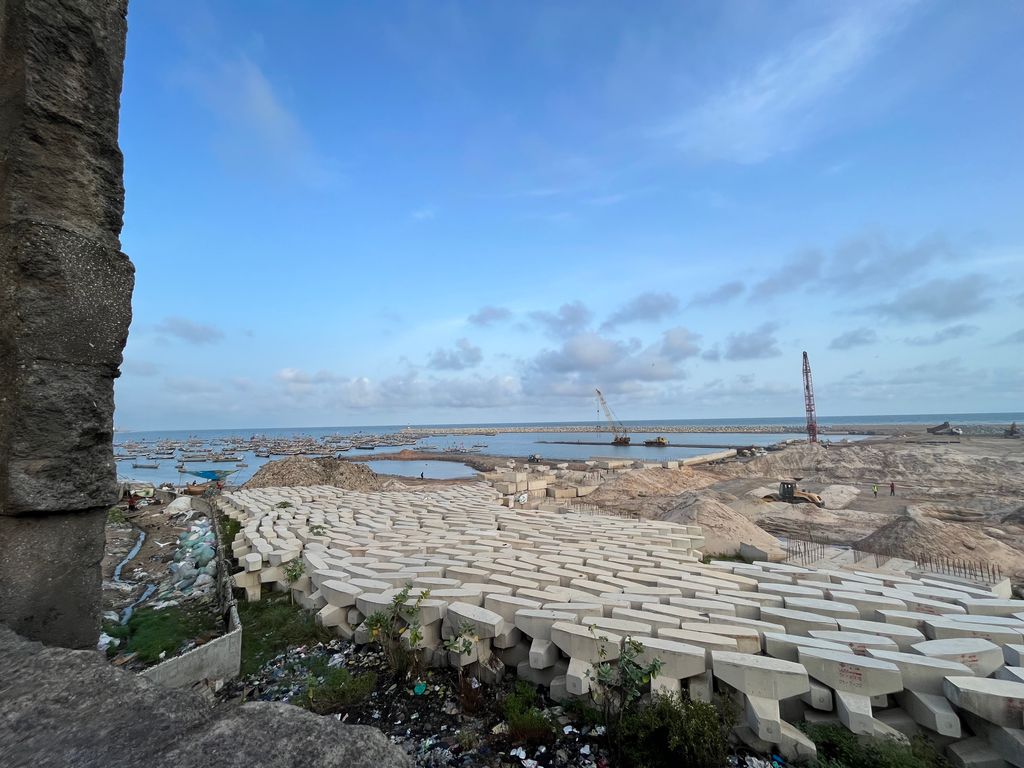
“That area looks ancient,” a cabdriver responded to my stated destination in Ga Mashie. While the neighborhood is not actually ancient, I understood the sentiment. Ga Mashie constitutes “Old Accra” and contains the Ghanaian capital’s oldest standing buildings.1 Constructed by European companies as defensive forts for trade goods, these structures date from the seventeenth century.2 The outposts later became hubs of the transatlantic slave trade (fig. 1).3 Prior to European incursion, the area was a village populated by fishermen from the Ga ethnic group. Many of the neighborhood’s current residents trace their lineage and livelihoods back to these inhabitants, even as the profession’s viability has declined due to climate change and industrial overfishing (fig. 2). Shipping and retail outposts that prospered during the colonial period have largely moved to the outer reaches of the Greater Accra Metropolitan Area.4 This economic decline has been paralleled by infrastructure decay.
Ga Mashie remains a vibrant and culturally rich space. The area echoes with the cheers and jeers of its famed boxing gyms, thumping base from funerals, and dice hitting plastic Ludo boards. Every year, residents perform vital processions like the Yams Festival for Twins and Hɔmɔwɔ Festival as markers of ethnic identity and social definition.5 Hɔmɔwɔ celebrates the end of a historical famine and is the most important event on the Ga community’s calendar.6 The Chale Wote Street Art Festival has become another annual marker for Ga Mashie. Held every August since 2011, the week-long event draws crowds from around Ghana and, increasingly, the world. The festival transfigures the space of Ga Mashie. Vendors and visitors throng John Evans Atta Mills High Street, closed to traffic for Saturday and Sunday (fig. 3).7 Artwork is installed in the historic forts (fig. 4) side-by-side with live performances activating the space (figs. 5, 6).8
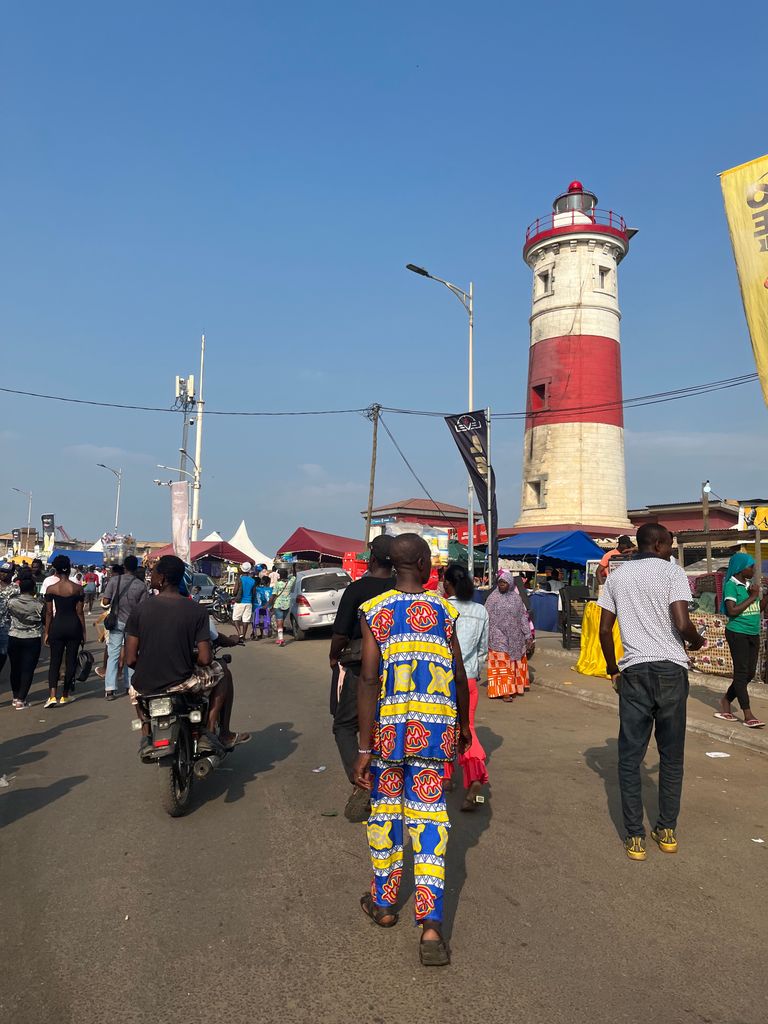
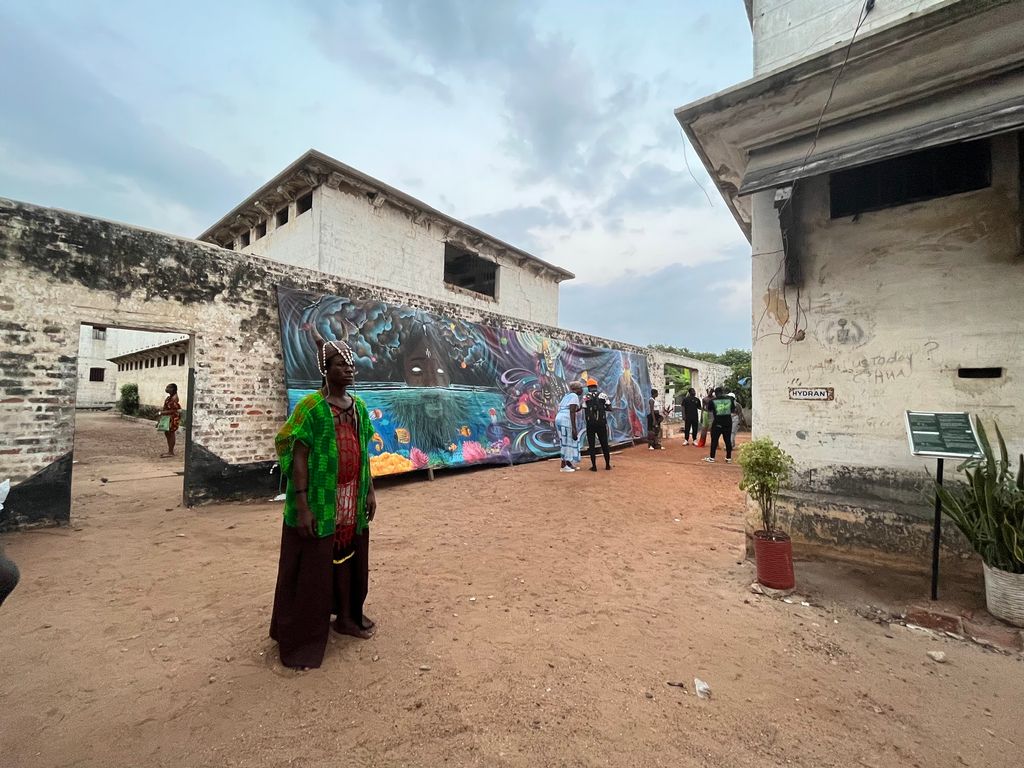
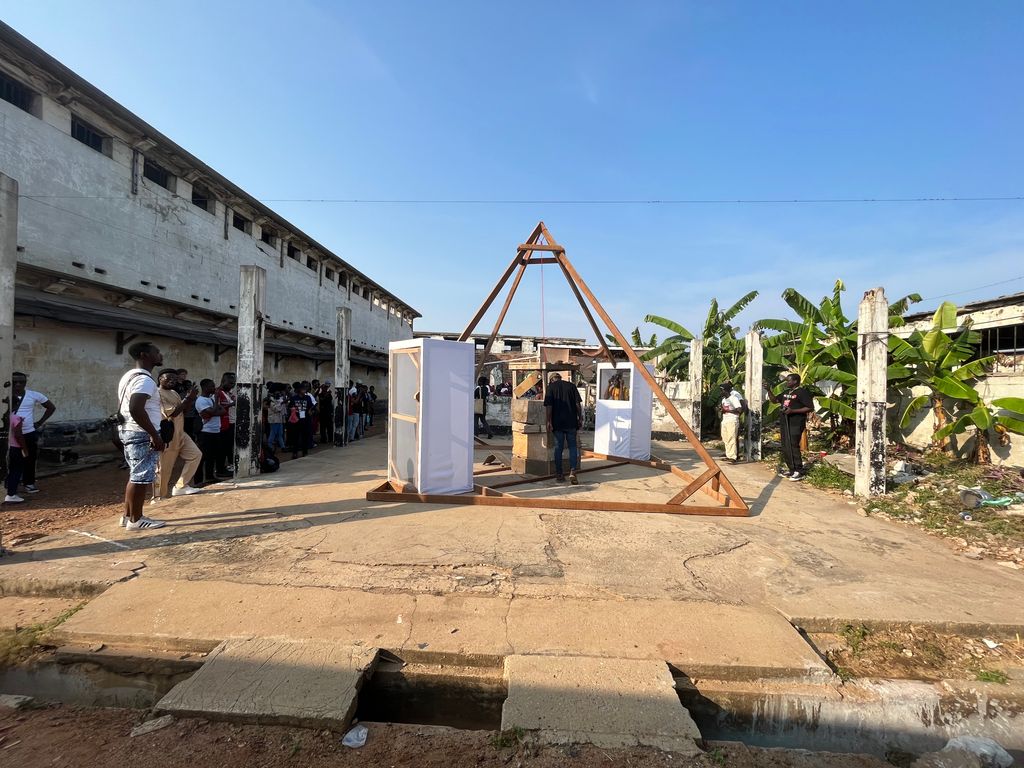
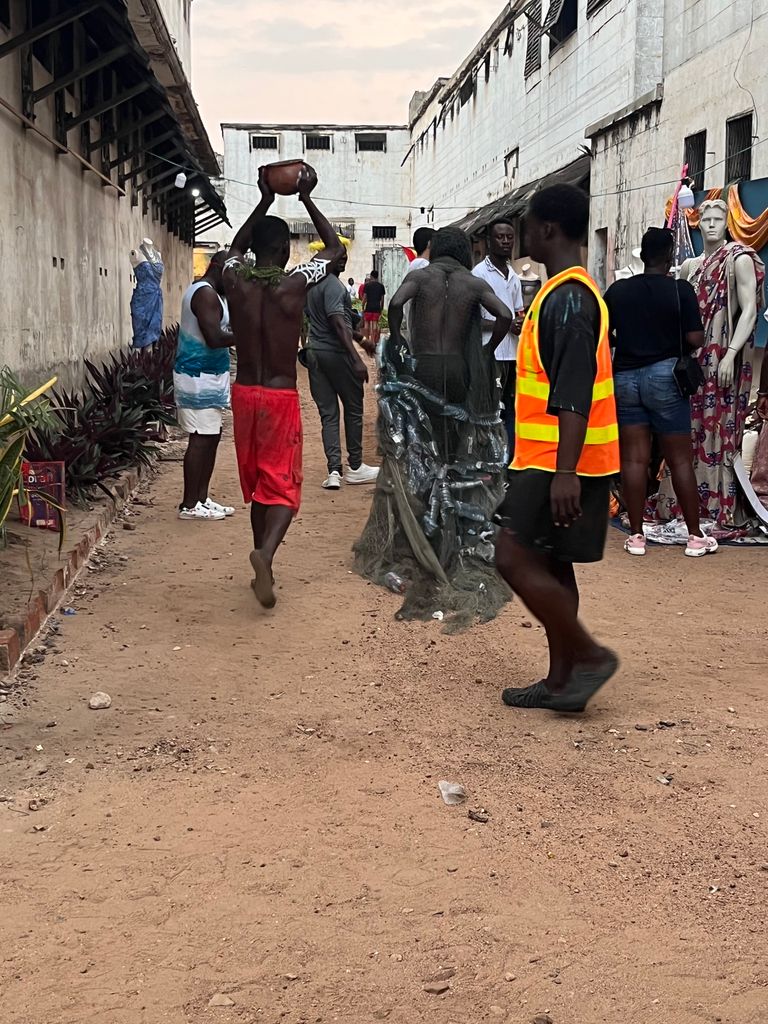
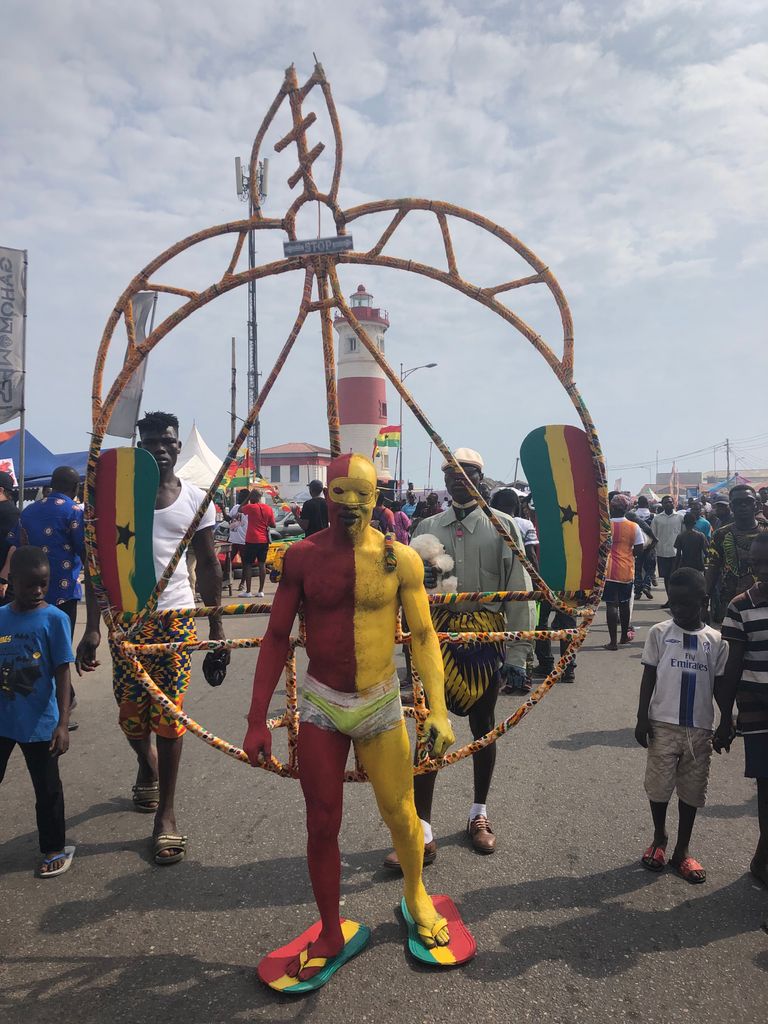
Figure 3. Scene from 2022’s Chale Wote Street Art Festival with the Jamestown Lighthouse in the background. John Evans Atta Mills High Street, Accra, Ghana. Photograph by the author, 2022; Figure 4. Scene from 2022’s Chale Wote Street Art Festival with mural by Nii Nortey Hamid (b. Ghana, 1987) in the background. Ussher Fort, Accra, Ghana. Photograph by the author, 2022; Figure 5. Martin Toloku (b. Ghana, 1992). EnU va DZinYE (I’m Possessed) (2022). Durational performance. Chale Wote Street Art Festival, Ussher Fort, Accra, Ghana. Photograph by the author, 2022; Figure 6. Scene from Nana Yaw Ananse’s performance Pour Pure Power Proposal for African Prosperity and Posterity Proposal (2022) with clothing vendors in the background. Chale Wote Street Art Festival, Ussher Fort, Accra, Ghana. Photograph by the author, 2022.
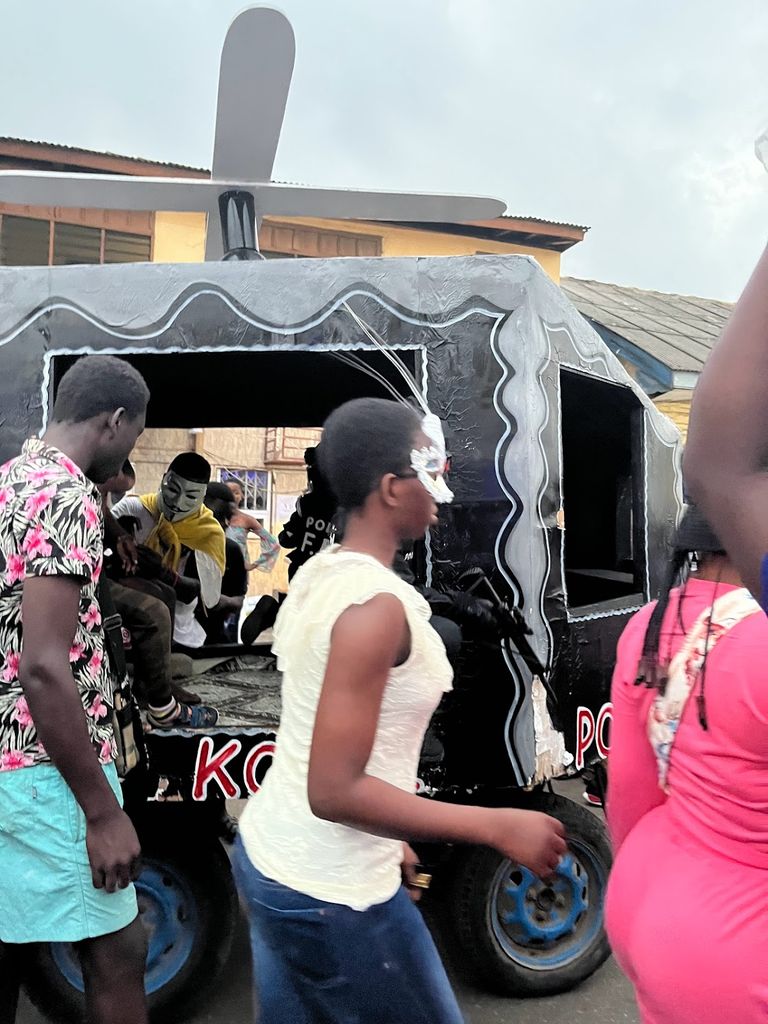
Chale Wote also brings out many unofficial performers who dress as outlandishly as possible to draw attention and photography fees (fig. 7). Delighted attendees can join in the fun by paying to get their faces painted or by purchasing cheap plastic masks (see fig. 8). Coming across a procession, the spectator must guess if it is art, spectacle, or something in between. Through this productive confusion, Chale Wote challenges standard expectations for performance art.
I came across a poignant example of such blurred boundaries at the 2022 festival: a wheeled cart transformed by plywood into a helicopter was decorated with hand-painted slogans like “Fear God” and accompanied by children costumed in “Police F.B.I.” uniforms with fake semi-automatics (fig. 8). For an encouraged fee, onlookers could place their own children inside the helicopter for a photograph opportunity. I was left asking—was this a comment on American imperialism? A way to draw attention, and earn cedis, the Ghanaian currency, in the thronged High Street? Or was it just plain cool, a recreation of violent Hollywood films? I argue that the blurring of lines between critical art, commerce, and popular culture is an essential feature, not a bug, of Chale Wote, one that asks big questions around the purpose of short-term art events, the spaces in which they take place, and the audiences they exist to serve.
Because of the centrality of performance art to its program, Chale Wote has been correlated with the myriad contemporary art fairs and biennials that have cropped up since the turn of the twenty-first century. Biennalization both reflects and shapes what contemporaneity under globalization looks like and who it benefits; the audiences for such events are often Western European and American visitors who drop in for singular performances.9 And yet, even as it gains international renown, Chale Wote continues to draw a local audience. Organizers have sustained this interest by tying the festival into Ga Mashie’s long-standing ritual processions. Recent program materials have explicitly listed the Yams Festival for Twins and Hɔmɔwɔ as event kick-offs.10 These religious celebrations are presented as anchors for Chale Wote’s goal of bringing contemporary art into public space.11 This year, a Beninese group performed Egungun and Zangbeto masquerades in what promoters described as “the most versatile public performance[s] of mythical imagination in West Africa.”12
Seen within the context of Chale Wote, it becomes difficult to read the above as simply “traditional” examples of African masquerade.13 These processions are an integral part of the festival’s spectacle and its substance, entertaining while also serving a crucial function for community social and spatial self-fashioning within Ga Mashie. This calls into question what we consider contemporary and what we relegate to tradition. European and American art historians have typically discussed performance art as a break with tradition.14 African art history has theorized performance differently—signified, not least, by the fact that African art’s historiography often discusses “performance” without the appellation of “art.”15 Emerging out of the discipline of anthropology and the ethos of area studies, African performance is most often discussed as an expression of static ethnic identity.16
By placing cutting-edge artists in spatial conversation with historical ritual processions, Chale Wote underscores that performance art is nothing new in African art.17 Performance art is not always a radical break from “tradition” but can also be a continuation of a rich legacy of movement through space to address social issues and contest political realities. This conceptualization explains the festival’s staying power and the role it continues to play in the Ga Mashie community. Yet multiple interviewees have told me that the festival is at a tipping point. Many believe it is at risk of becoming purely a food fair—an excuse to drink beer, do some tchotchke shopping, and dance at evening concerts. As I write from the fall of 2022, Ghana is facing rampant inflation and extreme economic strife.18 My research works to understand whether a once-a-year event can do enough to change daily life for Ga Mashie residents. Will its performance art retain the political edge necessary to trouble the status quo? Or might Chale Wote’s critical, cutting-edge art be overwritten by its own spectacle?
____________________
Colleen Foran is a PhD candidate studying African art at Boston University. Her research focuses on contemporary West African art, particularly on public and participatory art in Ghana’s capital of Accra. Prior to coming to BU, Colleen worked at the Smithsonian National Museum of African Art.
____________________
Footnotes
1. Abibata Shanni Mahama, Ama Twumwaa Acheampong, Oti Boateng Peprah, and Yaw Agyeman Boafo, Preliminary Report for Ga Mashie Urban Design Lab (New York: Millennium Cities Initiative, 2011), 2.
2. D. A. Tetteh and K. Y. Tuafo, James Town, British Accra: A Brief History, Luminaries & Landmarks (Accra, Ghana: African Stories Press, 2018), 9–11, 17.
3. While the forts were originally built to house material goods, the rapid growth of the slave trade meant that the buildings were repurposed to cruelly house human beings kidnapped from their communities to be transported and sold in South and North America and the Caribbean. Today, the only forts still standing in Ga Mashie are James Fort and Ussher Fort, though others are extant throughout Accra and Ghana. While these forts have been declared UNESCO World Heritage sites, their levels of preservation vary. They are often in very bad condition; UNESCO World Heritage Convention, “Forts and Castles, Volta, Greater Accra, Central and Western Regions,” accessed November 10, 2022, https://whc.unesco.org/en/list/34/.
4. The colonial era in Ghana ended in 1957, when it declared its independence from the United Kingdom. However, Ga Mashie’s economic decline is considered to have begun earlier. Many peg this to the 1920s, citing the 1921 construction of new market halls at Central, or Makola, Market and the 1928 opening of a deep-water port at Takoradi (as opposed to Ga Mashie’s “surf port,” which was more challenging to navigate for large vessels). Nonetheless, even if many wholesalers had left Ga Mashie by independence, the upscale department stores for which the area was known largely remained operational until moving to the suburbs in the 1950s and ’60s; Iain Jackson, Sharing Stories from Jamestown: The Creation of Mercantile Accra (Liverpool, UK: Liverpool School of Architecture, 2019), 68, 91, 93; Nate Plageman, “Colonial Ambition, Common Sense Thinking, and the Making of Takoradi Harbor, Gold Coast,” History in Africa 40 (2013): 332–33.
5. For more on how processional acts serve as both spatial and political acts of boundary-marking for the Ga people, see John Kwadwo Osei-Tutu, “‘Space’, and the Marking of ‘Space’ in Ga History, Culture, and Politics,” Transactions of the Historical Society of Ghana 4/5 (2000–01): 55–81.
6. For more detail on how these events are performed and their duration, see Mariam Goshadze, “When the Deities Visit for Hɔmɔwɔ: Translating Religion in the Language of the Secular,” Journal of the American Academy of Religion 87, no. 1 (March 2019): 191–224, and Marion Kilson, Dancing with the Gods: Essays in Ga Ritual (Lanham, MA: University Press of America, 2013).
7. While the festival lasts for about a week, the action is concentrated on the concluding Saturday and Sunday. The workweek includes panels, talks, and screenings in the lead up, but many of these take place away from Ga Mashie in other parts of Accra.
8. Some of these are durational feats of artistic endurance, while others are fleeting (respectively, see figs. 5, 6). The latter makes it easy for the visitor to miss some of the performances.
9. For more on how the growth of biennials can be understood to reflect the conditions of globalization, as well as an optimistic read on their potential to engender resistance to the hegemonic world order, see Caroline Jones, The Global Work of Art: World’s Fairs, Biennials, and the Aesthetics of Experience (Chicago, IL: University of Chicago Press, 2017).
10. Uplifting Ga culture has been a part of the festival’s fabric from its beginning: An undated proposal and budget given to me by Gabriel Nii Teiko Tagoe, the executive director of the Ga Mashie Development Agency (GAMADA) department within the Accra Metropolitan Assembly (AMA), introduces “The Kpanlogo Musical Fiesta.” It suggests a festival to draw tourists to Ga Mashie for concerts of the Ga music and dance known as Kpanlogo. According to the document, this will revitalize the fading genre as a means of “bring[ing] back the social cohesion that these communities enjoyed when this music and dance form was alive.” Tagoe told me this proposal was the seed for what would become Chale Wote, although the actual origins of the event are somewhat obscure and many claim credit for its ideation; Gabriel Nii Teiko Tagoe (executive director, GAMADA), in discussion with the author, September 7, 2022, GAMADA offices, Accra, Ghana.
11. The festival has also crafted new rituals, including the Day of ReMembering, a yearly procession held since 2017 where performers move through the space of Ga Mashie to honor those ancestors forcibly marched to the slave forts along the same streets; Kwame Boafo (performance artist and 2022 organizer, Chale Wote), in discussion with the author, November 10, 2022, Zoom.
12. Chale Wote organizers often present the festival as a pan-Africanist endeavor in their online and printed materials, reinforcing the idea that their interest in and respect for historical African performance is not limited to Ghanaian processions; Chale Wote Street Art Festival, “An exploration of a visual language, for the most versatile public performance of mythical imagination in West Africa; EGUNGUN+ ZANGBETOR,” August 28, 2022, https://www.facebook.com/Chalewotefest/posts/
pfbid0izRgznjPZvm35U3TPKYfDFmCGYc3MNcTPiSuzv41yzMiaYPzTHj2sQEA8BVspWtMl.
13. In African art historiography, “masquerade” is a more encompassing term that describes not only events where participants are wearing a mask or disguising their appearance. It can also include all events that feature a performer moving through space as a means of collective cultural definition.
14. The standard Western teleological account of the development of modern and contemporary art presumes a rupture model, with innovation followed by stagnation followed by repudiation that leads to innovation. Typically, the origins of performance art are located with European Dada artists working in the interwar period. The Dadaists’ ideas came to full fruition with American Fluxus artists and theorists and with the Viennese Actionists in the 1960s as they tore down the remaining boundaries between art and life. It is important to note that this “rupture” model has come under increasing scrutiny in recent years and has long been critiqued for framing these artistic movements as a mode of radical “avant-garde” politics.
15. See, for example, Frances Harding, ed., The Performance Arts in Africa: A Reader (London: Routledge, 2002) and Ruth M. Stone, “Performance in Contemporary African Arts: A Prologue,” Journal of Folklore Research 25, no. 1/2 (1988): 3–15.
16. Beyond the limitations placed on our understanding of African performance art, this framework also ignores the over-a-century-long interaction between classical African and modern art from Europe and the United States, as well as the robust interchange between continents that occurred for centuries outside the colonial history within which “contact” is commonly couched.
17. As scholars Salah Hassan and Olu Oguibe have argued, “if any creative or critical strategy establishes a firm link between contemporary and classical African art, that strategy is conceptualism,” Salah Hassan and Olu Oguibe, “Authentic/Ex-centric: Conceptualism in Contemporary African Art,” Authentic/Ex-centric: Conceptualism in Contemporary African Art (Ithaca, NY: Forum for African Arts, 2001), 10–23.
18. Over the past year, the Ghanaian cedi’s value against the American dollar has depreciated by almost fifty percent and many have begun to call for the current president Nana Akufo-Addo to resign; Thomas Naadi, “Ghana Undergoing Worst Economic Crisis - President,” BBC News, October 31, 2022, accessed November 7, 2022, https://www.bbc.com/ news/world/africa?ns_mchannel=social&ns_source
=twitter&ns_campaign=bbc_live&ns_linkname=635f49cb49d9ef23494b8a44%26
Ghana%20undergoing%20worst%20economic%20crisis%20-%20president%262022-10-31T04%3A31%3A16.035Z&ns_fee=0&pinned_post_locator=
urn:asset:e0f7eb3c-4252-4c86-b119-a6b28691b3d1&pinned_post_asset_
id=635f49cb49d9ef23494b8a44&pinned_post_type=share.