news
Editors’ Introduction
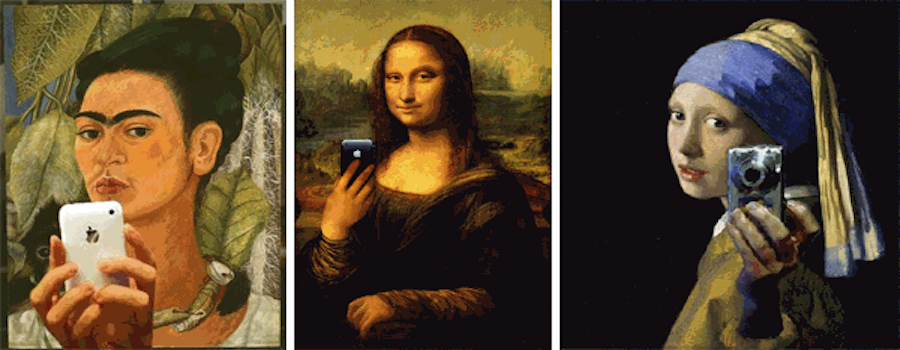
Our newest issue of SEQUITUR, which takes as its theme two separate yet related ideas, Self + Portrait, explores ideas of identity, representation, and discovery. Although the genre of self portraiture dates back to antiquity, how we read and understand images and constructions of selfhood, personality, and identification has changed and developed over time. The essays and interviews in this issue reflect such evolutions in creative expressions of individuality. Our contributors explore the ways that artists have uncovered social constructs of identity, investigated how the self might be reflected in space and place, and creatively questioned the relationship between representation and identity.
Kathryn Kremnitzer’s featured essay, “Privately Public: D. Appleton and Co.’s Artistic Houses (New York, 1883-4),” investigates the ways in which domestic interiors can reflect the likenesses of their inhabitants’ characters. In so doing the essay showcases how photographed dwellings were styled to communicate their owners’ achievements during the American Gilded Age.
Senior Editor Jordan Karney Chaim’s interview with artist Martine Gutierrez deals with many of the issues relating to the theme of Self + Portrait, including how gender and identity function as social constructs and how we present, define and invent ourselves. The interview was conducted on October 13, 2016 at the opening of the exhibition Martine Gutierrez: True Story, mounted at the Stone Gallery at Boston University and curated by Chaim.
This issue’s research spotlight by Emily Watlington considers how the reception of a video trilogy by David Maljković can be a useful entry point for a researcher looking to understand the effects of their own Western gaze. Her investigation of representation and misintepretation in the video work comments on how trans-cultural art history can and should be written, and furthermore on how identity and selfhood figures into the role of the art historian.
In her visual essay "Vault Skirt: A Notion for Play," artist Elizabeth Galvez modifies the skirt of Mexican folkloric dance to return the dancer to the unrestrained movements of childhood. The artist’s series of photographs communicate how notions of selfhood change with age and through her performative gestures and movements, her work leads viewers to contemplate their own relationships to play and amusement.
The issue includes eight outstanding exhibition reviews, which survey exhibitions from all over the world. For this issue we have expanded our review section, including reviews that do not fit within the issue’s theme, which we will continue to do in the future. Our reviewers analyze four exhibitions from Boston, two at the Museum of Fine Arts, one at Brandeis University's Rose Art Museum, and one at the Harvard Art Museums. These exhibitions present work from a broad range of time periods and locations, surveying work from the Renaissance to the Present and include artists from Asia, Italy, the United States and Colombia. Reviews of recent exhibitions at the Bowdoin College Museum of Art and the Canadian Centre for Architecture in Montreal address the evolving role of the portrait in American identity and the place of architecture in historical memory, respectively. Finally, two analyses from Europe round out our lengthy review section for this issue. One is from London’s Victoria & Albert Museum, which examines the career of an architectural engineer, and the other, from the Zacheta National Gallery of Art in Warsaw, surveys artistic reflections on the effects of travel and migration.
Although our authors take varying approaches to the theme of Self + Portrait, all address the relationship between selfhood and representation; in the process our contributors demonstrate how these intertwined concepts can be challenged and redefined. As an online journal we too are constantly redefining ourselves. We are delighted that SEQUITUR is growing as a venue for the publication of exhibition reviews and that we are continually able to exploit the myriad features of our online format. Ultimately, what this issue of SEQUITUR shows is that identity and medium are fluid, and should continue to evolve as such.
Sasha Goldman
Notes about Contributors
Sasha Goldman is a doctoral student studying Modern & Contemporary art at Boston University. Her research focuses on Italian art and exhibition histories, with a particular interest in national heritage, humor and curatorial practices.
Kathryn Kremnitzer is a PhD student at Columbia University in the Department of Art History and Archaeology.
Martine Gutierrez received her BFA from the Rhode Island School of Design in 2012. The Brooklyn-based performance artist draws from eclectic media, acting as subject, artist, and muse. Using photography and film, she documents her personal transformation by embodying various imagined personas. Gutierrez’s recent solo exhibitions include We & Them & Me at CAM Raleigh, North Carolina, and Can She Hear You at Ryan Lee Gallery, New York. This is her first solo exhibition in Boston.
Jordan Karney Chaim is a doctoral candidate and Raymond and Margaret Horowitz Foundation Fellow in American Art at Boston University where her research focuses on the changing institutional landscape of contemporary art in Los Angeles since the 1970s. Before attending Boston University, she was the Assistant Director at Mary Ryan Gallery in New York. She is currently based in San Diego, California.
Emily Watlington mediates contemporary art as a writer and curator. She is currently pursuing her master’s degree in the History, Theory, and Criticism of Art + Architecture at MIT, and serves as a curatorial research assistant at the MIT List Visual Arts Center. Her art criticism has appeared in publications such as Mousse and Art Papers.
Elizabeth Galvez received a Master of Architecture with a concentration in History Theory and Criticism from the Massachusetts Institute of Technology School of Architecture and Planning in 2016. She is currently an architectural designer at MERGE Architects in Boston, MA and teaches Visual Thinking at the Boston Architectural College.
Hannah Braun is a second year MA student at Boston University. Her research focuses on late-nineteenth- and early-twentieth-century American art history, looking at visual representations of urban life. In her spare time she enjoys exploring Boston’s art scene, hiking, and cooking.
Jackson Davidow is a doctoral candidate at MIT, where he studies modern and contemporary art, with an emphasis on its historical and theoretical entanglements with politics, science, and technology. He is currently at work on a dissertation manuscript titled “Viral Visions: Art, Epidemiology, and Spatial Practices in the Global AIDS Pandemic.”
Ewa Matyczyk is a doctoral candidate in the History of Art and Architecture at Boston University, studying Modern and Contemporary Art. Her dissertation “Public Transformations: Intervention, Memory, and Community in Warsaw, 1970-2010” examines the role of art and architecture in the changing context of the public sphere during late communism and after 1989.
Erin McKellar's research focuses on the design cultures of the 1940s. Her dissertation, “Tomorrow on Display: American and British Housing Exhibitions, 1940-1950,” investigates how the rhetoric and display strategies of exhibitions of town planning, dwellings, and furnishings in the two nations revealed the Allied Forces’ political goals.
Magdalena Milosz is a doctoral student at McGill University where her research focuses on the historical uses of architecture in the Canadian government’s attempts to assimilate Indigenous peoples. She is also an intern architect and holds a Master of Architecture and an Honours Bachelor of Architectural Studies from the University of Waterloo.
Erin Hyde Nolan is a doctoral candidate in the History of Art and Architecture Department at Boston University. She will defend her dissertation on the international circulation of Ottoman portrait photographs in February 2017. Most recently, she has held fellowships at the Max-Planck Society’s Kunsthistorisches Institut in Florenz and the Boston University Center for the Humanities.
Catherine O’Reilly is a Ph.D. candidate at Boston University, focusing on Italian Renaissance art. Her dissertation project is entitled “Last Supper Refectory Frescoes in Fifteenth-Century Florence: Painting, Performance, Senses, and Space.” She received her M.A. in Art History from Tufts University and her B.A. in Art History from Union College.
Sarah Parrish is a doctoral candidate in the History of Art & Architecture at Boston University, where her research focuses on contemporary fiber art in a global context. Her writing has been published in The Journal of Design and Culture in addition to several exhibition catalogues and art magazines.
2016-2017 SEQUITUR Editorial Team
Senior Editors: Sasha Goldman, Jordan Karney Chaim, Erin McKellar
Junior Editors: Lydia Harrington, Joseph Saravo
Faculty Advisor: Professor Ross Barrett
Special Thanks to Susan Rice and Chris Spedaliere
Privately Public: D. Appleton and Co.’s Artistic Houses (New York, 1883-4)
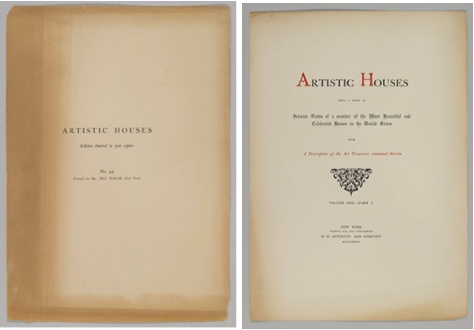
If a portrait photograph can capture the likeness of a person in both appearance and character, so too can a photograph of an interior, such as those that appear in Artistic Houses, preserve both the form and feeling of a room. Published by D. Appleton and Company of New York in two volumes, each comprising two parts with 203 plates total, Artistic Houses was printed in a limited run of five hundred copies for preselected subscribers in ten sections over a two-year period between 1883 and 1884.[1] The subscriber’s name appears printed on the secondary title page of volume 1 part 1 of each numbered copy as a personalized supplement to the half-title leaf in black and red type (Fig. 1).[2] Lest we be fooled by the book’s printed publication into thinking it was widely available, we should understand the audience of patrons that constitute the readership, or rather ownership, of Artistic Houses as private. The interiors photographed, the photographs themselves, and the publication as a whole were highly controlled in design and distribution according to the combined ambitions of the publisher, author, photographer, and owners.[3] Predetermined in form and function, Artistic Houses maps the people and things propelling America’s Gilded Age by and for a particular public.
The Travelers: Voyage and Migration in New Art from Central and Eastern Europe
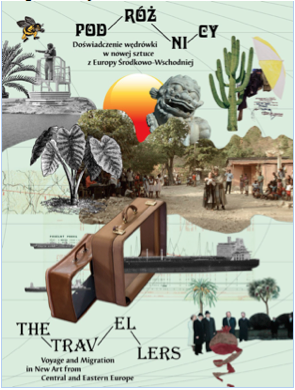
The Travelers: Voyage and Migration in New Art from Central and Eastern Europe
Zachęta National Gallery, Warsaw
May 14 – August 21, 2016
During the summer of 2016, a five-ton marble column greeted passersby on the sidewalk in front of the Zachęta National Gallery. Flanking the main entrance, the horizontal form was at once humorous in its uselessness and confusing in its dislocation. Was this a sculpture? Or perhaps an unfinished and abandoned renovation? In fact, it was part of almost forty artworks featured in The Travelers: Voyage and Migration in New Art from Central and Eastern Europe, curated by Magdalena Moskalewicz. Adrian Paci’s Column (2013) consisted of not only the puzzling behemoth outside, but also a video chronicling the process of commission, creation, and transportation of this architectural icon. Literally “made in China,” Column questioned authenticity and cultural identity in the context of today’s accelerated worldwide exchange of goods, labor, and capital.
Architecture as Evidence/La preuve par l’Architecture
![Installation view of Architecture as Evidence, Canadian Centre for Architecture, Montréal, 2016. © CCA, Montréal [Featured image]](/sequitur/files/2016/11/milosz_2016_06_16_MB_027-e1480441385254.jpg)
Canadian Centre for Architecture, Montreal
June 16, 2016 - September 11, 2016
A letter to a contractor stresses the urgency of a previously placed order for a hatch to be added to a roof. On an architectural plan, the hinges of a door have been reversed. Photographs show crowds of people, or an aerial view of a building. These fragments add up to an archive that attempts to answer a question: without the witness, how do we determine truth? Architecture as Evidence / La preuve par l’Architecture, a recent exhibition at the Canadian Centre for Architecture (CCA), was based on archival material collected to demonstrate the historical reality of engineered death at Auschwitz. A 2000 legal trial in which this material was entered as evidence was an opportunity to answer the question above. No survivor-witnesses were called to the stand. Instead, the evidence had to speak for itself, just as it did in this exhibition.[1]
Engineering the World: Ove Arup and the Philosophy of Total Design
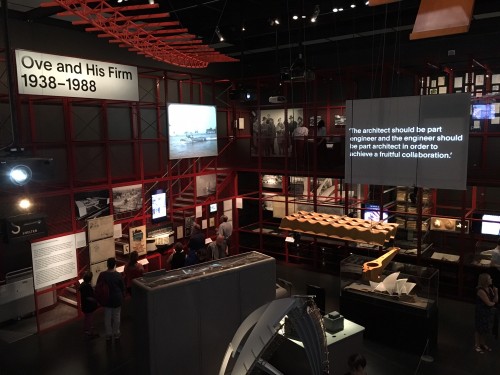
Engineering the World: Ove Arup and the Philosophy of Total Design
Victoria & Albert Museum, London
June 18 – November 6, 2016
From May 18 through November 6, 2016, the Victoria and Albert Museum staged its Engineering Season—a new museum program that celebrated the field of engineering design from small-scale projects to the large-scale infrastructure that transforms today’s cities. As part of this larger program, the V&A organized Engineering the World: Ove Arup and the Philosophy of Total Design, on view from June 18 through November 6, 2016. Co-curated by Zofia Trafas White and Maria Nicanor, the exhibition focused on the Danish-British engineer Ove Arup (1895-1988), often cited as the most influential architectural engineer of the twentieth century.
Megacities Asia
Megacities Asia
Museum of Fine Arts, Boston
April 3, 2016 – July 17, 2016
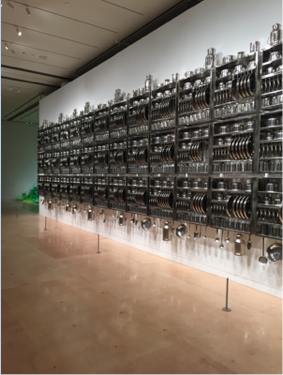
The Museum of Fine Arts, Boston’s (MFA) summer 2016 exhibition Megacities Asia invited visitors to visually immerse themselves in the frenetic pulse of five global megacities from the world’s most populous continent. A “megacity” is defined as a city whose population reaches or exceeds 10 million inhabitants. [1] Curators Laura Weinstein and Al Miner offered a vibrant sensory experience of life and artistic production from five megacities: Seoul, Mumbai, New Delhi, Shanghai and Beijing. The artists included in the exhibition draw on a diversity of materials, forms, and colors to create sculptures that play on the tensions between towering size and minute details. Despite this visual range, the exhibition organized its works into four neat thematic categories that spoke to broader issues in megacities: consumption and consumerism, modes of transportation, living spaces, and changing landscapes.
Manifestations of Self Through Art Objects


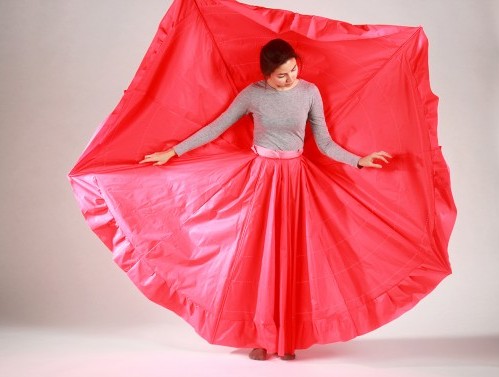
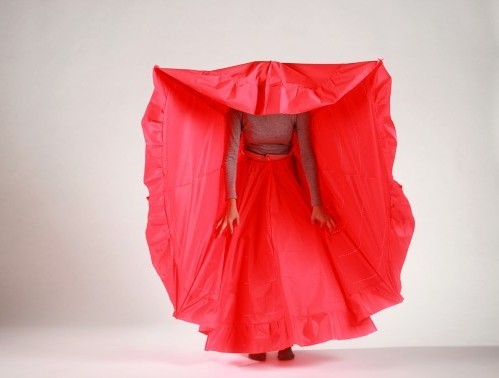

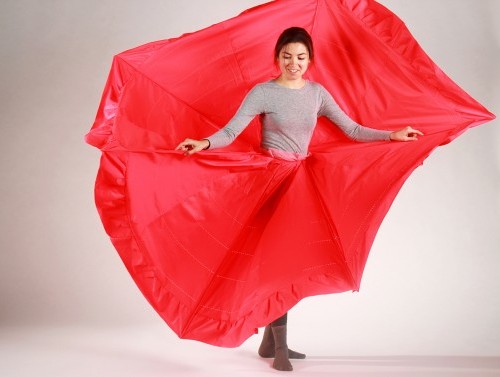


Elizabeth Gálvez, Vault Skirt: A Notion for Play, 2013. Fluorescent rip-stop nylon, steel rod, colored thread. All images property of Elizabeth Gálvez.
Vault Skirt is a piece that challenges the prescriptive society in which we live. As a child, one is encouraged to play and move freely throughout space. Yet as an adult, one can no longer simply play. Rather, the adult must engage in conventional activities, hobbies, or social interactions to have “fun.” Certain movements, especially those performed freely as a child, become accepted only in correlation to specific settings and activities. Un-restrained movement, furthermore, usually becomes unacceptable during adulthood. What becomes the adult’s outlet for the intrinsic play of childhood? Which activities return us to our most cherished experiences of pure enjoyment?
Vault Skirt seeks to transform a current tradition and social activity—dance—into one that allows for a free notion of play and movement. This work projects forward the typology of the skirt used within Mexican Baile Folklorico (Folkloric Dance). At the center of Baile Folklorico are the mesmerizing and colorful textures created by repetitive ensembles of skirts. These are the performances of twirling color and fabric that fascinated my eyes and mesmerized me into unencumbered imitations as a child. Vault Skirt reimagines a future for Baile Folklorico where the skirt becomes equipment to return us to the free movement of a child. By tweaking a simple element within the existing parameter of the original Folkloric Skirt, this work creates a vault-like enclosure to be controlled by the user. Vault Skirt allows the user to decide on the level of collectivity of the dance. As Vault Skirt falls downward, one may participate in a social dance; as one engages the vault-like structure, one is able to mask the face and play as an individual.
Elizabeth Gálvez
Doris Salcedo: The Materiality of Mourning
Doris Salcedo: The Materiality of Mourning
Harvard Art Museums
November 4, 2016 - April 9, 2017
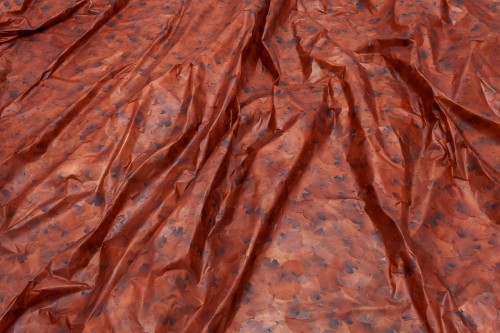
Doris Salcedo: The Materiality of Mourning is a small yet focused show at the Harvard Art Museums, presenting recent sculptural works by the pioneering Colombian artist. Organized by Mary Schneider Enriques, an associate curator at the museum, the exhibition is accompanied by a major scholarly catalogue and an exciting array of public programming. Known especially for her poignant assemblages of furniture and other ordinary yet evocative materials, such as concrete and steel, Salcedo has repeatedly embraced the language of post-minimalist abstraction since the mid-1980s. In so doing, she eloquently fuses together material form and pointed social critique to offer up an aesthetics and ethics of memory and loss, as the title of this exhibition clearly implies.
Wrapped in Tin Foil: A Report from the Balkans
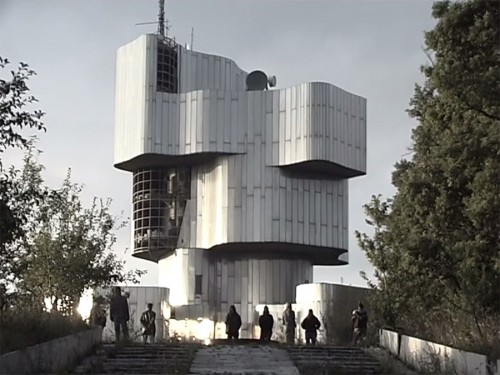
I relate to David Maljković’s (b. 1973 Yugoslavia, present day Croatia) characters in Scene for a New Heritage (2004-2006), a video trilogy set in the year 2045 about young men—“heritage-seekers”—on a road trip to Vojin Bakić’s 1981 Monument to the Partisans at Petrova Gora. I, too, grew up surrounded by monuments to a repudiated regime—in the Confederate capital—troubled and confused by their presence.