Conceptualizing a Maritime Salvage Culture
by Sybil F. Joslyn
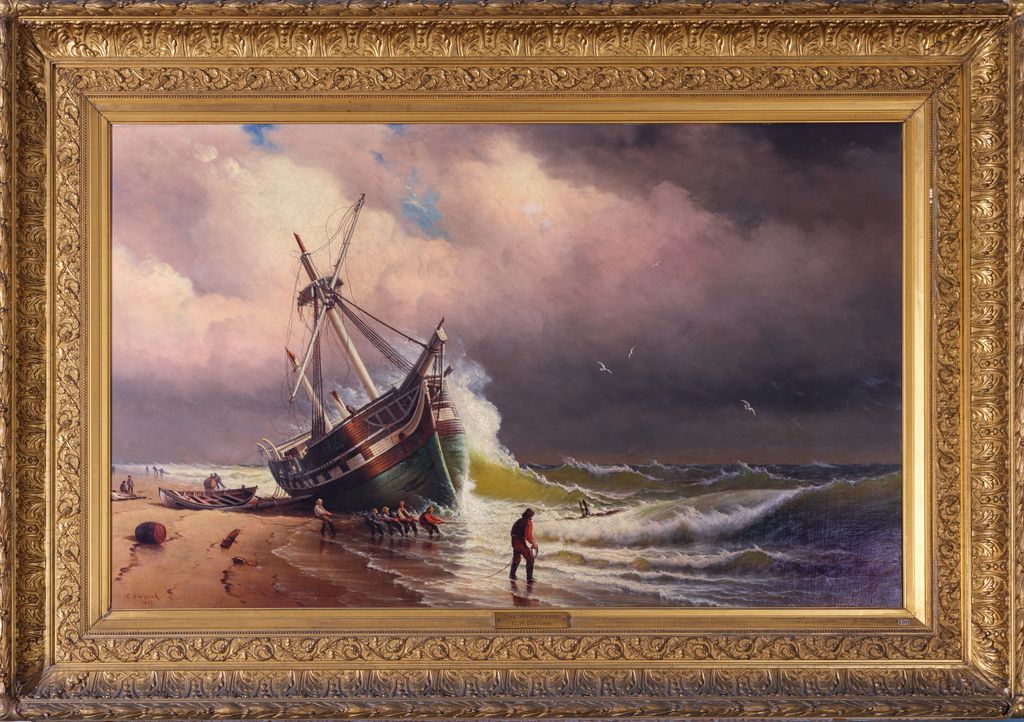
In Charles Henry Gifford’s 1877 work The Wreckers, a large sailing vessel leans helplessly on the shore, grounded and battered by rough surf (fig. 1). Elements of cargo and debris from the broken vessel litter the beach, and a small, intact lifeboat suggests salvation for the ship’s crew. Several figures similarly scatter along the liminal space between sea and shore, segmented by differing activities in the back, middle, and foregrounds. In the distance, onlookers are drawn to the immediacy of the immense wreck as two groups of figures, centered around survivors of the disaster, occupy the middle ground. In the foreground, a crew of men heave on a line to retrieve a piece of the wreck. A solitary figure at center, compositionally highlighted by the surf behind him, stands with a rope in his hand, signifying his readiness to gather additional materials as they wash ashore. While Gifford’s painting emphasizes certain elements of traditional shipwreck scenes, mainly the presence of onlookers, scattered debris, and the exhaustion of surviving crewmembers, he marks these narrative components of the painting as secondary to the occupational subject: the wreckers.
By the time Gifford created this work, the term wrecker had become synonymous with the professional maritime salvage worker. Emerging anglolexically in the seventeenth century and traditionally tied to economic, legal, and maritime spheres, the term salvage was defined as both the act of saving maritime property from wreck or capture, as depicted in Gifford’s work, and the compensation received by salvors for such recovery efforts. Throughout the nineteenth century, the salvage industry slowly professionalized in part due to the codification of American salvage law and strong procedural ties to the maritime insurance industry. As an economic and legal endeavor, the business of property salvage was ever-present, and it impacted demographics from working-class sailors to the merchant classes that financed maritime voyages. For those who had financial, occupational, or other interests in salvage operations, the professional process of salvage was defined for centuries by the recovery of valuable materials in exchange for reward after shipwreck or damage. However, over the course of the nineteenth century, this salvage paradigm of material recovery, value, and reward began to encompass other salvage activities outside of the economic and legal spheres, resulting in a lexical broadening of the term salvage and subsequent semantic change.1
My dissertation, “Worth Its Salt: Salvage in the Maritime Visual and Material Culture of America’s Long Nineteenth Century,” conceptualizes the emergence of a Salvage Culture defined by these salvage activities that shaped artistic production, object creation, and collecting practices in America’s maritime communities during the long nineteenth century. In its proposal of a novel framework of study for maritime object classes, this dissertation contributes to a growing body of scholarship in the blue humanities. Underpinned and formed by linguistic, social, and literary theoretical models, Salvage Culture helps us not only explain the semantic change of the term salvage and interpret the many varied processes of material recovery that occurred in the wake of maritime disaster, but also understand the peoples that engaged in these salvage activities and the art objects these processes yielded.2 For example, it can help us interpret examples of material culture and decorative arts that are a product of these other maritime salvage activities, like scrimshaw art objects and ship figureheads.

Traditionally confined to the literature of folk art and maritime art scholars, the art form of scrimshaw, defined as the craft and product of carving or decorating hard byproducts from the whaling industry like bone, baleen, and ivory, has rich interpretive possibilities. Primarily crafting during times of leisure and recreation, scrimshanders, who were most often crew members on whaling voyages, made scrimshaw art objects in a variety of forms. Perhaps the most popular form of scrimshaw, as evidenced by disproportionately extant numbers, was the jagging wheel or pie crimper, a fanciful example of which belongs to the collection of the National Museum of American History (fig. 2). Viewing the production of scrimshaw through the lens of Salvage Culture, that is, through the paradigm of material recovery, value, and reward, can allow scholars to unite various avenues of interpretation in its study, leading to a richer understanding of an object’s significance and context of creation. By reclaiming whaling byproducts (material recovery), scrimshanders created new value for these materials (recreational and creative value), and by transforming them through their craft, produced new objects of utility and beauty (reward). These objects both served as gifts for loved ones back home and preserved psychological well-being on multi-year voyages, visually embodying the lived experience and personal mythology of their creators.

Early collectors of ship figureheads, who often rescued these sculptural works from destruction when their vessels were wrecked or decommissioned, also participated in this nineteenth-century Salvage Culture. As traditional adornments for the prows of wooden sailing vessels, figureheads were ever-present during the Age of Sail but rapidly fell into disuse with the introduction of metal-hulled and steam-powered ships defined by a more streamlined and modern aesthetic. For these collectors, like famed architect Robert Swain Peabody, who displayed his collection of ship figureheads in the garden of his summer home at Peaches Point in Marblehead, Massachusetts, recovering these works redefined their value and established collector prestige (fig. 3). While viewed as a lesser craft during the height of their production in the mid-nineteenth century, ship figureheads attained a new and elevated aesthetic and cultural value when displayed within the gardens or homes of wealthy collectors. Occupying a comparable place to neoclassical sculpture in sumptuous country retreat gardens, these objects tied their owners to America’s golden age of maritime commerce and communicated the preservation of nineteenth-century hegemonic ideals in the face of rapid societal and technological change.
In proposing the conceptual and theoretical underpinnings of this nineteenth-century Salvage Culture, my dissertation outlines a shared paradigm between different salvage activities and proposes a new way to view maritime material culture. Fine art depictions of salvage and wrecking, scrimshanders’ creation of artworks from reclaimed whaling byproducts, and the preservation of ship figureheads and their nineteenth-century hegemonic legacy are just three examples that illustrate how the framework of Salvage Culture can increase our understanding of the nineteenth-century maritime material world. In allowing these case studies and object classes to speak to one another and find common ground, my dissertation, and its investigation of Salvage Culture, adds a novel current to the art historical subfield of blue humanities studies.
____________________
Sybil F. Joslyn is a PhD candidate in the History of Art & Architecture at Boston University. She specializes in visual and material culture in America’s long nineteenth century, with her dissertation exploring the role of maritime salvage as process and material in art production and the history of collecting.
____________________
1. For an overview of the model of semantic change I find most useful in conceptualizing Salvage Culture, see Elizabeth Cross Traugott and Richard B. Dasher’s theories on semantic change: “1 The framework” in Elizabeth Closs Traugott and Richard B. Dasher, Regularity in Semantic Change (Cambridge University Press, 2004), in particular sections “1.3.1 Mechanisms of semantic change: metaphorization, metonymization” and “1.3.2 The Invited Inferencing Theory of Semantic Change model of semantic change.” 1.
2. In addition to Traugott and Dasher’s theories on semantic change, the framework of Salvage Culture is supported by Arjun Appadurai’s conceptions of value as outlined in his introduction to The Social Life of Things: Commodities in Cultural Perspective (Cambridge University Press, 1986) and Steve Mentz’s paradigm of the wet and the dry as explored in “The Wet and the Dry: Shipwreck Hermeneutics” in Shipwreck Modernity: Ecologies of Globalization: 1550–1719 (University of Minnesota Press, 2015).