A Day in the Life: Inside Boston University’s MS in Nutrition & Dietetic Internship Program

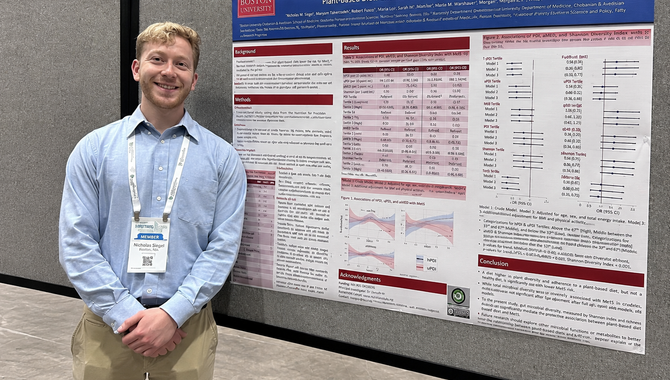
By the time Nick Siegel (SARG ’26, MS in Human Nutrition) arrives to work at 7:00 a.m., dozens of patients are already waiting to be evaluated. At UMass Memorial Medical Center, where Siegel is currently placed for the dietetic internship portion of Boston University’s MS/DI program, the dietetics team is responsible for assessing nutritional risk, recommending appropriate nutritional support, and helping guide a crucial part of patient care.
“I’m assigned a floor, so I have patients,” Siegel said. “You screen the floors, decide who needs to be seen, talk to the patient, make your recommendations, write the note, and the dietitian is there to answer [questions]. But besides that, I’ve been completely on my own.”
This autonomy is no accident. Instead, it is the culmination of a journey that begins with graduate coursework and culminates in real-world clinical practice. In the late stages of his internship, Siegel’s independence reflects Boston University’s goal in preparing students to not only understand nutritional science, but to apply it confidently in real, dynamic patient care.
An Integrated Pathway to Clinical Practice
Siegel’s journey, now progressed to working in a hospital setting, started years earlier at Sargent College, in a classroom. Boston University’s Master of Science in Nutrition & Dietetic Internship (MS/DI) program is designed to prepare students with the necessary knowledge and skills to earn their Registered Dietitian Nutritionist (RDN) license. The program does this by combining graduate coursework in nutritional science with a 29-week dietetic internship.
For students looking to enter the MS/DI program without a background in dietetics, the University also offers a Didactic Program in Dietetics/Master of Science in Nutrition & Dietetic Internship (DPD/MS/DI) pathway. This 3-year program allows students to complete required prerequisite coursework, earn their master’s degree, and complete the supervised practice requirement.
Preparing for Practice
Before students are tasked with caring for patients in a hospital setting, they first navigate realistic scenarios in a controlled environment on campus. At Sargent’s Center for Simulated Clinical Experiences, prospective interns have the opportunity to practice in a low-risk clinical environment, treating standardized patients portrayed by trained actors.
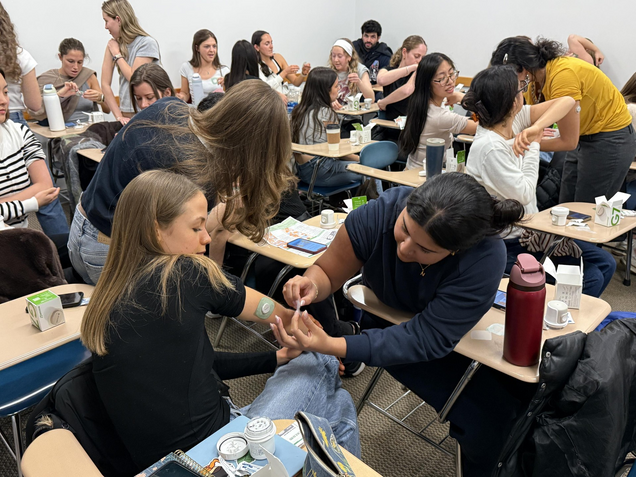
Siegel, who—like all MS/DI students—utilized this simulation experience, noted that the experience stifled a lot of the intimidation he and other interns, were feeling about entering the hospital setting. The lab, which looks identical to a hospital room, provides the prospective interns with skills they will need to apply on a daily basis in their internship, like communicating with patients and families, as well as performing nutrition-focused physical exams. Additionally, every simulation concludes with a debriefing session where trained faculty can provide guidance on practicing safely and developing confidence in administering treatment.
Marijane G. Staniec, MS, RDN, LDN, director of the Dietetic Internship at Boston University Sargent College, describes the Simulation Center as a crucial bridge between nutrition education and clinical practice. Staniec said the Simulation Center serves as more than just a practice space,
“They do simulations in the sim lab where they’re working with live human actors and actresses in a safe environment where they can make mistakes and get feedback. And then… they make that transition from the classroom to the internship.”
Beyond access to the Center for Simulated Clinical Experiences, every MS/DI student also completes a 3-credit Graduate Nutrition Practicum.

The practicum requires a minimum of 150 hours working with a Registered Dietitian Nutritionist (RDN) or other health care professional in an area of interest. With more than 50 practicum affiliates, Staniec notes that “students can really pursue an area of interest to them.” Depending on their career goals, students choose from a wide range of practicums including: clinical, community, sports, private practice, culinary, eating disorder treatment, nutritional research, and other specialty settings. Conducted in the final semester of graduate coursework, the practicum serves as final preparation before students enter the dietetic internship.
Learning on the Hospital Floor
Semesters of coursework, simulation, and supervised practice ultimately lead students to the centerpiece of the program: the dietetic internship. It’s in this internship that students will complete over 1,300 hours of supervised practice across clinical nutrition, food service management, community nutrition, pediatrics, and an elective rotation tailored to them.
Unlike traditional classroom instruction, the internship immerses students in the rhythm of patient care. Working with Registered Dietitians and interdisciplinary healthcare teams, interns rotate through a diverse array of clinical settings. Whether evaluating a patient’s nutritional risk or engaging in care discussions, each rotation is designed to strengthen students’ clinical judgment and apply the evidence-based practices taught in their coursework.
As the internship progresses, the interns assume increasing responsibility, progressing to the “staff relief” rotation. During this rotation, interns will function with a high degree of independence, whilst under preceptor supervision. Siegel, actively in the staff relief rotation, noted this as a milestone in his pathway to becoming a Registered Dietitian Nutritionist (RDN).
“The program crescendos into that final challenge, so to speak, because it is exciting to see how much you have learned, and grown, and are able to do this independently.”
Although a Registered Dietitian continues to review his work, Siegel notes that the internship is intentionally designed to foster independence. The staff relief rotation serves as a final step in the dietetic internship; students are no longer solely learning how to be a dietitian, they are practicing as one.
Patient-Centered Care
Despite the many means by which the hospital setting is simulated in graduate coursework, Staniec emphasizes that becoming an RDN requires more than memorizing nutrition guidelines or applying textbook knowledge. Throughout the course of the dietetic internship, Siegel learned that “the real world is not all black and white.” Each patient throughout the course of his rotations presents with different medical conditions, personal goals, cultural considerations, and financial and social circumstances. For these reasons, engaging with the internship means learning to interpret evidence and make individualized recommendations, rather than relying on any kind of one-size-fits-all solution.
For Siegel, this human element was reinforced in treating veterans at the diabetes clinic. Even after continuing on to further rotations of his internship, a patient with whom he worked months earlier remembered him, and specifically asked about him after Siegel had moved on. Siegel noted that the dietitian in residence followed up with him, and it reassured him to learn that the recommendations he made had a positive impact on his former patient. Moments like these, Siegel said, spoke to his ability to make a lasting impact on the patients he treated:
“He saw changes and his diabetes was better controlled. And so that was the lasting impression: these are real patients, and I am really helping them.”
Developing Future Stewards of Nutrition
While the multifaceted, immersive experience that is the MS/DI program prepares students for the responsibilities of becoming an RDN, Staniec emphasized that the program’s strength ultimately comes from the people who guide students through each stage of their training. Since the cohort structure for the program is small, faculty and preceptors are able to provide individualized mentorship with a nuanced understanding of each student’s goals, learning style, and professional interests. Staniec says,
“The commitment to making sure that when our students finish the program, they’re going to obviously go on and represent BU well, but they’re going to be stewards of our profession. Because nutrition… without nutrition, you can’t have health.”
Siegel echoed the importance of this support and how the intentional preparation really influenced the transition into full-time clinical practice.
“I think the support along the way, how much… maybe is the most valuable, the step-by-step pathway. They really prepare you well.”
For Staniec, and the rest of the Nutrition faculty, the goal extends beyond simply preparing students to earn their RDN credential. Rather the aim is to develop clinicians who can think critically, communicate effectively and compassionately, and continue to advance the profession of nutrition. With guidance from a dedicated faculty and an immersive education, BU’s program prepares students not only to enter the field, but to engage with a science Staniec calls a “lifelong learning.”
Story by Dylan Nuñez