Lea Stith: Translating Brain Signals into Research Solutions
By Jack Osmond

From Alzheimer’s disease and Highly Superior Autobiographical Memory to attention and spatial navigation, Lea Stith’s research on memory is hard to forget. Working in translational neuroscience, Stith uncovers insights about the brain to bridge neuroscience research and real-world applications.
Her interest in understanding the mind goes as far back as middle school, when she would spend her free time reading books about psychology and attending classes on neuroscience at Stanford University.
“You could take a class in almost any subject that they were offering. I did it for a couple of years, and any time I went, I picked all the classes that I could that were neuroscience and psychology,” Stith says.
She found her footing as a neuroscientist as an undergraduate at the University of California, Irvine. There, she studied psychology with an emphasis in cognitive neuroscience. Despite being only a freshman, she took a chance and applied to work as a Research Assistant in Michael Yassa’s Translational Neuroscience Lab.
Although she wasn’t as experienced as an upperclassman, Professor Yassa recognized her passion. “They told me after, ‘We don’t usually take freshmen, but you seem really excited about this.’ And that meant a lot to me, because it showed me the values of [the] lab.”
It was in the Yassa Lab that Stith discovered her first research niche: HSAM, or Highly Superior Autobiographical Memory. According to Stith, the condition is almost exactly what it sounds like:
“Essentially, people are able to very quickly recall almost any given moment of their life [from] a very early age,” Stith explains. “You could ask someone who has HSAM, ‘What were you doing on April 5th of this year?’ and they would say, ‘I got up, ate cereal for breakfast, and then I saw these friends.’”
In short, someone with HSAM can remember incredibly specific details from almost any day of their life with relatively high accuracy. The condition is incredibly rare; according to Stith, fewer than 100 people with HSAM have ever been identified. She hypothesizes, however, that there might be other types of superior memory that haven’t been discovered yet.
“My working theory was that there are probably more people who have it than we know,” she says. “A lot of these people’s memories were very calendrical — calendar-based. But I think there’s a broader spectrum.”
Her experience as an undergraduate researcher in the Yassa Lab both affirmed her love of neuroscience and provided a direction for her later research endeavors. Though she wasn’t interested in being a physician, she still wanted to help people through medicine. Translational neuroscience was the perfect way to do that.
“With translational neuroscience research,” Stith explains, “you can take these insights about how the brain works and translate them into real-world applications.”
Today, Stith has continued pursuing her passion for translational neuroscience within the Neurophotonics Center, where she is co-advised by Assistant Professor Matthias Stangl and Professor Chantal Stern. Both labs focus on spatial navigation, which forms the foundation of Stith’s current research.
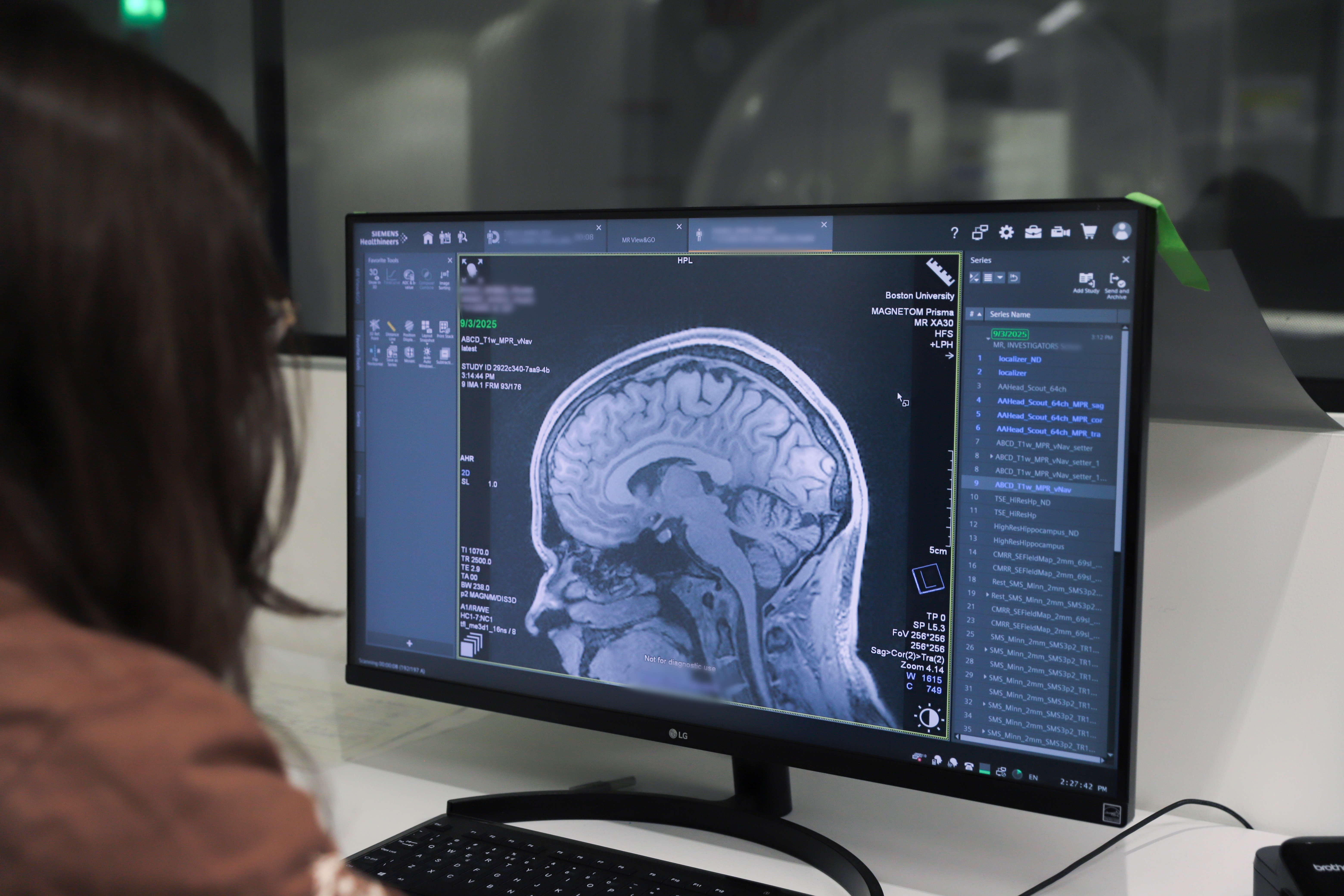
The Stangl Lab’s research focuses on using Responsive Neurostimulation (RNS) — electrodes implanted in the brain — to record neural activity while participants engage in behaviors like walking, observing movement, or performing simple, cognitive tasks. In parallel, Stith describes her work in the lab as part of a more “traditional experimentalist” style, where she’s recording patients with fMRI (functional magnetic resonance imaging) data collected during a virtual navigation task — playing a simple video game — in which participants move through an open environment while their brain activity is recorded.
Her research was born out of an issue with similar experiments: subjects kept falling asleep while playing the game. After running around collecting coins or following simple directions for 20, 30, or 40 minutes, people began to nod off in the MRI machines. If you’re trying to study what the brain does when it’s attending to a task, it’s not ideal to have your subjects dozing off.
Professor Stern realized that within this rich and variable dataset, there was an experiment of its own waiting to be developed. Rather than studying what the brain was doing during sustained attention, Stern suggested that Stith study how brain states change as people fall in and out of attentive states. This work is part of the Kilachand Neurovascular Coupling and Attention Project, which aims to bridge findings from animal models to human neuroimaging.
“There are a lot of everyday situations where our attention naturally fluctuates,” Stith says about the relevance of her research. “So, my work aims to understand how brain states are changing throughout that process.”
Stith hopes that by understanding how behavioral markers of attention and other brain states are correlated – in particular, the interaction between the dorsal attention network and the default mode network – she can create a framework for researchers to use attention as a marker of these brain states. In the future, rather than relying on expensive fMRI equipment, researchers would be able to study people’s physical behavior to understand what is happening inside their brains.

Stith’s experiment works by having her subjects enter the fMRI machine for roughly 90 minutes at a time. While inside, they don a headpiece that has a mirror attached, allowing subjects to see a screen behind them. On that screen is another virtual navigation task, where the subject is told to navigate through an open field searching for hidden coins across ten eight-minute sessions. While they’re doing this, the fMRI is capturing everything that’s happening inside their brains.
Stith has been supported by multiple grants that enable her to conduct her cutting-edge research, the bulk of which is funded by the Kilachand Neurovascular Coupling and Attention Project. In addition, she was recently awarded the Association for Croatian American Professionals Future Leaders Scholarship. Stith used the funding for a workshop learning advanced techniques for analyzing fMRI data, which has been crucial in her research.
Stith also says that her Croatian heritage plays an integral role in her success. Being raised by her Croatian mother, she says, “instilled a lot of the values and culture [in me] growing up. That’s a core piece of my identity.”
Being raised bilingual has also played a role in her success. “As a neuroscientist,” she explains, “you learn all about the benefits of bilingualism,” which include improved working memory, problem-solving, and goal-setting abilities.
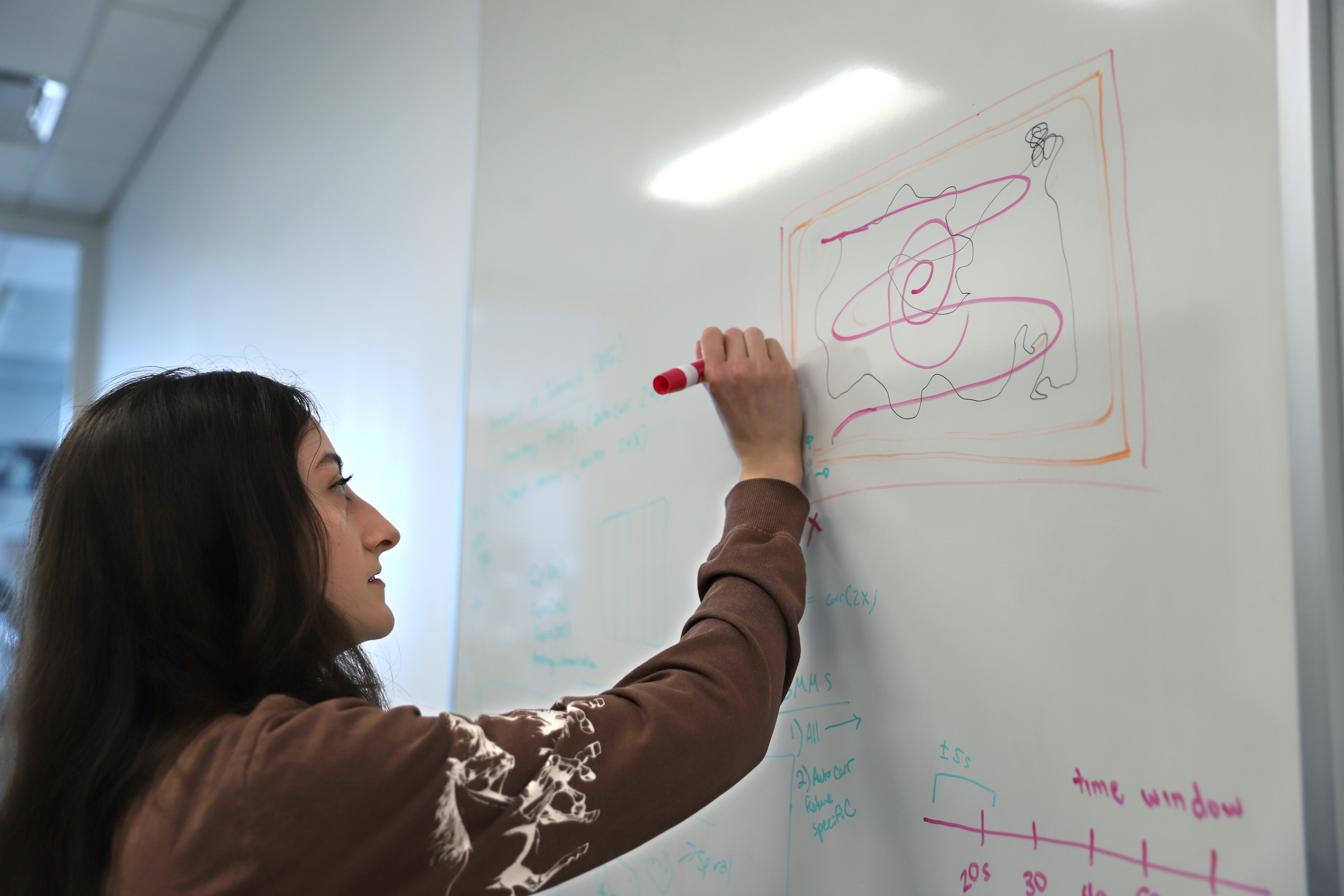 Beyond her research, Stith takes an active role in leadership on campus, serving both as the Co-President of the Neuroscience Graduate Student Organization (NGSO) and as a Graduate Women in Science and Engineering (GWISE) mentor for undergraduate students. As Co-President of NGSO, Stith works with Professor Shelley Russek, Director of the Graduate Program for Neuroscience (GPN), to “make the best student experience possible” for GPN students. Stith serves as a liaison between the student body and the program, coordinating times for student seminars, managing the NGSO budget, and helping organize student talks and panels for GPN’s annual retreat.
In her work as a mentor, Stith is inspired by her previous mentors throughout her time in school. “It’s really important for younger students to hear about the things that were difficult and the things that didn’t work. Not everything came easily, and my path wasn’t perfect, but those challenges shaped me both as a researcher and mentor. If you put in the hard work and if you’re really dedicated, there are ways to make your dreams and your goals happen.”
One crucial lesson she has passed on to her mentees is the importance of trial and error. “It’s not as important to find the most perfect research topic and question,” she explains. “Doing your PhD is such a big learning experience. Who you’re doing it with matters a lot, as does the environment and support system around you.”