Hooked on the Law
A fascination with the U.S. Supreme Court leads to a clerkship—and a future in data privacy and cybersecurity litigation.
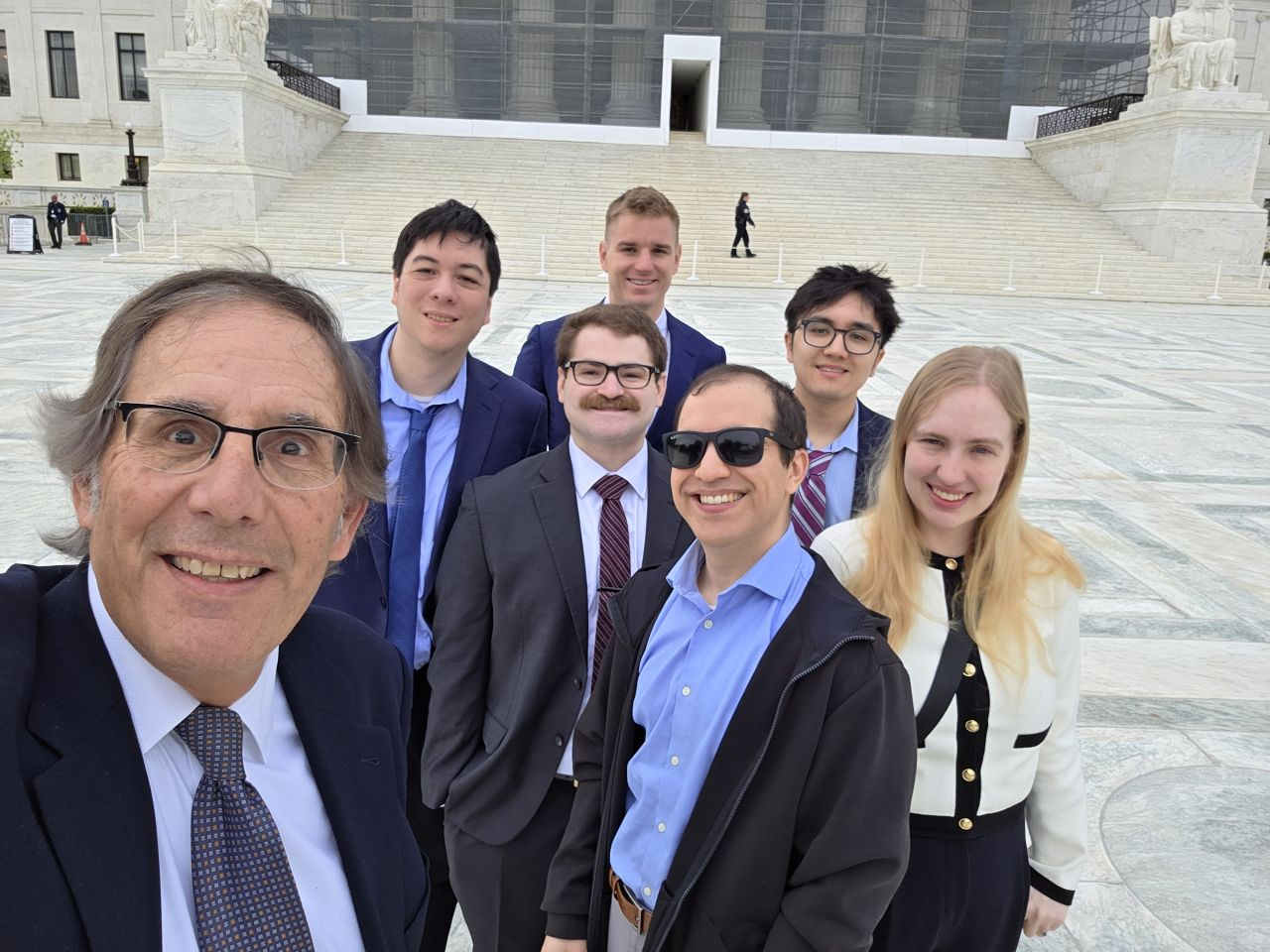
Kylee Hench (’26) (second to the left) with Professor Jack Beermann and classmates in Washington, D.C. to listen to a US Supreme Court oral argument.
Hooked on the Law
A fascination with the U.S. Supreme Court leads to a clerkship—and a future in data privacy and cybersecurity litigation.
Kylee Hench (’26) was midway through his undergraduate studies at Brown University in 2011 when he read his first US Supreme Court opinion. For a computer science major and avid video gamer, digging into a ruling from the high court may not have been second nature, but he had good reason: Brown v. Entertainment Merchants Association was a landmark decision for the fate of the video game industry, leaning on the First Amendment to strike down a 2005 California law that had banned the sale of violent games to children without supervision.
For Hench, it was illuminating to see his cherished hobby treated by the court with logic, rigor and respect — and to read a majority opinion that acknowledged video games as a form of protected speech, in line with novels or films. Hench had never thought so deeply about the law. Suddenly, he was hooked. He’s read every Supreme Court ruling since. He even participated in FantasySCOTUS, an online predictions league, and came in second for the October 2017 term.
Now, as he graduates from the Boston University School of Law, Hench is preparing to contribute to the opinion-writing process himself. In August, he will begin a clerkship with Associate Justice Dalila Argaez Wendlandt of the Massachusetts Supreme Judicial Court. When that ends, he’ll marry his past and present by joining Dechert as a litigation associate in its data privacy and cybersecurity practice.
Before entering law school, Hench spent three years as a researcher and consultant on artificial intelligence, then two years at home with his children, beginning when they were 4 and 6, respectively. Pivoting to a career in the law signaled a major change for the Massachusetts native. In that sense, entering with a deep well of knowledge about civil procedure and the Supreme Court’s rulings made a world of difference.
“People say, ‘Oh, you can’t really prepare for law school.’ Well, reading all the Supreme Court opinions really helped,” Hench says with a laugh.
If the transition from computer science to the law was at all jarring, Hench found his footing by the summer of his 1L year, when he interned with Judge O. Rogeriee Thompson (’76) of the First Circuit Court of Appeals — a BU Law alumna herself. The experience was everything he could have hoped for. He worked with fellow interns and clerks to provide bench memoranda based on parties’ briefs, dug into the precedent they raised, and watched some of the country’s top litigators argue, including former Solicitor General Paul Clement, who delivered “a masterclass.” What mattered most to Hench was the chance to dive into the substance of each case before the court.
“That summer was when I really knew I was in the right place,” Hench says.
Hench’s confidence about his career change was further cemented by a summer spent at Dechert and an externship at the Supreme Judicial Court in the fall of his 2L year, the latter of which was spurred along by a member of the BU Law alumni mentorship program who helped connect him with the opportunity.
I think it’s a good use of my time on this earth: doing justice.
Nothing in the classroom could rival the Supreme Court decision-making seminar he took with Professor Jack M. Beermann last spring. “For obvious reasons,” he says, “that was my favorite class.”
In addition to writing a mock opinion about one of the cases on the court’s docket and hearing from a former Supreme Court clerk who visited the class, the experience was highlighted by a trip to Washington, D.C., where Beermann and five classmates observed a session of Supreme Court oral arguments in person.
After reading so much of the justices’ work over the years, it was a special opportunity to witness a critical part of their process and learn more about how oral arguments give shape to a ruling. It also allowed Hench to replace the mental image of the court he’d developed over so many years with one that better reflected reality. He recognized some of the frescos in the courtroom, but the space was much smaller than he expected and the justices seemed somehow more human. Listening to oral arguments in the past, he’d never considered how much could be learned from their body language — the nods and shakes of a head that add texture to the process.
On that day in April 2025, Hench and his classmates watched arguments in Kennedy v. Braidwood Management, on preventive-care services under the Affordable Care Act, and Parrish v. United States, on the appeal deadline for a prisoner’s lawsuit. Of course, Hench later read both opinions.
Hench’s passion for the Supreme Court was evident, Beermann says, often leading him to update his professor on the latest developments in the court’s docket and at oral arguments. His curiosity consistently shone through, Beermann says.
“What stands out for me most about Kylee as a student is how he pushes himself to greater depths of understanding, and also how creative his thinking can be, recognizing connections and concepts that are far from obvious in the cases we read and wrote about,” Beermann says.
Although he’d heard plenty before coming to BU Law about how challenging law school can be, “the whole experience has been much more pleasant than I ever could have imagined,” Hench says. Now, he’s focused on being an effective clerk and avoiding the unintentional consequences that can come from inattentive work behind the scenes — missteps he’s encountered through his studies of the courts and his experiences during law school. He’s eager to contribute to jurisprudence in his home state, giving back to the place where he grew up, and then to begin his career in Big Law.
He can still remember being asked at orientation about his biggest worry or fear, which was simple at the time: “I’m not going to get a job,” he says. “That’s obviously not what happened.”
After so many years studying the Supreme Court’s opinions and immersing himself in the law, he’s ready to take part in the adversarial system he’s come to admire so much.
“Being a part of that process, I think, is very valuable for society and for the community,” Hench says. “So, I think it’s a good use of my time on this earth: doing justice.”