Summer 2026 update: International travel risks remain high due to increased federal vetting, travel bans, and unpredictable visa processing. Review the ISSO Travel Decision Guide, ISSO news updates and consult your ISSO advisor to assess your individual risk.
Travel is discouraged if you do not have a valid U.S. visa. Visa appointments are limited, must be completed in your country of citizenship or residence, and delays are common. If you plan to travel and assume the risk, secure a visa appointment before you leave the U.S. and allow at least 30 days for visa processing.
Key Factors to Consider When Planning International Travel
- Do you have the necessary immigration documentation to return to the U.S.?
- Do you need a travel signature on your I-20 or DS-2019? See details below.
- Do you have a valid U.S. visa?
- If not, can you obtain a new visa in time to return before the start of the next term?
- If not, are you a national of a country under a U.S. entry/travel ban?
- Are there other current or political events (military conflicts or sanctions) that could impact your ability to travel and/or obtain a visa? For example:
- Considerations with a change in federal administration.
- Consular posts can close without advance notice due to natural disasters or political conflicts
- Some researchers from China are still experiencing visa denials and visa revocations due to Presidential Proclamation 100043
- Even with a valid visa, some travelers are denied entry to the U.S. port of entry due to U.S. political sanctions on businesses and nationals of other countries
It is important that you asses your individual situation and evaluate possible risks when making travels plans in the middle of your academic activities. While family emergencies could necessitate travel in the middle of your program, you might choose to postpone some vacation or professional-related travel until after program completion.
What factors should I consider when deciding whether to travel during a time of political uncertainty?
- Do you have a valid visa to return? Can you obtain a new visa in the time (at least 30 days) allocated for travel?
- U.S. immigration history—do you have any gaps or violations in your U.S. immigration record?
- Social media presence/exposure that could concern U.S. federal authorities
- Data on electronic devices that might be viewed as a national security concern
- Inconsistency in information and documents submitted to USDOS and USCIS
- Criminal background in U.S. and abroad that could negatively impact your U.S. visa or U.S. admissibility
- International travel patterns to locations that could indicate national security concerns
- Evidence of cannabis use on your electronic devices
- Sensitivity of your field of study, research, expertise
- Current climate of enhanced vetting and scrutiny
- Refer to our Travel Decision Guide to help you decide whether to depart the U.S. during this time of uncertainty.
Do you need to renew your visa on this trip?
The visa in your passport must be valid on the day you will reenter the U.S. in order for you to be eligible to return in your immigration status. If your visa will expire before the date of your return, you must apply for a new visa at a U.S. consulate or embassy while you are out of the U.S.. If this will be your first time applying for a visa renewal, plan to request a new travel signature before you leave the U.S. and to speak with the ISSO advisor-on-call to make sure you are prepared for your visa appointment.
Please note: You will need to schedule an in-person visa interview at a U.S. consulate to apply for a new visa during your travel. If you need to apply for a new visa, you may experience administrative processing delays at the U.S. embassy, which could delay your return to the U.S.. If you are unsure of whether or not to travel, you should consult with your academic department about the consequences to your academic progress and the potential need for a leave of absence form BU if you are unable to return to the U.S. in time. The ISSO Advisor-on-Call can provide basic information about the travel signature request and the visa application process.
If your visa has expired and you are planning a short trip to Canada, Mexico or the adjacent islands, read up on automatic visa revalidation to see if this special provision might apply to you.
What is a travel signature?
- A travel signature is a signature from an ISSO advisor (sometimes referred to as Designated School Official or Alternate Responsible Officer) on your I-20 or DS-2019.
- This signature is generally valid for one year, and can be used for multiple trips abroad.
- You need to have a valid travel signature on the date you reenter the U.S. after international travel.
- A more recent travel signature is recommended if you plan to renew your visa on this trip abroad.
- If you have a valid travel signature already, there is no need request a new one!
Do you need a travel signature?
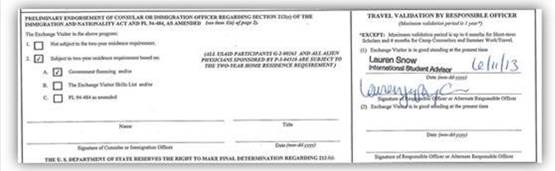
Check to see if there is already a travel signature on the right-hand side of your DS-2019 (for J-1 scholars). If your travel signature is up-to-date (within one year for continuing J-1 scholars), you do not need a new one! A travel signature is considered valid if it is dated no more than one year before the date you expect to return to the U.S.. A more recent travel signature is recommended if you will renew your visa on this trip abroad.
A sample DS-2019 signature appears on the right-hand side of the form:
How can I request a travel signature?
J-1 students can obtain a travel signature at the ISSO lobby or remotely through the ISSOPortal:
1) Request a DS-2019 travel signature in person: Stop by the ISSO front desk during normal ISSO business hours with the following documentation to request that ISSO review your records and sign your document while you wait:
- your BUID
- your passport with your J-1 visa
- your most recent DS-2019
- printed copy of your most recent I-94 arrival record to the U.S. from the USCPB I-94 arrival record website
OR
2) Request a new DS-2019 with a travel signature through the ISSOPortal. You will only need to present your documents when you return to the U.S., so you do not need the signature to leave the U.S..
- Log into the ISSOPortal. Go to the Request Center and click on the icon for Add Travel Signature.
- Follow the instructions in the request to complete the questionnaire, upload required documents and confirm your understanding of conditions to maintain status and official submit the request to ISSO.
- Monitor the status of your request through the Request Center in the ISSOPortal.
- Your ISSO advisor will review your request and update the ISSOPortal within 10 business days.
- You will receive an email to notify you that the new immigration document has been uploaded to the Document Center.
- Download, print and sign the new DS-2019 and plan to present the DS-2019 in paper form to a consular officer, if you need a visa and, to a U.S. customs officer when physically returning to the US.
-
-
J-1 scholars
1) Schedule a 15-minute appointment with ISSO Scholar Services. Bring following documentation to your scheduled appointment:
- your passport with your J-1 visa
- your most recent DS-2019
- printed copy of your most recent I-94 arrival record to the U.S. from the USCPB I-94 arrival record website
OR
2) Request a new DS-2019 with a travel signature via email. You will only need to present your documents when you return to the U.S. so you do not need the signature to leave the U.S.. Send an email to issosch@bu.edu with the subject line of “request a travel signature.” You must attach a digital copy of your most recent I-94 arrival record to the U.S. from the USCPB I-94 arrival record website and include the following information in your email request:
- your name and BUID
- dates you will depart and return to the U.S.
- your destination
- the date your current J-1 visa will expire
A member of the Scholar Services Team will send you a new DS-2019 via email within 10 business days. Please note that you will need to print, sign and present the DS-2019 in paper form to a consular officer, if you need a visa and, to a U.S. customs officer when physically returning to the U.S..
What is my SEVIS Fee Receipt?
All J-1 exchange visitors with “initial” immigration documents are required to pay this SEVIS Fee when you first begin your program of study. When entering the U.S., you may be asked to provide proof that this fee was paid. If you have been continuously enrolled with the same SEVIS record, you do not need to pay the fee again, provided you have proof of payment. If you took a leave of absence, had a break in status or traveled to regain status with a new SEVIS number, you will need to pay a new SEVIS Fee for a new SEVIS record. Proof of SEVIS Fee payment can be printed from the I-901 SEVIS Fee website.
What to expect at the port of entry/border?
Review the Know Before You Go information on the U.S. Customs and Border Protection website.
You should expect that U.S. Customs and Border Protection will review your visa and your relevant documents as you seek permission to return to the U.S.. The officer will ask you questions (similar to the visa application interview) to determine your eligibility for admissibility. Grounds for denial include health concerns like an infectious disease, criminal history, security threats, risk of becoming a public charge, intention to work illegally, or traveling without proper documentation. Do not assume that you will always be granted entry just because you have a valid visa. You should plan to explain your reasons why you wish to reenter to the U.S.. In most cases, you will be cleared for entry quickly at primary inspection at the port of entry. However, in some cases, you may be sent to secondary inspection so the officer can look at your record and your documents in greater detail and ask for additional information. You have very limited rights when you are at secondary inspection so pay close attention to the information below
What are your rights when you are seeking to enter the U.S.? The following general information is not a substitute for legal advice. ISSO recommends that you should consult an attorney if you have specific legal questions about your unique circumstances.
ACLU (American Civil Liberties Union) Know Your Rights: Enforcement at the Airport
Inspection of Electronic Devices at the Border
The Fourth Amendment to the U.S. Constitution generally forbids “unreasonable searches and seizures” by the government. However, due to what is known as the “border search exception,” the Supreme Court has previously ruled that at the border (which includes international ports of entry like airports), the government has a broader authority before someone is admitted into the U.S.. Given this legal landscape, U.S. Customs and Border Protection (CBP) claims broad authority to search and seize electronic devices at the border.
During this type of search, CBP agents may swipe through your phone, look through the documents on your computer. This includes accessing any social media or communication apps that you are logged into on your devices. The government also claims the authority to copy the data on your electronic devices. You may also be asked to give your passwords or security information to CBP officers to facilitate the search of your devices. It has been reported that CBP takes the position that it has the right to obtain and keep passwords as necessary to facilitate digital searches of a device that has been detained. While you may not be legally required to comply and disclose password or security information, as a foreign national (e.g., a visa holder), you may be perceived as failing to cooperate and CBP could deny you entry to the U.S.. CBP officers may return your devices or on rare occasion, confiscate your devices for further examination.
If you do not want a particular electronic device searched, you may choose not to travel internationally with it. If you need to travel internationally with electronic devices, the safest course is to travel with devices that contain only the specific files needed for the trip. CBP has the legal authority to perform a routine search of electronic devices that you carry across the border. If CBP decides to question you or inspect your electronic devices, you should never lie to or attempt to deceive CBP personnel, or try to obstruct the investigation (e.g., by deleting data). CBP personnel are federal agents; misrepresentation or lying to federal agents or knowingly interfering with their investigation is a crime. If CBP retains custody of your devices, make sure you get a receipt that describes your device and includes contact information so you can follow up at a later date.
What should I do after I return to the U.S.?
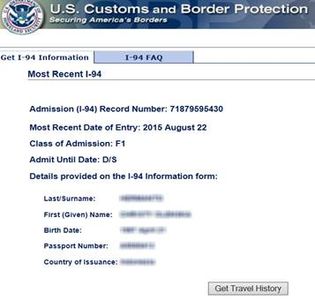
When you arrive in the U.S. by air or sea, U.S. Customs and Border Protection (CBP) will electronically update your I-94 arrival record to reflect the immigration status in which you were admitted and the length of lawful stay that you have been granted.
For J-1 exchange visitors and your J-2 dependents, your electronic record should reflect your correct status for “D/S” (duration of status). If you are entering in a status other than J (i.e., H-1B, TN, O-1, etc.), your passport stamp and electronic record should reflect the end date on your corresponding immigration document.
Each time you reenter the U.S., it is important to check both your electronic I-94 arrival record to make certain these are correct. We recommend that you retrieve your electronic I-94 arrival record after each entry to the United States and save a copy of your records. Errors to your admission status or length of stay can jeopardize your ability to study, work and remain lawfully in the U.S.. If you discover an error to your electronic I-94 arrival record, come to ISSO immediately to discuss how this can be corrected. See sample I-94 arrival record below:

If you have further questions about international travel or visa renewal, please connect with your ISSO Scholar Advisor. You can also refer to Traveling While at BU for more information.
