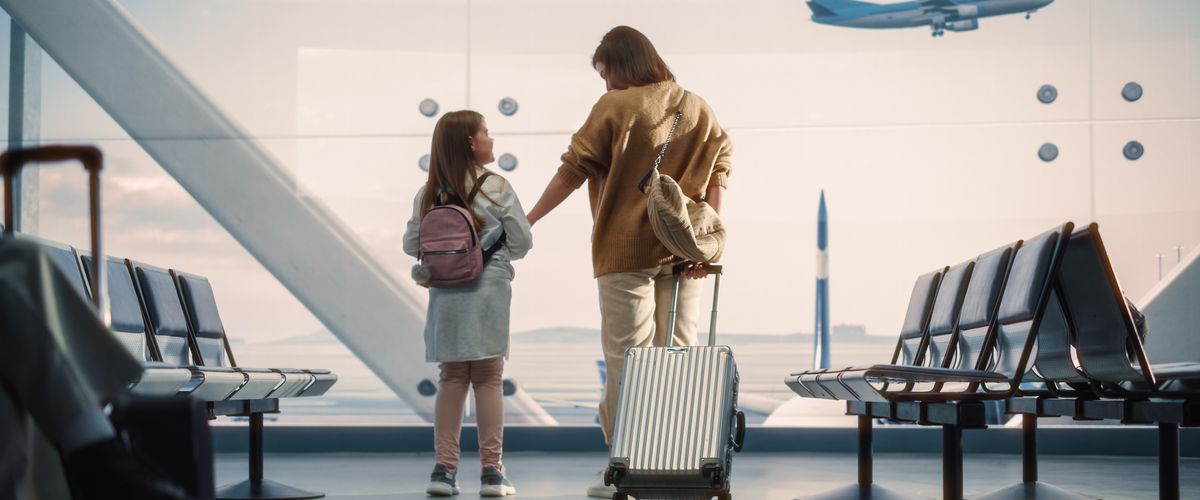
The ISSO is here to help guide you and your family members through your nonimmigrant processing needs.
U.S. immigration regulations define dependent family members as a legal spouse and/or minor children under the age of 21. If you have dependent family members who will join you for all or part of your time at BU, they will need to obtain the appropriate U.S. immigration classification to support their full-time activities. The ISSO team can help you assess options, but most dependents apply for derivative entry visas and enter the U.S. as F-2, J-2 H-4 dependents etc. Their ability to remain in the U.S. is directly dependent on your lawful status.
Parents, siblings, extended family members or other members of your household are not eligible or derivative dependent categories and should plan to travel to the U.S. for short visits in visitor status.
Adding Dependents
Adding Dependents to your F-1 or J-1 SEVIS Record
Students or scholars/employees who wish to bring dependents to the U.S. will need to:
- Include biographical details about their family members on personal data forms as part of their initial immigration processing or
- Work with their ISSO advisor after they have arrived in the U.S. to add dependent family members to their records
F-1 and J-1 students and exchange visitors will also need to provide financial documentation proving they have sufficient funding to cover the living expenses and required health insurance of their dependent family members for the duration of their stay in the U.S. F-2 and J-2 dependents will have their own SEVIS records and will be issued F-2 I-20s or J-2 DS-2019s.
Assisting Dependents Obtain Derivative Immigration Status
Dependents outside the U.S. would follow standard visa application procedures to apply for the appropriate entry visa at a U.S. consular post and then travel and enter the U.S. in that classification much like the primary student or scholar/employee. Dependents may also choose to apply for the new entry visa on their next planned travel outside the U.S.
Dependents inside the U.S. would need to work with their ISSO advisor to assess options to change to a dependent/derivative classification (J-2, F-2, H-4 etc.)
If your dependents decide to apply for a change of status from within the U.S., they should plan to submit the following to USCIS:
- USCIS I-539 Change of nonimmigrant status application
- G-1450 to pay the I-539 application fee
- Letter of explanation outlining the reasons the petitioner is requesting a change of status, how they will cover their expenses during this time and their plans after their primary family members will end their studies or scholarly activities.
- Marriage Certificate (if applicable) – Must include an official translation if not already in English.
- Birth Certificate for each minor child (if applicable) – Must include an official translation if not already in English.
- Financial Documents – Submit copies of financial documentation that you provided to request the I-20 or DS-2019 for each of your dependents.
- Proof that the primary student or scholar/employee is maintaining valid status. Students could submit a transcript full-time enrollment and other documents verifying current nonimmigrant status.Scholars/employees could provide copies of appointment letters, salary statement etc.
- Your current and previous DS-2019 or I-20
- Passport data page and I-94 arrival record for all family members
- Additional documentation base don your specific situation and U.S. immigration history
USCIS I-539 processing times vary greatly. Applicants will forfeit their application if they depart the U.S. while the application is pending.
Given the complexities and risks involved with USCIS applications, change of status applicants are encouraged to seek legal advice from an experienced immigration attorney with a change of status application.
Dependent Status Reminders
F-2 Dependents
Each F-2 dependent must have their own I-20, issued by the ISSO. The F-2 I-20 can be issued at the time of the F-1 student’s academic admission or can be issued after the F-1 student begins their program of study.
F-2 status is dependent on the F-1 principle to remain in the U.S. maintain valid status. F-2 dependents cannot stay in the U.S. without the F-1 principle. If the F-1 ends their program, the F-2 status ends as well.
F-2 spouses are prohibited from enrolling in full-time study in the U.S., but may enroll in part-time coursework. F-2 children may be enrolled full-time in an elementary or secondary school; however they are required to pay tuition (even if they are attending a public elementary or secondary school).
The F-2 status does NOT allow any option to obtain work authorization in the U.S.. Therefore, F-2 dependents cannot accept employment in the U.S..
F-2 dependents traveling separately from the F-1 principal must have a valid travel signature on their own I-20, and will need to be certain their visa and passport are valid for reentry.
F-2 dependents are generally admitted to the U.S. for “D/S” (duration of status)—this allows them to stay until the program end date reflected on the F-1 student’s I-20, as long as the F-1 student maintains full-time registration, legal status, and a SEVIS record in good standing. At the end of the F-1 student’s program of study, F-2 status permits a 60-day grace period to prepare for departure from the US.
F-2 I-20s are generally extended when the F-1 extends their I-20, but students should make sure to monitor their family’s documents to make sure they are valid at all times while they are in the U.S.
J-2 Dependents
Each J-2 dependent must have their own DS-2019, issued by the ISSO. The J-2 DS-2019 can be issued at the time the J-1 is preparing to enter the U.S. or can be issued after the J-1 has arrived in the U.S. to begin studies or scholarly activities.
J-2 status is dependent on the J-1 to remain in the U.S. maintain valid status. J-2 dependents cannot stay in the U.S. without the J-1 principle. If the J-1 ends their studies or scholarly activities, the J-2 status ends as well.
J-2 spouses are not restricted from enrolling in either part-time or full-time coursework.
J-2 dependents traveling separately from the J-1 principal must have a valid travel signature on their own DS-2019 and will need to be certain their visa and passport are valid for reentry.
J-2 dependents are generally admitted to the U.S. for “D/S” (duration of status)—this allows them to stay until the end date reflected on the J-1 student’s DS-2019, as long as the J-1 continues to maintain valid status and has an active SEVIS record in good standing. At the end of the J-1 studies or scholarly activities, J-2 status permits a 30-day grace period to prepare for departure from the U.S.
J-2 DS-2019s are generally extended when the J-1 extends their I-20 but J-1s should make sure to monitor their family’s documents to make sure they are valid at all times while they are in the U.S.
J-2s are allowed to work in the U.S. only with a valid Employment Authorization Document (EAD) issued by USCIS.
Applying for J-2 Employment Authorization
Dependents in the U.S. over the age of 15 in J-2 status can apply to USCIS for employment authorization (EAD). While many USCIS employment applications can be submitted on-line, J-2 applications for work authorization must be submitted via a paper application with an application fee, copies of immigration documentation and supporting documentation.
Suggested documents to include:
- G-1450 authorization for credit card transaction. See USCIS Fee Schedule to determine current I-765 fee.
- 2 color photos meeting USCIS specifications. Write your full name in pencil on the back of each photo. Do not cut photos.
- Completed I-765
- Part 2 – Information about you:
- Your U.S. mailing address: provide an address that will be valid for at least 3-6 months
- Item 20, J-2 EAD eligibility category is (c)(5)
- The J-1 student or exchange visitor is required to cover all of the J-2s living expenses so the J-2 should submit copies of financial documentation proving the J-1s funding sources and a statement from the J-2 dependent confirming they are seeking to gain experience and earn a bit of extra money but not to support the J-1 expenses.
- Copies of J-2 immigration documents: DS-2019(s), I-94 arrival record, entry visa, passport data page(s)
- Copies of J-1 immigration documents: DS-2019(s), I-94 arrival record, entry visa, passport data page(s)
Please contact your ISSO Advisor if you have any questions about the J-1 employment authorization application process.
I-765 EAD Application Mailing Instructions
- Assemble items in the order above and keep a copy for your records.
- Mail to the USCIS address for your state.
- Recommended: send by Certified Mail with Return Receipt or use a courier (FedEx, DHL, UPS) that provides delivery confirmation.
After you apply
- You can check status after receiving a USCIS receipt notice.
- Do not begin work until you receive the EAD. Employment is only allowed for the dates on the EAD.
- Apply for an SSN after you receive your EAD. You will need to make an appointment at a local Social Security Administration office as part of this process.
Extending J-2 Employment Authorization
- To renew, follow initial filing guidelines above to submit a new I-765 application with application fee, supporting documents and copies of all updated immigrations documents including copies of prior EADs
- You must have a new EAD to continue working after previous EAD expires. You should apply for a new EAD at least 6 months before your EAD expires to avoid a gap in employment authorization.
Other
Inviting Family to Visit
Dependent family members typically accompany students and scholars during their stay in the U.S. for long periods of time in dependent immigration statuses like F-2, J-2, H-4 etc. Occasionally, however, students and scholars/employees may wish to invite non-dependent relatives such as parents, siblings, grandparents, partners, children over the age of 21, friends etc. to visit them in the U.S. for short periods of time. These visitors generally enter the U.S. in a visitor visa (B-2) or through the Visa Waiver Program depending on their country of citizenship. Such, visitors should carefully review the U.S. Department of State’s information on entering the U.S. in visitor status.
While the U.S. Department of State continues to emphasize that letters of invitation are not required to apply for a visitor visa. You could issue an invitation letter to your visitors in addition a confirmation of your BU affiliation from ISSO. In addition. Please review these sample letters to assist you in writing a letter of invitation.
- International students can log into the ISSOPortal to request a visitor letter which will confirm you are a BU student. In addition, the BU Office of the Registrar could issue official Proof of Enrollment.
- International scholars/employees can reach out to their International Scholar Advisor if they have questions about the inviting visitors to the U.S..
Dependent Children Turning 21 or Other Changes to Your Family
A dependent child can only remain in a derivative dependent status until the date on which they turn 21 years of age. Once they reach their twenty-first birthday, they “age out” of eligibility for a dependent status. Contact your ISSO advisor 3-6 months in advance of your dependent’s 21st birthday to strategize discuss options to change to another immigration status.
In addition, sometimes your family relationships change, contact your ISSO advisor to strategize how marriages or divorces could impact immigration records and statuses.