Decoding “Digital Sin”: ForexTech and the New Frontiers of Currency Instability
By Pedro Perfeito da Silva and Marina Zucker-Marques
The spread of FinTech—technology-driven innovation in financial services—is changing how people and businesses save, invest, make payments, access credit and manage their finances. While studies highlight FinTech’s potential to promote financial inclusion and efficiency, it also creates new risks for developing countries, from financial instability to currency pressures.
A new working paper from the Boston University Global Development Policy Center shows that not all FinTech innovations are the same. One group, which we call ForexTech—firms leveraging technology to expand access to crypto-assets and foreign currency accounts—is deepening persistent challenges to policy autonomy in developing economies.
Brazil’s experience of currency instability in 2024 illustrates these dynamics. Increased adoption of crypto-assets and digital dollar accounts led to capital flight and currency market pressures, driven by regulatory gaps and a wave of liberalization. Efforts to regulate ForexTech face obstacles across interest groups, institutions and ideas—such as central bank independence, international commitments and fragmented support for capital account regulation. Unlike in the 2010s, when Brazil managed inflows successfully, addressing outflows from ForexTech has proved far more difficult politically.
Our study finds that although the participation of ForexTech firms remains small in Brazil’s primary foreign exchange market, their business models are geared toward buying US dollars—which puts downward pressure on the Brazilian real. In 2024, traditional banks like Citibank and Banco do Brasil dominated the foreign exchange primary market, handling $76 billion in net transfers abroad—more than twice the volume of all ForexTech firms combined, at nearly $30 billion. However, ForexTech’s market share represents only 7.1 percent, while traditional banks still control 65.7 percent of trading. This shows that, even with their smaller presence in the foreign exchange primary market, ForexTech firms punch above their weight when it comes to transfers, intensifying the demand for US dollars and adding to pressures weakening the Brazilian real.
Research in international finance has highlighted the vulnerabilities that developing countries face when borrowing abroad in foreign currencies—an issue widely known as “original sin.” Today, however, developing countries may be confronting a new kind of challenge: the “digital sin.” This refers to the phenomenon of allowing—or even encouraging—resident capital outflows through ForexTech channels, such as access to crypto-assets or dollar-denominated digital accounts. If left unaddressed, “digital sin” could accelerate dollarization across a wider range of developing economies, with significant implications for their financial stability.
Insights from the case study
Brazil’s exchange rate turmoil in 2024 reflects shifting politics and economic pressures. After cycles of impeachment, market reforms and government changes, President Luiz Inacio Lula da Sliva’s third administration faced tough conditions: fragmented coalitions, slowing growth, business resistance and global instability. A new fiscal framework and efforts to close tax loopholes was met by private sector pushback, fueling an increase in demand for dollars. As exports slowed and capital outflows surged, the Brazilian real weakened sharply in 2024 (Figure 1), prompting record central bank interventions of $33 billion—almost 10 percent of foreign reserves.
Figure 1: Daily Exchange Rate, USD to BRL, 30 December 2022 to 31 December 2024

Beyond political drivers, the foreign exchange futures market—where people buy and sell contracts to exchange currencies at a fixed price on a future date—influences Brazil’s foreign exchange rate dynamics in the spot market—where there is immediate delivery. Our research shows that rising ForexTech activity in the spot market is now accentuating downward pressure on the Brazilian real and increasing balance of payments vulnerability.
As Figure 2 shows, Net financial transfers abroad have surged since 2021, and in 2024 reached a $95 billion outflow—pushing Brazil’s primary foreign exchange market into a $19 billion deficit. In December 2024, Roberto Campos Neto, who was Central Bank Governor at the time, called the outflows trend “one of the worst years in history,” citing large corporate dividend payouts and increased individual outflows, especially via digital platforms.
Figure 2: Primary Foreign Exchange Market, Brazil, USD Billion, 2018–2024

The rise and implications of ForexTech in Brazil
Our study maps the diversity of ForexTech institutions in Brazil, showing they range from digital banks and payment platforms to specialized investment firms. They differ in size, origin and client focus, but many share international ties with subsidiaries or parent companies based in the US, UK or Cayman Islands. Contrary to popular belief, not all ForexTech firms are newcomers—some evolved from regional banks, while others have traditional banks as shareholders, including J.P. Morgan, Itaú Unibanco and Santander. These platforms are also increasingly integrated with crypto trading, directly offering cryptocurrencies and stablecoins, partnering with sector leaders and enabling cross-border transactions, further blurring the line between traditional finance and digital assets.
ForexTech firms offer foreign exchange services to broad sections of the population. Table 1 shows that average transfer size can range from R$188,000 to as low as R$300. Traditional banks, on the other hand, handle much larger transfers, often in the millions. This highlights how ForexTech is making foreign exchange more accessible, but also spreading risks to a larger portion of the population.
Table 1: Average Transfers Abroad by Selected Financial Institutions (ForexTech vs. Traditional Banks), Brazil, USD, 2024

The overlap between ForexTech and crypto is also significant: platforms now offer direct access to crypto-assets and stablecoins, with crypto-related capital outflows reaching nearly $17 billion in 2024—corresponding to roughly 25 percent of the country’s trade balance of goods and matching the total trade balance (i.e. the one combining goods and services). This number also corresponds to around 15 percent of Brazil’s capital and financial account as shown in Figure 3.
Figure 3: Net Outflows via Purchase of Cryptocurrencies, Brazil, USD Billion and Share of Capital and Financial Account (%), 2018–2024
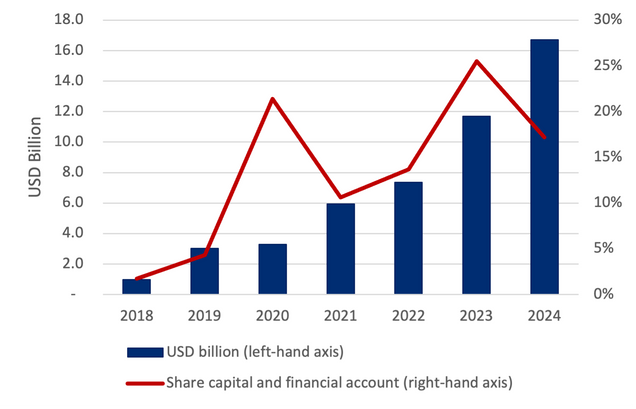
Figure 4 shows that crypto-asset holders in Brazil peaked at 9.2 million people in November 2023. The value of holdings hit a record $8.5 billion in December 2024, when foreign exchange pressures were highest. Sharp swings in the number of holders—such as a drop to 3 million people in November 2024, followed by a rebound to 6.2 million people—suggest that many use crypto-assets for sending money out of Brazil, not long-term investment.
Figure 4: Crypto-Asset Holdings by Brazilian Legal Entities and Natural Persons (Million) and Volume (Monthly), USD Billion, August 2019–December 2024

Most crypto-asset transactions in Brazil favor US dollar-denominated stablecoins, with just 3 percent involving Brazilian real-denominated options as show in Table 2. This trend reinforces Brazil’s financial ties to the dollar and creates new risks for monetary autonomy. Whether through foreign currency accounts or crypto-assets, Brazilian residents are increasingly buying dollar-based products.
Table 2: Crypto-Asset Transactions, Accumulated Share, Brazil, August 2020–December 2024

Historically, Brazil has been proactive in managing capital flows, particularly in the 2010s. But our research finds the digital age poses new—and tougher—challenges. Regulating capital inflows, as Brazil once did, is not enough: today, ForexTech-fueled pressures demand creative policies to stem capital outflows. These measures, however, face steep political and institutional barriers, especially as domestic elites and global actors lobby for fewer restrictions in the name of “market credibility.” Our analysis draws on international political economy (IPE) frameworks, tracking how institutions, ideas and interests shape what’s possible for policy.
In Brazil, the combination of regulatory inertia, economic orthodoxy and external pressures have tied policymakers’ hands—leaving the country exposed to technologically driven financial subordination. Rather than the favorable conditions that allowed Brazil’s leadership to manage capital flows after the global financial crisis in 2008, a myriad of factors delayed the much-needed tightening of capital flow management in 2024: a new exchange rate regime overseen by an independent central bank, the elusive pursuit of Organization for Economic Co-operation and Development (OECD) membership, the lack of International Monetary Fund (IMF) support for encompassing restrictions and the absence of a socio-political consensus against capital outflows. As monetary sovereignty is hard to get but easy to lose, the continuity of this political stalemate may have long-term consequences, even if the instability forces a regulatory response. Table 3 summarizes the main differences between the two periods the article analyzes.
Table 3: Domestic Politics of Capital Flow Management: Prevailing Factors

What’s next? Policy solutions for a digital age
Can countries like Brazil regain control and mitigate risks to monetary sovereignty in the age of ForexTech? We argue that the solution is multifaceted, and includes:
- Level Regulatory Playing Field: Apply consistent tax and regulations to ForexTech actors as for all financial institutions to close loopholes and discourage regulatory arbitrage.
- Controls on Outflows: Tighten capital outflow management, even knowing these tools are only partly effective and must keep pace with evolving technology.
- Central Bank Digital Currencies (CBDCs): Develop and deploy digital currencies—like Brazil’s Drex—to help central banks track, oversee and potentially restrict cross-border digital flows.
- Advertising and Information Regulation: Expand oversight of marketing for crypto-exchanges and dollar accounts, beyond traditional channels, to curb speculative behavior.
Brazil is well-positioned in several respects, particularly its expertise in FinTech monitoring and its world-leading instant payment platform (Pix). However, technical innovation cannot substitute for the political will and international cooperation required to rebalance the risks.
Without proactive, adaptive oversight, unchecked ForexTech growth could fuel volatility, worsen external imbalances and deepen dollarization—robbing emerging economies of the policy space needed for development. As global coordination remains elusive (underscored by the US’s push for dollar-centric digital asset regimes, such as the GENIUS Act), the burden falls on domestic policymakers. The costs of inaction are stark: greater vulnerability to capital flight, more unstable exchange rates and a narrowing path for inclusive development. As foreign currency debt has been an original sin haunting developing economies, these new avenues for capital outflows can turn into a digital sin, adding an extra layer of financial subordination.
Safeguarding monetary sovereignty in the digital age requires moving ForexTech regulation to the center of capital flow and currency policy debates. Our research highlights the urgent need for innovative, politically feasible solutions to the challenges posed by financial subordination—old and new.
Read the Working Paper