News
U.S. Surgeon General Urges More Aid for Opioid Addicts
 ON THE CHARLES RIVER
US Surgeon General Urges More Aid for Opioid Addicts
During a visit to BU, Dr. Jerome Adams says "We have to make it easier to get help than to get high." Learn what he had to say
 FACULTY EXPERT
Investing in Cryptocurrency: Do or Don't?
BU professor Mark Williams explains why they're risky. Get up to speed
 STUDENT LIFE
SheHacks Boston
BU students host a weekend hackathon that tackles the gender gap in computer science.
See how they're #makingthenewnormal
IN CASE YOU MISSED IT...
The Washington Post covered a new BU Initiative on Cities survey that identified mayors' concerns about affordable housing... Three BU scholars explain the impact of the Women's March... BU College of Engineering Dean Kenneth Lutchen wrote about improving university-industry partnerships in The Harvard Business Review... James Bird of the BU College of Engineering spoke to CBS Sunday Morning about the science of bubbles... Arianne Chernock of the College of Arts & Sciences explained our fascination with the royal family to the Huffington Post.
President Delivers State of the Union Address
BU IN DC>
Wen Li of the College of Arts & Sciences spoke on January 31 at a National Academies symposium celebrating the 60th anniversary of the Explorer 1 Mission and the discovery of the Earth's radiation belts.
Shoumita Dasgupta of the School of Medicine spoke at a meeting of the Inter-Society Coordinating Committee for Practitioner Education in Genomics on February 1.
PRESIDENT DELIVERS STATE OF THE UNION ADDRESS
President Donald J. Trump delivered his State of the Union address to Congress on Tuesday night, highlighting the economy, the recently enacted tax bill, and his foreign policy. He urged Congress to adopt his plan to provide a path to citizenship for undocumented young people brought to the United States by their parents, in exchange for heightened border security and a reduction in legal immigration. He also offered support for opening "great vocational schools." Rep. Joseph Kennedy III (D-Fall River) offered the Democratic response to the speech, expounding on the character and diversity of Americans.
BROWN SHARES VIEWS ON HIGHER ED BILL
President Robert A. Brown wrote the Massachusetts Congressional delegation last week to share Boston University's views on a pending bill to update the Higher Education Act. Brown's letter expressed concerns that the Promoting Real Opportunity, Success, and Prosperity Through Education Reform Act (PROSPER Act, H.R. 4508) would eliminate important sources of financial aid that make college more affordable and graduate school more accessible. The U.S. House of Representatives may vote on the bill this month, but Senate leaders are expected to introduce a competing bill later this spring.
BUZZ BITS...
- The director of the Centers for Disease Control and Prevention (CDC) resigned on Wednesday. Dr. Brenda Fitzgerald's financial conflicts of interest rendered her unable to fulfill her duties during her seven months in the job. Dr. Anne Schuchat, a career CDC official, will now serve as acting director.
- The President announced his intention to nominate Dr. James Reilly as director of the U.S. Geological Survey (USGS). Dr. Reilly is a former astronaut who currently serves as an adviser to the U.S. Air Force National Security Space Institute. The USGS portfolio includes earthquake monitoring, volcano hazards, and climate change observation.
- On Tuesday, the National Council on Disability released a report asserting that sexual assault of students with disabilities is not "on the radar" of the nation's college and universities.
Telling the Truth about Rwanda
Pardee professor speaks today about his new book on country’s recovery
 Timothy Longman with youth from Kabarondo, a village in the Eastern Province of Rwanda, in 2006. Photo courtesy of Timothy Longman.
Timothy Longman doesn’t go back to Rwanda anymore. Too much of his work has displeased the regime.
“I don’t feel safe to go,” says Longman, director of BU’s Institute on Culture, Religion, and World Affairs (CURA) and a former director of the Rwanda field office of Human Rights Watch. “It’s far too easy for someone to have a tragic car crash or eat something that was ‘spoiled.’ And I have been singled out by the foreign minister as someone she does not like.”
Longman’s new book, Memory and Justice in Post-Genocide Rwanda (Cambridge University Press, 2017), continues his examination of that country’s long recovery from the genocidal tribal wars that killed more than 500,000 people in 1994. His earlier book Christianity and Genocide in Rwanda (Cambridge University Press, 2010) looks at how the leaders of Christian churches supported the genocide to secure their own power. Rwanda has been rightly praised for its recent successes, but its recovery has not been without cost, and life there now is extremely hard for most, says the Pardee School of Global Studies and College of Arts & Sciences professor of political science and of international relations.
“I have friends, students, and researchers who were killed, and in some cases I know who killed them.”—Timothy Longman
As a University of Wisconsin–Madison grad student in political science, Longman planned to do his dissertation research in Congo. But in 1991, two weeks before he was to fly there, rioting targeting westerners broke out. A faculty member advised him to refocus, suggesting Rwanda as “a nice, peaceful little country.” Longman spent much of 1992 and 1993 in Rwanda, watching the country fall apart as it was wracked by extremist politics and fears of ethnic violence.

Different sources offer different numbers, but Longman believes that between 500,000 and 600,000 Rwandans were killed in the bloodbath that began in April 1994—in a country roughly the size of Vermont. Most of the dead were Tutsis massacred by Hutu, who also killed moderate Hutu. Neighbors killed neighbors in a firestorm of violence fueled by ethnic differences, but sparked and fanned by government propaganda. After months of violence, Tutsi rebels known as the Rwandan Patriotic Front (RPF) overthrew the government and stopped the genocide. Longman returned there as director of the Rwanda field office of Human Rights Watch in 1995 and 1996, charged with investigating what had happened and witnessing the country’s struggles to move beyond the chaos. Much of what he learned is described in his new book.
“It helped to go back to Rwanda as a human rights worker instead of just a scholar, because I felt I was able to do something proactive,” Longman says. He helped to train international criminal tribunal researchers so they could hold people accountable, and he served as an expert witness in trials held in countries around the world to bring people accused in the genocide to justice.
“This is a subject I can’t just approach from an academic perspective,” he says. “I have friends, students, and researchers who were killed, and in some cases I know who killed them. One of the main organizers of the genocide in one of the communities where I worked extensively was someone I knew very well. I’ve eaten in his house; he used to give me rides to the capital. He ended up participating in the killing of some of my friends, and I have friends he raped. That reality is tough to live with, to know that normal, ordinary people, people you would have dinner with in their homes, are capable of such terrible things.”
While efforts to restore justice and rebuild the country often look successful on the surface, Longman says, most of the economic gains have benefited a small and politically connected elite. He made several return trips to continue his research, but eventually decided that it was unsafe. His books describe shades of gray in Rwanda’s postgenocide era, which some powerful Rwandans prefer to see as a black-and-white success story.
Longman acknowledges that the current government is very efficient, is successfully managing development, and has been relatively effective in its fight against corruption. But, he says, RPF leaders are working hard to keep tight reins on power. Ideas and initiatives are dictated from the top. And while the RPF government has done a great job of attracting international investment, economic inequality is widespread, and freedom of speech is treated as a luxury the country cannot afford.
“Prof. Longman does not offer simple or simplistic answers on Rwanda. Because there are none,” says Adil Najam, dean of the Pardee School. “His research stands out not only because it sheds new and nuanced light on transitional justice, but even more because it is undertaken with such care and thoughtfulness.”
“Memory and Justice in Post-Genocide Rwanda is seminal,” says Fallou Ngom, a CAS professor of anthropology, who succeeded Longman last year as director of the African Studies Center. “The book has set a new standard of excellence for postgenocide studies not just in Africa, but everywhere.”
Longman doesn’t think there’s danger of a return to widespread violence. In fact, the government deliberately reminds people of the horrors of violence, with genocide memorials containing unburied remains, which unfortunately also makes life painful for survivors who wish to bury their dead. In one of the book’s passages, Longman recounts walking through a memorial as fragments of victims’ bones crunched under his shoes.
“But,” he says, “I also don’t think any kind of positive development in Rwanda is possible for the long term unless the government begins to allow its population to speak and to organize and to think for itself.”
Despite the challenges of working in Rwanda, Longman maintains a deep love for the country and its people. He says he has tried to move on to other countries for his research, but he keeps getting drawn back in.
“Given the terrible events that I have seen in Rwanda, the friends that I have lost, the difficult stories that I have heard, I feel a moral responsibility to bear witness,” he says. “I have Rwandan friends that I’ve known for more than 25 years, and I feel an obligation to continue to share their stories and to do what I can to contribute to Rwanda’s development. You can’t walk away from something like the Rwandan genocide. It will haunt me the rest of my life.”
Timothy Longman will read from Memory and Justice in Post-Genocide Rwanda today, January 31, at 4 pm, at the African Studies Center, Room 505, 232 Bay State Rd.
Author, Joel Brown can be reached at jbnbpt@bu.edu.
A BU Professor, Two Alums Win City of Boston Fellowships
Filmmaker, writer, and artist receive $10,000 grants
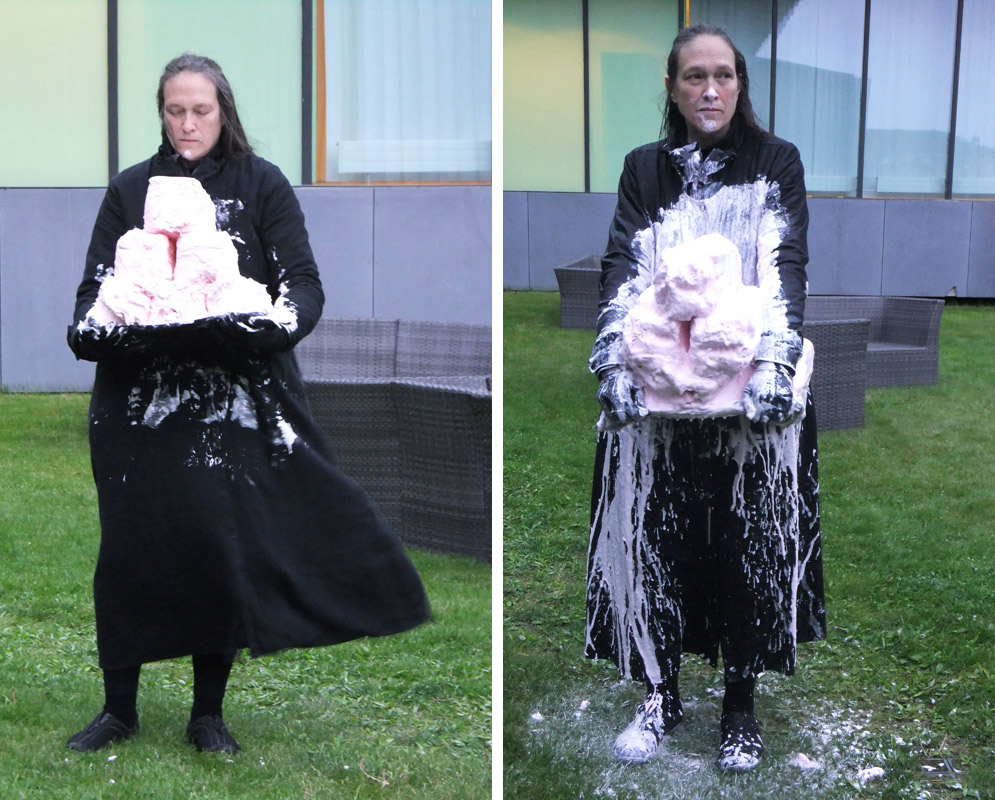
Performance artist Marilyn Arsem (CFA’73) outside the Museum of World Culture in Sweden holding several gallons of melting peppermint ice cream. Photo courtesy of Marilyn Arsem.
Marilyn Arsem has been called the godmother of performance art in Boston.
Arsem (CFA’73) walked for miles across Svalbard, Norway’s thawing permafrost in the Arctic Circle, to deliver vegetables, and purified water for six hours in a coastal town in Taiwan, both for performance art pieces exploring environmental concerns. She screamed in unison with riders on the world’s tallest free-fall ride in Sweden. And she did it while cradling 11 gallons of melting peppermint ice cream in her arms.
“I am always trying to challenge myself to do something different and create something new,” says the Jamaica Plain resident. “I don’t get bored. There’s always something to discuss, to think about.”
Arsem is one of five winners of the city of Boston’s inaugural Artist Fellowship Awards, administered by the Boston Cultural Council and honoring “exceptional original artistic work.” Also receiving one of the $10,000 grants are two others with BU ties: BU Creative Writing Program alum Dariel Suarez (GRS’12) and Mary Jane Doherty, a College of Communication associate professor of film
More than 300 people applied for the fellowship, and a panel of 27 art and culture experts from city institutions selected the recipients.
“It was a very, very difficult jury process,” says Julie Burros, chief of arts and culture for the city of Boston. “We had such a wealth of outstanding applicants.”
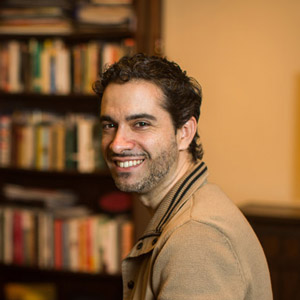
Dariel Suarez (GRS’12) finds time to write before work on weekdays and on Sundays at his home in Brighton. Photo by Jake Belcher.
Fiction writer Dariel Suarez says his grant will help him continue work on his second book, which is about human trafficking and is set in South Florida, Latin America, and his native Cuba. The novel, he says, explores the ways that people endure adversity.
“I see the world as complex and nuanced,” Suarez says. “Life is not as happy as we think, but it’s not as terrible as we like to think either.”
Suarez immigrated to Florida from Havana when he was 14 and started writing fiction for a class at Palm Beach Community College. A teacher liked his work and encouraged him to continue.

Suarez as a boy in Cuba.
He did, with gusto. He earned a master’s degree in fiction at BU, where he was a founding editor of Middle Gray Magazine.He’s remained in Boston and has published several short stories in literary magazines and journals, as well as a collection titled A Kind of Solitude, which was a finalist for the New American Press Fiction Prize and the Autumn House Press Fiction Contest.
Suarez completed his debut novel, The Playwright’s House, about a Cuban political prisoner, last year. Creative Writing Program director Ha Jin, a College of Arts & Sciences professor of creative writing and a National Book Award–winning author of several novels and short stories, says that Suarez writes with energy, exuberance, and psychological acuity. “The straightforward prose adds gravity and earnestness to what is undoubtedly a remarkable novel,” he says.
Suarez lives in East Boston and works full-time as the head of faculty and curriculum at the Boston creative writing center GrubStreet. He is also a member of the Back Porch Collective, a Boston writers’ group with members from around the world.
Mary Jane Doherty has taught at BU for 27 years. She also brings stories to life with passion, although hers are not fictional. For the last two years, she has been filming the Boston Children’s Chorus, exploring how the group uses the power of song to transcend barriers of race and economics among its young members.
The grant, says Doherty, is a windfall and will allow her to pay for sound production engineering for the project.

Mary Jane Doherty has taught at BU for 27 years; she produces her own nonfiction narrative documentaries, which have received critical praise. Photo by Jackie Ricciardi.
“The soundtrack is everything,” she says.
After many years producing commissioned work, Doherty, who lives in the Back Bay, returned to making her own films in 2007. Her narrative documentaries do not use scripted action, staging, or interviews. When she begins filming with her handheld camera, she says, she doesn’t know how a story will end.
One of her first self-produced films, Secundaria, chronicles the lives of three teen dancers striving to win spots with Cuba’s renowned Ballet Nacional. The film was a New York Times Critics Pick, and was described by the paper as a “lucid, watchful portrait of young ballet dancers desperately trying to plie their way out of poverty.”
The trailer to Doherty’s film Secundaria, about aspiring Cuban ballet dancers.
Doherty’s work has taken her in unimagined directions. Last year, she learned that Rainer Weiss, an MIT professor emeritus, whose work was the subject of one of her earliest films as a student, had won the Nobel Prize in physics.
Stay tuned.
“I’m going to film them again, 35 years later,” Doherty says.
Performance artist Marilyn Arsem studied directing as a BU undergrad, but thought it was too conventional. Instead, she founded Mobius, Inc., a collaborative of artists in Boston. For nearly three decades she was also a School of the Museum of Fine Arts faculty member, retiring in 2014. That same year, the MFA honored her with its Maud Morgan Prize, given to a woman who has demonstrated creativity and vision and has made significant contributions to the contemporary art landscape. Arsem is the first performance artist to win the $10,000 prize. These days, she is in demand globally, with upcoming performances in Venice, Taiwan, and Belfast.
Arsem isn’t sure how she will use the city’s grant, but she is currently considering projects about 19th-century feminism in Boston and the life of one of her Massachusetts ancestors, who was a governess for the family of writer Nathaniel Hawthorne.
“I’m interested in making art that is human-scale, that responds to particular places and issues and politics and materials,” Arsem says. “The experience is created the same time viewers are watching it.”
Find more information about Boston Cultural Council grants or apply here.
Author, Megan Woolhouse can be reached at megwj@bu.edu.
SPH Seminar: US Surgeon General Urges More Aid for Opioid Addicts
“We have to make it easier to get help than to get high”
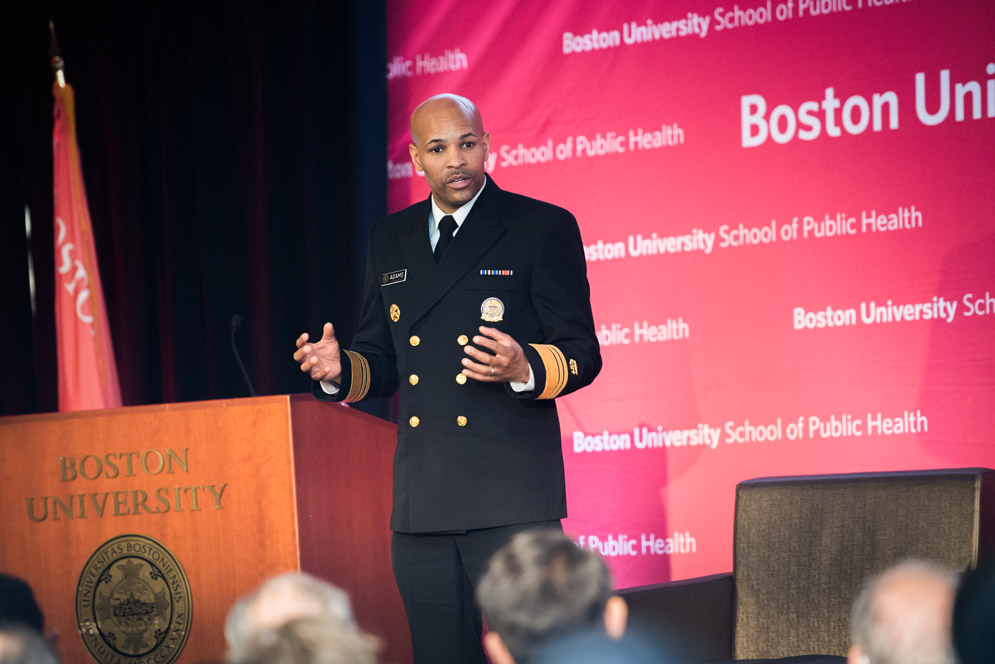
Jerome M. Adams, the US surgeon general,speaking at a School of Public Health Dean’s Seminar on the nation’s opioid crisis on January 26. Photo by Jackie Ricciardi.
Before a standing-room-only crowd at the Medical Campus last Thursday, Jerome M. Adams, US surgeon general, drove home the severity of the opioid crisis with a simple question.
“Raising your hand, how many of you know someone who is suffering from an opioid use disorder?” he asked.
Almost everyone in the room raised their hands—including Adams. “My little brother, Phillip, is in state prison right now, suffering from a still-untreated substance use disorder,” he said. “Addiction touches each and every one of us. No one is spared, black, white, rich, poor, urban, or rural.”
A vice admiral in the US Public Health Service, Adams was the headliner at the School of Public Health Dean’s Seminar The Opioid Crisis in America: A Conversation with the US Surgeon General. In addition to the overflow crowd of 400, another 500 were live-streaming the event.
The opioid epidemic has become one of the nation’s most pressing public health issues. According to the Centers for Disease Control and Prevention (CDC), drug overdose deaths in the United States have increased more than sixfold since 1980, and overdose is now the fourth leading cause of death overall, behind only heart disease, cancer, and chronic lower respiratory disease.
An epidemic that affects everyone will take everyone to beat it, Adams said, from scientists to law enforcement to local community leaders. “We must mount a robust response, but we can’t do it alone.”
To illustrate the importance of these partnerships, he shared his experience as Indiana’s health commissioner, when he presided over the state’s efforts to deal with an unprecedented HIV outbreak driven by needle drug use in Scott County. To tackle the outbreak, Adams first reached out to county faith leaders, the area Chamber of Commerce, and the local chief of police, seeking support for evidence-based, proven methods of prevention and treatment. “Science is what we know to be true, and policy is what we can convince the public to accept,” he said, and to bridge that gap, partnerships like this are vital.
The strategy worked, and to the surprise of many, the public “in conservative Indiana” even accepted a syringe exchange program, a proven method for stemming HIV transmission, but often not supported by public opinion.
Adams also warned against putting the newest and best methods into place only in those communities where they are easiest to implement. “I’m concerned that we are at times setting ourselves up to worsen disparities when we only allow the preventions we know to be effective to be applied to certain communities,” he said. Putting these strategies into place in communities with fewer resources and more distrust is worth the challenge, he said, but takes partnerships to build support.
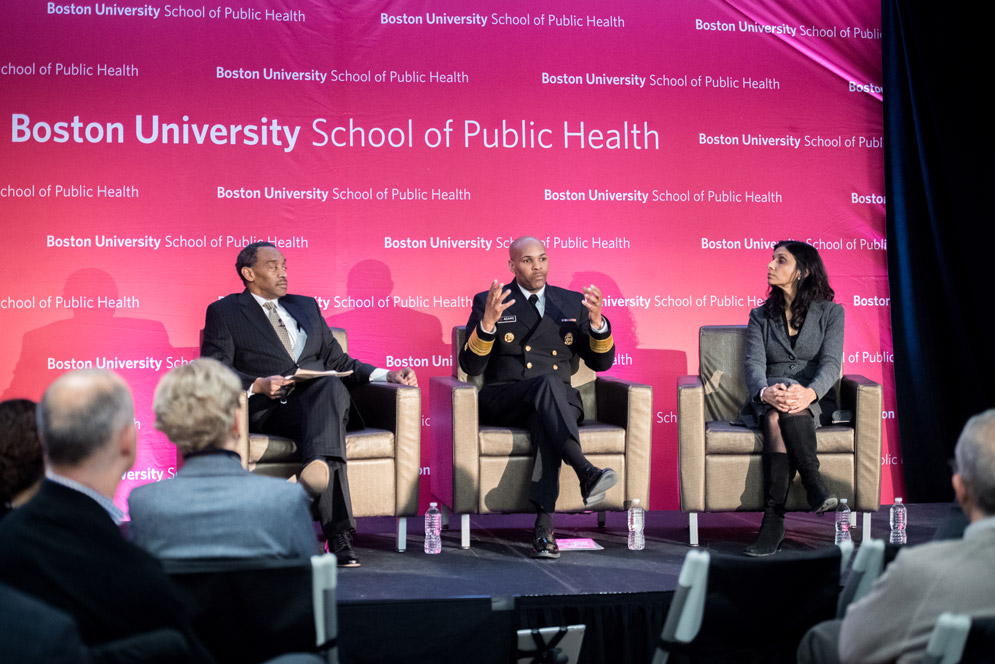
Also speaking at the seminar was Monica Bharel (CAS’94, MED’94), Massachusetts public health commissioner, who said that the gap between science and policy is driven by stigma, and is especially apparent in the limited availability of proven treatment. “It’s very hard to expand the opportunity for treatment, because people don’t want these places in their backyard,” Bharel said of the critical shortage of treatment centers.
She noted that only one third of treatment centers use medications like methadone. “If someone presents with a nonfatal overdose, and they get started on either buprenorphine or methadone, their risk of fatal overdose goes down by 50 percent,” she said. “Just imagine if that was a chemotherapy or a blood pressure drug. Everyone would have it, and we would all be using it.”
Jonathan Woodson, Larz Anderson Professor in Management at the Questrom School of Business and director of BU’s Institute for Health System Innovation and Policy, an event cosponsor, moderated a discussion between Adams and Bharel that focused on actionable steps to combat the epidemic. Discussing how the public can get more involved, the two public health experts stressed the importance of increasing public access to naloxone, the overdose-reversing medicine also known by the brand name Narcan. Massachusetts has ramped up both availability and training, Bharel said, and bystanders have already saved thousands of lives.
Bharel and Adams then demonstrated use of naloxone on stage with a training kit that sprays water. “I’m not going to squirt water up your nose,” Bharel assured Adams, eliciting laughter from the audience.
Holding up the spray, she told the crowd that those undergoing bystander training are given two doses. She then proceeded to show how easy it is to apply the spray. “So, someone is down,” she said, “you understand they’re nonresponsive, you think it’s an opportunity to use naloxone, and you just”—she sent a small cloud of mist up in front of the stage.
Every nonfatal overdose, Adams said, is an opportunity to connect someone with treatment. Those who interact with people with opioid use disorders need to work together toward that aim, from primary care physicians to the criminal justice system to those providing services for people who are homeless. “We have to make it easier to get help than to get high,” he said.
He said that also means providing “wrap-around services” for people struggling with addiction. “One of the things that we’re working on at the federal level is to be more permissive with Medicaid waivers, so folks can provide not just addiction treatment in the traditional sense,” he said, “but an expanded definition of treatment that includes peer recovery coaches, housing, job training, and all of the things that we know are critical components of success, and that we know if they are not provided will increase the chances of relapse.”
Adams ended the seminar on a hopeful note. Ultimately, he said, the key to advancing against the opioid epidemic is to amass more evidence of what contributes to successful recovery and then to put that evidence to work in the form of policy.
“We need to fight for good, evidence-based programs and show communities how they can incorporate them. If we do that, we will get where we need to be. I’m convinced of it.”
Author, Michelle Samuels can be reached at msamu@bu.edu.
SheHacks Boston Student Organizers Are #makingthenewnormal
Weekend hackathon tackles the gender gap in computer science
A negative experience at a New York hackathon gave Fiona Whittington (COM'19) the idea for SheHacks Boston. Photo by Jake Belcher.

Fiona Whittington went to her first hackathon by herself. It didn’t go well.
“When I walked in some guy came up to me and was like, ‘Do you even code?’” she says, imitating his sneer. “And I’m like, ‘Look at my laptop, it says Girls Who Code. Of course I belong here.’”
That hackathon in New York a year ago was pretty traumatic, says Whittington (COM’19). There were hardly any other women, and she felt unwelcome, at least until a couple of BU guys took her under their wing. “Women should never have to feel that way at a hackathon,” she says.
She decided to do something about it. This weekend, BU plays host to SheHacks Boston, which she created in response to that reception in New York and hopes will be the largest-ever female and femme nonbinary hackathon. The event has a target of 1,000 attendees, and more than 800 college and high school students have already registered. Most are from the United States and Canada, but a few are coming from as far away as Ethiopia and Morocco.
The SheHacks mission statement: “Empower women and femme nonbinary individuals in technology to achieve. Provide them with opportunities to explore the tech industry in an inspiring, encouraging, and energizing environment. Create a community of inclusivity within the tech industry.”
The chosen hashtag? #makingthenewnormal.

Whittington (left) and Natalie Pienkowska (CAS’20) are among the leaders of SheHacks Boston, the largest ever (they hope) all-female hackathon, scheduled for this weekend at BU. Photo by Jake Belcher.
“What drove me to do it is that there are such amazing opportunities to learn and grow and network,” says Whittington, director of SheHacks. “An all-female hackathon is a great way for women to have access to those opportunities to learn and grow in a safe environment.”
For the uninitiated, a hackathon isn’t some quasi-criminal identity-theft fest, but a programming marathon where coders collaborate to create software that could be used to meet a variety of challenges.
Headquartered at the George Sherman Union’s Metcalf Hall, but spreading out to rooms in several other campus buildings, SheHacks will bring together teams of two to six coders who will compete for prizes ranging from consumer technology such as Amazon Fire tablets to a pitch session with a venture capital firm. Numerous challenge categories include Gender Equality (help victims of sexual assault raise their voice and access resources) and Political Polarization (help combat the fake news phenomena) as well as She </Laughs> (for the team with the most hilarious and creative hack).
SheHacks begins at 8 pm Friday and runs until 2 pm Sunday, with hacking, prizes, pizza, hacking, music, guest speakers, hacking, and more. BU students make up the majority of the central organizing group of about a dozen, but MIT, UMass Boston, Northeastern and NYU are also represented, and students from other local schools are among the 100 volunteers.

SheHacks is funded by more than $130,000 from dozens of sponsors, among them Major League Hacking, Facebook, Bloomberg, and Mass Housing. Other supporters are the College of Arts & Sciences, the CAS computer science department, the College of Engineering electrical and computer engineering department, the Questrom School of Business, Innovate@BU, BUildLab, and BU Spark! Whittington says she’s also received key support from Natalie McKnight, dean of the College of General Studies, and Tracy Schroeder, vice president of information services and technology.
“The world needs the perspective of women in all aspects of technology,” says Schroeder. “Women have different needs and perspectives on these things than men, and if women are not involved, women will not be well served.
“Is it lonely for women in tech? Short answer: yes,” Schroeder says. “I can’t tell you how many meetings I attend where I am the only woman in the room. I’m over it, I can handle it, but it shouldn’t be that way. What do I hope comes from SheHacks? More women in the technology profession. It’s that simple.”
“This is an ambitious undertaking, particularly for undergraduates,” says McKnight, who made a personal donation to SheHacks. “I am very impressed with their courage and professionalism.”
Surprise: “You can do it.”
Whittington is an advertising major, but she jokingly calls herself an unofficial computer science minor and spends a lot of time at the Rafik B. Hariri Institute for Computing and Computational Science & Engineering, where Spark! the initiative to support student innovation and entrepreneurship in technology, is housed. She is also the founder and president of the BU chapter of Girls Who Code, a club that promotes diversity in technology through weekly Coffee, Code, and Chill events and held a small BU-only hackathon, Hack the Gap (that would be the gender gap), last fall.
“This has really been a full-fledged student effort,” says Ziba Cranmer, director of BU Spark! “Fiona was my star employee at Spark! and we spoke often about how to create an innovative and inclusive computer science community at BU, and specifically about the issue of women and underrepresented minorities in tech.”
“Fiona started this because she recognized the problem and how it affects everyone, especially at our age, in classes, and especially hackathons,” says SheHacks head of finance Natalie Pienkowska (CAS’20), who is majoring in computer science and minoring in business and environmental analysis. “We all shared this, how we’d end up being the only female on our teams and be a little pushed aside and wouldn’t have a major role.”
Whittington and Pienkowska are collaborating on an Undergraduate Research Opportunities Program (UROP) project studying how women’s interest in STEM (science, technology, engineering, math) fields is affected by a gender-restricted environment versus a coed environment, using SheHacks as a case study. UROP pairs students with faculty mentors and provides funding for their projects.

SheHacks Boston organizers Julia Bighetto (CGS’18) (from left), Pienkowska, Sreeya Sai of Northeastern University, and Whittington during a recent planning session for SheHacks Boston at BU Spark! Photos by Jake Belcher.
Whittington says it’s not the condescension that bothers her most, or the failure to take her seriously at male-dominated hackathons. “The surprise is what bothers me most, surprise from both genders,” she says. “The girls who say, ‘That’s really cool, but I could never do that.’ That’s what really irks me. You can do it. Just copy and paste a couple of lines of code and press run, you know?
“But that’s also what’s beautiful about computer science, when you see someone for the first time believe in themselves, and how easy it really is,” she says. “People believing in themselves, that’s all I’m really hoping for.”
Iccha Singh, a 15-year-old high school sophomore and coder from Princeton, N.J., believes in herself. She met Whittington and other SheHacks organizers at a hackathon in Pennsylvania last year and immediately got excited. Now listed as SheHacks high school ambassador, Singh raised just over $2,500 via a Kickstarter campaign to pay for a bus to bring 50 women from New Jersey high schools and colleges to Boston for the event.
“I’m currently taking AP computer science at my high school, and there’s not many girls there,” says Singh. “I expected to face this in the workforce as well, because women make up only 25 percent of coders, and this is going to be an issue until everyone accepts it as a real issue and starts changing their act.” At SheHacks, she hopes, she’ll see women treating one another not as competitors, but helping one another learn and grow and using software to make the world a better place—“that’s the biggest thing.”
“Technology is amazing, and we’re creating a community around it,” Pienkowska says. “With everything going on in the media today with #metoo and things like that, it’s a great time for all females to come together, and we’re just focusing on this one little part of it.”
SheHacks Boston will be held at the George Sherman Union Metcalf Hall from 8 pm Friday, January 26, until 2 pm Sunday, January 28. Walk-in registrations will be accepted in the GSU second-floor lobby beginning at 8 pm on Friday.
Author, Joel Brown can be reached at jbnbpt@bu.edu.
Government Reopens After Shutdown
BU IN DC
Graham Wilson, Katharine Lusk, Katherine Levine Einstein, David Glick, Maxwell Palmer, Stacy Fox, and Patricia Cahill of the Initiative on Citiesreleased the annual Menino Survey of Mayors at the National Press Club on January 23.
Dean Sandro Galea of the School of Public Health discussed his book, Healthier, with more than 100 alumni at the Army Navy Country Club on January 24. He and Catherine Ettman also met with officials at the U.S. Department of Health and Human Services and on Capitol Hill.
Tony Janetos of the Pardee Center for the Study of the Longer-Range Futureattended the National Council for Science and the Environment's annual conference on January 23 and 24.
GOVERNMENT REOPENS AFTER SHUTDOWN
The federal government reopened Monday evening after a three-day shutdown that forced federal agencies to temporarily cease operations; agencies are now operating under a continuing resolution that lasts through February 8th. The new deadline is designed to give Congressional leaders additional time to negotiate a bipartisan agreement to protect Deferred Action for Childhood Arrivals (DACA) recipients and lift caps on federal spending to enable the completion of fiscal year 2018 appropriations. Federal grant-making agencies will continue to withhold funds to grantees until they have certainty about their budgets for the remainder of the fiscal year.
BUZZ BITS...
- The Department of Defense released a summary of its National Defense Strategy last week. Among other things, the document highlights the need to modernize space and cyberspace capabilities, utilize advanced autonomous systems, and cultivate a skilled workforce with expertise in areas ranging from history to data science.
- The Senate Health, Education, Labor and Pensions (HELP) Committee held a hearing on access and innovation in higher education this week as it continues preparing to renew the Higher Education Act. Two New Englanders were among the witnesses: Dr. Barbara Brittingham of the New England Association of Schools and Colleges and Michael Larsson of Match Beyond.
- Dr. Nina Schor has been named deputy director of the National Institute of Neurological Disorders and Stroke (NINDS) at the National Institutes of Health. Schor previously chaired the department of pediatrics at the University of Rochester.
EVENTS NEWS YOU CAN USE
The Military Health System Research Symposium (MHSRS) released its call for abstracts, including a specific competition for young investigators. This year, MHSRS will feature breakout sessions on infectious disease, blast injury research, health information technology, medical and surgical care, manufacturing innovation, and precision medicine. The Symposium offers an opportunity for academia to engage with program managers and Department of Defense officials, who are often hard to reach, on military biomedical and health-related research topics. Abstracts are due by March 16.
SPH Dean Galea’s “Healthier” Book Talk in Washington, DC

Details
Date: Wednesday, January 24, 2018
Time: 6:00 PM to 7:30 PM
Location: Army Navy Country Club
1700 Army Navy Drive
Arlington, VA 22202
"Healthier: Fifty Thoughts on the Foundations of Population Health" is a collection of essays on the social, economic, and cultural forces that shape population health. The book builds off of two years of contributions to Boston University School of Public Health Dean’s Notes. The voices of SPH students, faculty, staff, and alumni all informed Healthier’s perspective on a range of important public health topics, including climate change, inequality, racism, and the health of LGBT populations.
On Wednesday, January 24, 2018, SPH Dean Sandro Galea held a book talk to continue the discussion on how we can improve health by promoting justice and improving the social, economic, and environmental determinants of well-being. Healthier was published by Oxford University Press in July 2017. This event was hosted by Christine S. Hunter, MED ’80, CAS ’80, Chief Medical Officer, US Office of Personnel Management, BU School of Public Health Dean’s Advisory Board Member.
Leaders of US Cities Worried about Lack of Affordable Housing
IoC Menino Mayoral Survey finds cost drives people away

Affordable housing and climate change were two of the biggest concerns addressed in the University’s Initiative on Cities 2017 Menino Survey of Mayors. Photo by iStock/RSfotography.
If you want to get mayors of US cities talking, says BU political scientist David Glick, ask them about affordable housing. Republicans and Democrats alike, mayors of big coastal cities and medium-size Midwestern towns “are all worried about it,” says Glick, a researcher with the University’s Initiative on Cities (IoC). “Some are more worried about middle-class housing, some are worried about subsidized low-income housing.”
Glick, a College of Arts & Sciences assistant professor of political science, is a co–principal investigator of the IoC’s annual Menino Survey of Mayors, and he says that widespread worry was one of the most striking findings of the current survey (its fourth). The survey explored mayors’ attitudes and concerns about a number of issues, among them sustainability, their relationship with state and federal governments, and how to thwart Trump administration actions that they oppose. Katherine Levine Einstein and Maxwell Palmer, both CAS assistant professors of political science, are the survey’s other principal investigators.
The IoC released the 2017 findings January 23 at a public event at the National Press Club in Washington, D.C.
Of the 115 mayors of cities in 39 states across the country surveyed, only 13 percent said they thought their housing stock matched the needs of their constituents. Over half cited housing costs as one of the top three factors prompting residents to move away, outpacing other important concerns such as jobs, schools, and public safety.
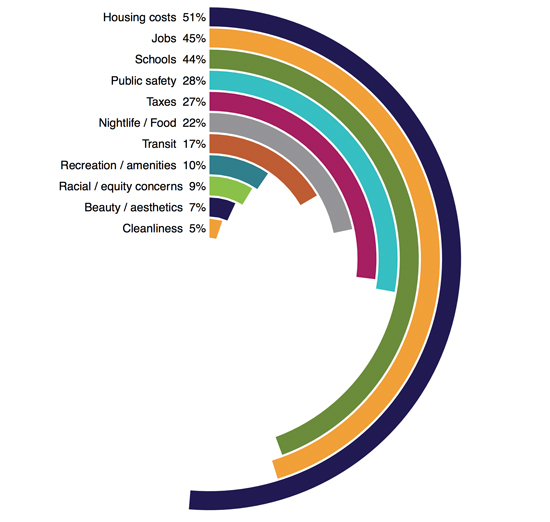
Graphic showing the top reasons mayors gave for why residents leave their cities. Courtesy of Boston University Initiative on Cities’ 2017 Menino Survey of Mayors.
Unsurprisingly, the survey noted that mayors of cities with the highest housing costs—those in the top one third of the national housing price distribution—expressed the most concern about their housing stock. But even in the least expensive cities—those in the bottom one third of the housing price distribution—“only 18 percent of mayors believed their housing served constituents ‘extremely well’ or ‘very well.’”
The lack of federal funds and insufficient bank financing were the obstacles to addressing affordable housing problems most frequently cited by mayors, according to the survey. For all the optimism mayors expressed about their ability to get things done, said Einstein, addressing the Washington audience, “the reality is that mayors are still limited by a lack of federal resources, particularly in important areas such as affordable housing.”
The mayors surveyed were all from cities with populations over 75,000. They represent cities “across every demographic, every region of the country, racial demographics, income, population,” Einstein said. They were interviewed in summer 2017 by IoC researchers, either by phone or in person. They were promised anonymity, she said, to encourage them to speak openly about sensitive issues, such as their relationship with state and federal governments.
“I think this is the gold standard of research on mayors and their leadership roles in cities because of the care researchers take to make sure they are really getting the voice of mayors captured in the responses,” said IoC director Graham Wilson, a CAS professor of political science, speaking at the press club. Wilson cofounded the IoC, a cross-University research initiative, in 2014 with Boston’s longtime mayor, the late Thomas M. Menino (Hon.’01), a CAS political science professor of the practice and IoC codirector.
Concern about climate change was another survey finding that Einstein highlighted: 84 percent of mayors said that human activities, rather than natural changes, have caused increases in Earth’s temperature. According to 2017 Gallup data, only 68 percent of the public believe that climate change is a result of pollution from human activities. In general, the survey noted, “Midwestern and Northeastern mayors—in line with their general political liberalism—were more likely to attribute climate change to human activities relative to leaders of Southern and Western cities.”
About two thirds of mayors agree, or strongly agree, that cities should aggressively address climate change even if it means making financial sacrifices. “This is again striking,” said Einstein. “Not only do they believe it’s a consequence of human activity, they also think we should take strong action to address climate change even if it means losing some revenue.”
The mayors highlighted an array of steps cities could take to mitigate climate change; the top three were reducing the number of vehicles on the roads, energy-efficient upgrades, and green, or alternative, energy sources.
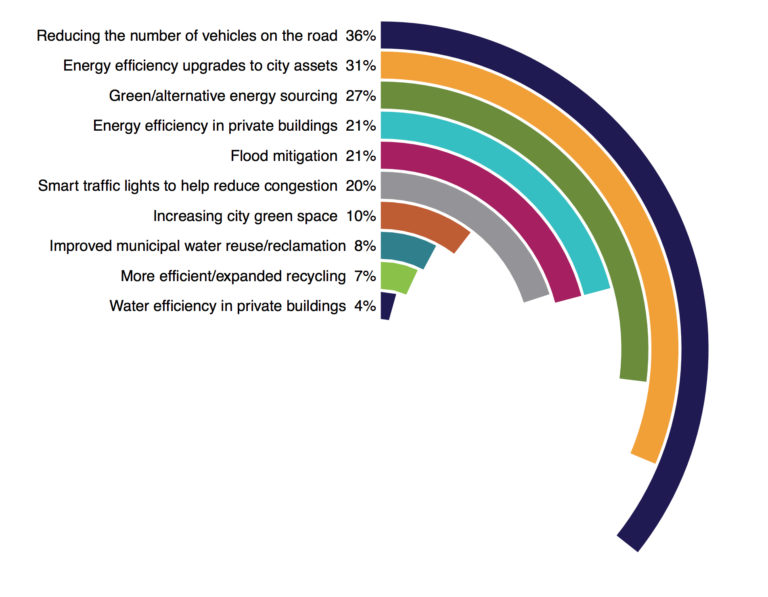
Graphic illustrating mayors’ top priorities for sustainability investments for their city. Courtesy of Boston University Initiative on Cities’ 2017 Menino Survey of Mayors.
Democratic mayors were 50 percent more likely than Republican mayors to say that cities should address climate change even if it means sacrificing revenue, the survey found.
“This was by far the most polarized area of our survey,” Einstein said. Noting that IoC researchers asked the question about climate change in both 2014 and 2017, she added that while “Democrats’ views appear to be unchanged, Republicans’ appear to be trending more toward disagreeing and falling a bit more in line with national party trends.”
“Mayors have been leading on climate change for a number of years,” said IoC founding executive director Katharine Lusk, who was a policy advisor to Menino when he was Boston’s mayor. “What’s different this year is the tone and actions of the Trump administration, which have created newfound energy for local action and city-to-city cooperation. We wanted to know where mayors stand. It’s exciting that overall more mayors are willing to make financial sacrifices to mitigate the effects of climate change, but also troubling that the issue has become polarized even in local politics.”
On the question of their ability to counter Trump administration actions that they may disagree with, the mayors were divided, by party and by issue. They were optimistic, the survey noted, that they could do “a lot in response to objectionable federal-level actions pertaining to the environment or policing, but are less sanguine about their ability to counteract the administration when they disagree on education and immigration policies.”
The survey also showed that mayors were looking for new ways to be heard and to influence policymakers, including hiring lobbyists and working with their congressional delegations. They were more pessimistic than in years past about the financial support they were getting from federal and state governments, and this pessimism was shared by Republican and Democratic mayors. They told IoC researchers that they thought they had the resources to fund just half of their city’s infrastructure needs over the next five years.
And yet for all the obstacles mayors confront, Glick and other IoC researchers say, a significant number of those surveyed seemed to agree with Menino, who liked to say that being mayor was “the best job in politics.”
“Mayors really cheer you up,” Wilson told the Washington audience. “You can see them working with other people. These are people who will restore your faith in the capacity of democratic institutions to come to grips with problems in people’s lives.”
The 2017 IoC survey was supported with funding from Citi Community Development and the Rockefeller Foundation.
Author, Sara Rimer can be reached at srimer@bu.edu.
2017 Menino Survey of Mayors Briefing Event

Professor Graham Wilson, co-founder and Director of the Boston University Initiative on Cities kicks off the 2017 Menino Survey of Mayors briefing in Washington, DC. Photo by Jennifer Grodsky, BU Federal Relations.
On January 23, 2018, an exclusive briefing on the 2017 Menino Survey of Mayors, a project led by the Boston University Initiative on Cities and supported by Citi and The Rockefeller Foundation, was held at the National Press Club in Washington, DC.
The Menino Survey is the only systematic survey of American mayors. Based on interviews with 115 mayors, this year’s Survey delves into the ways in which our mayors are increasingly taking the lead as they tackle critical urban issues such as the need for affordable housing and sustainability, while simultaneously confronting federal and state funding shifts. The Survey also offers insight into how mayors are rallying individually and as a collective to address certain challenges and opportunities where they believe cities can achieve positive change.
Any questions or comments about this event, please contact Stacy Fox at the BU Initiative on Cities by email at sfox@bu.edu or by phone at 617-358-8086.
ABOUT THE SURVEY: The Menino Survey of Mayors, now in its fourth year, is the only nationally representative and scientifically rigorous survey of American mayors. It was created by the Boston University Initiative on Cities, an urban leadership and research center, to reveal the priorities, challenges, perspectives and relationships of mayors across the country as they seek to build vibrant, sustainable, and inclusive communities. The Survey is named for the late Mayor Tom Menino, the Initiative’s co-founder and a transformative and renowned Mayor of Boston.