Strike Up the Band for Boston University Tanglewood Institute’s 60th Anniversary
Celebration this weekend will include concerts and a gala
Strike Up the Band for Boston University Tanglewood Institute’s 60th Anniversary
Strike Up the Band for Boston University Tanglewood Institute’s 60th Anniversary
If it were a piece of music, the upcoming gala weekend celebrating the Boston University Tanglewood Institute’s (BUTI) 60th anniversary would be called a fanfare or jubilee. Nicole Wendl would like it to be an overture.
As BUTI’s executive director, Wendl hopes the concerts and other events scheduled for August 1–4 in Lenox, Mass., kick off a bright future for the institution, which draws talented teens from all over the world each summer to immerse themselves in classical music on the BUTI campus and at the Boston Symphony Orchestra’s (BSO) world famous summer home down the street.
Under the banner Celebrating 60 Years, Supporting the Next Generation, the gala weekend will feature a Young Artists Orchestra Performance at the BSO’s Seiji Ozawa Hall, a benefit dinner with a private performance by renowned Grammy Award–winning violinist and BUTI parent Joshua Bell, and a BUTI Tanglewood on Parade Program with BUTI alumni and current students performing side by side at the BSO’s Koussevitzky Music Shed.

“It’s a big four days, and hopefully it’s really exciting and inspirational,” says Wendl. “I want people to come together and create something beautiful across generations.”
There will also be a Young Artists Wind Ensemble concert in honor of H. Robert Reynolds, BUTI’s longtime conductor, who passed away in January. Tickets to public events are available through the event page on the College of Fine Arts website.
“For 60 years, Boston University Tanglewood Institute has been fundamental to Boston University’s commitment to the arts and education,” says University President Melissa Gilliam. “It is an honor to be the home of this transformative place that helps talented young people to grow musically and personally.
“Ultimately, many of these remarkable students will go on to enrich all our lives through their music,” Gilliam says. “Congratulations, BUTI, and thank you to the BSO for their continued support of this program and its students.”

Wendl hopes the celebratory weekend provides a launching pad for the institute’s next 60 years.
First up: necessary infrastructure improvements to Groton Place, the striking 1903 mansion that is the main building on campus—“air-conditioning” is frequently mentioned as a needed improvement.
“These really are the best players in the country, and I want our campus to reflect that incredible artistry,” Wendl says. “We have some upgrades that we need to make.”

Also on Wendl’s list: more scholarship support, so that coming to Lenox can be an easier decision for students of different economic backgrounds. “You don’t want a student to have to choose between a really incredible top-level educational experience here and a program that’s free,” she says.
Longer-term goals include a “renewed and expanded campus” with more housing for students, faculty, and staff and a new performance/conference space.
“We should be thinking about the campus as a place to inhabit all year round, whether that’s by BUTI or by making it a home for something that’s happening University-wide,” Wendl says. “A place that is a flagship of the arts and of Boston University, a place that really capitalizes on the beauty of the Berkshires all year round, not just in the summer.”
A near-capacity cohort of 445 students will attend BUTI this summer for two, six, or eight weeks of lessons, performances, and master classes intended to make the most of their talents. Their teachers and mentors include many musicians from BSO’s Tanglewood Music Center. Students also get ample access to Tanglewood performances.
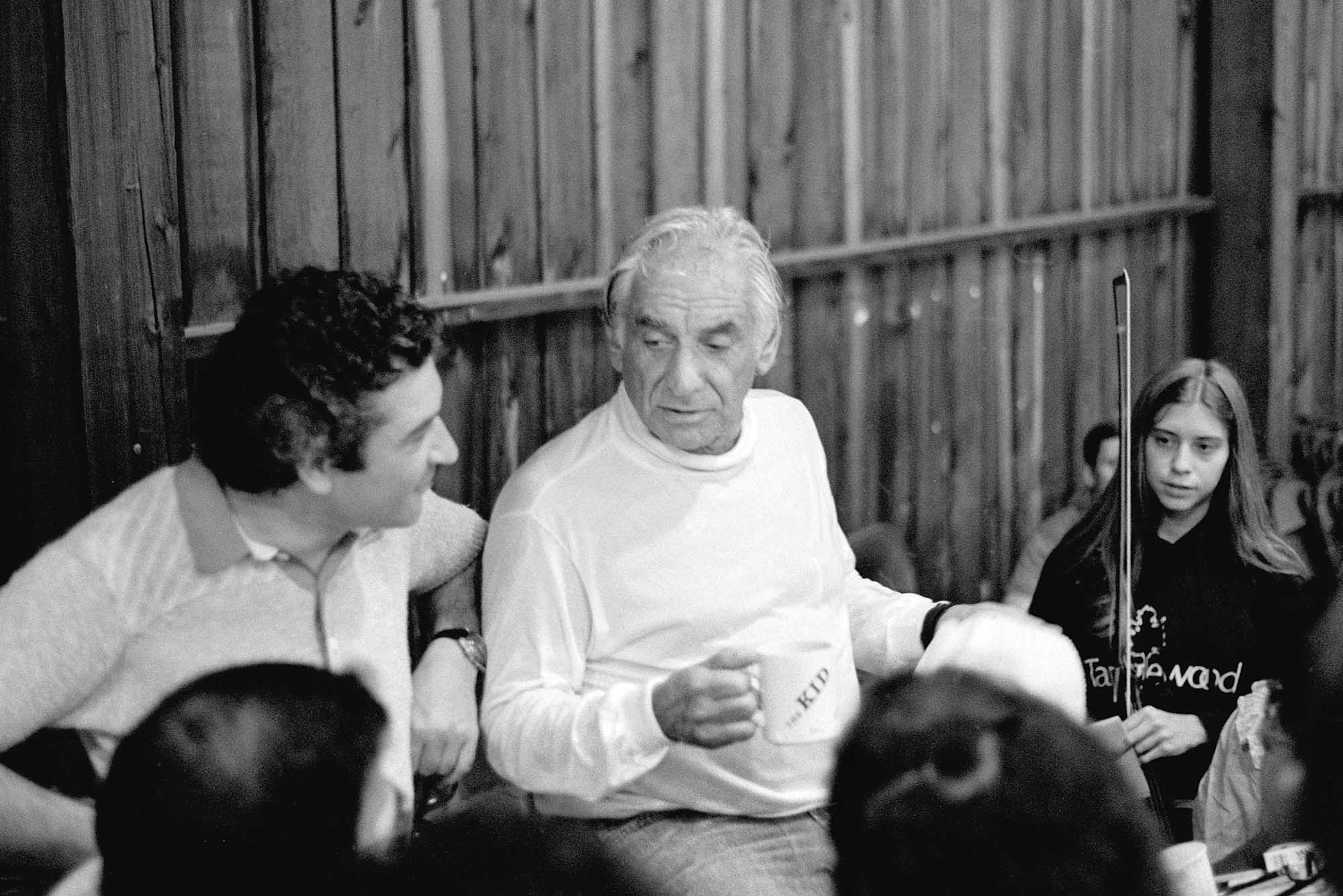
(BUTI is part of BU, however, and not formally affiliated with the BSO, despite “Tanglewood” in its name.)
Every summer, BUTI students give more than 60 free performances in the Lenox area, providing them an opportunity to enhance their musicianship and gain valuable exposure to performing in front of live audiences.
“BUTI complements the arts and culture of the Berkshires not only by adding high-level musicianship but also youthful energy,” says Harvey Young, BU’s inaugural and interim vice president for the arts, who recently stepped down as dean of the College of Fine Arts. “When you’re with BUTI students, you’re seeing the next generation of music makers. You’re getting a glimpse at, and hearing, the future.”
Training some of the world’s most accomplished musicians
“The number of professional musicians whose start began at Boston University Tanglewood Institute is staggering,” says Young, who is also a professor in the College of Arts & Sciences. “Whether it’s the LA Phil, Philadelphia Orchestra, Boston Symphony, or dozens of other orchestras around the globe, you will find many BUTI alumni as principal musicians and in senior leadership.”


The BUTI Young Artists Wind Ensemble—led by conductor David Martins, former master lecturer at BU’s School of Music—rehearses at Seiji Ozawa Hall at Tanglewood on July 18, .
Renowned BUTI alums include acclaimed artists such as Grammy-nominated composers Nico Muhly (BUTI’96,’97), Missy Mazzoli (BUTI’98, CFA’02), and Joseph Conyers (BUTI’98), principal bass at the Philadelphia Orchestra. Muhly and Conyers are returning to work with BUTI students this summer.
“The opportunities that you get when you’re at a program like BUTI are so special,” says Deborah Grausman (BUTI’98), a successful singer and voice actress, whose résumé includes acting with Topol and Harvey Fierstein in a touring production of Fiddler on the Roof and a recurring role as Smartie, a friend of Oscar the Grouch, on Sesame Street.
“It’s not just the program through BUTI, right? We had master classes. You can go to the Tanglewood Music Center concerts. You can go to the BSO concerts,” she says. “And so it was this whole campus experience that was very magical. I mean, everyone talks about how Tanglewood is a magical place, but it really is. To be so young and to have those opportunities!”
BUTI “was this whole campus experience that was very magical.”
Grausman’s best memory? A master class with the Welsh bass-baritone Bryn Terfel, who mentioned that he was singing in The Marriage of Figaro with the Metropolitan Opera that fall. He told Grausman and other BUTI students to come visit if they came to the Met. She did and got a backstage tour, during which several cast members talked with her and signed her score for a college production of Figaro she was about to sing in.
“It was sort of an unreal experience, and I wouldn’t have had that if I hadn’t seen his master class at BUTI,” Grausman says.
Following in her mother’s footsteps, she is now a member of BUTI’s advisory board.
The institute also introduces its students to BU School of Music faculty and pedagogy, and many of the high schoolers choose the College of Fine Arts for their undergraduate or graduate education.
Singer Maria Nicoleta Cutitaru (BUTI’24, CFA’29) had attended other summer music programs, but six weeks in Lenox “definitely” helped make up her mind to matriculate at BU.
BUTI “was a preview of what being a voice major at BU would look like,” she says. Her teachers at BUTI included BU Opera Institute alum Michelle Johnson (CFA’07) and Penelope Bitzas, a CFA emeritus associate professor of music and voice, who is director of the Young Artists Vocal Program at BUTI.

“Penelope was very supportive, just in introducing me to BU and talking about what I would need to help me out with my auditions,” says Cutitaru. “Now I just finished my first year [at CFA], and I’m in New Mexico at the Taos Opera Institute for part of the summer.”
But for her, too, the intangibles of a BUTI summer may be the most memorable part.
“We honestly spent a lot of time on the lawn at Tanglewood listening to operas and concerts,” she says. “It was really fun to be part of the audience and see the joy people get from this music. And Lenox is so small that everybody in town knew us, so it was really nice to walk through there, and people would recognize us and talk about our concerts.
“You’re playing and collaborating with all these people. You can have instrumentalists and vocalists in the same room, in the same circle,” Cutitaru says. “Being there had that summer-cabin feeling, but surrounded by music, like there was music all around.”
And training the next generation of musicians
“The vibe there is really awesome,” says Owen Veith (BUTI’23,’25,’26, CFA’30), who has spent three of his four high school summers at the institute. “You come out of your dorm in the morning, and you’re in the mountains, it’s foggy, you hear music from people practicing, and it’s just great. Very motivating.”

A French horn player from Quincy, Mass., Veith had also spent a lot of time training as a ballet dancer and was trying to choose which path to follow. BUTI played a role in his decision, and also in his choice to enroll in BU’s College of Fine Arts this fall on a music performance track.
“It put BU’s music program on the map for me,” Veith says.
Damion Sampath (BUTI’24,’26, CFA’30,’31), a saxophone player from Brockton, Mass., says his favorite thing about the institute is the opportunity to listen to live music each evening and be among people from different musical backgrounds.

“It’s very exciting to be here at BUTI, a community where everyone arrives with an intent to learn. The atmosphere is encouraging and pushes me to be the best version of myself.”
Like Veith, Sampath says that his experience at BUTI was a primary factor in his decision to enroll in CFA’s School of Music. He applied early decision and was accepted into the school’s BM in Performance to MM in Music Education program, where students earn both a bachelor’s and a master’s degree.
“BUTI gave me the opportunity to study with saxophone professors at CFA and gave me a glimpse of the amazing experience I would have studying at BU under their direction,” Sampath says.
Ellie Stevens (BUTI’25,’26, CFA’30) of Natick, Mass., has been hearing about the attractions of BU for most of her life; her father is Aaron Stevens, a senior lecturer in computer science at CAS. She has also played the bassoon since fifth grade. And in high school, when she began to think seriously about a future in music, BUTI naturally became part of the discussion.

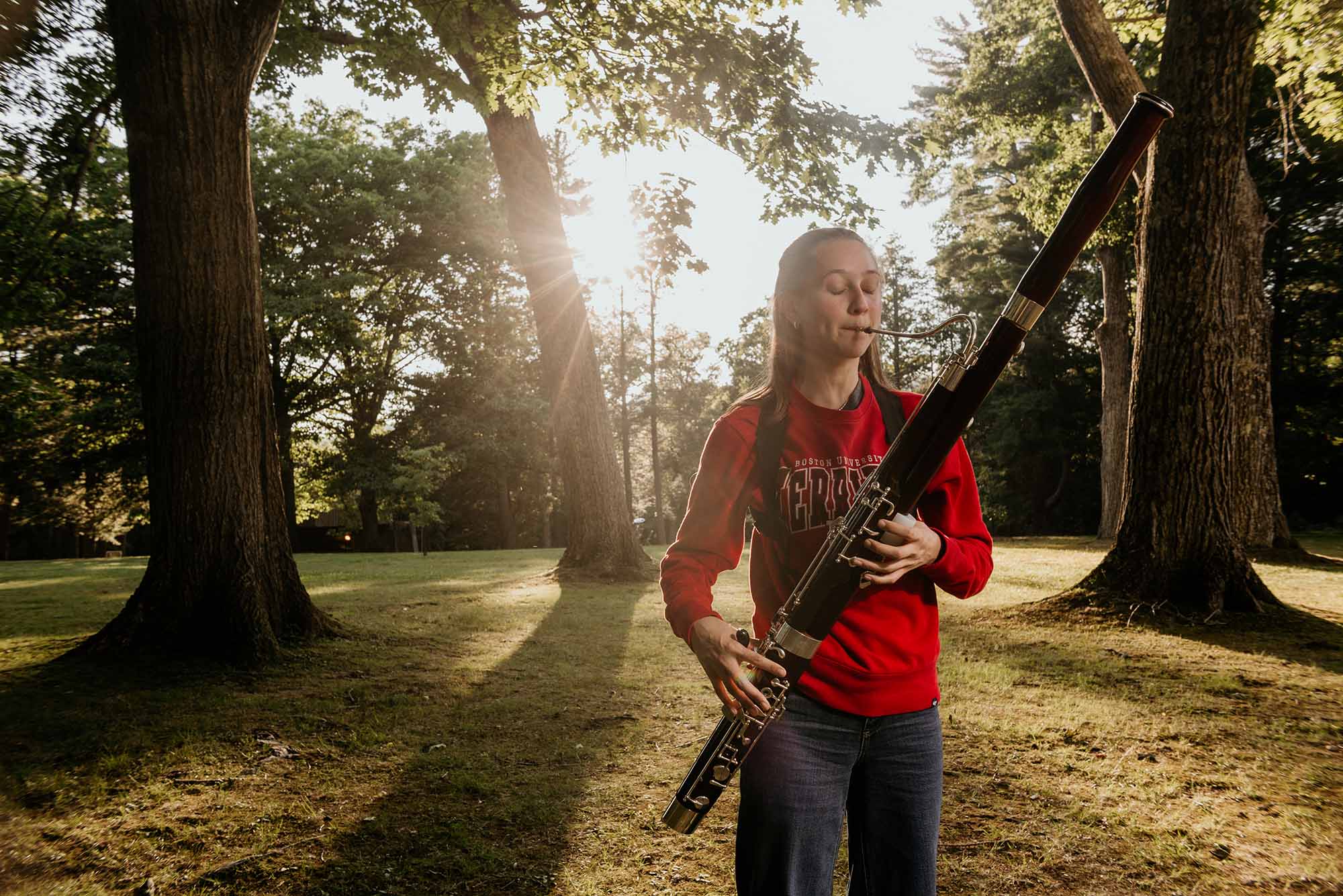
Damion Sampath (BUTI’24,’26, CFA’30,’31) (left) practices his saxophone in one of BUTI’s outdoor sheds, while Ellie Stevens (BUTI’25,’26, CFA’30) practices her bassoon on the grounds of BUTI.
Stevens went to BUTI last summer for several weeks, “to see what it feels like to do music all day and have that be my life,” she says. “I played for five or six hours a day, and I wouldn’t have known how to structure that myself. The bassoon workshop was the first time in my life that I’d been in a room with nine other bassoonists.” She’s back this year for more.
“It feels like a cross between college and summer camp. You can talk about music and everyone understands,” Stevens says. “It’s such a diverse group of people with different interests and hobbies outside of here, but we all have that common interest. If you have better friends, you make better music.”
Last summer, she also began study under Margaret Phillips, a CFA lecturer in bassoon and contrabassoon and BUTI workshop director, which helped seal Stevens’ decision to attend BU, where she plans to major in music education.
As always with BUTI, there was an intangible factor too. Stevens pauses for a moment before describing it: “I think this is the first place where I was surrounded by so many people who take music so seriously, and it taught me to see myself that way.”