Mitchell Zuckoff Wrote Boston Globe Stories about 9/11
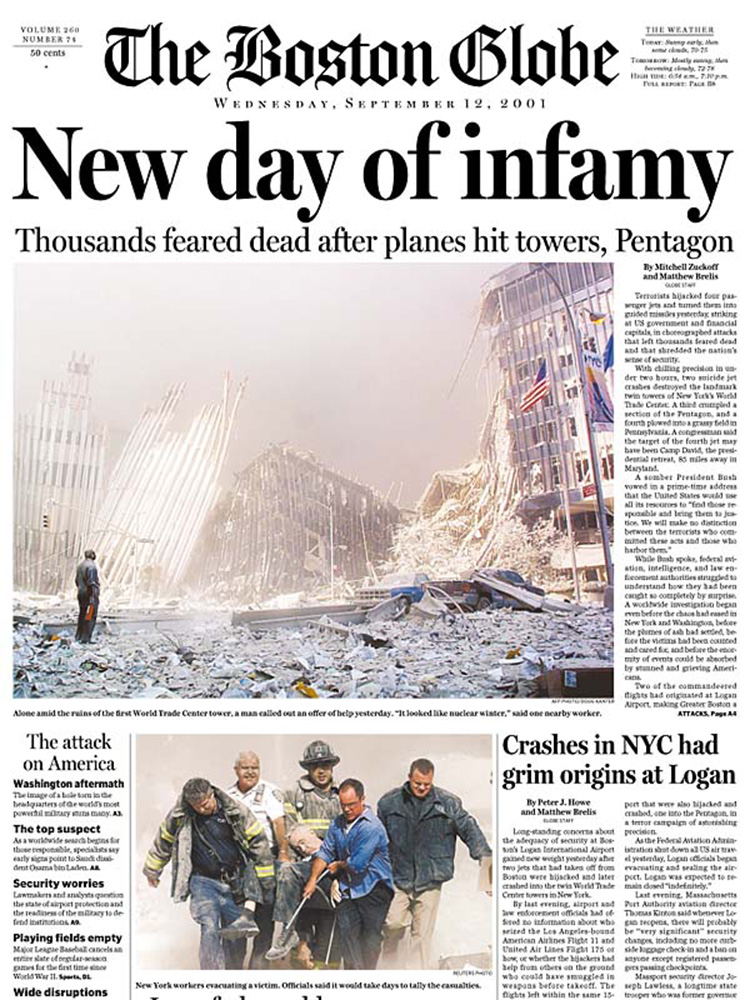
As a reporter for the Boston Globe, Mitchell Zuckoff coordinated coverage the week of the September 11, 2001, terrorist attacks, including writing the paper’s page one stories on September 12 and 13.
BU’s Mitchell Zuckoff, Who Wrote the Boston Globe’s Page One Stories After 9/11, Recalls How Those Harrowing Days Unfolded
Sumner M. Redstone Professor in Narrative Studies at COM describes the week that changed the world
As soon as longtime journalist Mitchell Zuckoff heard that two commercial airplanes had slammed into the World Trade Center towers the morning of September 11, 2001, the 39-year-old raced from home along the Massachusetts Turnpike to the Boston Globe offices, his car radio cranked to news stations for updates. Suddenly, he had a bad feeling. He realized he was driving through a tunnel beneath Prudential Center tower—one of Boston’s iconic skyscrapers. For the first time that morning, Zuckoff was worried.
“We had no idea how many planes were in the sky, and we knew already that two of these planes had taken off from Logan [International Airport in Boston],” says Zuckoff, the Sumner M. Redstone Professor in Narrative Studies at the Boston University’s College of Communication since 2003. “We didn’t know if other cities were going to be targets, so it occurred to me as I’m driving under the Pru [that], this is what you’d hit in Boston. This is the tallest building on our skyline. That 20 seconds of driving under that building in that tunnel was really the most jarring introduction to what I was about to go into.”
Zuckoff was heading into the biggest American news event in a half-century, certainly the biggest he’d covered as a reporter, and one that would change the trajectory of his career.
A Seasoned Reporter in the Control Chair
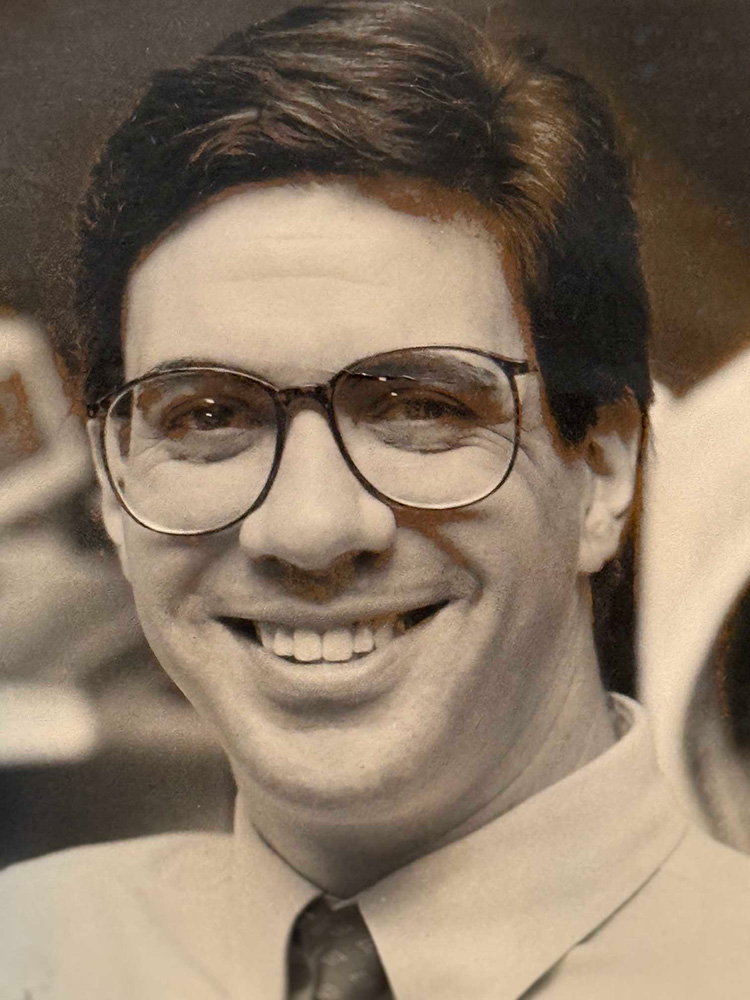
At home in Newton, Mass., that morning, Zuckoff had turned on the TV when his wife—Globe photojournalist Suzanne Kreiter—told him a plane, later identified as American Airlines Flight 11, had struck the North Tower. He’d assumed at first, like many, that it was a tragic accident. But watching United Airlines Flight 175 strike the South Tower live minutes later removed any doubt that both crashes were intentional.
Zuckoff—who was on book leave from his position with the Globe—ran to the phone to call his editor, Mark Morrow. The phone was ringing by the time he got to it. “Your book leave is over,” Morrow said. “Get in here.”
As Zuckoff arrived at the Globe’s Morrissey Boulevard newsroom at around 9:30 am, Morrow met him at the door. “I want you in the control chair,” Morrow said, indicating that Zuckoff would be coordinating the day’s coverage and writing the lead news story about the attacks.
In more than a decade at the Globe, Zuckoff had covered some of the biggest news stories—including the Columbine school shooting and the untimely death of Boston political royalty John F. Kennedy, Jr., in a plane crash, both in 1999—as a member of the paper’s investigative Spotlight Team and as a roving national reporter. It was natural, he says, that the Globe would expect him to have a role in its coverage of the 2001 terrorist attacks.
On September 11, Zuckoff monitored cable news reports and updates from Globe correspondents reporting locally and in New York City. These included transportation reporter Matthew Brelis mining his sources at the Massachusetts Port Authority, which operates Logan Airport, and reporter Tina Cassidy, who was in New York City that day covering Fashion Week. “[Cassidy] turned on a dime, from fashion reporter in a pencil skirt and high heels into a war correspondent,” Zuckoff recalls. “She ran toward the towers from Midtown, from the fashion district.”
With the full trust of his editors and yellow legal pads strewn across his desk, Zuckoff set to work organizing every detail he and other Globe reporters were learning about what was unfolding that sun-drenched Tuesday morning 25 years ago. One pad held a list of every lead Globe reporters were tracking and information to share across the team of correspondents. Another pad held the locations of Globe staff. A third pad became a repository of details and phrases Zuckoff wanted to use in his story. He wrote down technical specifications about each of the planes, as well as a chilling phrase he says popped into his head: that the hijackers had “turned these passenger jets into guided missiles.”
Balancing Reporting and Emotions
The emotional reality of the story they were covering hit Zuckoff and other reporters almost immediately. With two of the hijacked flights having originated in Boston, Zuckoff says “we all knew we might have neighbors on those flights.”
They learned that seven employees of Framingham, Mass.-based TJX Companies were on American Airlines Flight 11, bound for Los Angeles, as was Al Filipov, the father of their Globe colleague David Filipov. Zuckoff set aside his own grief. The implications of the attacks in the near- and long-term wouldn’t hit him until early the next morning, as he was driving home from the newsroom.
“I was so focused on the micro, I really needed to compartmentalize all those other thoughts—that this is the biggest story I’ll work on, that we were now at war,” he recalls. “I was like, ‘How do I write the biggest four-car crash story that anybody’s ever seen? Because that’s what it is—a crash story. It’s the first thing we learn in journalism.”
I was so focused on the micro, I really needed to compartmentalize all those other thoughts—that this is the biggest story I’ll work on, that we were now at war. I was like, ‘How do I write the biggest four-car crash story that anybody’s ever seen? Because that’s what it is—a crash story. It’s the first thing we learn in journalism.
The one exception: Early in the day, Kreiter had been sent to Boston’s Seaport to photograph SWAT snipers protecting the fuel terminals from potential attacks. What if Boston was attacked while his wife was on assignment?
“I have pretty good powers of concentration and focus, and that was the one thing that was knocking me off my game,” Zuckoff admits.
‘Six Lives’ and a New Chapter
Underneath a banner headline reading “New day of infamy,” Zuckoff’s September 12 Page One story, cowritten with Brelis, soberly summarized the previous day’s events:
Terrorists hijacked four passenger jets and turned them into guided missiles yesterday, striking at US government and financial capitals, in choreographed attacks that left thousands feared dead and that shredded the nation’s sense of security.
Zuckoff was back at the paper at 8 am on September 12, remaining in the control seat of the Globe’s breaking news coverage. The following day, he crashed a 10:30 am meeting of the top editors to pitch an idea that he’d been turning over in his head: A comprehensive account of Flight 11 that would weave together the stories of six people connected to the flight, including victims, a first responder, a survivor on the ground, and a hijacker.
Zuckoff reported the story, “Six Lives,” over 48 hours with a handful of colleagues. It appeared on page one of the first Sunday edition after the attacks.
“I’ve never been so tired in my life,” he says, “but I stuck around the paper because in those days the first edition of the Sunday paper would roll off [the press] somewhere around 4 pm [Saturday].”
The 9/11 attacks and aftermath changed Zuckoff’s life. Within the year, he decided to pivot away from newspaper work and focus on writing nonfiction books and teaching. “Six Lives” became the basis of his book Fall and Rise: The Story of 9/11 (Harper, 2019). He’s written eight other nonfiction works, including 13 Hours: The Inside Account of What Really Happened in Benghazi (Twelve, 2015), which was adapted into a 2016 feature film starring John Krasinski. His next book tells the harrowing story of the April 2026 rescue of two US pilots whose F15-E was shot down in Iran and is also set to be adapted for the big screen by director Michael Bay and Universal Pictures in 2028. Zuckoff joined the COM faculty in 2003.
“I never wanted to write a bigger story the rest of my life,” he says. “I felt like I had done everything, that all my ambitions as a newspaper reporter had been fulfilled.
“There’s a before and after for me in my career, and it’s 9/11.”
Find a list of all those with ties to the BU community killed on 9/11 here.