BU Program Allows Students from Different Backgrounds to LEAP into Engineering
Late Entry Accelerated Program includes a free two-week experiential program putting engineering tools in the hands of master’s students new to the field

During the intersession LEAP LIFE program, students from nonengineering backgrounds get hands-on experience assembling circuit boards, as Kathryn Miles (ENG’28) is doing here, among other engineering skills.
BU Program Allows Students from Different Backgrounds to LEAP into Engineering
Late Entry Accelerated Program includes a free two-week experiential program putting engineering tools in the hands of master’s students new to the field
“Good…good…that looks fine… That looks pretty good. Have you soldered before?”
A pair of magnifying lenses perched atop his head, Eric Hazen circulates throughout a large workshop where students are using tweezers and hot soldering irons to attach conductors, resistors, and capacitors to printed circuit boards. When a student expresses some frustration, Hazen, a College of Engineering biomedical engineering department senior research engineer, says, “It’s not so bad—I’ve seen worse. You need to tap it as fast as possible after the solder’s melted, because it only stays melted for about 200 milliseconds.”
Some students chatter while they work, others are silent as they scrutinize the tiny tools and materials in their fingers. The small-scale welding task might look tedious, but it’s kind of fun, says one student.
“I worked with fruit flies in undergrad,” Eli Nogueira-Miller (ENG’27) says. “They’re so much smaller than this.”
The workshop is in Boston University’s Engineering Product Innovation Center (EPIC). Hazen, an EPIC electronics advisor, and his student and staff assistants are offering guidance and encouragement to 26 students in ENG’s Late Entry Accelerated Program (LEAP), a unique program that allows students with nonengineering backgrounds to earn master’s degrees in engineering. Instead of requiring them to earn a second bachelor’s degree, LEAP provides a customized, streamlined set of undergrad coursework that prepares them to advance into any of ENG’s nine master’s programs.
“LEAP students often come in saying that they aren’t really an engineer, but I would add ‘yet’ to that sentence,” says Mary Bertrand (MET’23), director of ENG’s Career Development Office. “And once they graduate, they aren’t just an engineer, they’re an engineer plus what they did before,” whether that be working at law or accounting firms, selling solar panels, starting nonprofits, or making kombucha. “Those lived experiences add value to their engineering master’s degrees and allow them to impact the world differently than traditional engineers—and the world needs both.”
During their first year, LEAP students can take a free two-week intersession program called LEAP LIFE, an acronym combining LEAP and the phrase “Leap Into the Future of Engineering.” Students literally get their hands dirty (or their fingers sticky with the rosin flux used in soldering circuit boards), gaining technical skills they’ll need to land internships, and ultimately, careers in engineering.
For the first week of LEAP LIFE, all students take common sessions in EPIC, covering fundamental skills and tools such as coding, product management software, and electronics design and assembly. In the second week, they split into two groups. One group heads to the Bioengineering Technology & Entrepreneurship Center (BTEC), where they learn to use instruments found in labs across the biotechnology and medical technology sectors.
The students at BTEC study mammalian cell cultures using centrifuges, inverted light microscopes, and more. They label cellular structures with dyes and capture images of them with fluorescent microscopes, and they’re introduced to the Bio X 3D Bioprinter. Within a few months, students might be using the same kind of equipment in industry internships, helping to develop diagnostics and therapeutics for life-threatening diseases.
“I was very impressed with the students,” says Xin Brown (CAMED’02), an ENG senior lecturer in biomedical engineering and biotech instructor for this year’s LEAP LIFE cohort. “They all have a solid academic background and research or work experience, and they showed good work ethic and teamwork spirit.”

Brown also brought students to the Biointerface Technology Facility, where they learned to operate a Rheometer, assessing the ink they had just used in the bioprinter. “The students performed very well,” Brown says. “They were engaged, diligent, curious and asked many good questions.”
The other LEAP LIFE group stays in EPIC, where they learn milling, turning, and sheet metal fabrication. Students acclimate themselves to the hum and whine of a CNC lathe, the wispy smoke and quick sparks from the laser cutter.
Gavin Prescott (ENG’27) says his impression of EPIC had been of “loud, dangerous machines, and goggles.” During his first semester of LEAP, a professor had suggested he go into EPIC to use a laser cutter for an extra credit assignment. “I thought, ‘Laser cutter? That sounds scary! I guess no extra credit for me,” says Prescott, who was an anthropology major as an undergrad and then worked on archaeological digs. But during the second week of LEAP LIFE, he says, “it only took them an hour to teach us the laser cutter, and I realized, this thing’s easy! I could have done that extra credit project in 15 minutes!’”
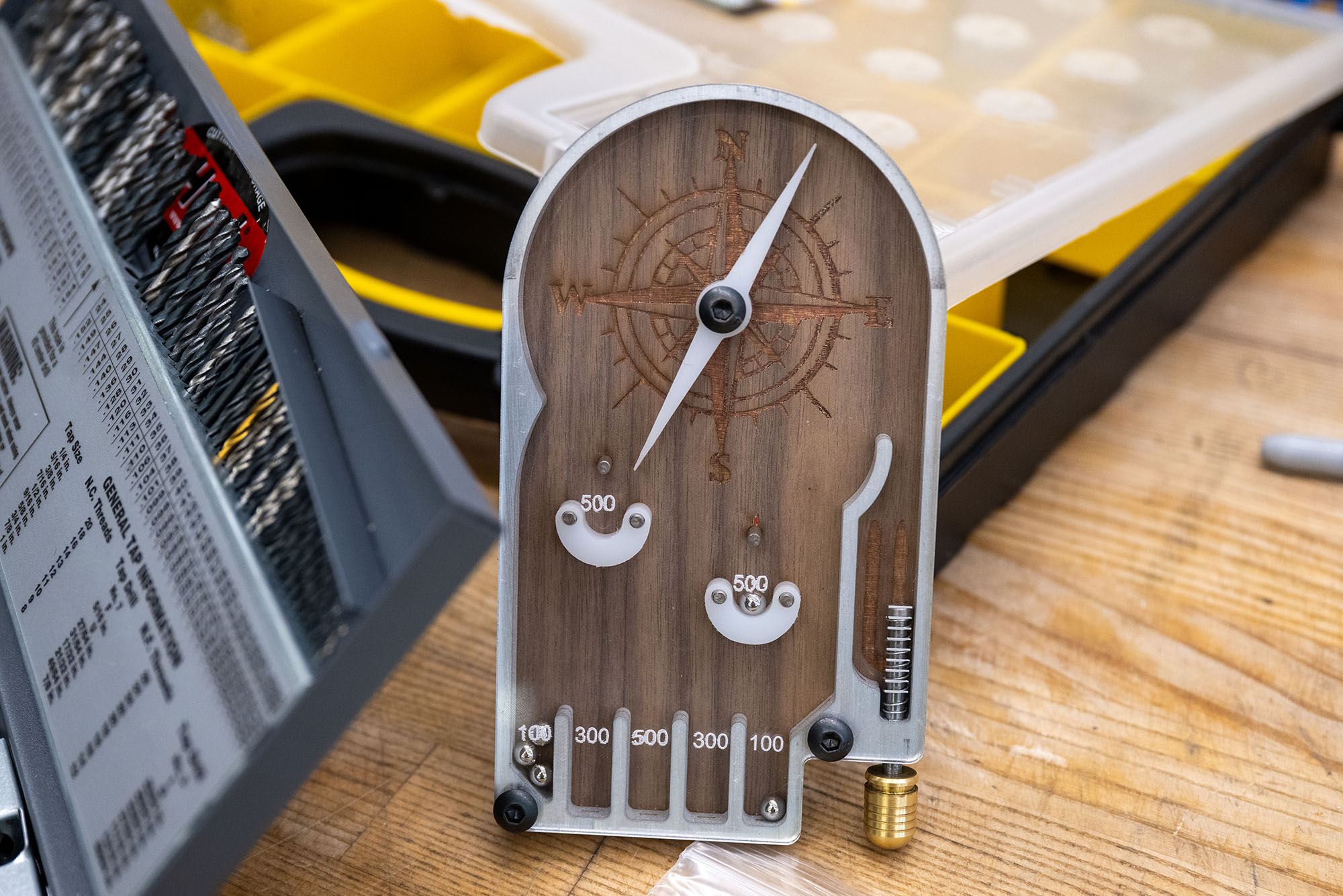
The students designed and built their own bagatelles, small pinball games, whose every component was made using a different machine available at EPIC. “This project elicits a wonderful blend of creative imagination and technical execution,” says EPIC senior laboratory manager Tasker Smith. “And it serves as a fun introduction to our team and all of the technology EPIC has to offer.”
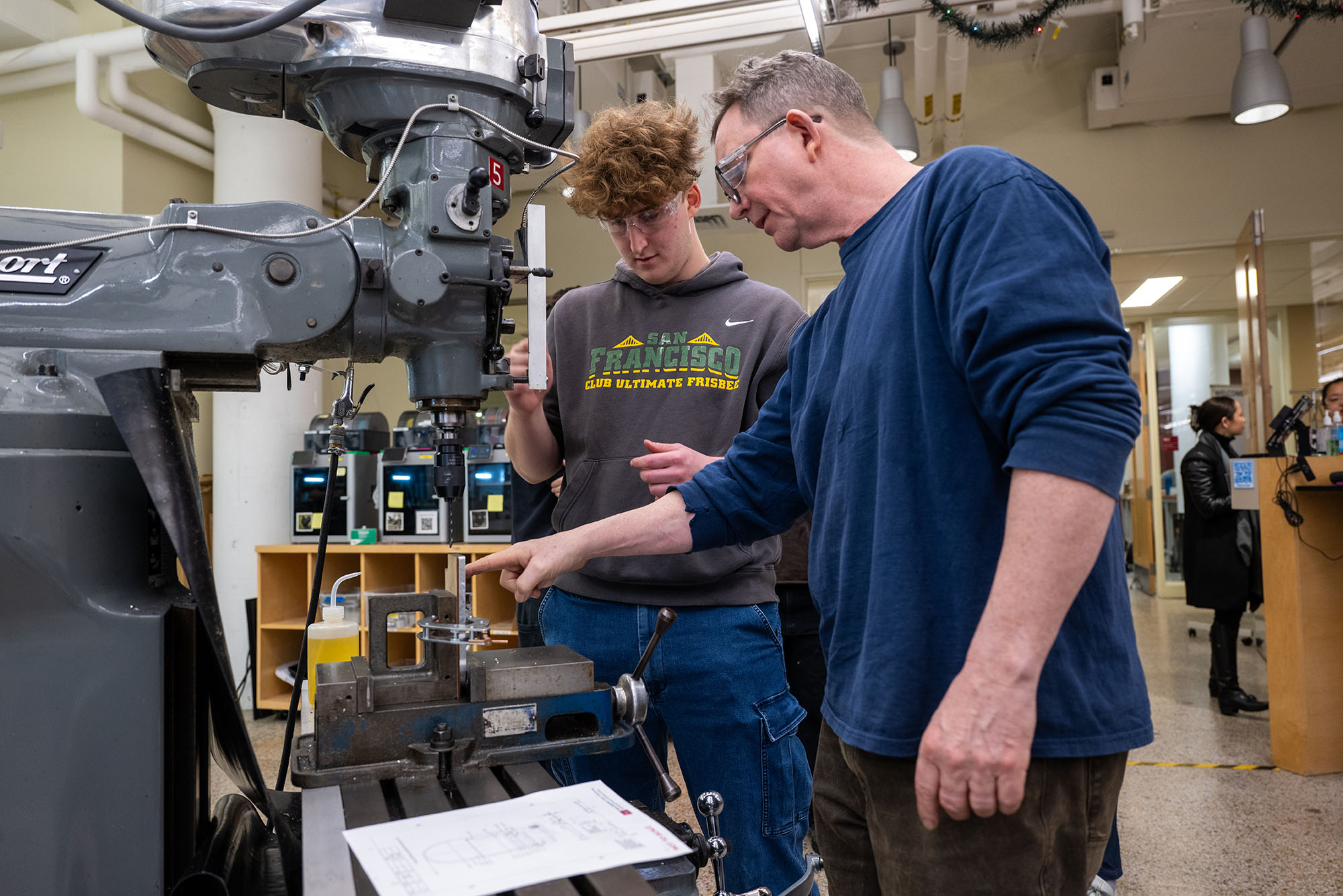
“It demystifies it,” agrees Nicolás Bonnet McNamara (ENG’27). “It was a great way to get that intimidation factor out of the way. Now it’ll feel a lot easier to just go into EPIC and ask for help and get practice on those machines in more depth. Everyone there is super friendly and open to helping you learn new techniques.”
The second week of LEAP LIFE also featured a lively social event where current and incoming LEAP students mingled with LEAP alumni, including Rebekah Tsang (ENG’21), who designs high-end toaster ovens and air fryers at SharkNinja.
“I loved the cohort aspect of LEAP,” Tsang says. “There’s a good community. I felt supported. I found I loved engineers—we’re curious people, and we feed off each other’s curiosity. We’re problem-solvers, always wanting to do things better, to reinvent, to improve. It’s not being satisfied with things the way they are.”
“I want to do something that affects the world positively,” says Prescott. “One reason I came here was all the resources, like RASTIC, EPIC. I don’t just want to learn concepts; I want to work on stuff. There were lots of things I was told I couldn’t do as an undergrad. But I come here, and I ask, ‘Hey, what can I do?’ and the answer is, ‘What can’t you do?’”